Page 54 of 346
53
uuChild SafetyuProtecting Child Passengers
Safe Driving
•Any child who is too small to wear a seat belt correctly must be restrained in an
approved child seat that is properly secured to the vehicle using either the lap belt
portion of the lap/shoulder belt or the lower anchors of the LATCH system.
•Never hold a child on your lap because it is impossible to protect them in the
event of a collision.
•Never put a seat belt over yourself and a child. During a crash, the belt would
likely press deep into the child and cause serious or fatal injuries.
•Never let two children use the same seat belt. Both children could be very
seriously injured in a crash.
•Do not allow children to operate the doors, windows or seat adjustments.
•Do not leave children in the vehicle unattended, especially in hot weather when
the inside of the vehicle can get hot enough to kill them. They could also activate
vehicle controls causing it to move unexpectedly.
1Protecting Child Passengers
To deactivate a lockable retractor, release the buckle
and allow the seat belt to wind up all the way.
To remind you of the passenger’s front airbag
hazards and child safety, your vehicle has warning
labels on the dashboard (U.S. models) and on the
front visors. Please read and follow the instructions
on these labels.
2Safety Labels P. 65
3
WARNING
Allowing a child to play with a seat belt or
wrap one around their neck can result in
serious injury or death.
Instruct children not to play with any seat
belt and make sure any unused seat belt a
child can reach is buckled, fully retracted,
and locked.
Page 55 of 346
54
uuChild SafetyuSafety of Infants and Small Children
Safe Driving
Safety of Infants and Small ChildrenAn infant must be properly restrained in a rear-facing, reclining child seat until the
infant reaches the seat maker’s weight or height limit for the seat, and the infant is
at least one year old.
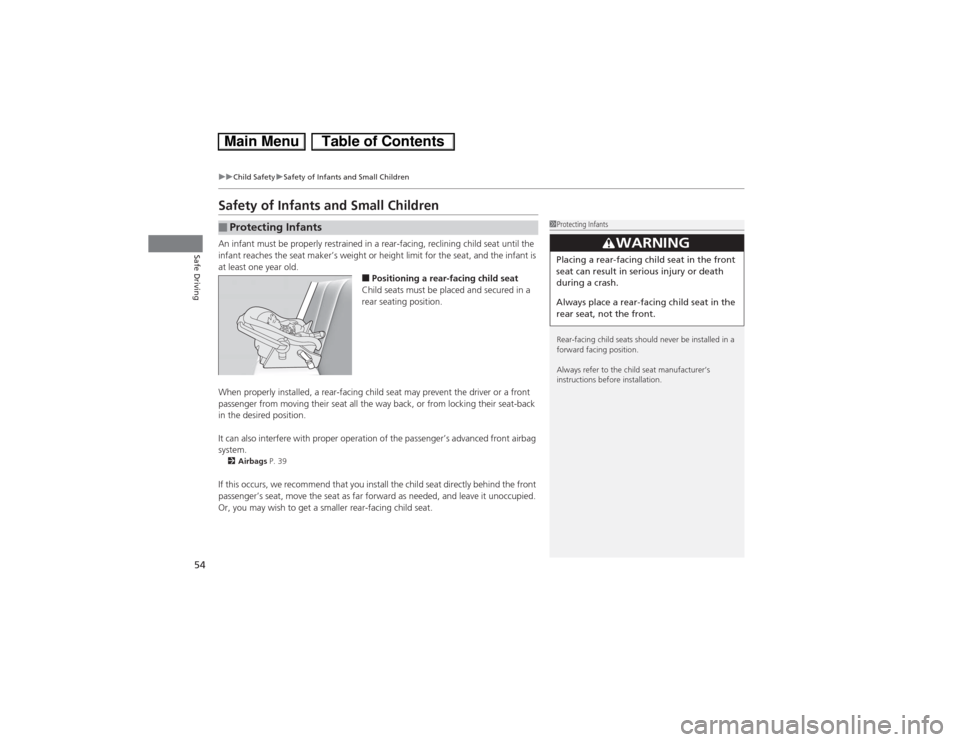
■Positioning a rear-facing child seat
Child seats must be placed and secured in a
rear seating position.
When properly installed, a rear-facing child seat may prevent the driver or a front
passenger from moving their seat all the way back, or from locking their seat-back
in the desired position.
It can also interfere with proper operation of the passenger’s advanced front airbag
system.
2Airbags P. 39If this occurs, we recommend that you install the child seat directly behind the front
passenger’s seat, move the seat as far forward as needed, and leave it unoccupied.
Or, you may wish to get a smaller rear-facing child seat.■Protecting Infants
1Protecting Infants
Rear-facing child seats should never be installed in a
forward facing position.
Always refer to the child seat manufacturer’s
instructions before installation.
3
WARNING
Placing a rear-facing child seat in the front
seat can result in serious injury or death
during a crash.
Always place a rear-facing child seat in the
rear seat, not the front.
Page 59 of 346
uuChild SafetyuSafety of Infants and Small Children
58Safe Driving
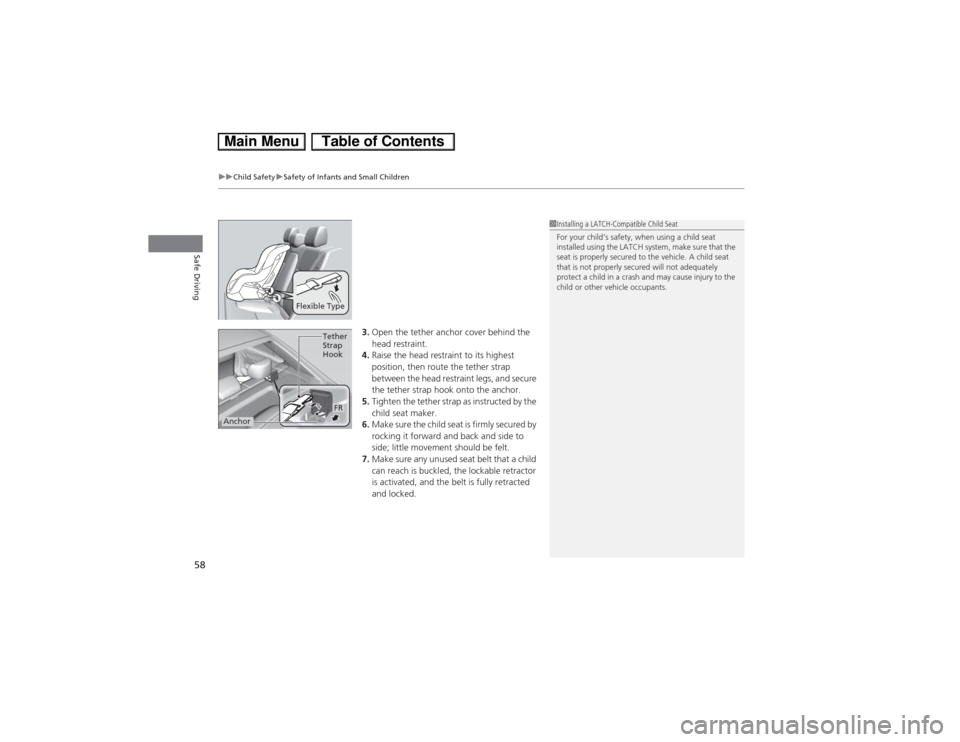
3.Open the tether anchor cover behind the
head restraint.
4.Raise the head restraint to its highest
position, then route the tether strap
between the head restraint legs, and secure
the tether strap hook onto the anchor.
5.Tighten the tether strap as instructed by the
child seat maker.
6.Make sure the child seat is firmly secured by
rocking it forward and back and side to
side; little movement should be felt.
7.Make sure any unused seat belt that a child
can reach is buckled, the lockable retractor
is activated, and the belt is fully retracted
and locked.
Flexible Type
1Installing a LATCH-Compatible Child Seat
For your child’s safety, when using a child seat
installed using the LATCH system, make sure that the
seat is properly secured to the vehicle. A child seat
that is not properly secured will not adequately
protect a child in a crash and may cause injury to the
child or other vehicle occupants.
Tether
Strap
Hook
Anchor
FR
Page 60 of 346
Continued
59
uuChild SafetyuSafety of Infants and Small Children
Safe Driving
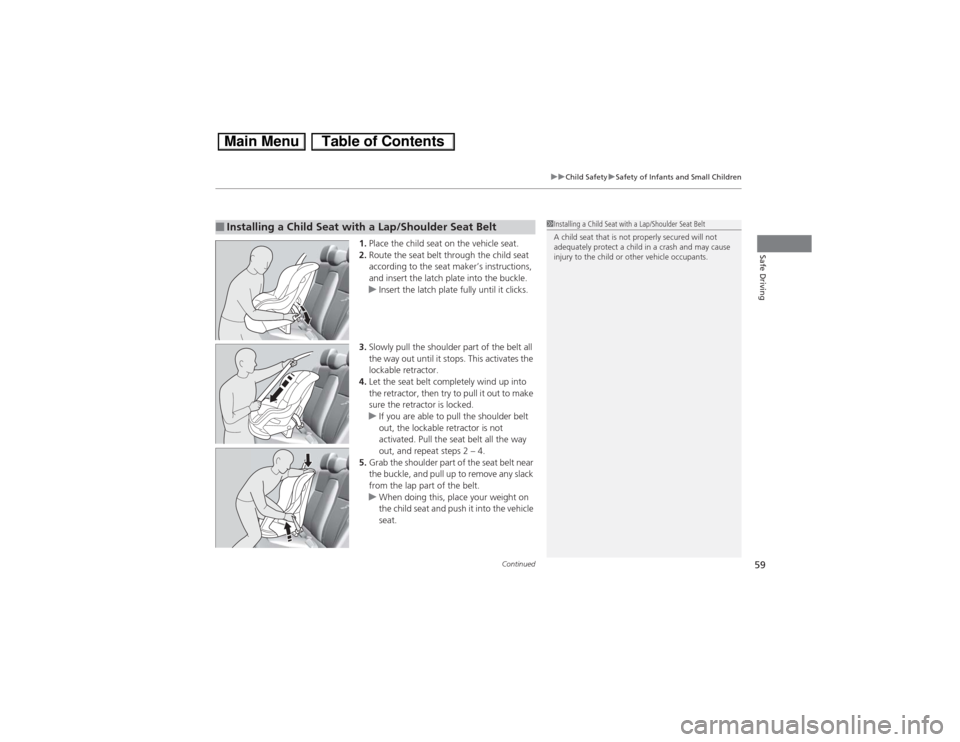
1.Place the child seat on the vehicle seat.
2.Route the seat belt through the child seat
according to the seat maker’s instructions,
and insert the latch plate into the buckle.
uInsert the latch plate fully until it clicks.
3.Slowly pull the shoulder part of the belt all
the way out until it stops. This activates the
lockable retractor.
4.Let the seat belt completely wind up into
the retractor, then try to pull it out to make
sure the retractor is locked.
uIf you are able to pull the shoulder belt
out, the lockable retractor is not
activated. Pull the seat belt all the way
out, and repeat steps 2 – 4.
5.Grab the shoulder part of the seat belt near
the buckle, and pull up to remove any slack
from the lap part of the belt.
uWhen doing this, place your weight on
the child seat and push it into the vehicle
seat.
■Installing a Child Seat with a Lap/Shoulder Seat Belt
1Installing a Child Seat with a Lap/Shoulder Seat Belt
A child seat that is not properly secured will not
adequately protect a child in a crash and may cause
injury to the child or other vehicle occupants.
Page 61 of 346
uuChild SafetyuSafety of Infants and Small Children
60Safe Driving
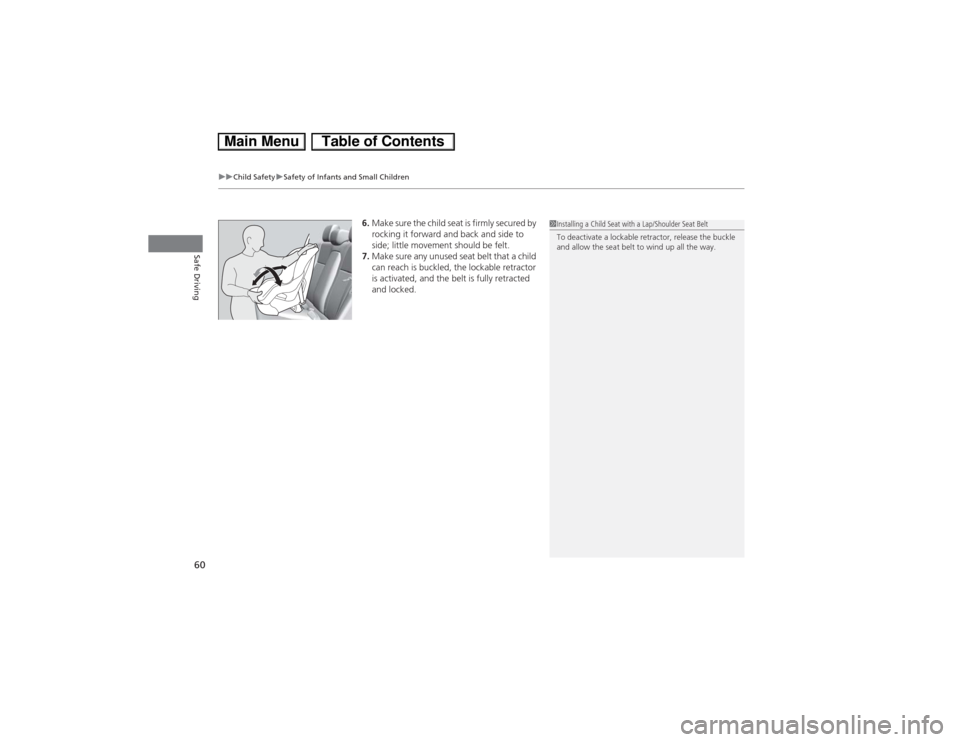
6.Make sure the child seat is firmly secured by
rocking it forward and back and side to
side; little movement should be felt.
7.Make sure any unused seat belt that a child
can reach is buckled, the lockable retractor
is activated, and the belt is fully retracted
and locked.
1Installing a Child Seat with a Lap/Shoulder Seat Belt
To deactivate a lockable retractor, release the buckle
and allow the seat belt to wind up all the way.
Page 72 of 346
71
uuIndicatorsu
Continued
Instrument Panel
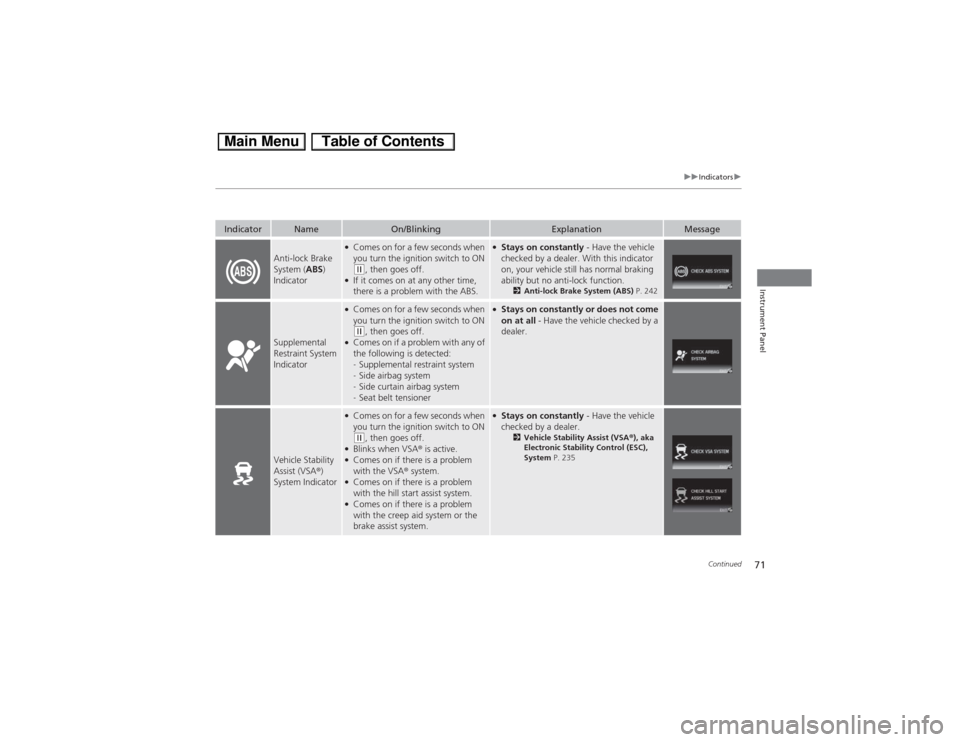
Anti-lock Brake
System (ABS)
Indicator
●Comes on for a few seconds when
you turn the ignition switch to ON (w, then goes off.
●If it comes on at any other time,
there is a problem with the ABS.
●Stays on constantly - Have the vehicle
checked by a dealer. With this indicator
on, your vehicle still has normal braking
ability but no anti-lock function.
2Anti-lock Brake System (ABS) P. 242
Supplemental
Restraint System
Indicator
●Comes on for a few seconds when
you turn the ignition switch to ON (w, then goes off.
●Comes on if a problem with any of
the following is detected:
-Supplemental restraint system
-Side airbag system
-Side curtain airbag system
-Seat belt tensioner
●Stays on constantly or does not come
on at all - Have the vehicle checked by a
dealer.
Vehicle Stability
Assist (VSA®)
System Indicator
●Comes on for a few seconds when
you turn the ignition switch to ON (w, then goes off.
●Blinks when VSA® is active.●Comes on if there is a problem
with the VSA® system.●Comes on if there is a problem
with the hill start assist system.●Comes on if there is a problem
with the creep aid system or the
brake assist system.
●Stays on constantly - Have the vehicle
checked by a dealer.
2Vehicle Stability Assist (VSA®), aka
Electronic Stability Control (ESC),
System P. 235
Indicator
Name
On/Blinking
Explanation
Message
Page 76 of 346

75
uuIndicatorsu
Continued
Instrument Panel
Indicator
Name
On/Blinking
Explanation
Message
High-Beam
Indicator
●Comes on when the high beam
headlights are on.
—
—
Lights On
Indicator
●Comes on whenever the light
switch is on, or in AUTO when the
exterior lights are on.
●If you remove the key from the ignition
switch while the lights are on, a chime
sounds when the driver’s door is opened.
—
Immobilizer
System Indicator
●Comes on briefly when you turn
the ignition switch to ON
(w, then
goes off.
●Comes on if the immobilizer
system cannot recognize the key
information.
●Blinks - You cannot start the engine.
Turn the ignition switch to LOCK
(0, pull
the key out, and then insert the key and
turn it to ON
(w again.
●Repeatedly blinks - The system may be
malfunctioning. Have the vehicle checked
by a dealer.●Do not attempt to alter this system or add
other devices to it. Electrical problems can
occur.
—
CRUISE MAIN
Indicator
●Comes on when you press the
CRUISE button.
2Cruise Control P. 225
—
CRUISE
CONTROL
Indicator
●Comes on if you have set a speed
for cruise control.
2Cruise Control P. 225
—
Page 78 of 346
77
uuIndicatorsu
Continued
Instrument Panel
Indicator
Name
On/Blinking
Explanation
Message
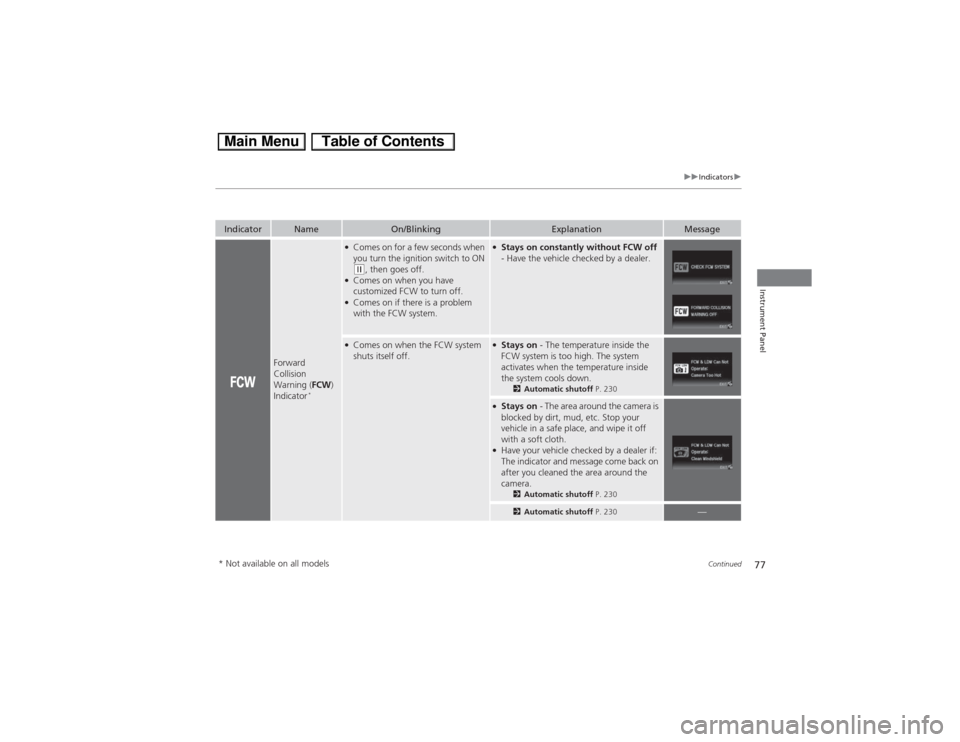
Forward
Collision
Warning (FCW)
Indicator
*
●Comes on for a few seconds when
you turn the ignition switch to ON (w, then goes off.
●Comes on when you have
customized FCW to turn off.●Comes on if there is a problem
with the FCW system.
●Stays on constantly without FCW off
- Have the vehicle checked by a dealer.
●Comes on when the FCW system
shuts itself off.
●Stays on - The temperature inside the
FCW system is too high. The system
activates when the temperature inside
the system cools down.
2Automatic shutoff P. 230
●Stays on - The area around the camera is
blocked by dirt, mud, etc. Stop your
vehicle in a safe place, and wipe it off
with a soft cloth.●Have your vehicle checked by a dealer if:
The indicator and message come back on
after you cleaned the area around the
camera.
2Automatic shutoff P. 2302Automatic shutoff P. 230
—
* Not available on all models