2013 FORD TAURUS climate control
[x] Cancel search: climate controlPage 164 of 541
Cooled seats
The cooled seats will only function when the engine is running.
To operate the cooled seats:
Press the cooled seat symbol/button to cycle through the
various cooling settings and off. Cooler settings are
indicated by more indicator lights.
If the engine falls below 350 rpm while the cooled seats are on, the
feature will turn itself off and will need to be reactivated.
Note:When the heated/cooled front seat is active, you will be able to
hear the fan operating inside the seat. This is normal.
Heated and cooled seat air filter replacement (if equipped)
The climate controlled seat system includes air filters that must be
replaced periodically. Refer toScheduled maintenance information.
The filters are located under each front seat and can be accessed from
the 2nd row foot-well area. Move the front seats all the way forward and
to the full up positions to ease access.
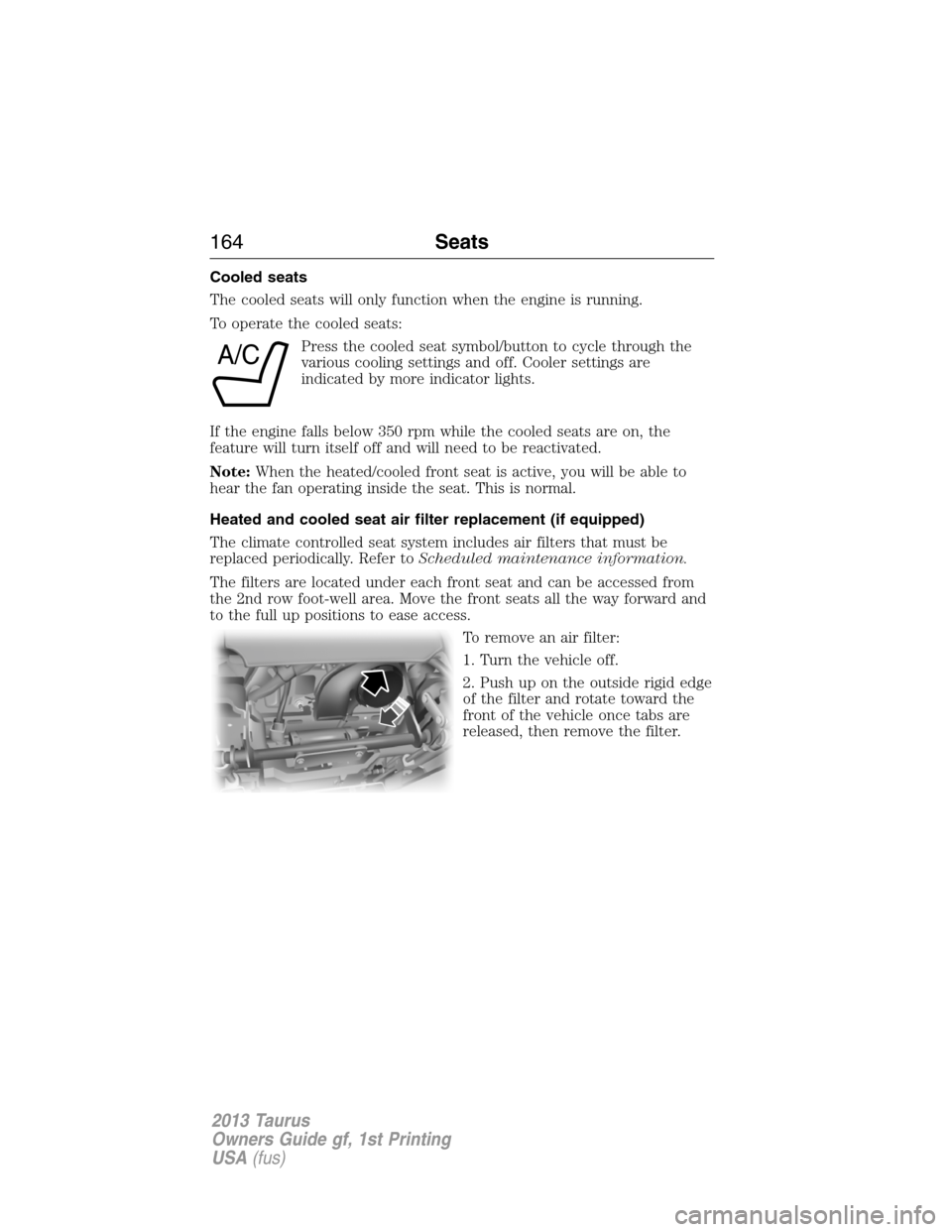
To remove an air filter:
1. Turn the vehicle off.
2. Push up on the outside rigid edge
of the filter and rotate toward the
front of the vehicle once tabs are
released, then remove the filter.
A/C
164Seats
2013 Taurus
Owners Guide gf, 1st Printing
USA(fus)
Page 180 of 541
If the engine does not start after three attempts, wait 10 seconds and
follow this flooded engine procedure.
1. Select park or neutral.
2. Fully press the accelerator pedal and hold it there.
3. Fully press the brake pedal.
4. Start the engine.
Your vehicle may have remote start capability. Refer toRemote startin
theKeys and Remote Controlchapter.
Guarding Against Exhaust Fumes
WARNING:If you smell exhaust fumes inside your vehicle, have
this checked immediately. Do not drive your vehicle if you smell
exhaust fumes. Carbon monoxide is present in exhaust fumes. Take
precautions to avoid its dangerous effects.
Important Ventilating Information
If you stop your vehicle and leave the engine idling for long periods of
time, we recommend that you do one of the following:
•Open the windows at least 1 inch (2.5 cm).
•Set your climate control to outside air.
ENGINE BLOCK HEATER (IF EQUIPPED)
WARNING:Failure to follow engine block heater instructions
could result in property damage or physical injury.
WARNING:Do not use your heater with ungrounded electrical
systems or two-pronged (cheater) adapters. There is a risk of
electrical shock.
Note:The heater is most effective when outdoor temperatures are below
0°F (-18°C).
The heater acts as a starting aid by warming the engine coolant. This
allows the climate control system to respond quickly. The equipment
includes a heater element (installed in the engine block) and a wire
harness. You can connect the system to a grounded 120 volt A/C
electrical source.
180Starting and Stopping the Engine
2013 Taurus
Owners Guide gf, 1st Printing
USA(fus)
Page 252 of 541
Vehicles Not Equipped with a 2.0L Engine
Note:Put your climate control system in recirculated air mode to
prevent exhaust fumes from entering the vehicle. Refer to theClimate
Controlchapter.
Follow these guidelines for your specific powertrain combination to tow
your vehicle for personal travel (such as behind a motor home or a
truck). These guidelines are designed to prevent damage to your vehicle
after it is hooked-up to the RV or tow dolly.
Front-wheel drive (FWD) vehicles can be towed with all four wheels on
the ground or with the front wheels off the ground by using a tow dolly.
If you are using a tow dolly follow the instructions specified by the
equipment provider. If you are towing with all four wheels on the ground,
refer to the towing instructions found at the end of this section.
All-wheel drive (AWD) vehicles can be towed with all four wheels on the
ground or with all four wheels off the ground using a vehicle transport
trailer. Do not tow your AWD vehicle with the front wheels off the
ground (by using a tow dolly) and the rear wheels on the ground; this
will cause damage to your AWD system. If you are using a vehicle
transport trailer, follow the instruction specified by the equipment
provider. If you are towing with all four wheels on the ground, refer to
the towing instructions found at the end of this section.
If you tow your vehicle with all four wheels on the ground:
•Tow only in the forward direction.
•Release the parking brake.
•Place the transmission in N (Neutral).
•Do not exceed 65 mph (105 km/h).
•Start the engine and allow it to run for five minutes at the beginning
of each day and every six hours thereafter. With the engine running
and your foot on the brake, shift into D (Drive) and then into R
(Reverse) before shifting back into N (Neutral).
252Towing
2013 Taurus
Owners Guide gf, 1st Printing
USA(fus)
Page 273 of 541
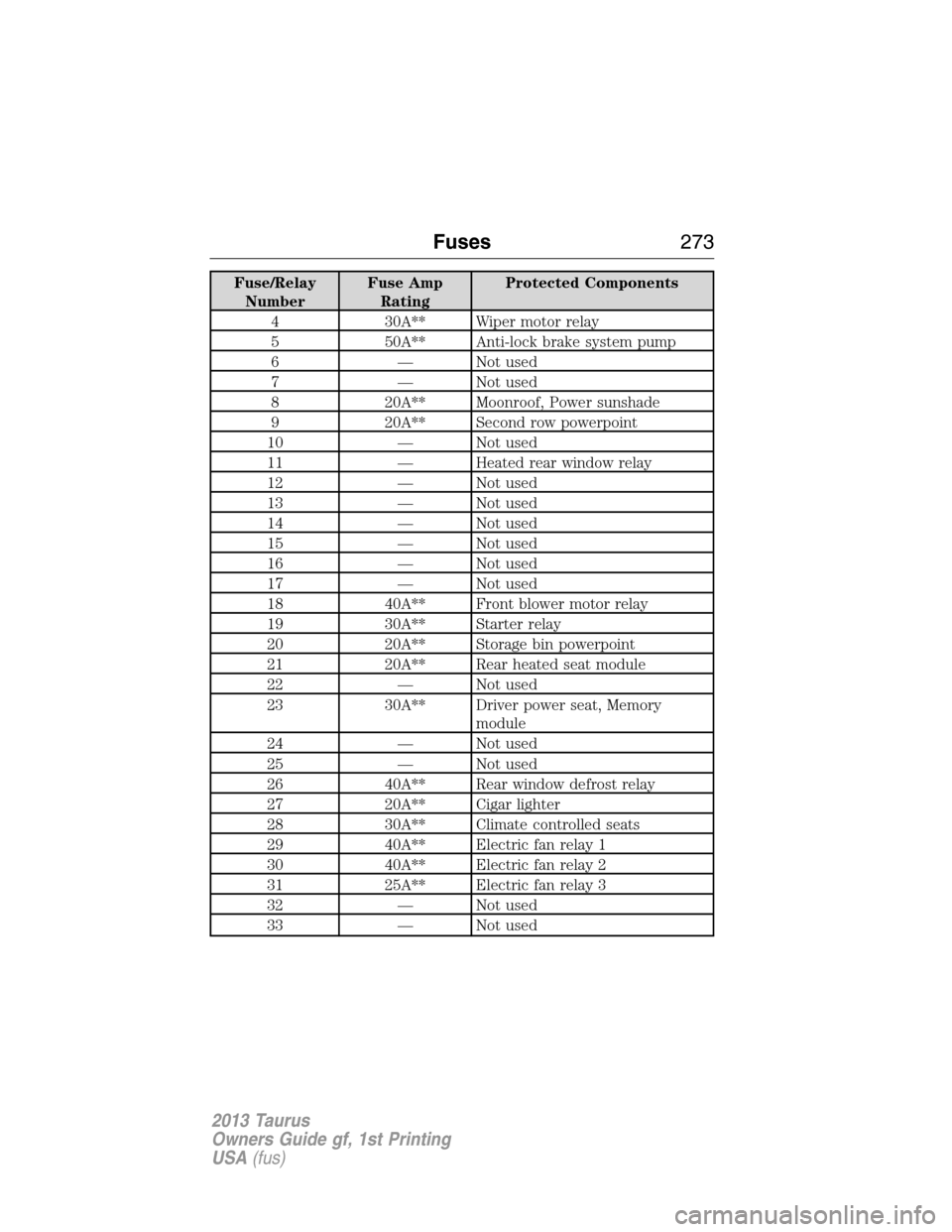
Fuse/Relay
NumberFuse Amp
RatingProtected Components
4 30A** Wiper motor relay
5 50A** Anti-lock brake system pump
6 — Not used
7 — Not used
8 20A** Moonroof, Power sunshade
9 20A** Second row powerpoint
10 — Not used
11 — Heated rear window relay
12 — Not used
13 — Not used
14 — Not used
15 — Not used
16 — Not used
17 — Not used
18 40A** Front blower motor relay
19 30A** Starter relay
20 20A** Storage bin powerpoint
21 20A** Rear heated seat module
22 — Not used
23 30A** Driver power seat, Memory
module
24 — Not used
25 — Not used
26 40A** Rear window defrost relay
27 20A** Cigar lighter
28 30A** Climate controlled seats
29 40A** Electric fan relay 1
30 40A** Electric fan relay 2
31 25A** Electric fan relay 3
32 — Not used
33 — Not used
Fuses273
2013 Taurus
Owners Guide gf, 1st Printing
USA(fus)
Page 279 of 541

Fuse/Relay
NumberFuse Amp
RatingProtected Components
31 5A Not used (spare)
32 15A Smart window motors, Master window
and mirror switch, Rear window power
sunshade module, Lock switch
illumination
33 10A Not used (spare)
34 10A Reverse park aid module, Automatic
high beam and lane departure module,
Rear heated seat module, Blind spot
monitor module, Rear video camera
35 5A Motorized humidity sensor, Heads-up
display, Traction control switch
36 10A Heated steering wheel
37 10A Not used (spare)
38 10A Auto–dimming mirror (without
automatic high beam and lane departure
module), Moonroof module and switch
39 15A High beams
40 10A Rear park lamps
41 7.5A Occupant classification sensor, Restraint
control module
42 5A Not used (spare)
43 10A Not used (spare)
44 10A Not used (spare)
45 5A Not used (spare)
46 10A Climate control module
47 15A Fog lamp relay
48 30A Circuit
BreakerFront passenger power window, Rear
power windows
Fuses279
2013 Taurus
Owners Guide gf, 1st Printing
USA(fus)
Page 318 of 541
TIRE CARE
Information About Uniform Tire Quality Grading
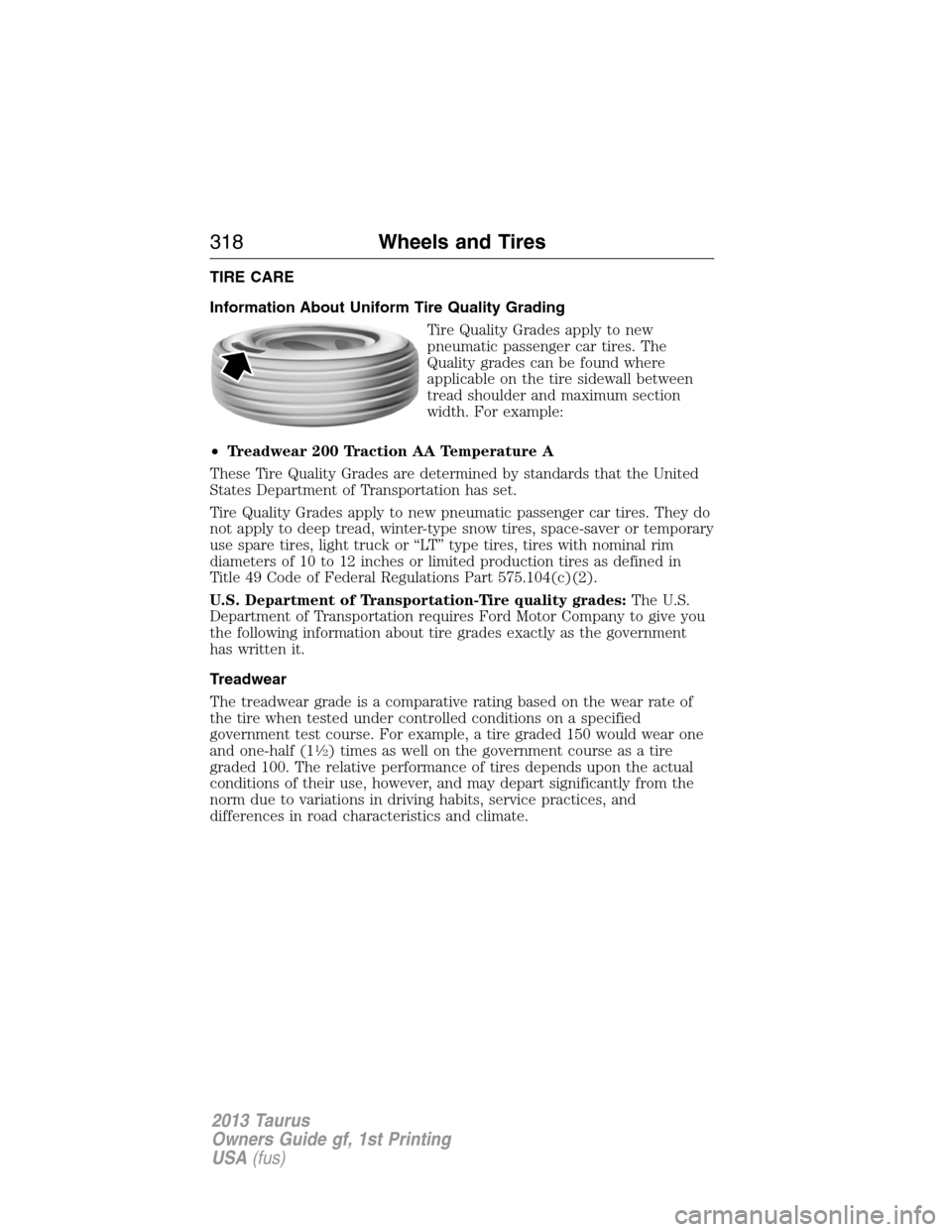
Tire Quality Grades apply to new
pneumatic passenger car tires. The
Quality grades can be found where
applicable on the tire sidewall between
tread shoulder and maximum section
width. For example:
•Treadwear 200 Traction AA Temperature A
These Tire Quality Grades are determined by standards that the United
States Department of Transportation has set.
Tire Quality Grades apply to new pneumatic passenger car tires. They do
not apply to deep tread, winter-type snow tires, space-saver or temporary
use spare tires, light truck or “LT” type tires, tires with nominal rim
diameters of 10 to 12 inches or limited production tires as defined in
Title 49 Code of Federal Regulations Part 575.104(c)(2).
U.S. Department of Transportation-Tire quality grades:The U.S.
Department of Transportation requires Ford Motor Company to give you
the following information about tire grades exactly as the government
has written it.
Treadwear
The treadwear grade is a comparative rating based on the wear rate of
the tire when tested under controlled conditions on a specified
government test course. For example, a tire graded 150 would wear one
and one-half (1
12) times as well on the government course as a tire
graded 100. The relative performance of tires depends upon the actual
conditions of their use, however, and may depart significantly from the
norm due to variations in driving habits, service practices, and
differences in road characteristics and climate.
318Wheels and Tires
2013 Taurus
Owners Guide gf, 1st Printing
USA(fus)
Page 334 of 541
USING SUMMER TIRES
Your Taurus SHO may be equipped with summer tires to provide superior
performance on wet and dry roads. Summer tires do not have the Mud
and Snow (M+S or M/S) tire traction rating on the tire side wall. Since
summer tires do not have the same traction performance as All-season or
Snow tires, Ford does not recommend using summer tires when
temperatures drop to approximately 40°F (5°C) or below (depending on
tire wear and environmental conditions) or in snow/ice conditions. Like
any tire, summer tire performance is affected by tire wear and
environmental conditions. If you must drive in those conditions, Ford
recommends using Mud and Snow (M+S, M/S), All-season or Snow tires.
USING SNOW CHAINS
WARNING:Snow tires must be the same size, load index, speed
rating as those originally provided by Ford. Use of any tire or
wheel not recommended by Ford can affect the safety and performance
of your vehicle, which could result in an increased risk of loss of vehicle
control, vehicle rollover, personal injury and death. Additionally, the use
of non-recommended tires and wheels could cause steering, suspension,
axle or transfer case/power transfer unit failure.
The tires on your vehicle may have all-weather treads to provide traction
in rain and snow. However, in some climates, you may need to use snow
tires and chains. If you need to use chains, it is recommended that steel
wheels (of the same size and specifications) be used, as chains may chip
aluminum wheels.
Note:The suspension insulation and bumpers will help prevent vehicle
damage. Do not remove these components from your vehicle when using
snow tires and chains.
Follow these guidelines when using snow tires and chains:
•If possible, avoid fully loading your vehicle.
•Use only SAE Class S cables or equivalent on P235/60R17 or
P235/55R18 tires on the front tires only. SAE Class S chains or other
conventional link chains may cause damage to the vehicle’s wheel
house and/or body. Use of optional spike spider type traction devices
or equivalent is also acceptable.
•
Do not install tire chains, cables or optional traction devices on the rear
tires. This could cause damage to the vehicle’s wheel house or body.
•Do not use tire chains, cables or optional traction devices with
optional P255/45R19 or 245/45R20 tires.
334Wheels and Tires
2013 Taurus
Owners Guide gf, 1st Printing
USA(fus)
Page 377 of 541
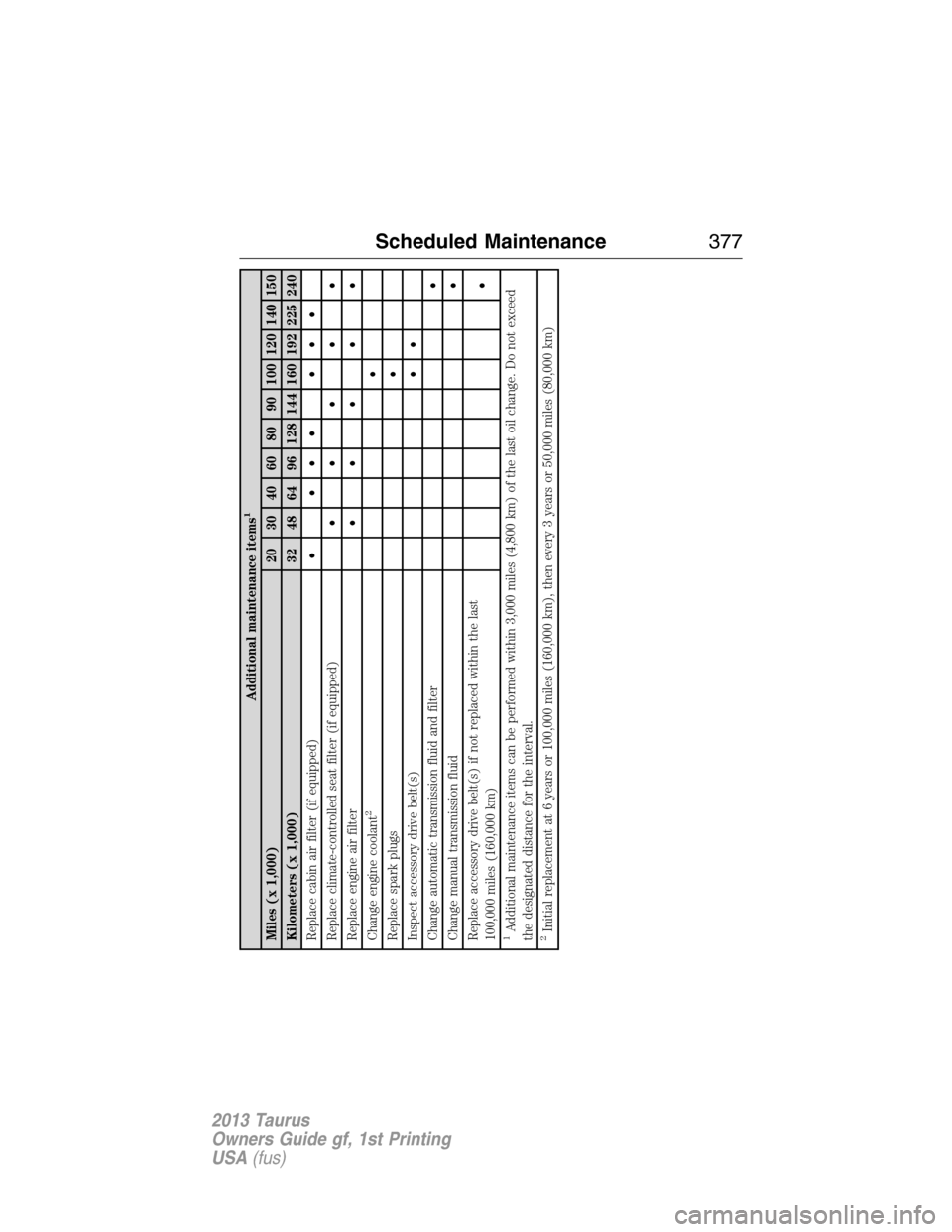
Additional maintenance items
1
Miles (x 1,000) 20 30 40 60 80 90 100 120 140 150
Kilometers (x 1,000) 32 48 64 96 128 144 160 192 225 240
Replace cabin air filter (if equipped)• ••• •••
Replace climate-controlled seat filter (if equipped)•••••
Replace engine air filter•••••
Change engine coolant
2
•
Replace spark plugs•
Inspect accessory drive belt(s)••
Change automatic transmission fluid and filter•
Change manual transmission fluid•
Replace accessory drive belt(s) if not replaced within the last
100,000 miles (160,000 km)•
1Additional maintenance items can be performed within 3,000 miles (4,800 km) of the last oil change. Do not exceed
the designated distance for the interval.2Initial replacement at 6 years or 100,000 miles (160,000 km), then every 3 years or 50,000 miles (80,000 km)
Scheduled Maintenance377
2013 Taurus
Owners Guide gf, 1st Printing
USA(fus)