2013 FORD SUPER DUTY air filter
[x] Cancel search: air filterPage 34 of 95
Installation – DFCM filter
1. Install the new filter into the filter bowl tabs and replace the seal on
the DFCM header (top portion of DFCM). Refer toMotorcraft part
numbersin theMaintenancechapter for the fuel filter kit part number.
2. Lube O-ring with lubricant packet in the filter kit. This will assist in
making sure the filter gets properly tightened.
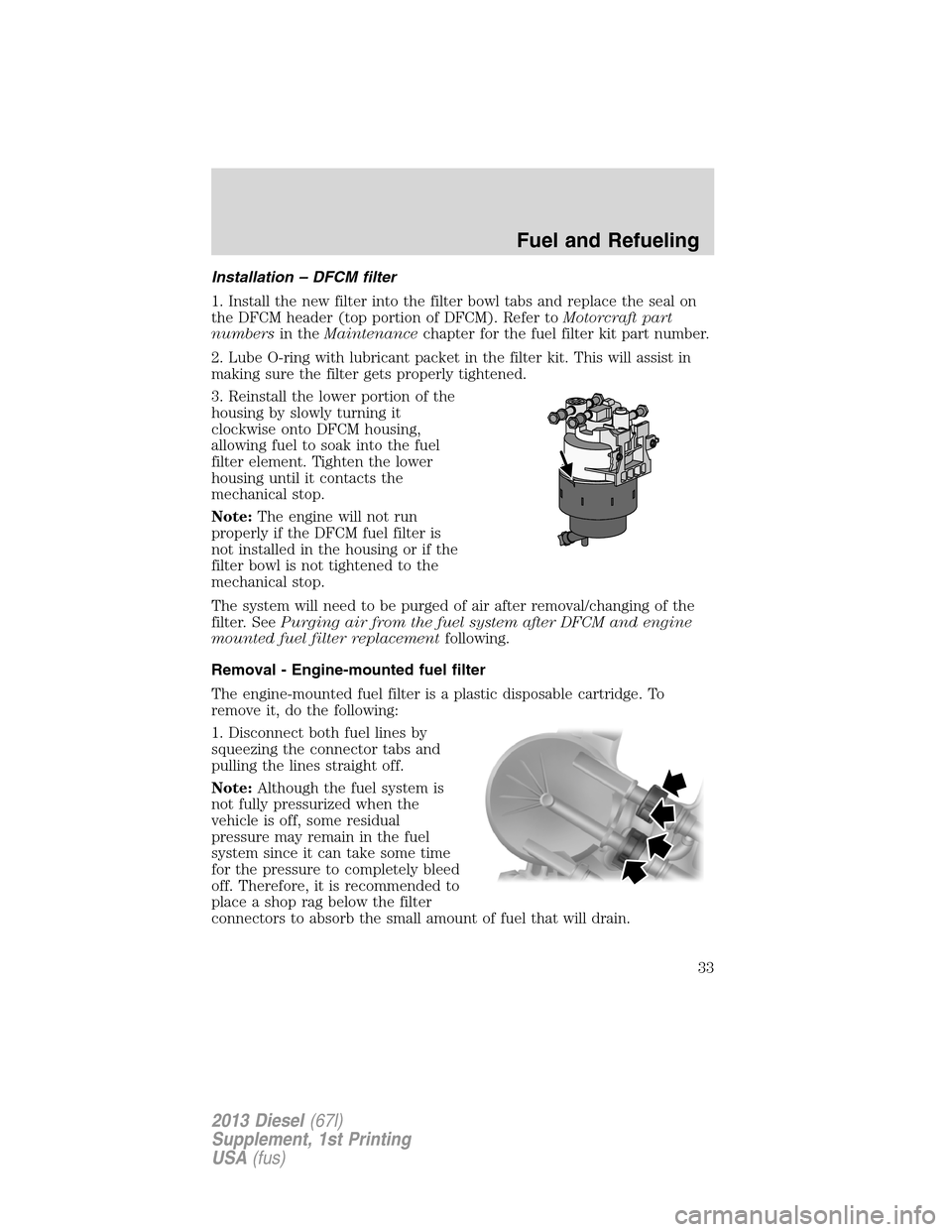
3. Reinstall the lower portion of the
housing by slowly turning it
clockwise onto DFCM housing,
allowing fuel to soak into the fuel
filter element. Tighten the lower
housing until it contacts the
mechanical stop.
Note:The engine will not run
properly if the DFCM fuel filter is
not installed in the housing or if the
filter bowl is not tightened to the
mechanical stop.
The system will need to be purged of air after removal/changing of the
filter. SeePurging air from the fuel system after DFCM and engine
mounted fuel filter replacementfollowing.
Removal - Engine-mounted fuel filter
The engine-mounted fuel filter is a plastic disposable cartridge. To
remove it, do the following:
1. Disconnect both fuel lines by
squeezing the connector tabs and
pulling the lines straight off.
Note:Although the fuel system is
not fully pressurized when the
vehicle is off, some residual
pressure may remain in the fuel
system since it can take some time
for the pressure to completely bleed
off. Therefore, it is recommended to
place a shop rag below the filter
connectors to absorb the small amount of fuel that will drain.
Fuel and Refueling
33
2013 Diesel(67l)
Supplement, 1st Printing
USA(fus)
Page 35 of 95
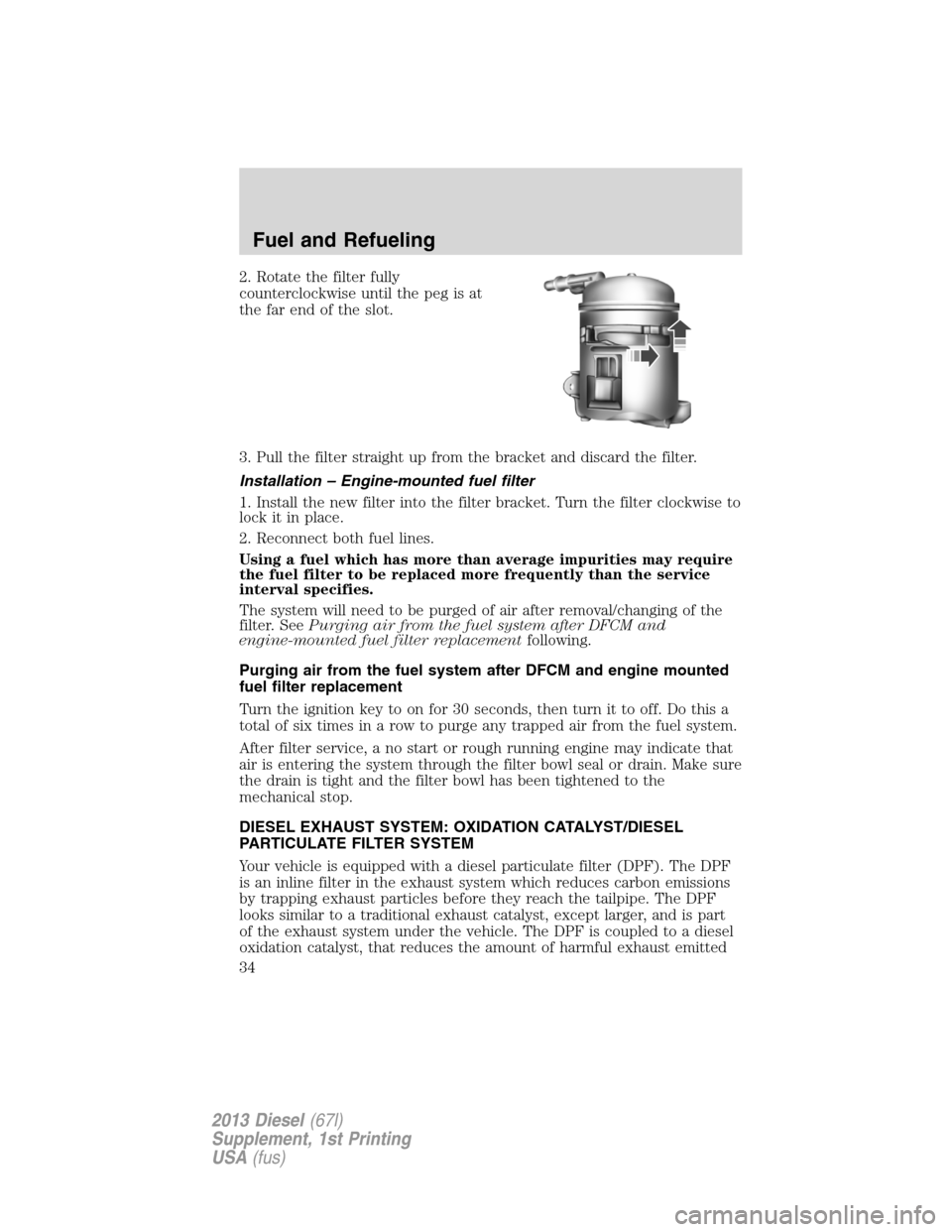
2. Rotate the filter fully
counterclockwise until the peg is at
the far end of the slot.
3. Pull the filter straight up from the bracket and discard the filter.
Installation – Engine-mounted fuel filter
1. Install the new filter into the filter bracket. Turn the filter clockwise to
lock it in place.
2. Reconnect both fuel lines.
Using a fuel which has more than average impurities may require
the fuel filter to be replaced more frequently than the service
interval specifies.
The system will need to be purged of air after removal/changing of the
filter. SeePurging air from the fuel system after DFCM and
engine-mounted fuel filter replacementfollowing.
Purging air from the fuel system after DFCM and engine mounted
fuel filter replacement
Turn the ignition key to on for 30 seconds, then turn it to off. Do this a
total of six times in a row to purge any trapped air from the fuel system.
After filter service, a no start or rough running engine may indicate that
air is entering the system through the filter bowl seal or drain. Make sure
the drain is tight and the filter bowl has been tightened to the
mechanical stop.
DIESEL EXHAUST SYSTEM: OXIDATION CATALYST/DIESEL
PARTICULATE FILTER SYSTEM
Your vehicle is equipped with a diesel particulate filter (DPF). The DPF
is an inline filter in the exhaust system which reduces carbon emissions
by trapping exhaust particles before they reach the tailpipe. The DPF
looks similar to a traditional exhaust catalyst, except larger, and is part
of the exhaust system under the vehicle. The DPF is coupled to a diesel
oxidation catalyst, that reduces the amount of harmful exhaust emitted
Fuel and Refueling
34
2013 Diesel(67l)
Supplement, 1st Printing
USA(fus)
Page 36 of 95
from the tailpipe. As soot gathers in the system it begins to restrict the
filter. The soot gathered inside the filter needs to be periodically cleaned.
The soot can be cleaned in two different ways; passive regeneration and
active regeneration. Both methods occur automatically and require no
actions from the driver/operator. During either one of these regeneration
methods you may notice an increase/change in exhaust noise/tone. At
certain times, the message center will display various messages related
to the DPF. See theInformation Displayschapter in theOwner Guide
for more information.
Passive regeneration
In passive regeneration, the exhaust constituents / temperature are at an
appropriate level where some soot can be reduced or oxidized (burned)
thus cleaning the filter. This method occurs naturally as a result of
normal engine operating conditions (at varying levels due to drive
patterns).
Active regeneration
Note:Do not disregard theDRIVE TO CLEAN EXHAUST FILTERor
Drive to Clean Exhaust Systemmaintenance message for extended
periods of time. Failure to perform active or operator commanded
regeneration (OCR) (if equipped) when instructed may result in a
clogged DPF. If your DPF fills beyond what can be safely regenerated,
active regeneration and OCR will be disabled. This could cause
irreversible damage to the DPF, requiring service and possible
replacement that may not be covered by your warranty.
Once the DPF is full of exhaust particles, the engine control module will
command the exhaust system to clean the DPF through a process called
active regeneration. Active regeneration requires the engine computer to
raise the exhaust temperature to eliminate the particles. During cleaning,
the particles are converted to harmless gasses, and the DPF will then be
clean and ready to continue trapping exhaust particles.
The regeneration process operates more efficiently when the vehicle is
safely operated at least 30 mph (48 km/h) with a steady pedal for
approximately 20 minutes to complete the process. The frequency and
duration of regeneration will fluctuate as both are determined by how
you drive your vehicle, outside air temperature, and altitude. For most
driving, regeneration frequency will vary from 100 - 500 miles (161 -
805 km) between occurrences and each occurrence will last from 9 -
20 minutes. The duration of regeneration is usually reduced if a constant
speed above 30 mph (48 km/h) is maintained.
Fuel and Refueling
35
2013 Diesel(67l)
Supplement, 1st Printing
USA(fus)
Page 42 of 95
Resonator/Tailpipe assembly maintenance
WARNING:Failure to maintain the functional holes, in the
tailpipe section of the exhaust, clean and free of debris or
foreign material may result in the holes becoming blocked or plugged.
Do not modify or remove the tail-pipe section. Blocked or plugged
holes or removal/modification of the system could result in elevated
exhaust gas temperatures which may result in vehicle/property damage
or personal injury.
WARNING:The normal operating temperature of the exhaust
system is very high. Never work around or attempt to repair any
part of the exhaust system until it has cooled. Use special care when
working around the diesel oxidation catalytic converter and/or the
diesel particulate filter (DPF). The diesel oxidation catalytic converter
and/or the DPF heats up to a high temperature after only a short
period of engine operation and can stay hot even after the engine is
turned off. Failure to follow these instructions may result in personal
injury.
Note:Additions of aftermarket devices or modifications to the exhaust
system can reduce the effectiveness of the exhaust system as well as
cause damage to the exhaust system and/or engine. These actions may
also affect the vehicle’s warranty. See theWarranty Guidefor more
information.
The diesel resonator tail-pipe assembly is a uniquely functioning device
that accompanies the Oxidation Catalyst/DPF assembly. The assembly
serves multiple functions. First it serves as an acoustic device to
attenuate exhaust noise. Second it provides an exit path for the exhaust
from the vehicle. It also is designed to help control the temperature of
the exhaust during DPF regeneration events. The visible holes in each
leg of the twin tip and the holes under the shield just inboard of the
right rear tire(s) are functional. The holes need to be kept clear of
mud/debris or foreign material to maintain proper function of the
exhaust system. Clean and remove debris or foreign material if present
as needed. Spraying with a hose during regular washing of vehicle should
help keep holes clean and clear of debris or foreign material.
Fuel and Refueling
41
2013 Diesel(67l)
Supplement, 1st Printing
USA(fus)
Page 44 of 95
Among those acts which the U.S. Environmental Protection Agency may
presume to constitute tampering are the acts listed below:
•Removal of hood blanket, fender apron absorbers, fender apron
barriers, underbody noise shields or acoustically absorptive material.
•Tampering or rendering inoperative the engine speed governor, so as
to allow engine speed to exceed manufacturer’s specifications.
The complexity of the diesel engine makes it so the owner is discouraged
from attempting to perform maintenance other than the services
described in this supplement.
If you experience difficult starting, rough idling, excessive exhaust
smoke, a decrease in engine performance or excess fuel consumption,
perform the following checks:
•a plugged or disconnected air inlet system or engine air filter element.
•water in the fuel filter/water separator.
•a clogged fuel filter.
•contaminated fuel.
•air in the fuel system, due to loose connections.
•an open or pinched sensor hose.
•check engine oil level.
•wrong fuel or oil viscosity for climactic conditions.
If these checks do not help you correct the engine performance problem
you are experiencing, consult an authorized dealer.
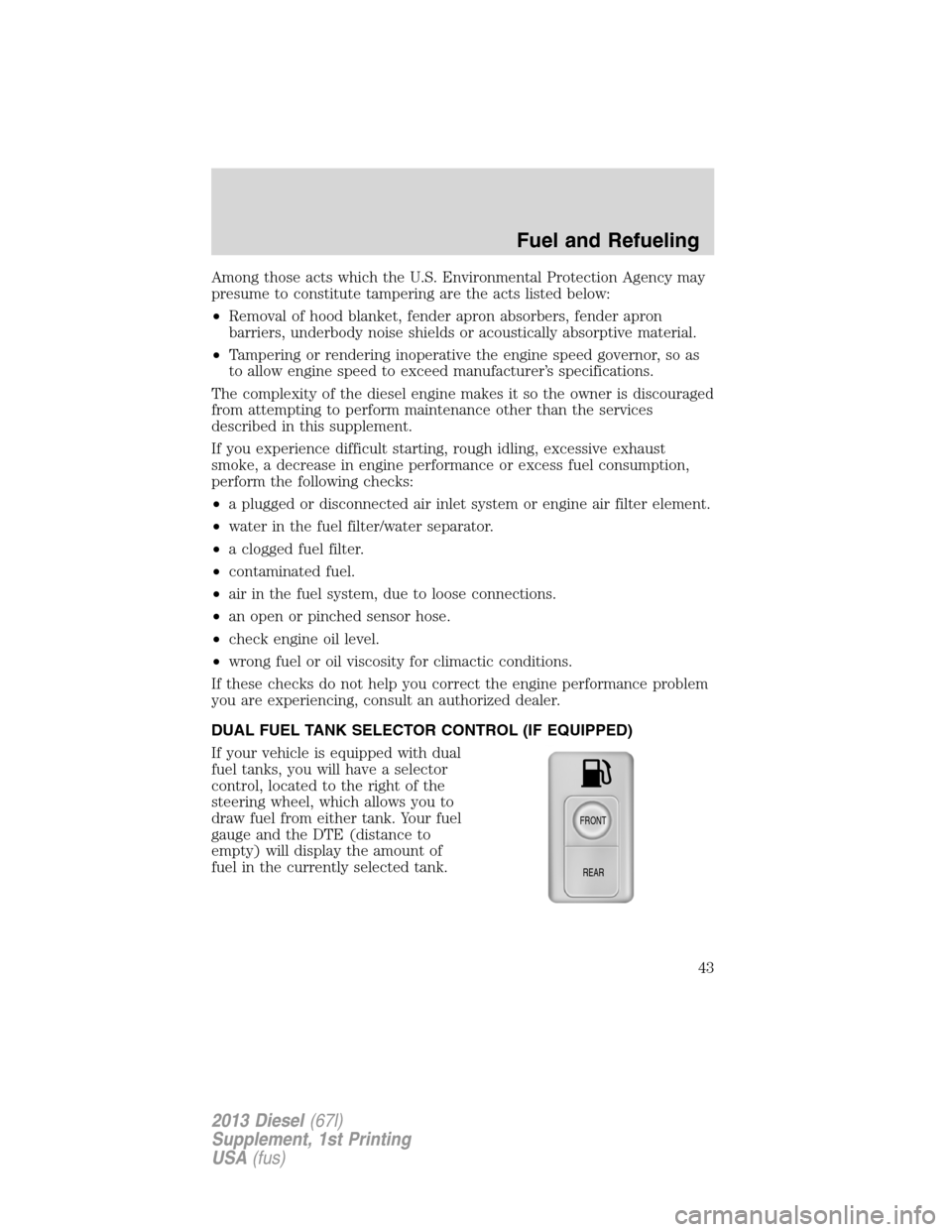
DUAL FUEL TANK SELECTOR CONTROL (IF EQUIPPED)
If your vehicle is equipped with dual
fuel tanks, you will have a selector
control, located to the right of the
steering wheel, which allows you to
draw fuel from either tank. Your fuel
gauge and the DTE (distance to
empty) will display the amount of
fuel in the currently selected tank.
FRONT
REAR
Fuel and Refueling
43
2013 Diesel(67l)
Supplement, 1st Printing
USA(fus)
Page 49 of 95
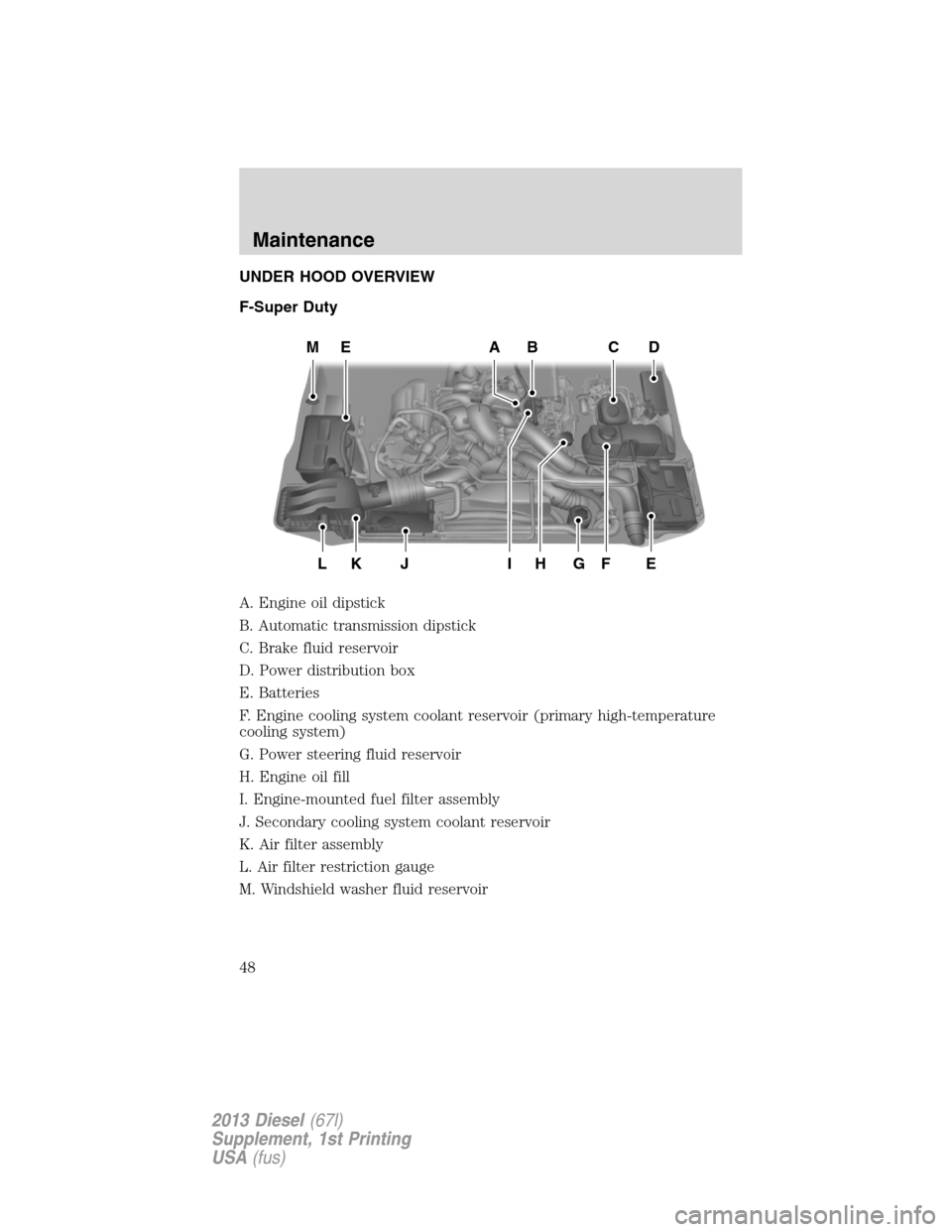
UNDER HOOD OVERVIEW
F-Super Duty
A. Engine oil dipstick
B. Automatic transmission dipstick
C. Brake fluid reservoir
D. Power distribution box
E. Batteries
F. Engine cooling system coolant reservoir (primary high-temperature
cooling system)
G. Power steering fluid reservoir
H. Engine oil fill
I. Engine-mounted fuel filter assembly
J. Secondary cooling system coolant reservoir
K. Air filter assembly
L. Air filter restriction gauge
M. Windshield washer fluid reservoir
MEBC
EGJKLF
DA
HI
Maintenance
48
2013 Diesel(67l)
Supplement, 1st Printing
USA(fus)
Page 59 of 95
Engine-driven cooling fan (fan clutch)
Your vehicle is equipped with an engine driven cooling fan drive (also
called a fan clutch). This fan drive changes the fan speed to match the
vehicle’s changing cooling air flow requirements. Fan speed, fan noise
level and fuel consumption all will increase based on the driving
conditions that include trailer towing, hill climbing, heavy loads, high
speed and high ambient temperature, individually or in combination.
The fan drive is designed to provide the minimum fan speed (and
resulting minimum fan noise and fuel consumption) required to meet the
ever changing vehicle cooling air flow requirements. You will hear the
amount of fan noise increasing and decreasing as the engine power
requirements and vehicle driving conditions change as you drive. This is
to be expected as being normal to the operation of your vehicle. High
levels of fan noise might also be heard when your engine is first started,
and should normally decrease after driving for a short time.
AIR FILTER RESTRICTION GAUGE AND AIR FILTER REPLACEMENT
WARNING:To reduce the risk of vehicle damage and/or
personal burn injuries do not start your engine with the air filter
removed and do not remove it while the engine is running.
Note:Vehicle operation in heavy snowfall or extreme rain conditions
may feed excessive amounts of snow/water into the air intake system.
This could plug/soak the air filter with snow and may cause the engine to
lose power and possibly shut down.
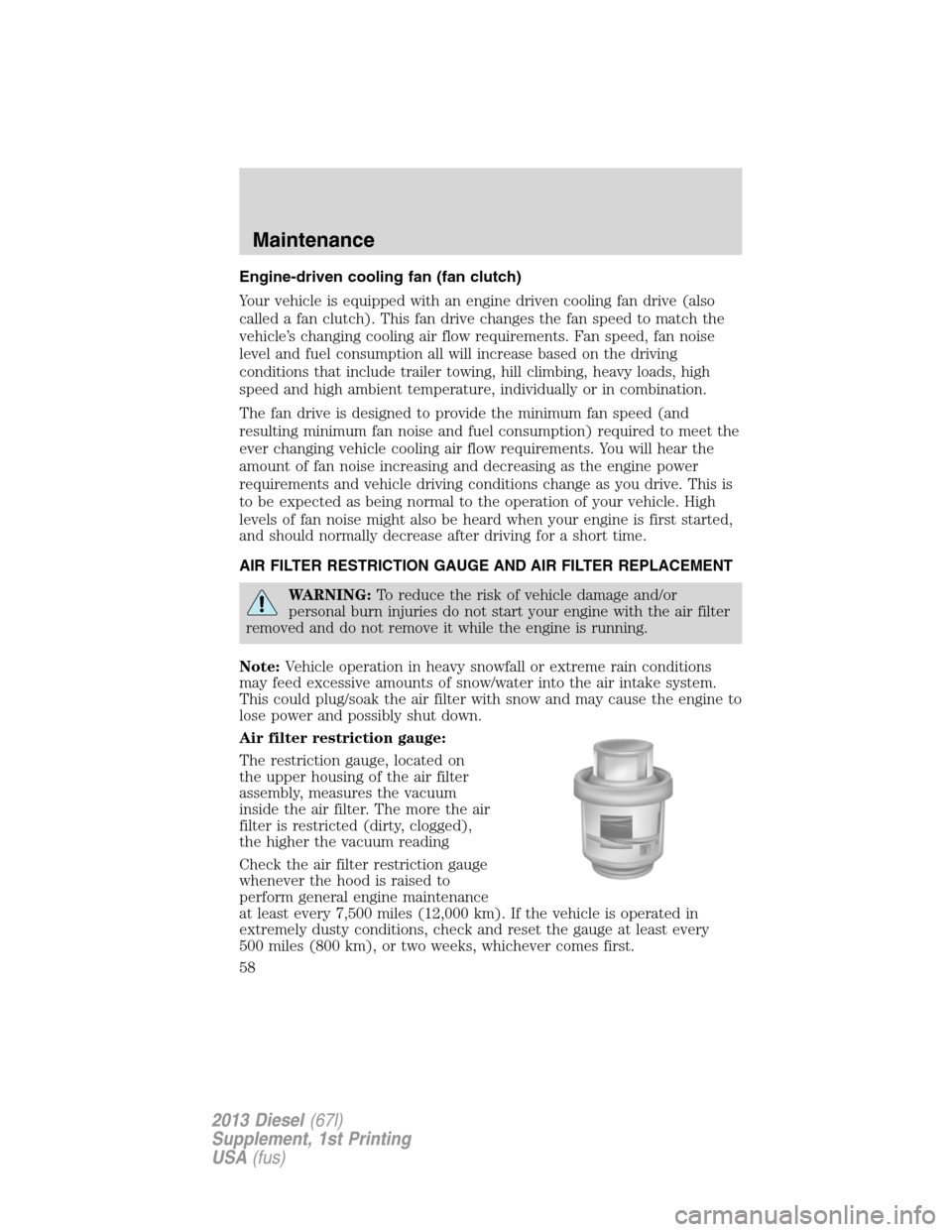
Air filter restriction gauge:
The restriction gauge, located on
the upper housing of the air filter
assembly, measures the vacuum
inside the air filter. The more the air
filter is restricted (dirty, clogged),
the higher the vacuum reading
Check the air filter restriction gauge
whenever the hood is raised to
perform general engine maintenance
at least every 7,500 miles (12,000 km). If the vehicle is operated in
extremely dusty conditions, check and reset the gauge at least every
500 miles (800 km), or two weeks, whichever comes first.
Maintenance
58
2013 Diesel(67l)
Supplement, 1st Printing
USA(fus)
Page 60 of 95
Change the air filter when the gauge reads near the “change filter” line
and the chamber is filled with yellow. Engine performance and fuel
economy are adversely affected when the maximum restriction is
reached.
Blowing-out the air filter element with compressed air is not
recommended as the compressed air may damage the filter paper.
Note:It is not possible to determine the level of filter clogging by visual
appearance alone. A filter which appears to be dirty may actually have
several thousand miles (kilometers) of life remaining.
Use the underhood air filter restriction gauge to determine when
the air filter element needs to be changed.
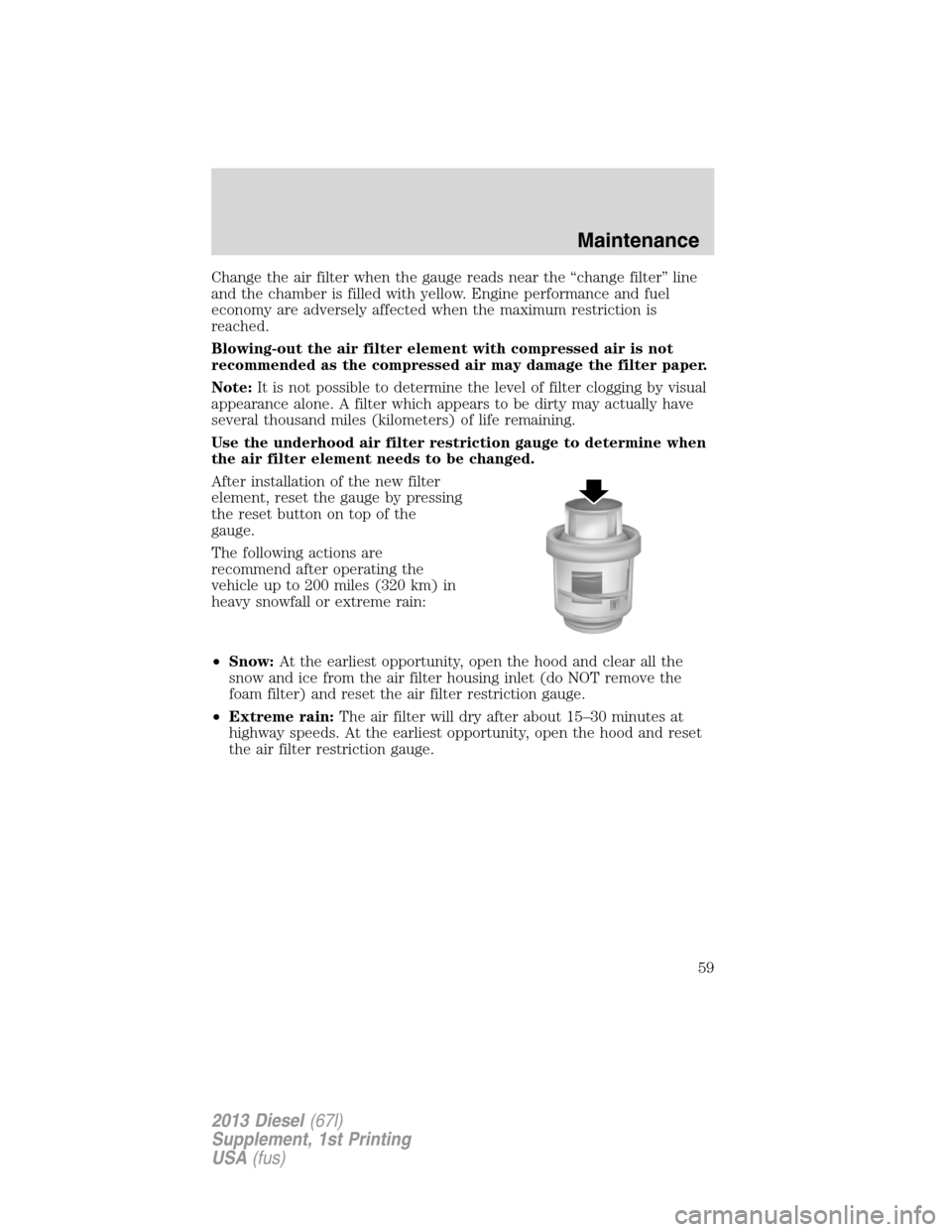
After installation of the new filter
element, reset the gauge by pressing
the reset button on top of the
gauge.
The following actions are
recommend after operating the
vehicle up to 200 miles (320 km) in
heavy snowfall or extreme rain:
•Snow:At the earliest opportunity, open the hood and clear all the
snow and ice from the air filter housing inlet (do NOT remove the
foam filter) and reset the air filter restriction gauge.
•Extreme rain:The air filter will dry after about 15–30 minutes at
highway speeds. At the earliest opportunity, open the hood and reset
the air filter restriction gauge.
Maintenance
59
2013 Diesel(67l)
Supplement, 1st Printing
USA(fus)