2013 FORD FUSION (AMERICAS) instrument panel
[x] Cancel search: instrument panelPage 7 of 458

The Better Business Bureau (BBB) Auto
Line Program (U.S. Only)......................223
Utilizing the Mediation/Arbitration Program (Canada Only)
.......................223
Getting Assistance Outside the U.S. and Canada........................................................224
Ordering Additional Owner's Literature.....................................................225
Reporting Safety Defects (U.S. Only).............................................................225
Reporting Safety Defects (Canada Only).............................................................226
Roadside Emergencies
Roadside Assistance
...................................227
Hazard Warning Flashers..........................228
Fuel Shutoff
...................................................228
Jump-Starting the Vehicle.......................228
Fuses
Changing a Fuse
............................................231
Fuse Specification Chart............................231
Maintenance
General Information
....................................241
Opening and Closing the Hood...............241
Under Hood Overview - 1.6L EcoBoost™................................................243
Under Hood Overview - 2.0L EcoBoost™................................................244
Under Hood Overview - 2.5L...................245
Engine Oil Dipstick - 1.6L EcoBoost™................................................245
Engine Oil Dipstick......................................246
Engine Oil Check..........................................246
Engine Coolant Check................................247
Automatic Transmission Fluid Check...........................................................250
Brake Fluid Check........................................250
Power Steering Fluid Check....................250
Fuel Filter
........................................................250
Washer Fluid Check....................................250 Changing the 12V Battery
..........................251
Checking the Wiper Blades......................252
Changing the Wiper Blades.....................252
Changing the Engine Air Filter.................253
Adjusting the Headlamps
.........................254
Removing a Headlamp..............................255
Changing a Bulb...........................................257
Bulb Specification Chart..........................260
Vehicle Care
General Information
...................................262
Cleaning Products
.......................................262
Cleaning the Exterior..................................262
Repairing Minor Paint Damage
..............263
Waxing
.............................................................263
Cleaning the Engine
...................................264
Cleaning the Windows and Wiper Blades..........................................................264
Cleaning the Interior...................................264
Cleaning the Instrument Panel and Instrument Cluster Lens
.......................265
Cleaning Leather Seats
.............................266
Cleaning the Alloy Wheels.......................266
Vehicle Storage
.............................................267
Wheels and Tires
Tire Care
..........................................................269
Tire Pressure Monitoring System...........283
Using Snow Chains.....................................287
Changing a Road Wheel
...........................288
Technical Specifications...........................292
Capacities and Specific- ations
Engine Specifications
................................293
Motorcraft Parts
..........................................294
Vehicle Identification Number
................295
Vehicle Certification Label
.......................295
Transmission Code Designation
............296
Technical Specifications...........................297
4
Fusion/Mondeo (CC7) Table of Contents
Page 38 of 458

Proper Driver and Front Passenger
Seating Adjustment
WARNING
National Highway Traffic Safety
Administration (NHTSA)
recommends a minimum distance
of at least 10 inches (25 centimeters)
between an occupant’ s chest and the
driver airbag module. To properly position yourself away from
the airbag:
•
Move your seat to the rear as far as you
can while still reaching the pedals
comfortably.
• Recline the seat slightly (one or two
degrees) from the upright position.
After all occupants have adjusted their
seats and put on safety belts, it is very
important that they continue to sit
properly. A properly seated occupant sits
upright, leaning against the seat back, and
centered on the seat cushion, with their
feet comfortably extended on the floor.
Sitting improperly can increase the chance
of injury in a crash event. For example, if
an occupant slouches, lies down, turns
sideways, sits forward, leans forward or
sideways, or puts one or both feet up, the
chance of injury during a crash is greatly
increased.
Children and Airbags WARNING
Airbags can kill or injure a child in a
child seat. Never place a rear-facing
child seat in front of an active airbag.
If you must use a forward-facing child seat
in the front seat, move the seat all the way
back. Children must always be properly
restrained. Accident statistics suggest that
children are safer when properly restrained
in the rear seating positions than in the
front seating position. Failure to follow
these instructions may increase the risk of
injury in a crash.
KNEE AIRBAG
A driver
’s and passenger ’s knee airbag is
located under or within the instrument
panel. During a crash, the restraints control
module may activate the driver ’s and
passenger ’s knee airbag (individually or
both) based on crash severity and
respective occupant conditions. Under
certain crash and occupant conditions, the
driver ’s and passenger ’s knee airbag may
deploy (individually or both) but the
corresponding driver ’s front airbag may not
activate. As with front and side airbags, it
is important to be properly seated and
restrained to reduce the risk of death or
serious injury. Make sure the knee airbags are
operating properly. See Crash
Sensors and Airbag Indicator
(page
40).
35
Fusion/Mondeo (CC7) Supplementary Restraints SystemE142846
Page 39 of 458

FRONT PASSENGER SENSING
SYSTEM
WARNINGS
Even with Advanced Restraints
Systems, children 12 and under
should be properly restrained in a
rear seating position. Failure to follow this
could seriously increase the risk of injury or
death. Sitting improperly out of position or
with the seat back reclined too far
can take off weight from the seat
cushion and affect the decision of the front
passenger sensing system, resulting in
serious injury or death in a crash. To reduce the risk of possible serious
injury: Do not stow objects in seat
back map pocket or hang objects off
seat back if a child is in the front passenger
seat. Do not place objects underneath the
front passenger seat or between the seat
and the center console. Check the
passenger airbag off or pass airbag off
indicator lamp for proper airbag status.
Failure to follow these instructions may
interfere with the front passenger seat
sensing system. Any alteration or modification to the
front passenger seat may affect the
performance of the front passenger
sensing system. This system works with sensors that are
part of the front passenger
’s seat and
safety belt to detect the presence of a
properly-seated occupant and determine
if the front passenger ’s frontal airbag
should be enabled (may inflate) or not. The front passenger sensing system uses
a pass airbag off indicator which will
illuminate and stay lit to remind you that
the front passenger frontal airbag is
disabled. The indicator lamp is located at
the top center of the instrument panel.
Note:
The indicator lamp will illuminate for
a short period of time when the ignition is
turned on to confirm it is functional.
The front passenger sensing system is
designed to disable (will not inflate) the
front passenger's frontal airbag when a
rear facing infant seat, a forward-facing
child restraint, or a booster seat is
detected. Even with this technology,
parents are STRONGLY encouraged to
always properly restrain children in the rear
seat. The sensor also turns off the
passenger front airbag and seat-mounted
side airbag when the passenger seat is
empty.
• When the front passenger sensing
system disables (will not inflate) the
front passenger frontal airbag, the
indicator lamp will illuminate and stay
lit to remind you that the front
passenger frontal airbag is disabled.
• If the child restraint has been installed
and the indicator lamp is not lit, then
turn the vehicle off, remove the child
restraint from the vehicle and reinstall
the restraint following the child
restraint manufacturer's instructions.
36
Fusion/Mondeo (CC7) Supplementary Restraints SystemE157152
Page 43 of 458

impacted side of the vehicle will be
activated. The side curtain airbags are
designed to inflate between the side
window area and occupants to further
enhance protection provided in side impact
crashes.
The system consists of the following:
•
Side curtain airbags located above the
trim panels over the front and rear side
windows identified by a label or
wording on the headliner or roof-pillar
trim.
• A flexible headliner which opens above
the side doors to allow side air curtain
deployment. Crash sensors and monitoring
system with readiness indicator.
See Crash Sensors and Airbag
Indicator (page 40).
Children 12 years old and under should
always be properly restrained in the back
seats. The side curtain airbags will not
interfere with children restrained using a
properly installed child or booster seat
because it is designed to inflate downward
from the headliner above the doors along
the side window opening. The design and development of the side
curtain airbags included recommended
testing procedures that were developed
by a group of automotive safety experts
known as the Side Airbag Technical
Working Group. These recommended
testing procedures help reduce the risk of
injuries related to the deployment of side
curtain airbags.
CRASH SENSORS AND
AIRBAG INDICATOR
WARNING
Modifying or adding equipment to
the front end of the vehicle (including
frame, bumper, front end body
structure and tow hooks) may affect the
performance of the airbag system,
increasing the risk of injury. Do not modify
the front end of the vehicle. The vehicle has a collection of crash and
occupant sensors which provide
information to the restraints control
module which deploys (activates) the
front safety belt pretensioners, driver
airbag, passenger airbag, knee airbag(s),
seat mounted side airbags, and the side
curtain airbags. Based on the type of crash
(frontal impact or side impact), the
restraints control module will deploy the
appropriate safety devices.
The restraints control module also
monitors the readiness of the above safety
devices plus the crash and occupant
sensors. The readiness of the safety
system is indicated by a warning indicator
light in the instrument cluster or by a
backup tone if the warning light is not
working. Routine maintenance of the
airbag is not required.
A difficulty with the system is indicated by
one or more of the following:
40
Fusion/Mondeo (CC7) Supplementary Restraints SystemE75004
Page 44 of 458
· The readiness light will not
illuminate immediately after the
ignition is turned on.
• The readiness light will either flash or
stay lit.
• A series of five beeps will be heard. The
tone pattern will repeat periodically
until the problem, the light or both are
repaired.
If any of these things happen, even
intermittently, have the supplemental
restraint system serviced at an authorized
dealer immediately. Unless serviced, the
system may not function properly in the
event of a crash.
The safety belt pretensioners and the front
airbag supplemental restraint system are
designed to activate when the vehicle
sustains longitudinal deceleration
sufficient to cause the restraints control
module to deploy a safety device.
The fact that the safety belt pretensioners
or front airbags did not activate for both
front seat occupants in a crash does not
mean that something is wrong with the
system. Rather, it means the restraints
control module determined the accident
conditions (crash severity, belt usage)
were not appropriate to activate these
safety devices.
• Front airbags are designed to activate
only in frontal and near-frontal crashes
(not rollovers, side impacts or rear
impacts) unless the crash causes
sufficient longitudinal deceleration.
• The safety belt pretensioners are
designed to activate in frontal and
near-frontal crashes, and may also
activate when a side curtain deploys. •
A knee airbag deploys from under the
instrument panel when the front airbag
activates in a crash.
• Side airbags and side curtain airbags
are designed to inflate in side-impact
crashes, not rollovers, rear impacts,
frontal or near-frontal crashes, unless
the crash causes sufficient lateral
deceleration.
AIRBAG DISPOSAL
Contact your authorized dealer as soon as
possible. Airbags must be disposed of by
qualified personnel.
41
Fusion/Mondeo (CC7) Supplementary Restraints System
Page 50 of 458

The tag with your transmitter details the
starting procedure.
To remote start your vehicle:
1. Press the lock button to lock all the
doors.
2. Press the remote start button twice. The exterior lamps will flash twice.
The horn will sound if the system fails to
start, unless quiet start is on. Quiet start
will run the blower fan at a slower speed
to reduce noise. It can be switched on or
off in the information display. See General
Information (page 83).
Note: If the vehicle has been remote started
and is equipped with an integrated keyhead
transmitter, you must turn the ignition on
before driving the vehicle. If equipped with
an intelligent access transmitter, you must
press the
START/STOP button on the
instrument panel once while applying the
brake pedal before driving your vehicle.
The power windows will be inhibited during
the remote start and the radio will not turn
on automatically.
The parking lamps will remain on and the
engine will run for 5, 10, or 15 minutes,
depending on the setting. Extending the Vehicle Run Time
Repeat Steps 1 and 2 with the vehicle still
running to extend the run time for another
remote start duration. If you programmed
the duration to last 10 minutes, the second
10 minutes will begin after what is left of
the first activation time. For example, if the
vehicle had been running from the first
remote start for five minutes, the vehicle
will continue to run now for a total of 15
minutes.
Wait at least five seconds before remote
starting after a vehicle shutdown.
Turning the Vehicle Off After Remote
Starting
Press the button once. The
parking lamps will turn off.
You may have to be closer to the
vehicle than when starting due to ground
reflection and the added noise of the
running vehicle.
You can disable or enable the remote start
system through the information display.
See
General Information (page 83).
REPLACING A LOST KEY OR
REMOTE CONTROL
Replacement keys or remote controls can
be purchased from an authorized dealer.
Authorized dealers can program remote
controls for your vehicle. See
Passive
Anti-Theft System (page 59).
To re-program the passive anti-theft
system see an authorized dealer.
47
Fusion/Mondeo (CC7) Keys and Remote ControlsE138626 E138625
Page 70 of 458

LIGHTING CONTROL
OffA
Parking lamps, instrument panel
lamps, license plate lamps and
tail lamps
B
Headlamps
C
High Beams Push the lever forward to switch the high
beams on.
Push the lever forward again or pull the
lever toward you to switch the high beams
off. Headlamp Flasher
Pull the lever toward you slightly and
release it to flash the headlamps.
AUTOLAMPS (IF EQUIPPED)
Note: It may be necessary to switch your
headlamps on manually in severe weather
conditions. The headlamps will switch on and off
automatically in low light situations or
during inclement weather.
The headlamps will remain on for a period
of time after you switch the ignition off.
You can adjust the time delay using the
information display controls. See
Information Displays
(page 83).
67
Fusion/Mondeo (CC7) LightingE142449 E162679 E162680 E142451
Page 122 of 458
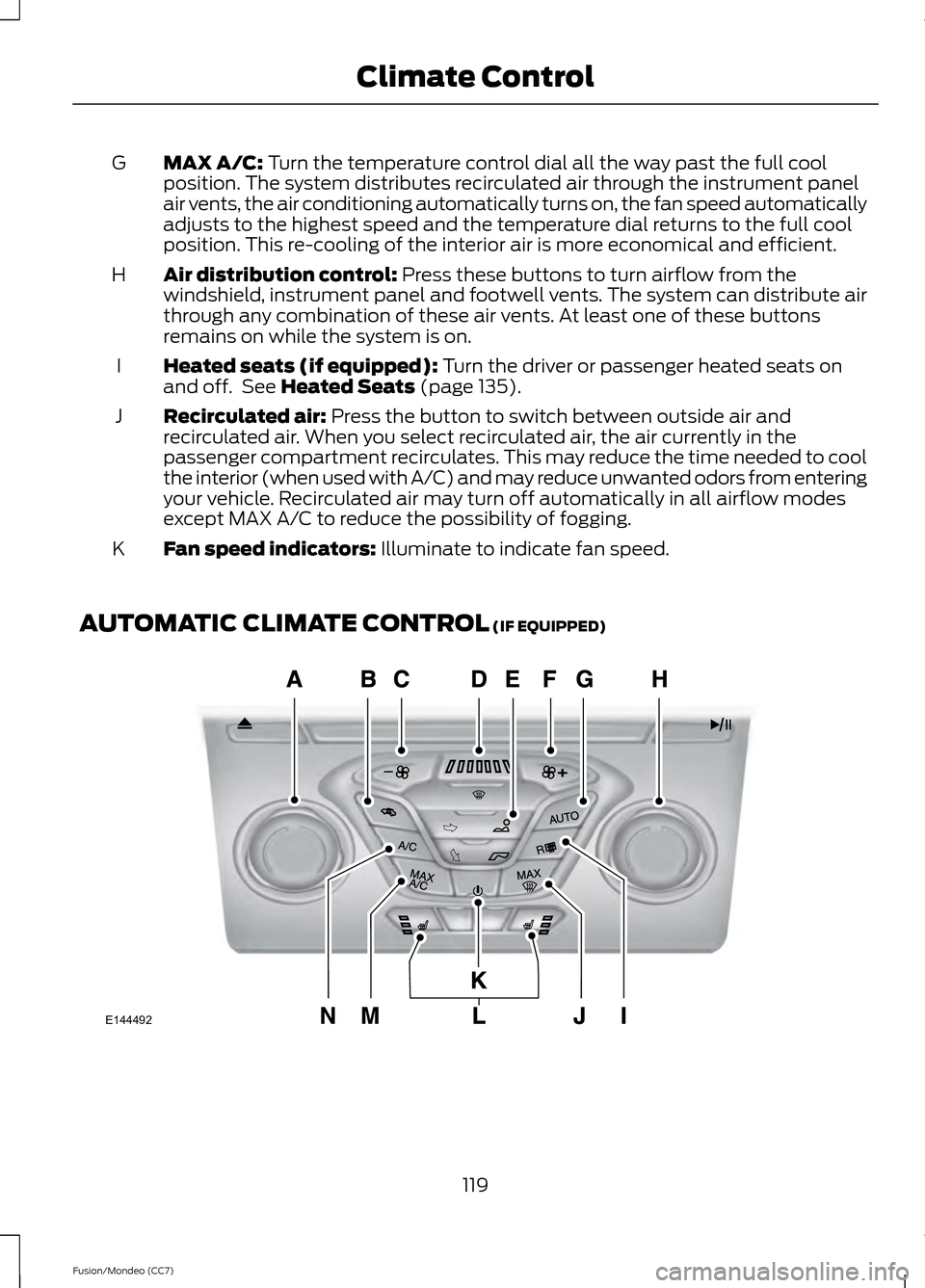
MAX A/C: Turn the temperature control dial all the way past the full cool
position. The system distributes recirculated air through the instrument panel
air vents, the air conditioning automatically turns on, the fan speed automatically
adjusts to the highest speed and the temperature dial returns to the full cool
position. This re-cooling of the interior air is more economical and efficient.
G
Air distribution control:
Press these buttons to turn airflow from the
windshield, instrument panel and footwell vents. The system can distribute air
through any combination of these air vents. At least one of these buttons
remains on while the system is on.
H
Heated seats (if equipped):
Turn the driver or passenger heated seats on
and off. See Heated Seats (page 135).
I
Recirculated air:
Press the button to switch between outside air and
recirculated air. When you select recirculated air, the air currently in the
passenger compartment recirculates. This may reduce the time needed to cool
the interior (when used with A/C) and may reduce unwanted odors from entering
your vehicle. Recirculated air may turn off automatically in all airflow modes
except MAX A/C to reduce the possibility of fogging.
J
Fan speed indicators:
Illuminate to indicate fan speed.
K
AUTOMATIC CLIMATE CONTROL
(IF EQUIPPED) 119
Fusion/Mondeo (CC7) Climate ControlE144492