Page 2 of 39
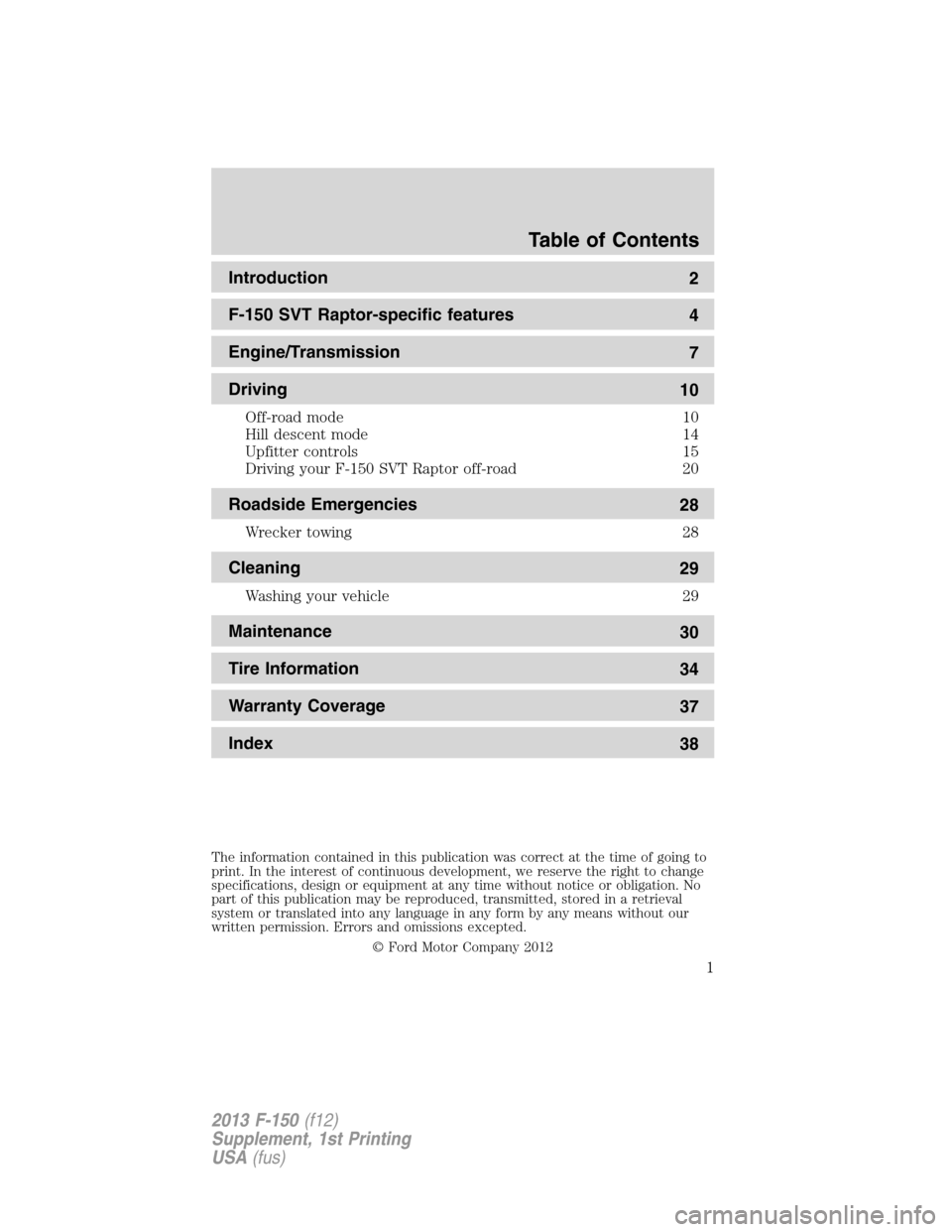
Introduction
2
F-150 SVT Raptor-specific features
4
Engine/Transmission
7
Driving
10
Off-road mode 10
Hill descent mode 14
Upfitter controls 15
Driving your F-150 SVT Raptor off-road 20
Roadside Emergencies
28
Wrecker towing 28
Cleaning
29
Washing your vehicle 29
Maintenance
30
Tire Information
34
Warranty Coverage
37
Index
38
The information contained in this publication was correct at the time of going to
print. In the interest of continuous development, we reserve the right to change
specifications, design or equipment at any time without notice or obligation. No
part of this publication may be reproduced, transmitted, stored in a retrieval
system or translated into any language in any form by any means without our
written permission. Errors and omissions excepted.
© Ford Motor Company 2012
Table of Contents
1
2013 F-150(f12)
Supplement, 1st Printing
USA(fus)
Page 22 of 39
Before taking your F-150 SVT Raptor off-roading, a basic vehicle
inspection should be done to ensure that the vehicle is in top working
condition.
It is always recommended that at least two vehicles are used while
off-roading. The buddy system helps ensure that help is close at hand
should a vehicle become stuck or damaged. It is also wise to take
supplies such as a first aid kit, supply of water, tow strap, cell or satellite
phone with you any time an off-road excursion is planned.
OFF-ROAD SCREEN
The real-time status of the Raptor’s off-road systems can be continuously
monitored using the first off-road screen found under the Truck Apps
menu in the information displays screen.
See theInformation Displayschapter of yourOwner’s Manualfor
more information.
BASIC OFF-ROAD DRIVING TECHNIQUES
•Grip the steering wheel with thumbs on the outside of the rim. This
will reduce the risk of injury due to abrupt steering wheel motions
that occur when negotiating rough terrain. Do not grip the steering
wheel with thumbs inside the rim.
•Throttle, brake and steering inputs should be made in a smooth and
controlled manner. Sudden inputs to the controls can cause loss of
traction or “upset” the vehicle, especially while on sloped terrain or
while crossing obstacles such as rocks or logs.
•Look ahead on your route noting upcoming obstacles, surface texture
or color changes or any other factors which may indicate a change in
available traction, and adjust the vehicle speed and route accordingly.
During pre-run, mark obstacles with GPS markers to ensure
appropriate speeds are used to avoid potential vehicle damage.
•When driving off-road, if the front or rear suspension is bottoming-out
and/or excessive contact with the skid-plates is encountered, reduce
vehicle speed to avoid potential damage to the vehicle.
•When running with other vehicles, it is recommended that
communication is used, and the lead vehicle notify other vehicles of
obstacles that could cause potential vehicle damage.
•Always keep available ground clearance in mind and pick a route that
minimizes the risk of catching the underside of the vehicle on an
obstacle.
Driving
21
2013 F-150(f12)
Supplement, 1st Printing
USA(fus)
Page 33 of 39

Item CapacityFord part name or
equivalentFord part number /
Ford Specification
Rear axle fluid friction
modifier4 oz. (118 ml) Additive Friction ModifierXL-3
EST-M2C118-A
SuperCab fuel tank 26 gallons (98.4L) — —
CrewCab fuel tank 36 gallons (136.3L) — —
Transmission fluid
3
12.4L
(13.1 quarts)
4
Motorcraft
MERCON�LV AT FXT-10-QLV /
MERCON�LV
Transfer case lubricant1.4-1.5L
(2.9-3.1 pints)Motorcraft Transfer Case
FluidXL-12 / —
1Add the coolant type originally equipped in your vehicle.2Fill 6 millimeter to 14 millimeter (1/4 inch to 9/16 inch) below bottom of fill hole.
Your vehicle’s rear axle is filled with a synthetic rear axle lubricant and is considered lubricated for
life. These lubricants do not need to be checked or changed unless a leak is suspected, service is
required or the axle assembly has been submerged in water. The axle lubricant should be changed
any time the rear axle has been submerged in water.3Ensure the correct automatic transmission fluid is used. Transmission fluid requirements are
indicated on the dipstick or on the dipstick handle. Check the container to verify the fluid being
added is of the correct type. Refer to yourscheduled maintenance informationto determine the
correct service interval.4Approximate dry fill capacity including transmission fluid cooling system, actual refill capacities
will vary based on vehicle application and transmission fluid cooling system (i.e. coolers size,
cooling lines, auxiliary cooler capacities). The amount of transmission fluid and fluid level should
be set by the indication on the dipstick’s normal operating range.5Use of synthetic or synthetic blend motor oil is not mandatory. Engine oil need only meet the
requirements of Ford specification WSS-M2C945-A and the API Certification mark.
Maintenance
32
2013 F-150(f12)
Supplement, 1st Printing
USA(fus)