2013 AUDI TT brake light
[x] Cancel search: brake lightPage 22 of 262

20 Instruments and warning /indicator lights
Bi) Fuel supply too low
When the (g symbol illuminates, this means
there are about 1.9 gallons (7 liters) of fuel
left in the fuel tank. Time to refuel!
Qpage 177.
If the symbol lights up, even when there is
ample fuel in the tank, and the text
Tank sys
tem malfunction! Please contact workshop
appears in the display, there is a fault in the
system. Contact a qualified workshop to have
the fault rectified.
c::>
Windshield washer fluid level too
low
If the Ill symbol illuminates, add w indshield
washer f luid to the washer system
Qpage 194.
® Defective light bulb warning
The defective light bulb warning tells you
when a vehicle light bulb has become defec
tive.
If a defect ive bulb has been detected by the
system or a light bu lb burns out, the
fsl sym
bol with a message appears in the disp lay to
tell you wh ich bu lb is burnt out and where it is
l ocated. For example:
Rear left turn signal
After 5 seconds, the message disappears. If
you want to recall the message into the dis
p lay, press the CH ECK button
Q page 10,
fig.
3 (?) .
There are three reasons why the defective
bulb message would appear in the display:
- The light bulb has burnt out
Q page 231.
- The fuse is "blown" Q page 228, Replacing
fuses.
- The wire connection to the light bu lb is de-
fective.
H ave the bu lb rep laced or the connection re
pa ired by your a uthorized Audi Service depart
ment.
A WARNING
- Light bulbs are pressurized and could ex
plode wh ile they are being changed caus
ing serious pe rsonal injury.
- Work with due care when handling the
h igh-voltage sect ion of gas discharge
(xenon) lamps. Fa iling to do so could re
sult in death or serious injury!
BRAKE LIGHT t<® > Brake light defective
In case of a ma lfunction or component fail-
ure, the symbo l (USA models)/
(@ ll
repaired or replaced, as necessary:
- Brake light bulbs
- All wir ing connections
- Brake light switch
Contact your authorized Audi dea ler for assis
tance if necessary.
(D Tips
The brake light sw itch is on ly inspected as
part of the functional check after the en
gine is started.
i,0 Headlight range control defective
Applies to vehicles: wit h dynamic headlight range adjust
ment
If the II illuminates, the dynamic headlight
range control is no longer working properly.
Have the system checked and repaired at your
authorized Audi dealer .
rsO Adaptive light defective
Applies to vehicles: with Ada ptive Lig ht
rm Adaptive light defective
When this symbol rm illuminates, it means
that Adaptive Light is defect ive. Go to a qua li
fied workshop to have the headlights or the
control unit for the Adaptive Light repaired.
Page 56 of 262

54 Seat s a nd s tor ag e
Seats and storage
General recommen
dations
Why is your seat adjustment so
important?
The safety belts and the airbag system can
only provide maximum protection if the front
seats are correctly adjusted.
There are various ways of adjust ing the front
seats to provide safe and comfortable support
for the driver and the front passenger . Adjust
your seat properly so that :
- you can easily and quick ly reach all the
switches and controls in the instrument
panel
-your body is prope rly supported thus reduc
ing physical stress and fatigue
- the safety be lts and airbag system can offer
maximum protection
¢ page 108 .
In the following sec tions, you will see exactly
how you can best adjust you r seats .
There are special regulations and instructions
for insta lling a child safety seat on the front
passenger's seat. Always heed the informa
tion rega rd ing child safety provided in
~ page 130, Child Safety.
A WARNING
Incorrect seating position of the driver and
all other passengers can result in serious
personal in jury.
- Always keep your feet on the floor when
the vehicle is in motion -never p ut your
feet on top of the instrument panel, out
of the w indow or on top of the seat cush
ion! This applies espec ially to the passen
gers .
If your seating position is incorrect
yo u increase the r isk of injury in the case
of sudden braking or an acc ident.
If the
airbag infla tes and the seating position
is incorrect this could result in personal
injury or even death.
- It is import ant for bo th the driver and
front passenger to keep a distance of at least 10 inches (25 cm) between them
selves and the steering wheel and/or in
strument panel. If you're s itting any
closer than th is, the a irbag system can
not protect you properly . In addition to
this, the front seats and head restra ints
must be adjusted to your body height so
that they can give you max imum protec
tion.
- Always try to keep as much distance as
possible between yourself and the s teer
ing wheel or instrument pane l.
- Do not adjust the driver's o r fron t pa s
senger's seat whi le the vehicle is moving.
Your seat may move unexpected ly, caus
ing sudden loss of vehicle contro l and
personal injury . If you ad just yo ur seat
while the veh icle is moving, you are out
of posit ion.
Driver's seat
The correct seat position is important for safe
and relaxed driving.
We recommend that you adjust the driver's
seat in the fo llowing manner:
.,. Adjust the seat in fore and aft direction so
t ha t you can easily p ush the peda ls to the
floor wh ile keeping your knee slightly bent
~ A in Why is your seat adjustment so im
portant? on page 54 .
.,. Adjust the seatback so that when you sit
w ith your back against the seatback, you can
still grasp the top of the steering wheel.
.,. Posit ion the head restraint accord ing to the
occupant 's height~
page 57 . For maxi
mum protection, t he top of the head re
s t raint shou ld be a t least at eye level, pref
erably higher and idea lly level with the top
of the head
¢ page 94, fig. 92.
A WARNING "--
Never place any objects in the dr iver's foot-
well. An object could get into the pedal
area and interfere with pedal function. In
case of sudden braking or an acc ident, you
would not be able to brake or accelerate!
Page 60 of 262

58 Seat s a nd s tor ag e
Rear seats
General information
Safe transportation of passengers on the rear
seats requires proper safety precautions .
Fig. 58 Correc t seat po sit io n on the rear bench seat
A ll passengers on the rear seats must be sea t
ed in compliance w ith the sa fety guidelines
explained in
c::> page 100 and c::> page 108.
The correct seating position is critical for the
safety of front
and rear seat passengers alike
c::> page 93.
A WARNING
,--
- Occupants in the front and rear seats
must always be properly restrained.
- Persons taller than 4 feet 11 inches
(1. 50 m) must never sit in the rear seat
area . The rear passenger compartment is
too small for passenger taller than 4 feet 11 inches
(1. 50 m).
- The minimum clearance between the
passenge rs' heads and the rear window
must never, under any circumstances, be
less than 1 inc h (2.5 cm) with the pas
sengers sit ting fully upright. Ta ller per
sons, as well as children on booster seats
who are too close to the rear window, can suffer severe head and neck injuries
when the rear lid is closed or if a crash
occurs. Always make sure that rear seat
passengers ca nnot be struck when the
rear lid is closed .
- When the rear backrest is folded down
do not allow passengers to occupy the
load surface available while the vehicle is
in motion. Vehicle occupa nts must al
ways be properly restrained. -
Never store any heavy, hard objects on
the rear lid cover. This can be hazardous
for rear seat occupants if the rear lid is
opened or if the vehicle is braked sud
denly or in the event of a crash .
- Loose items inside the passenger com
partment, can fly forward in a crash or
sudden maneuver and injure occupants .
Always sto re a rticles in the luggage com
pa rtment and use the faste ning eyes, es
pecia lly when the rea r seatbacks have
been fo lded down.
- Read and heed all WARN INGS
c::> page 93, Proper seating positions
for passengers in rear seats.
Rear window shelf '
You can place light articles of clothing on the
rear window shelf behind the seatback .
A WARNING ~ -
Whenever you are driving, do not leave any
hard objects on the rear window shelf or
a llow your pet to sit on the she lf. These
could become a hazard for veh icle occu
pants in the event of sudden brak ing or a
crash!
(i) Tips
- A vent slot is located between the shelf
and the rear w indow. Do not block the
vent with any items you may place on the
rear window she lf.
- Do not place bu lky items on the rear win
dow shelf as they wou ld restr ict or block
the driver's vision t hrough the rear view
m irror .
Page 66 of 262

64 Seats and storage
Before you purchase any accessories, a lways
read and fo llow the information in
c::> page 245, Additional accessories and parts
replacement.
A WARNING
The outlet p lus any appliances plugged in
to it rema in functional even if the ignition
is switched off or the ignition key is re
moved. N ever leave children inside the ve
hicle withou t supe rv ision.
Q) Note
To avo id damag ing the socket, only use
plugs that fit properly .
(D Tips
When the engine is off and accessor ies are
still plugged in and are on, the vehicle bat
tery ca n still be dra ined .
Storage
General
A WARNING
-Always remove objec ts from the instru
ment panel. Any items not put away
cou ld slide around inside the vehicle
wh ile driving or when acce lerating or
when applying the brakes or when driv
ing around a corner.
- When you are drivi ng make sure tha t
anything you may have placed in the cen
ter console or other storage lo cations
cannot fa ll out into the footwells . In case
of sudden braking you would not be able
to brake, depress th e clutch or acceler
ate.
-Any articles of cloth ing that you have
hung up must not interfere with the driv
er's v iew. The coat hooks are desig ned
only for lightweight clothing. Never hang
any clothing with ha rd, po inted or heavy
objects in the pocke ts on the coat hooks.
Dur ing sudden braking or in an acciden t -
especially if the airbag is deployed -
-
these objects co uld injure any passen
gers inside the vehicle.
Glove compartment
The glove compartment is illuminated and
can be locked.
I i I
I
ij
----------- i
Fig. 67 Glove compa rt me nt
To open glo ve com partment
.. Pull the handle c::>fig. 67 in the direction of
the arrow push down lid to the fully open
position .
To close gl ove c ompa rtment
.. Push the glove compartment lid upward un-
til the lock engages.
CD changer *
The CD changer fo r the Sound System is locat
ed in the g love compartment.
A WARNING
To reduce the risk of pe rsonal injury in an
accident or sudden stop, always keep the
glove compartment closed while driving.
Storage compartment in the front seats
App lies to veh icles : w it h storage compart men t in the
fro nt seats
There is a fold-out storage compartment in
the front of the seats.
Opening
.. Lift the handle and pull the drawer out.
Closing
-
.. Push the drawer in complete ly until it latch -
es. .,.
Page 74 of 262

72 On the road
you leave your veh icle . This makes a vehicle
theft even more difficult ¢ .&. .
Ignition ke y saf ety lock
After swi tching off the ignition, the ig nit ion
key can on ly be removed from the ign it ion
lock when the se lector lever is in the "P"
(Park) position . After you have removed the
key, the selector lever is locked and cannot be
moved.
Ignition on @
If it is diffic ult to turn the key after you have
inserted it into the ignition lock, turn the
steering wheel back and forth. This will take
the load
off the steering lock mechanism and
you will be able to turn the key freely and
start the engine.
Starting the engine @
In this position the engine starts . While the
engine is starting, the power supply to the headlights and other e lectrica l consumers is
temporari ly interrupted to conserve battery
power. After the engine has started, release
the key and it will return to posit ion
(D .
Before the starter can be operated again the
key must be turned back to position @. The
non -repeat loc k prevents you from damaging
the starter when the engine is runn ing .
A WARNING
-Never remove the key from the ign ition
lock whi le the vehicle is moving. The
steeri ng wheel will lock causing loss of
c ontrol.
- If you have to leave your vehicle -even
for just a m inute -always remove t he ig
nition key and take it with you. This is es
pecially important if you a re going to
leave ch ildren behind in the vehicle. The
children co uld start the engine or use
other vehicle controls. Unsupervised use
of vehicle controls (for examp le, power
windows) can cause serious personal in
jur ies .
(!) Tips
If the vehicle battery has been disconnect
ed and then reconnected, then you must
l eave the key in position
(D for about 5
seconds before you can start the engine.
Starting and stopping
the engine
Starting the engine
The engine can only be started with an origi
nal Audi key.
.,. Set the park ing brake.
.,. Move the se lector lever to the neutral posi
tion (automatic transmission): selector lever
in
P or N) ¢ .&_ .
.,. On vehicles with manua l transmission, fully
depress the clutch pedal.
.,. Turn the ignition key to pos it ion @
¢ page 71, fig . 71 -do not depress the gas
pedal when starting the engine!
.,. Let go of the key as soon as the engine
starts.
A cold engine may at first be loud after it has
been sta rted. This is due to the hydrau lic
valves bu ild ing up the oil pressure. This nor
mal and no need for co nce rn .
If the engine does not start immediately, stop
trying after 10 seconds and then try to restart
the engine abou t 30 seconds late r.
A WARNING
Neve r star t or let the eng ine run in a con
f ined or enclosed area . Exhaust fumes
from the engine contain carbon monoxide,
a colorless and odor less gas . Ca rbon mon
oxide can be fatal if inhaled.
- Never leave the engine id ling unattend
ed. An unattended veh icle w ith a runn ing
engine poses a danger of personal injury
or theft.
Page 75 of 262
CD Note
-Avoid high engine speeds, fast accelera
tion or heavy engine loads whi le the en
gine is still cold. This could damage the
engine.
- The engine cannot be started by pushing or towing the veh icle.
@) For the sake of the environment
To avoid unnecessary engine wear and to
reduce exhaust emissions, do not let your
veh icle stand and warm up. Be ready to
drive off immediately after starting your
veh icle. Maintain moderate speed until the
eng ine is completely warm . Remember,
the engine performs best at operating
temperature .
Stopping the engine
~ Turn the ign ition key to position @
~page 71, fig. 71.
_& WARNING
-Never turn off the engine before the ve
hicle has come to a complete stop. The
full function of the brake booster and the
power steering is not guaranteed . You
must use more force to turn or brake if
necessary. Because you cannot steer and
brake as you usually would, this could
lead to crashes and serious injur ies.
- The radiator fan can continue to run for
up to 10 minutes even after you have
turned
off the engine and removed the
ignition key . The radiator fan can also
turn on again if the engine coolant heats
up because of intense sunlight or heat
build-up in the engine compartment.
CD Note
Do not stop the engine immed iate ly after
hard or extended driving. Keep the engine
running for approximately two minutes to
prevent excessive heat build-up.
On the road 73
Parking brake
Parking brake
When the parking brake is set, it prevents the
vehicle from rolling away unintentionally .
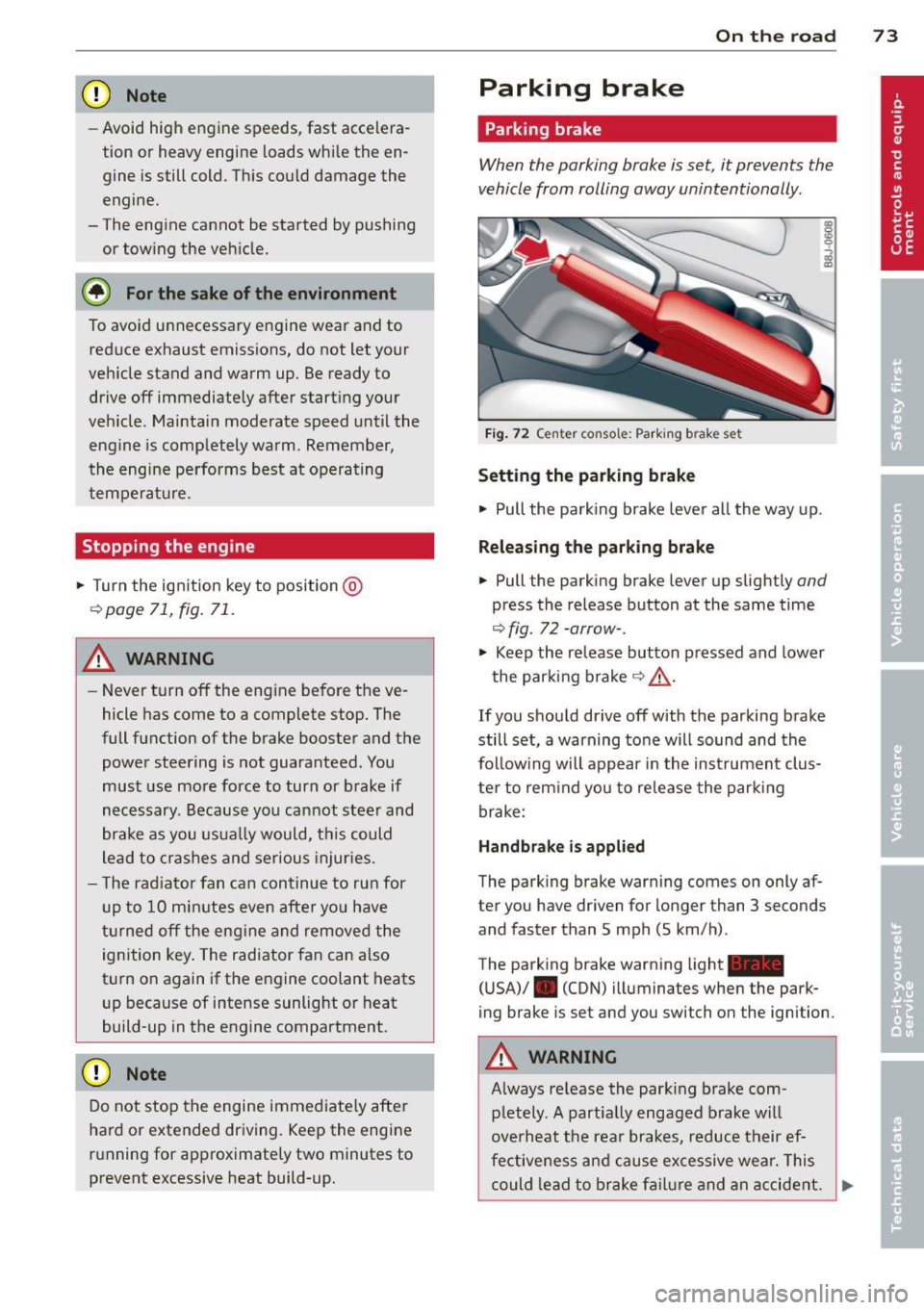
Fig. 72 Center console: Parki ng b rake set
Setting the parking brake
~ Pull the park ing brake lever all the way up.
Releasing the parking brake
~ Pull the parking brake lever up slightly and
press the release button at the same time
~ fig. 72 -arrow-.
~ Keep the release button pressed and lower
the parking brake~&_ .
If you should drive
off with the parking brake
still set, a warning tone will sound and the
follow ing will appear in the instrument clus
ter to rem ind you to release the parking
brake:
Handbrake is applied
The parking brake warning comes on only af
ter you have driven for longer than 3 seconds
and faster than 5 mph (5 km/h) .
The parking brake warning light_
(USA)/ . (CON) illuminates when the park
ing brake is set and you switch on the ignition .
A WARNING
Always re lease the park ing brake com -
pletely. A partially engaged brake will
overheat the rear brakes, reduce their ef
fectiveness and cause excessive wear. This
could lead to brake failure and an accident. .,.
Page 83 of 262

The park lock must only be engaged with the
vehicle
stationary c::> &.
To engage P and to remove the lever from th is
position, you must depress the release b utton
(button in the selector lever handle)
and si
multaneously you must step on the brake
pedal.
R · re verse
I n th is position, reverse is engaged.
Reverse gear must only be engaged with the
veh icle
stationary and the eng ine runn ing at
id le speed
c::> ,&. .
To engage R, you have to depress the release
button
and s imultaneously step on the brake
pedal. In the R position, the back-up lights il
lum inate with the ign ition on.
N • N eutra l
The transmission is in neutral in this position .
D -Norm al p osi tion f or d riving forwa rd
In this position, the forward gears are auto matica lly shifted up and down, depending on
engine load and vehicle speed.
To engage D from N, the brake peda l must be
depressed at speeds be low 5 km/h or when
the vehicle is stationary
c::> & .
In certain circumstances (driving in the moun
tains for examp le) it can be beneficial to
switch temporarily to the manua l shift pro
gram
c::> page 84 in order to adjust the gear
ratios to driving cond itions
manually.
S -Sport setting
The 5 se tt ing shou ld be selected for spor ty
d riving . The power reserves of the engine can
be fu lly exp loited through later upshifts.
To engage S from N, the brake pedal must be depressed at speeds be low 5 km/h or when
the vehicle is stationary
c::> & .
Tra n sm iss io n 81
A WARNING
- Never p lace the selector lever in the R or
P posit ion while the veh icle is moving -
risk of an accident!
- With the engine running, it is necessary
to hold the vehicle with the foot brake in all selector lever positions (except P and N), because even at idle speed the trans
fe r of power is never completely inter
rupted -the vehicle " creeps". If the vehi
cle is stationary and the transmission is
engaged, the engine should never be
speeded up unintentionally (e .g. manual
ly from under the hood). Otherwise the
veh icle w ill immediately start to move -
sometimes even if the park ing brake is
firmly applied - risk of an accident!
- Before you or other persons open the
hood and work on a running engine, the
selecto r lever must be moved to P and
the park ing brake applied f irmly - risk of
an accident! Follow the wa rning sticke rs
c::> page 174, Engine compartment.
(D Tips
If yo u have inadvertently shifted into N
while the vehicle is moving, you shou ld re
move you r foot from the accelerator and
wait unt il the engine speed has dropped to
idle before shifting back to Dor 5 .
Selector lever lock
Applies to veh icl es: w ith S tronic
The selector lever lock prevents a gear from
being engaged accidentally and unintention
ally setting the vehicle in mo tion.
F ig. 81 Selector lever locks
Page 84 of 262

82 Transmi ssion
The selector lever lock is released as fo llows:
,. Switch the ignition on.
,. Step on the brake peda l
and simultaneously
hold down the re lease button .
Automatic selector lever lock
The selector lever is locked in the P and N po
sitions when the ignition is on . To move the
l eve r from these positions the d river must de
press the brake pedal. As a reminde r to the
d river, the fol low ing wa rning appears in the
instr ument cluster d isplay when the s electo r
is in P and N :
To start en g in e or sel ect gear ap ply fo ot
br ake when sta tionary
The selector lever lock is effective only when
the vehicle is stationary and at speeds be low
5 km/h. A t higher speeds, the lock in the N
position is automatically switched off.
The selector lever is not locked when rapid
shifts a re made th rough t he N pos it ion (e.g .
from R to D). This allows you to " rock" the ve
hicle if it becomes stuc k. If the lever is in the
N position for more than 1 second with the
brake peda l not depressed, the se lector lock
engages automatica lly.
Rele ase button
The release b utton in t he se lector lever ha n
d le prevents accidental shifts into certa in se
lecto r lever positions. When you press the re
lease button, the selector lever lock is cancel
l ed. In the illustration, the pos it ions in which
the release but ton has to be pressed are high
lighted in color
c> fig. 81.
Ignition key remo val lock
The ign it ion key can on ly be removed after the
ignition is switched off if the selector lever is
in P. As long as the ignit ion key is removed,
the selector lever is locked in P .
@ Tips
If the selector lever does not engage ,
there is a malfunction. The eng ine is disa
bled to p revent the vehicle from driving off
unintent iona lly. To allow the selector lever to engage again, proceed as follows:
Press
and release the brake peda l.
Driving Notes
Applies to vehicles: w ith S tronic
The forward gears are shifted up or down au
tomatically.
-
------F ig . 82 Section fro m cente r co nso le : Se lecto r leve r
w it h re lea se but ton
Starting the engine
,. The se lecto r lever must be in the P or the N
po sit ion. At low temperatures (below -10
° C), the eng ine can only be started when the
selector lever is in the P position.
Starting from stop
,. Step on and hold the b rake pedal.
,. Hold the release button (bu tton in sele ctor
lever) down , move the selecto r lever to the
desired position, for example D
c> page 80,
and re lease the button .
,. Release the brake peda l and accelerate
Q _A .
Stopping t emporarily
,. Bring the veh icle to a full s top wi th the
brake, e.g . at traffic signals .
,. Do not acce lerate .
Parking
,. Step on and hold the b rake peda l¢ & .
,. App ly the parki ng b rake firmly .
,. Ho ld the release button down, move these
lector lever to P and release the button .
Stopping on an incline
,. Always hold the vehicle with the footb rake
or park ing brake in orde r to prevent
IIIJJ,