2013 AUDI Q5 flat tire
[x] Cancel search: flat tirePage 270 of 316

268 Tires and wheels
the tire to overheat and can lead to tire
failure. Under-inflation also is likely to
impair the vehicle's handling and stop
ping ability.
- The driver is responsible for maintaining
the correct tire pressures. You must
check the tire pressures regularly.
- Under certain conditions (such as a spor
ty driving style, winter conditions or un paved roads), the pressure monitor indi
cator may be delayed.
-Ask your authorized Audi dealer if run flat tires may be used on your vehicle.
Your vehicle registration becomes invalid
if you use these tires when not permit
ted. Damage to your vehicle or accidents
could also result.
@ Tips
- The tire pressure monitoring system
stops working when there is an ESC/ABS
malfunction.
- Using snow chains may result in a system
malfunction.
- The tire pressure monitoring system on
your Audi was developed using tires with the "AO" or "RO" identification on the
tire sidewall¢
page 259. We recom
mend using these tires.
Reset tire pressure monitoring system
Applies to vehicles: with tire pressure monitoring system
If the tire pressure is adjusted, wheels are ro
tated or changed, the TPMS must be reset via
radio or MMI*.
11> Befo re resetting the TPMS, the current pres
sures of all four tires must correspond to
the specified values. Adjust the tire pressure
and reset the pressure in the tire pressure
monitoring system according to the load
you are carry ing
¢page 252.
11> Turn on the ignition.
11> Select: ICARI function button > Tire pres
sure monitoring
> Store now . Or
i,. Select: ICARI function button > Car sys
tems *
control button > Servicing & checks >
Tire pressure monitoring > Store tire pres
sures.
@ Tips
Do not store the tire pressure if there are
snow chains on the tire.
Page 271 of 316

What do I do now?
Jack, tools and
inflatable spare tire
Onboard tool kit and vehicle jack
The vehicle tools and vehicle jack* are stored
in the luggage compartment under the floor
cover.
Fig . 209 Luggage co mpa rtment: onboard too l kit and
v e hicle jack
The vehicle jack* is sto red under the on board
tool kit¢
fig. 209.
Hybr id drive*: the storage location of the on
board tool kit varies
¢ page 104.
The on board tool kit includes:
- Hook for removing wheel covers*
- Plastic hook to remove wheel bolt covers*
- Al ignment p in for changing wheels
- Wheel bolt wrench
- Folding chocks
- Screwdriver with reversible blade
- Socket (removable Torx socket)*
- 10 x 13 open ended wrench (for disconnect-
ing the battery cables)
- Towing eye
Before storing the jack*, make sure it is
wound back down as far as it will go.
A WARNING
Imprope r use of the vehicle jack* can
cause serious personal injuries.
- Never use the j ack* supplied with your
Audi on another vehicle, particularly on a heavier one . The jack* is only suitable for
use on the vehicle it came with .
What do I d o now ? 269
-Using a bumper jack to ra ise the vehicle
will damage the bumper system. The
jack may slip, causing injury.
- Never support your vehicle on cinder
blocks, br icks or other objects. These
may not be able to support the load and
could cause injury when they fa il.
- Never start or run the engine while the
veh icle is supported by the jack* .
- If you must work under the vehicle, al
ways use safety stands specifically de signed for th is purpose .
- Never use the hexagonal socket in the
handle of the screwdriver to loosen or
tighten the wheel bolts .
- Always make sure the inflatable spare
tire* and even a flat tire are secured in
place and not loose, otherwise they
could fly forward, causi ng personal injury
to passengers in the vehicle in an acci
dent or sudden maneuver.
(0 Tips
Some of the on board items listed above
a re provided on certain models only or are
optiona l extras.
Folding chocks
The folding chocks are part of the on board
tool kit.
Fig . 210 Ope ning folding chocks .
To use the chocks, you first have to raise the
support plate¢
fig. 210 (D and then insert
the locking plate with the two "tabs" into the
elongated holes in the base plate@¢& . ""
Page 272 of 316

2 70 What do I do now ?
& WARNING
-The ch ock cannot fulfil its function and
may lose its stab ility if t he "tabs" on the
s u pport plate are not inserted cor rectly
in to the elongat ed ho les i n th e b ase
pla te. If th is happens, the veh icle may
sta rt to move wh ile a wheel is being
change d.
- N ever u se the f old ing chocks if they are
damaged o r if th ey have no t been assem
bled correc tly .
Removing bass box
Appl ies to vehicles: wit h bass box
Before the inflatable spare tire" can be taken
out, the bass box mus t be removed.
Fig . 211 Spare w hee l well : Bas s box
Removing bass box
., Lift up the cargo floor using the hand le .
., Sq ueeze the locking ta bs
c:::> fig . 211 © of
the connector .
., Disconnect the connector @and place the
l ead to one side.
., Turn the large screw counter -cloc kwise .
., Carefully remove the bass box .
Installing bass box
., Carefully place the bass box in the wheel.
The inscr ipt io n "FRO NT" on the bass box
must face forward .
., Reconnect the connector that was removed .
., Secure the bass box wi th the large sc rew.
., Fold the cargo floor back down.
Inflatable spare tire
Applies to vehicles: w ith inflatable spare t ire
The inflatable spare tire expands to its full di
ameter when it is inflated .
Fig . 2 12 In flatable spa re t ire wi th compresso r
Removing inflatable spare tire
., Lift up t he cargo floo r using the handle .
., Remove the dirt t ray .
., Tur n the large screw
c:::>fig. 212 co u nte r
clockw ise .
., Remove the bass box as required
¢ page 270 .
., Take out the inflatable spa re tire .
., Always store the vehicle tool kit, the jack*
and the rep laced tire in the luggage com
pa rtment
¢ page 145.
Stow ing the inflatable spare tire
., Release the air by unscrewing the va lve
stem .
., Screw the valve stem back in afterwards .
., Wait a few hours before p lacing the wheel
in the spare wheel well¢
A-
., Inst all the bass box as required¢ page 270.
., Se cure t he wheel with t he large screw .
., Place the d irt tr ay b ack in .
., Fold t he cargo floor back down.
After using the inflatable spare wheel
T he inflatab le spare tire can be re-used as
lo ng as it is not damaged a nd is not wo rn
down to the t read wear indi ca tors ¢
_A .
When you let the a ir out of the inf latab le
spar e tir e, it does not ass ume its folded shape
again for severa l hours . U nti l then, it cannot
be pla ced ba ck in the spare whee l we ll and
stowed secu re ly.
Page 273 of 316

/! WARNING
-Never use the spare tire if it is damaged
or if it is worn down to the tread wear in
dicators .
- If the inflatable spare tire is more than 6
years old, use it on ly in an emergency
and with extreme ca ution and carefu l
dr iv ing.
- The inflatab le spare tire is intended only
for temporary and short-term use . It
should be replaced as soon as poss ible
with the no rma l wheel and tire.
- The tire pressure value for the inflatable
spare t ire is located on the driver's side
8-p illar
c::> page 252, fig. 204.
- Maximum permiss ible speed is 50 mph
(80 km/h).
- Avoid full-throttle acce lerat ion, heavy
braking, and fast corner ing.
- When the air is let out of the inflatable
spare wheel, it does not assume its fold
ed shape for severa l hours. Until then, it
cannot be placed back in the spare wheel
well and stowed secu rely.
- Never drive with more than one inflata
ble spare tire.
- For technical reasons, the use of tire
chains on the inf latable spare tire is not
permitted .
If it is necessary to d rive w it h
t ir e cha ins, the inflatable spare whee l
must be mo unted on the fron t axle in the
event of a fla t in a rea r tire. The new ly
available front wheel must then be in
sta lled in place of the rear whee l with
the flat tire. Installing t he tire chain be
f ore mounting the whee l and tire is rec
ommended.
- loose items in the passenger compart
me nt can cause serious personal in jury
dur ing hard braking or in an acc ident.
Never store the inf latable spare tire o r
jack* and tools in the passenge r com
partment .
CD Note
-The inf latable spare tire has been devel
oped spec ifically for this vehicle model.
What do I d o now ? 271
It must not be exchanged or used for
ot her vehicle models . Sim ila rly, inflata
ble t ires from other vehicle models must
not be used.
- Norma l summer or winte r ti res m ust not
be installed on the inf latable tire rim.
Inflating inflatable spare tire
Applies to vehicles: with inflatable spare tire
Fig. 2 13 Lu ggage compartme nt left s ide: comp ressor
.,. Remove the left tr im panel in the luggage
compa rtment.
.,. Open the Velcro strap and
remove the com
pressor ¢
fig. 213.
.,. Unscrew the valve stem from the spare tire .
.,. Screw the tire f iller hose from the compres
sor firmly onto the va lve of the spare tire .
.,. Insert the pl ug from the comp ressor into a
socket of th e vehicle ¢
page 75.
.,. Switch t he comp ressor on.
.,. let the compressor r un unti l t h e va lue
specif ied on the ti re press ure la bel is
reached
c::> page 2 52, fig . 204 . Switch the
compressor off after r unning for 12 minutes
at the most -danger of overheating!
A WARNING
The compressor and the tire filler hose can
become extreme ly hot while t hey a re run
n ing -da nger of b urns!
CD Note
Switch the compressor off after running
for 12 mi nutes at the most -danger of
ove rheating! Allow the compressor to cool
down for a few m inutes befo re you use it
again .
Page 274 of 316

272 What do I do now ?
Tire repair
General information and safety
precaution s
Applies to vehicles: with tire repair kit
The tire repair is only meant for temporary
use.
Fig. 214 Tir e damag e, for wh ich t he t ire re pair k it is
not sui tab le
Your veh icle is equipped with a tire repair kit
(Tire Mob ility System) .
In the event of a flat tire, the tire repair kit is
found in the luggage compartment beh ind
the r ight side trim panel, and is made up of
tire sealant and a compressor
Q page 104,
fig . 113.
Only tire damage caused by foreign objects up
to approximately 0 .16 in
(4 mm ) in diameter
can be safely sealed with the tire repa ir kit.
The foreign object can stay in the tire.
The tire sealant may not be used:
-If the tire has cuts or punctures that are
larger than 0.16 in (4 mm)
<=)fig. 214 @.
-If the rim is damaged @.
-If you drove with very low tire pressure or
without a ir in the tire@.
Tire repair kit usage is described in
Perform
ing the repair
9 page 2 73 and in the instruc
tions with the sealant bottle.
The tire repair kit is able to be used at tempe r
atures as low as -4 °F ( -20 °C) .
A WARNING
Pay attention to the follow ing after repair
ing the tire: -
Do not drive faster than 50 mph (80 km/
h) .
-Avoid hard acceleration, braking sharp ly,
and fast cornering .
- The vehicle may become more difficult to
control.
- Tires sea led with the tire repair kit are
only meant to be used
temporarily .
Damaged tires must be replaced.
- The tire repair kit may
NOT be used
- If the t ire has cuts or punctures that
are larger than 0.16 in (4 mm) .
- If the rim is damaged .
- If you drove with very low t ire pressure
or without air in the tire.
- Obtain qualified help if it is not possible
to perform the repair with the tire seal
ant .
- The tire sealant must not come in con
tact with skin, eyes, or clothes.
- If tire sea lant gets in your eyes or on
your skin, thoroughly rinse the affected
area immediately with clean water.
- Change your clothes immediately if they
get tire sealant on them.
- Do not inha le the fumes.
- If the tire sealant is swallowed, thor-
ough ly rinse out your mouth and drink
lots of water.
- Do not induce vomiting . Seek medical at
tention immediately.
- If an a llergic reaction occurs, seek imme
diate medical attention.
- Keep the tire sealant away from children.
@) For the sake of the environment
Used sealant bottles may be returned to
your authorized Audi dea ler fo r disposal.
(D Tips
- If sealant has spilled out, let it dry and
then you can remove it by peeling it away
like a foil.
- Note the expiration date on the sealant
bottle. Replace the tire sealant at an au
thorized Audi dealership.
Page 275 of 316

Performing the repair
Applies to vehicles: with tire repair kit
F ig. 2 15 Perform ing the repa ir
Prep arati ons
.. Park the veh icle as far as possib le from
moving traffic in the event of a flat tire.
.. Set the
park ing bra ke to prevent the vehicle
from roll ing unintentionally .
.. Sh ift the
s e le ctor l ever i nto th e P po sition .
.. Determ ine whether a repair w ith the t ire re
pair kit is possible o r not
9 page 2 72.
.. Let all of the passengers
exi t the vehicle
and move a safe distance away 9 &,. .
.. Take the sealant bottle and the compresso r
out of the luggage compartment
9page 104 , fig. 113.
.. Affix the label "max. 50 mph (80 km/h)",
found on the sealant bottle, to the instru ment cluster where it can be seen by the
driver .
Filling a tire
.. Shake the bottle thorough ly before fi lling.
.. Screw the accompanying filling hose com-
pletely onto the bottle. This breaks through
the foi l seal automatically at the connec
t ion .
.. Remove the valve cap from the tire valve
and unscrew the valve insert using the ac
companying va lve inser t tool
9 fig. 215 .
.. Lay the valve insert on a clean surface.
.. Remove the sealing plug from the filling
hose and connect the hose to the tire va lve .
.. Hold the bottle with the bottom fac ing up
ward and empty the entire contents into the
tire.
.. Then pull out the hose and screw the valve
i nsert t ightly back into the tire valve .
What do I do now ? 273
Inflating a tir e
.. Sc rew the fill ing hose for the compressor
onto the t ire valve and insert the connector
into the cigarette lighter .
.. Inflate the tire to between 29 PSI (200 kPA)
and 36 PSI (250 kPA) and read the pressure
on the gauge .
.. If this t ire pressure is not reached, dr ive
your veh icle approximately 33 ft (10 meters)
forward or backward so that the sealant can be red istributed inside the tire. If at th is
t ime the required a ir pressure st ill canno t be
reached, the tire is too bad ly damaged and
cannot be repaired w ith the t ire sea lant .
Final inspection
... Stop the vehicle aft er driving for about 10
m inutes and check the tire pressure.
... If the tire pressure is lower than 19 PSI
(130 kPA), then the tire is too severely dam
aged. Do not continue driving . Please seek
professiona l assistance .
A WARNING
-Turn on the emergency flashers if you
have a flat tire w hile in mov ing traffic .
This is for your protect ion and the for the
safety of other drivers.
- Take care to move all of the passengers
to a safe place (behind a guard ra il for
examp le) .
- Read and follow the manufacturer's safe
ty precautions on the compresso r and in
the instructions on the bottle of sealant!
- If a tire pressure of 29 PSI (200 kPA)
cannot reached afte r inflat ing for 12 m i
nutes, then the t ire is too severe ly dam
aged. Do not cont inue drivi ng.
- Obta in q ual ified help if it is not possible
to pe rform the repair wit h the tire seal
a nt .
- If the tire pressure is less than 19 PSI
(130 kPA) afte r 10 minutes of driving,
then the tire is too severely d amaged . Do
not continue dr iving. Seek p rofess ional
assistance. ..,.
Page 276 of 316

274 What do I do no w?
Special ca re is requ ired if you are repairin g
t he t ire o n a steep incline.
@ Tips
- Do not operate the compressor for more
than 12 minutes continuously, otherwise i t can overheat. Once the compressor has
cooled, you can continue to use it.
- If sealant has spi lled out, let it dry and
then you can remove it by pee ling it away
like a fo il.
- Remember to obtain a new bottle of
sealant from your authorized Audi dealer
after repairing a tire. After this, the func
tionality of the tire repair set is restored.
- Obey all laws.
Changing a wheel
Before changing a wheel
Observe the following precautions for your
own and your passenger's safety when chang
ing a wheel .
.,. After you experience a tire fa ilure, pull the
car well away from moving traffic and try to
reach
le ve l ground before yo u stop ¢&_ .
.,. All p assengers sho uld
le ave the c ar and
move to a safe location (for instance, behind
the guardrai l)¢
,A .
.,. Engage the parking brake to prevent your
vehicle from ro lling un intentionally¢ &_.
.,. Move
selecto r le ver to pos ition P ¢ ,A .
.,. If you are tow ing a trailer: unhitch the trail
er from your veh icle.
.,. Block the diagonally opposite wheel with
the fo ld ing chocks or other objects.
.,. Take the
jack * and the inflatab le spare tir e*
out o f the luggage compartmen t
¢page 269.
A WARNING
You or your passengers cou ld be injured
while changing a whee l if yo u do not fol
low these safety precautions:
-
- If you have a flat tire, move a safe d is
tance off the road. Turn off the engine,
turn the emergency flashers on and use
other warning devices to a lert other mo
torists.
- Make sure that passengers wait in a safe
place away from the vehicle and well
away from the road and traffic.
- To help prevent the vehicle from moving
suddenly a nd possib ly slipping off the
jack*, always fully set the pa rking brake
a nd b lock the wheel d iagonally opposite
t he wheel be ing c hanged w it h t he fold
ing chocks or other objec ts. When one
front wheel is lifted off the ground, plac
ing the Automatic Transmission in P
(Park) will
not prevent the vehicle from
mov ing.
- Before you change a wheel, be sure t he
ground is level and firm. If necessary,
use a sturdy board under the jack*.
- Always store the vehicle tool kit, the
jack * and the replaced tire in the luggage
compartment¢
page 145.
Changing a wheel
When you change a wheel, follow these
quence described below step-by-step and in
exactly that order.
1. Remove the decorative wheel cover* . For
more details see also ¢
page 2 75, Deco
rative wheel covers
or¢ page 2 75,
Wheels with wheel bolt caps .
2. Loosen the wheel bolts ¢ page 276 .
3. Locate the prope r mounting point fo r the
jack* and align the jack * below that point
¢ page 276.
4 .
Lift the c ar with t he jack *¢ page 2 76 .
5 . Remove the
wheel with the flat tir e and
then insta ll the
inflatable spare tire*
¢ page 277 .
6. Tighten all whee l bolts lightly.
7.
Lower the vehicle with the jack*.
8. Use the wheel bolt wrench and
firmly
t ighten all wheel bolts¢ page 276.
9. Replace the decorative
whe el cover *.
Page 277 of 316
/! WARNING
Always read and follow all WARNINGS and information
~ .& in Raising the vehicle on
page
277 and ~page 278.
After changing a wheel
A wheel change is not complete without the
doing the following.
• Always store the vehicle too l kit, the jack*
and the repla ced tire in t he l uggage com
partment ~
page 145.
• As soon as possible, have the tightening
to rques
on all wheel bolts checked with a
torque wrench . The correct tightening tor
que is 105
ft lb (140 Nm).
• Have the flat tire
re pl ac ed as soon as possi
ble.
(D Tips
- If you notice that the wheel bolts are
corroded and difficult to t urn wh ile
changing a tir e, they should be replaced
before yo u check the tighten ing torque.
- Drive at reduced speed unt il you have the
t ightening torques checked .
Decorative wheel covers
Applies to vehicles: with decora tive wheel covers
The decorative wheel covers must be removed
first to access the wheel bolts.
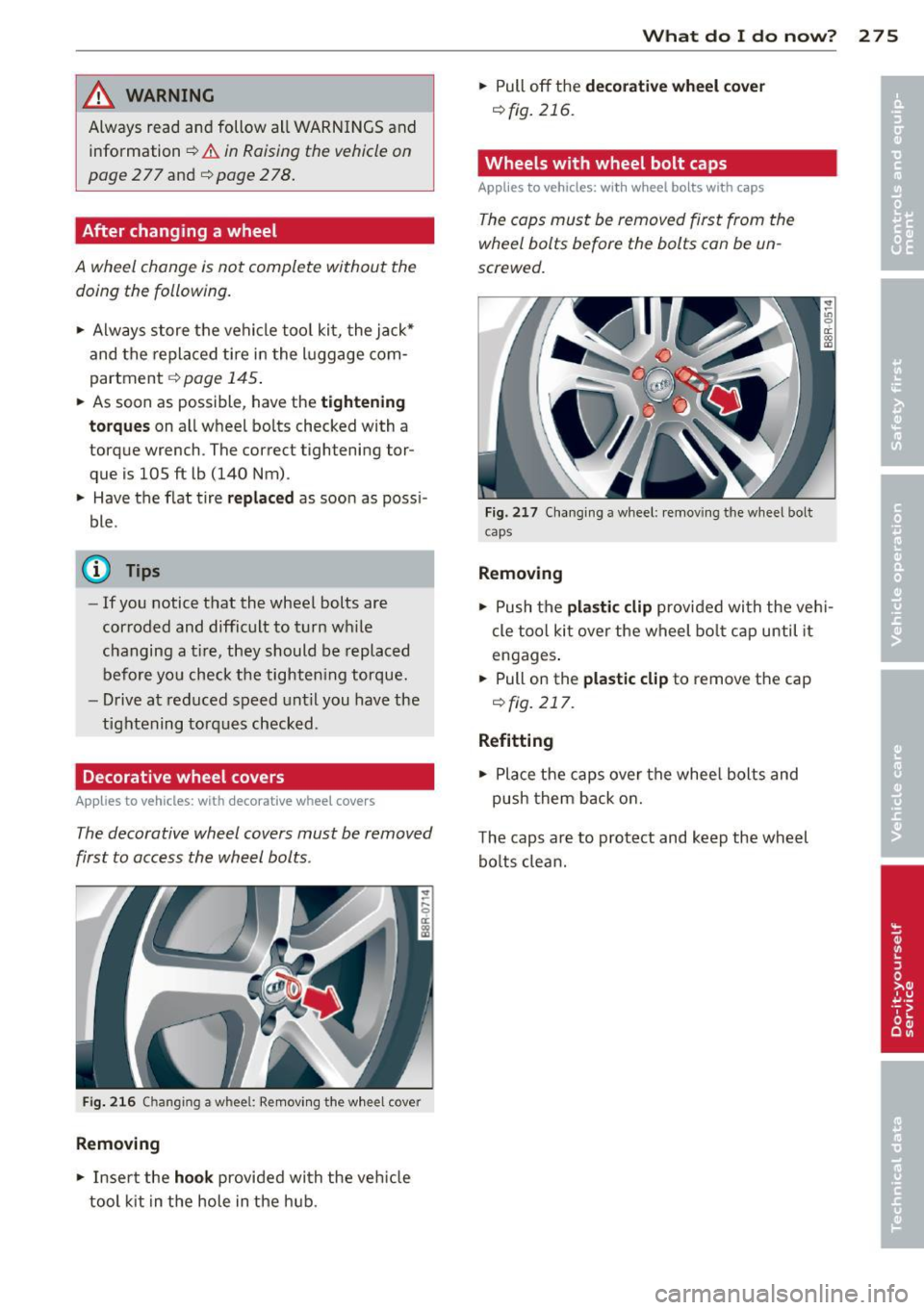
Fig. 2 16 Ch anging a wheel: Removi ng the wheel cove r
Removing
• Inse rt the hook provided wi th the ve hicle
tool kit in the hole in the h ub.
What do I d o now ? 275
• Pull off the deco rative wheel co ver
~ fig. 216.
Wheels with wheel bolt caps
Applies to vehicles: with wheel bolts with caps
The caps must be removed first from the
wheel bolts before the bolts con be un
screwed.
Fi g. 217 Cha ngi ng a w heel : rem ovi ng the wheel bolt
caps
Removing
• Push the plast ic clip provided with the ve hi
cle too l ki t over the wheel bo lt cap until it
engages .
• Pull on the
pla sti c clip to remove the cap
r:!) fig. 217.
Refitting
• Place the caps over the whee l bolts and
push them back o n.
T he caps are to protect and keep the whe el
bo lts clea n.