2013 AUDI A5 CABRIOLET recommended oil
[x] Cancel search: recommended oilPage 199 of 290

Caring for vehicles with matte finish
paint
Applies to vehicles: with matte finish paint
Vehicles with matte finish paint require spe
cial care due to the characteristics of the
paint.
Washing b y hand
To avo id damag ing the pa int when wash ing ,
first remove dust and large particles from
your veh icle. Insects , g rease spots and finge r
p rints a re best removed with a
s pecial cleaner
for matt e fini sh paint .
Apply the product using a microfiber cloth . To
avoid damaging the paint su rface, do not use
too muc h press ure.
R inse the vehicle thoroughly w ith water . Clean
the vehicle starting at the top and working to
ward the bottom using a
neu tral shampoo
and a soft mi cro fiber cloth . Stop freque ntly to
rinse the clot h thorough ly.
Clean the wheels and sill panels last . Use a
clea n
sp o nge on these areas.
Rinse the vehicle thoroughly aga in and let it
air dry . If there are any water spots, they can
be removed us ing a
l e ath er cloth .
Clean again with the special cleaner for matte
finish paint
i f nece ssary.
Rem oving stubb orn dirt
B ird d ropping s or tree sap
are best removed
with p lenty of water and a m icrof ib er cloth.
You sho uld r inse off
ga soline r esidue immedi
ately with plenty of water.
A WARNING
- Wash your vehicle only when the ignition
is switched off to reduce the risk of a
crash .
- Always read and heed all WARNINGS and
other information ¢page 194.
(D Note
-Do no t treat vehicle parts painted w ith
matte finish paint using polish ing mate -
Cleaning and protec tion 197
ria ls or hard wax. These p rod ucts could
cause damage to the appearance or sur
face that cannot be repaired .
- Never use protective wax . It can destroy
the matte finish effect.
- Do not place any s tickers or magnetic
signs on vehicle pa rts painted with
matte finish paint. The paint could be
damaged when the stickers or magnets
are removed.
- To prevent paint damage, do not wash
the vehicle i n direct sunlight .
- To prevent damage to the paint surface,
do not use insect remova l sponges,
rough kitchen sponges or sim ilar items.
- Yo u should
remove debris (such as in
sects) from t he headlight lenses on a
regu lar bas is, for example when refuel
ing your veh icle. Only clea n the head
lights us ing a wet cloth or sponge,
neve r
a dry one. Cleaning with soapy wate r is
recommended.
(D Tips
Fo r more informat ion on special clean ing
products desig ned fo r matte f inish paint ,
see your Aud i dea le r.
Power top care
The power top requires special care .
Keep ing your top looking great and mak ing
certain that it lasts a long time depend to a
great extent on prope r use a nd care. Remove
bird dropp ings as soon as poss ible , since the
cor ros ive chemicals in them wi ll cause the
rubber imp regna tion in you r top to swell and
poss ibly allow the fabr ic to leak.
With normal soiling, all you need to do is
cl ea r th e top wi th a soft br ush and clea r wa
te r. A lways b ru sh in the di rection of the fabric
from front to rear.
If the top is very dirty and has spotted areas
cl ean it with a brush using a conve rtible top
cl eaner . Always brush in the d irect ion of t he
f abric from front to rea r. R inse wi th p lenty of
clear water, and allow the top to air-dry .
IJI,-
•
•
Page 210 of 290

208 Fuel supply and filling your fuel tank
-Anti -knock index must be 87 AKI or higher.
- Blend must contain not more than 15%
MTBE .
Seasonally adjusted gasoline
Many gasoline grades are blended to perform
especially well for winter or summer driving .
During seasonal change-over, we suggest that
you fill up at busy gas stat ions where the sea
sonal adjustment is more likely to be made in
time.
CD Note
- Fuels containing a high percentage of
ethanol such as ESO and E85 may only
be used in vehicles with flex ible fuel en
gines. Using high ethano l fuel in vehicles
not equipped with flexib le fue l eng ines
can cause severe engine damage.
- Methanol fuels which do not mee t these
requirements may cause corrosion and
damage to plastic and rubber compo
nents in the fuel system.
- Do not use fuels that fail to meet the
specified criteria in this chapter.
- If you are unable to determine whether
or not a particular fuel blend meets the
specifications, ask your service station or
its fuel supplier.
- Do not use fuel for which the contents
cannot be identif ied.
- Fuel system damage and performance
problems resulting from the use of fuels
different from those specified are not
the respons ibility of Audi and are not
covered under the New Vehicle or the
Emission Control System Warranties .
- If you experience a loss of fuel economy
or driveab ility and performance prob
le ms due to the use of one of these fuel
blends, we recommend that you switch
to unblended fuel.
Ethanol fuel (B io-ethanol)
App lies to veh icles : w ith flex ible fue l en g in e
You can recognize vehicles with a flexible fuel
engine by looking at the label on the inside of
the fuel filler flap.
Vehicles with flexible fuel engines may be op
erated with bio -ethanol fuels such as E85
(85% ethanol and 15% gasoline) or with un
leaded gasoline (91 AKI/ROZ 95) . The vehicle
may also be operated with a mixture of these
fuels.
Your fuel consumption w ill increase when us
ing bio-ethanol fue ls due to the lower amount
of energy contained per unit volume in etha
nol.
Warming up the flexible fuel engine in
low temperatures
Due to the chemical composition of b io-etha
nol , a certain amount of fuel ends up in the
engine oil when driving short distances in very
low temperatures. This fue l evaporates again
when the engine is warmed up.
II Please warm up engine.
If the driver message appears in the instru
ment cluster display, drive with a warm en
gine to reduce the o il level.
CD Note
- Never fill with methanol o r with a higher
percentage of b io-ethanol than 85%
(E85). A higher percentage of bio-etha
nol in the fuel can cause damage to the
engine or to the fue l system.
- If you use only E85, it is recommended
to fill the fuel tank complete ly with un
leaded premium grade gaso line every
5,000 miles.
- If you experience starting, rough id le or
hesitation driveability problems, fill the
fue l tank comp letely with unleaded pre
m ium grade gasoline and dr ive it nor
mally until the gasoline is used. See your
authorized Audi dealer if the problem
persists .
Page 217 of 290

Modern eng ine lubrication has taken a quan
tum leap in the last few years . Many synt hetic
oils ava ilable today provide better engine lu
brication that can outlast traditional petrole
um-based o ils, making them a smart choice
for use throughout the life of your Audi.
Whether you use synthetic or petroleum based engine oil, the oil that you use must
conform to Audi's oil quality standard
VW 502 00 to help keep your vehicle's engine running smoothly and help prevent the for
mat ion of harmfu l deposits, sometimes called
"sludge", that ove r time can lead to expensive
r epairs.
At the t ime of pri nting, engine o ils available in
the U.S . and Canada that meet the exacting
specifications of Audi oi l standard VW 502 00
are synthetic engine oils. This does not mean, h owever, that every synthetic engine oil w ill
meet Audi oil standard VW 502 00. So always
be sure that you use an approved oi l.
To help preve nt the format ion of harmful de
posits use only oi l with the fo llowing spec ifi
cations printed on the oil container:
Audi oil standard VW 502 00
O il conta iner labels may carry the specif ica
tion s ingly or in comb inat ion w ith other des ig
nations and oil qua lity standards.
Viscos ity
Engine oi ls are graded according to their vis
cosity. The proper v iscosity grade oi l for your
engine depends on cl imactic or seasonal con
d itions where you dr ive. You can use oil with a
viscosity grade of SAE SW40 across all tem
pe rature ranges for normal d riving conditions .
However, if eng ine oi l viscosity grade SAE
SW40 is not avai lab le, you can also use viscos
ity grade SAE SW-30 or SAE OW-40 as long as
it meets Audi o il quality standard VW 502 00
specifications.
Because engine oil that meets the Audi oil
standard may not be available everywhere
when you need it, we st rongly recomme nd
that you always carry with you a n ext ra quart
Checkin g and fillin g 215
(li ter) of oil that exp ress ly con forms to the
VW 502 00 specificatio n, in case you have to
top
off the o il while on the road.
Only if the level of the o il is at or be low the
minimum mark -and no oi l that expressly
confo rms to Audi oil standard VW 502 00
spec ifications is available -may you top
off
with a h igh quality engine o il, preferab ly syn
thet ic-based, that meets ACEA A3 or API SM
spec ifications, but even then, only in v iscosity
grades SAE SW-40, SA E SW-30, o r SAE
OW- 40. However, dur ing the entire time be
tween o il cha nge inte rva ls, never top
off with
more than a tota l of 0. 5 q t/liter engine o il
that does not con form to A udi oil specification
vw 502 00.
Fo r more information abo ut eng ine oi l tha t
has been approved for your veh icle, ple ase
contac t eit h er yo ur autho rized Aud i dea le r or
Audi C ustomer Re lations at 1 (800) 822 -2834
or visit our web site at www .a u diusa.com or
www.aud icanada.ca. Here you w ill also find a
current list of oils (manufacturers, brand
names etc.) that conform to Audi oil standard
vw 502 00.
Changing the engine oil
T he eng ine oi l and o il f ilter m ust be changed
according to the mileage (kilometers) and
time intervals specified i n your ve hicle's War
ranty
& Maintenance booklet. Do not exceed
these interva ls - harmful deposits from old
engine oil can reduce engine performance and
can lead to expensive engine repairs.
Changi ng the oil at the recommended inter
vals is so very important beca use the lubricat
ing propert ies of oil decrease gradually during
norma l veh icle use. If you a re not sure when
yo u have your o il cha nged, ask your author
ized Audi Se rv ice Adv isor.
Under some circumstances the engine oil
shou ld eve n be changed more frequent ly.
Change oil more often if you dr ive most ly
sho rt distances, operate the ve hicle in dusty
areas o r most ly under stop-and -go traff ic con-
di tions, o r when you use your vehi cle where .,..
•
•
Page 218 of 290

216 Check ing and filling
temperatures stay below freezing point for
long periods.
Detergent addit ives in the o il w il l make fresh
oil look dark after the eng ine has been run
ning for a short time . This is norma l and is not
a reason to change the oi l more often than
recommended.
D am age or m alfunc tions du e to lack of
m ainten ance
It
is essential that you change your oil at the
recommended in tervals using only engine o il
that complies with Audi oi l standard
VW 502 00. Your Limited New Vehicle War
ranty does not cover damage or malfunctions
due to fail ure to fo llow recommended mainte
nance and use requ irements as set forth in
the Audi Owner's Manual and Warranty
&
Maintenance book let . Your dealer will have to
deny warranty coverage unless you present to
the dea ler proof in the form of Service or Re
pa ir Orders that all scheduled ma intenance
was performed in a t imely manner.
Eng ine oil consumption
The engine in your vehicle depends on an ade
quate amount of oil to lubricate and cool all
of its moving parts.
In order to provide effective lubrication and
cool ing of internal engine components, a ll in
ternal combustion eng ines consume a certa in
amount of oil. O il consumption varies from
engine to engine and may change significantly
over the life of the engine. Typica lly, engines
with a specif ied break-in period (see
¢
page 187) consume more oil during the
break-in period than they consume after oil
consumption has stabilized.
Under norma l conditions, the rate of oil con
sumption depends on the quality and viscosity
of the oil, the RPM (revolutions per minute) at
which the engine is operated, the ambient
temperature and road condit ions . Further fac
tors are the amount of oil d ilution from water
condensat ion or fuel residue and the ox ida
tion level of the oi l. As any engine is subject to wear as mi
leage builds up, the oil consump
tion may increase over time until replacement
of worn components may become necessary.
With a ll these variab les coming into play, no
standard rate of oil consumption can be es
tablished or specified. There is no alternative
to regu lar and frequent check ing of the o il lev
el, see
Note .
If
the yellow engine oil leve l warning symbo l
I! in the instrument cluster lights up, you
shou ld check the oil leve l as soon as possib le
¢
page 217. Top off the oil at your earliest
convenience ¢
page 217.
A WARNING '"---
Before you check anythi ng in the engine
compartment, always read and heed all
WARNINGS¢
A in Working in the engine
compartment on page 212.
(D Note
Driving w ith an insufficient o il level is like
ly to cause severe damage to the engine .
(D Tips
-The oil pressu re warn ing display . is
not an indic ator of the oil l evel. Do not
r el y on it . In stea d, check th e oil l eve l in
y our engin e at regular inter val s, pref
erably ea ch time you r efu el, and alwa ys
before go ing on a long trip .
-If you have t he impression yo ur engine
consumes excessive amoun ts of o il, we
recommend that you consu lt an author
ized Aud i dea ler to have the cause of
your concern properly diagnosed. Keep in m ind that the accurate measu rement of
oil consumption requ ires great care and
may take some time. An authorized Aud i
dealer has instructions about how to
measu re oil consumption accurately.
-
Page 220 of 290

218 Check ing and filling
@ For the sake of the environment
- Under no circumstances can the oil come
in contact with the sewage network or
the soil.
- Observe and follow legal regu lations
when disposing of empty oil containers.
Changing the engine oil
We recommend thot hove your oil changed by
an authorized Audi dealer or a qualified serv
ice station.
Before you check anything in the engine com
partment,
a lways r ea d and heed all WARN
ING S ¢ & in Working in the engine compart
ment on page 212.
The engine oil must be changed according to
the intervals specified in your Warranty
&
Maintenance book let. This is very important
because the lubricating properties of oil di
minish gradually during normal vehicle use .
Under some circ umstances the engine oi l
should be changed more frequently . Change
oil more often if you drive mostly short dis
tances, operate the vehicle in dusty areas or under predominantly stop-and -go traffic con
d itions, or have your veh icle where tempera
tures remain below freez ing fo r extended pe
riods.
Detergent addit ives in the o il w ill make fresh
oil look dark after the eng ine has been run
n ing fo r a short time. This is norma l and is not
a reason to change the oil mo re often than
recommended.
Because of the problem of proper disposal ,
a long w ith the special tools and necessary ex
pertise required, we strong ly recommend that
you have your o il changed by an authorized
Audi de ale r or a qualified service station.
If you cho ose t o c han ge your oil yours elf ,
please note the following important informa
tion :
A WARNING
To reduce the risk of personal injury if you
must change the eng ine oil in your vehicle
yourself:
- Wear eye protect ion.
- To reduce the risk of burns from hot en- gine oil, let the engine cool down to the
touch.
- When removing the o il dra in plug with
your fingers, stay as far away as possible. Always keep your forearm parallel to the
ground to help prevent hot oil from run
n ing down you r arm.
- Dra in the oil into a container designed
for this purpose, one large enough to hold at least the tota l amount of oil in
your engine.
- Engine oil is poisonous. Keep it we ll out
of the rea ch of childre n.
- Continuous contact with used eng ine o il
is harmfu l to your sk in. Always protect
your skin by washing oil off tho ro ughly
with soap and wate r.
@ Note
Neve r mix oil additives with your engine
oi l. These additives can damage your en
g ine and adversely affec t you r A ud i L imit
ed New Veh icle War ranty.
@ For the sake of the environment
- Before changing your oil, first make su re
you know where you can prope rly dispose
o f the used oil.
- Always dispose of used eng ine oi l proper
ly. Do not dump it on garden soil, wood
ed areas, into open streams o r down
sewage drains.
- Recycle used engi ne oil by taking it to a
used engine oil collection facility in you r
area, or contact a service station.
Page 230 of 290
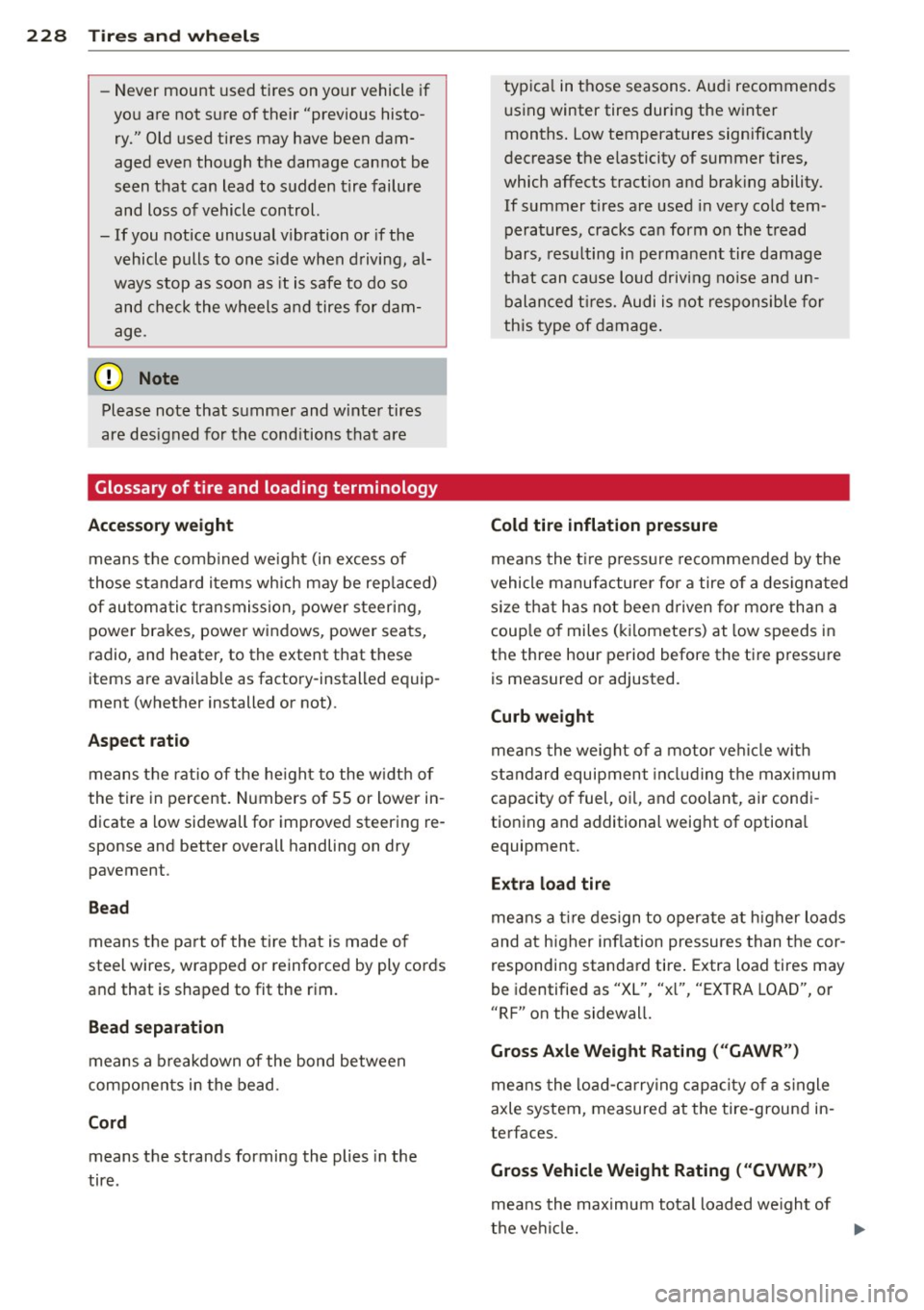
228 Tire s and wheel s
-Never mount used tires on yo ur vehicle if
you are not sure of their "previous histo
ry." Old used tires may have been dam
aged even though the damage cannot be
seen that can lead to sudden t ire failure
and loss of vehicle control.
- If you notice unusual vibration or if the
vehicle pulls to one side when driving, al
ways stop as soon as it is safe to do so
and check the wheels and tires for dam
age.
(D Note
Please note that summer and winter tires
are designed for the cond itions that are
Glossary of tire and loading terminology
Accessory weight
means t he comb ined we ight (in excess of
those sta ndard items which may be rep laced)
of au toma tic tra nsmission, power steer ing,
power brakes, power windows, power seats,
radio, and heater, to the extent that th ese
items are availab le as factory -installed equip
ment (whether installed or not) .
Aspect ratio
means t he ratio of the he ight to the w idth of
the tire in percent . Numbers of 55 or lower in
dicate a low sidewall for improved steering re
sponse and better overall handling on dry pavement .
Bead
means the part of the ti re that is made of
steel wires, wrapped or reinforced by ply cords
and that is shaped to fit the rim.
Bead separation
means a b reakdown of the bond between
components in the bead.
Cord
means the strands forming the plies in the
tire . typ
ica l in those seasons . Audi recommends
using winter tires during the winter
months . Low temperatures signif icant ly
decrease the e lasticity of summer tires,
which affects tract ion and brak ing ability.
If summer tires are used in very co ld tem
peratures, cracks ca n form on the tread
bars, res ulting in permanent tire damage
that can cause loud driving no ise and un
balan ced t ires. Audi is not responsible for
th is type of damage .
Cold tire inflation pressure
means the tire p ressu re recommended by t he
vehicle manufacturer fo r a tire of a des igna ted
s iz e that has not bee n driven for more than a
coup le of miles (k ilometers) at low speeds in
t h e three hour period before the tire pressure
is measured or adjusted.
Curb weight
mea ns the we ight of a motor ve hicl e w ith
standard equipment including the max imum
capacity of fuel, oil, and coolant, air condi
tioning and additional weight of optiona l
equipment.
Extra load tire
me ans a t ire design to operate at higher loads
and at h igher inflation pressures than the cor
responding standard tire . Extra load tires may
be identified as "XL", "x l" , "EXTRA LOAD", or
"RF" on the sidewall.
Gross A xle Weight Rating ("GAWR ")
means the lo ad -c a rry ing c apac ity of a s ingle
axle system , measured a t the tire-ground in
terfaces.
Gross Vehicle Weight Rating ("GVWR ")
mea ns the maximum total loaded we ight of
t h e ve hicl e. .,.
Page 246 of 290

24 4 T ire s and wheel s
Wheel bolts
Wheel bolts must always be tightened to the
correct torque .
The design of wheel bolts is matched to the
factory installed rims. If differen t rims are fit
ted, the correct wheel bolts with the r ight
length and correctly shaped bolt heads must
be used. This ensures that wheels are fitted
secure ly and that the brake system funct ions
correctly .
In ce rtain circumstances, you may not use
wheel bolts from a different vehicle -even if it
i s the same model~
page 2 71.
_& WARNING
Improperly tig htened o r maintained whee l
bolts can become loose ca using loss of
contro l, a co llision and serious persona l in
jury.
- Always keep the wheel bolts and the
threads in the wheel hubs clean so the
wheel bolts can turn easily and be prop
erly t ightened.
- Never grease or oil the wheel bo lts and
the threads in the wheel hubs. They can
become loose while driving if greased or
oiled, even if tightened to the specif ied
torque .
- Only use wheel bolts that belong to the
rim being installed .
- Never use different wheels bolts on your
vehicle .
-Always maintain the correct tighten ing
torque for the wheel bo lts to reduce the
risk of a wheel loss. If the tightening tor
que of the wheel bolts is too low, they
can loosen and com e out when the veh i
cl e is moving. If the tightening torque is
too high, the whee l bolts and threads
can be damaged and the wheel can be
come loose.
@ Note
The spec ified torq ue fo r the wheel bo lts is
90 ft lbs. (120 Nm) wi th a toler ance of
± 7,4 ft lbs. (± 10 Nm). Torque wheel bo lts diagonally. After changing a wheel, the
torque m
ust be checked as soon as possi
ble with a torque wrench -preferably by an
a uthori zed Audi dea ler or q ua lified work
shop .
Low aspect ratio tires
Your Audi is factory -equ ipped w ith low aspect
ratio tires . T hese tires have been thoroughly
tested and been se lected specifically fo r your
model for their superb perfo rmance, road fee l
and hand ling under a variety o f driv ing condi
t ions . As k your authorized A udi dealer for
more details .
T he low aspect ratio of these tires is ind icated
by a numera l of
55 or l ess in the tire's s ize
designation. The numeral represents the ratio
of the tire's sidewa ll height in relation to its
tread width exp ressed in percentage . Conven
tiona l tires have a he ight/w idth ratio of 60 or
more .
The performance of low-a spect-r atio tire s is
pa rt icul arly s ens itive to imp ro per i nfl ation
pressure. It is therefore import ant that low
aspect ratio tires are inflated to the specified pre ssure and that the inflation pressure is
r e gularly checked and maintained . Tire pres
sur es should be checked at l east once a
month and always before a long trip
~ page 233, Checking tire pressure.
What you can do to avoid tire and rim
damage
Low aspect ratio tires can be damaged mo re
easily by impact w it h potholes, c urbs, g ull ies
o r ridges on the road, pa rticul arly if the tire is
u nderinfla ted .
In orde r to minimize the occurrence of impact
damage to t he tires of your vehi cle, we recom
mend tha t you observe the following preca u
tions:
- Always ma inta in recommended inflation
pressu res. Check your tire pressure eve ry
2 ,000 miles (3,000 km) and add air if neces -
sary. ..,.
Page 269 of 290
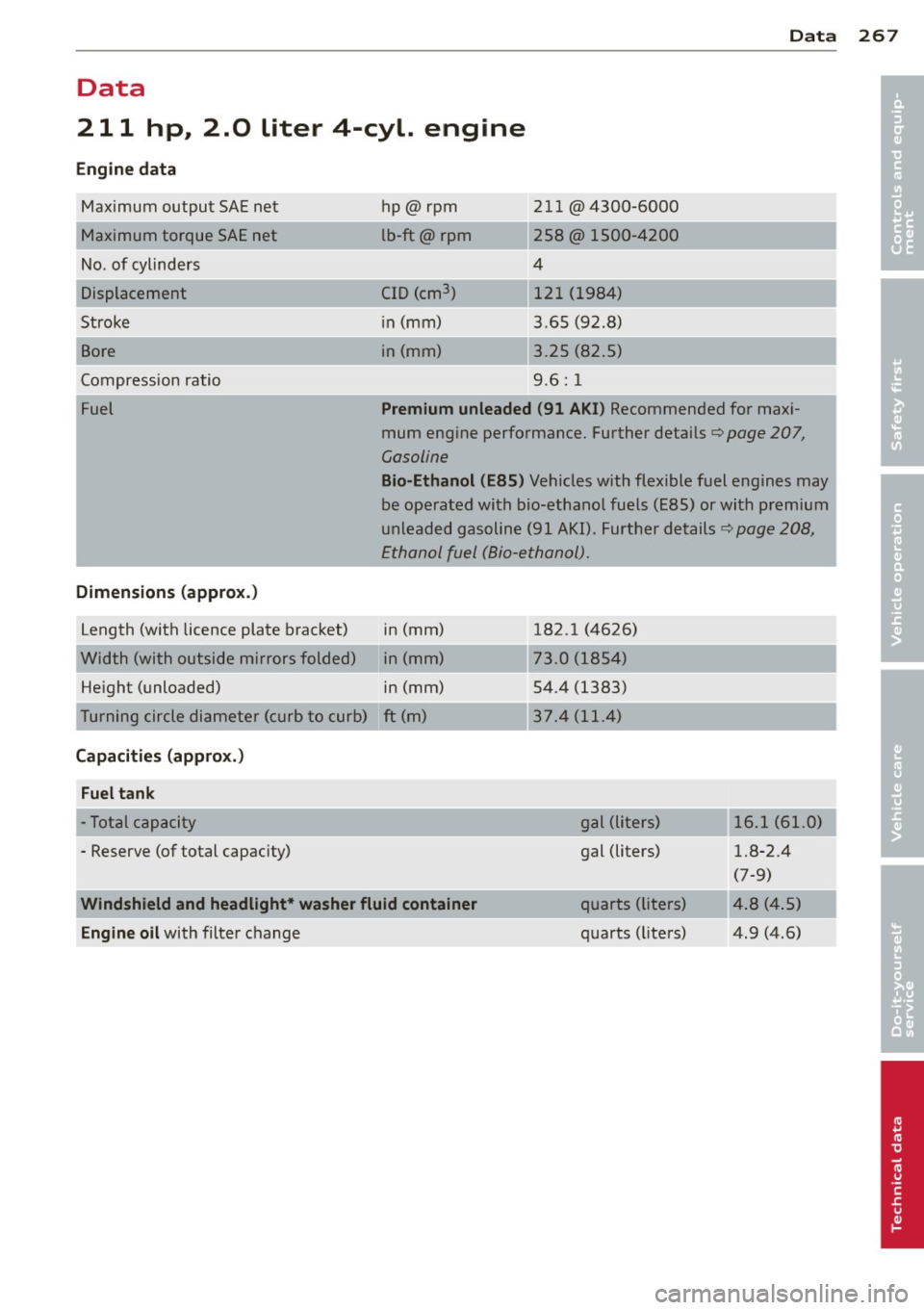
Data
211 hp, 2.0 liter 4-cyl. engine
Engine data
211 @4300-6000
Maximum output SAE net
Maximum torque SAE net
No. of cylinders
Displacement hp@rpm
lb-ft@ rpm
-·--
Stroke
Bore
Compression ratio CID (cm
3
)
in (mm)
in (mm)
__ .. ,
258@ 1500-4200
4
121 (1984)
3 .65 (92.8)
3.25 (82 .5)
9 .6: 1
Data
Fuel Premium unleaded (91 AKI) Recommended for maxi
mum engine performance. Further details¢ page 207,
Gasoline
Bio-Ethanol (E85) Vehicles with flexible fuel engines may
be operated with bio-ethanol fuels (E85) or with premium
unleaded gasoline (91
AKI) . Further details¢ page 208,
E thanol fuel (Bio-ethanol).
Dimensions (approx .)
Length (with licence plate bracket) in (mm)
Width (with outside mirrors folded) in (mm) He ight (unloaded) in (mm)
T urning circle diameter (curb to curb) ft (m)
Capacities (approx.)
Fuel tank
- Total capacity
- Reserve (of total capacity)
--.. ,
--.. ,
Windshield and headlight* washer fluid container Engine oil
with filter change 182
.1 (4626)
73.0 ( 1854)
54.4 (1383)
37 . 4 (1 1.4)
gal (liters)
gal (liters)
quarts (liters)
quarts (liters) 1.8-2.4
(7-9)
4 .9 (4 .6)
267
•
•