2013 AUDI A4 SEDAN wheel
[x] Cancel search: wheelPage 236 of 294
234 Tires and wheels
Cold tire inflation pressure
Tire pressure affects the overall handling, performance and safety of a vehicle.
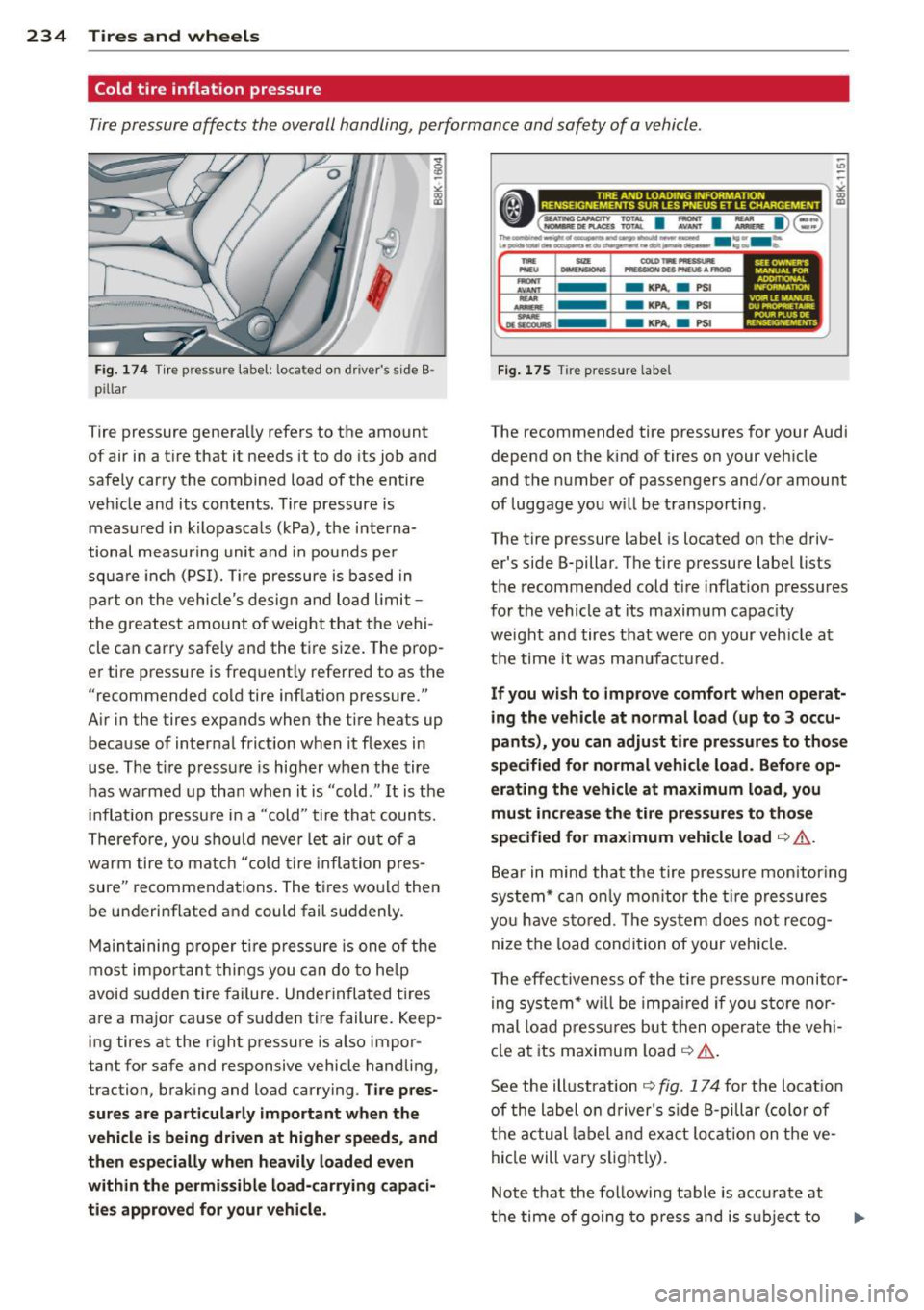
Fig. 174 Tire pressure label: located on driver's side B·
pillar
Tire pressure genera lly refers to the amount
of air i n a tire that it needs it to do its job and
safely carry the combined load of the entire
vehicle and its contents. Tire pressure is measured in kilopasca ls (kPa), the inte rna·
tional measuring unit and in pounds pe r
squa re inch ( PSI). Tire pressure is based in
pa rt o n the vehicle's desig n an d load limit
the greatest amount of weight that the vehi ·
cle can car ry safe ly and the tir e size . The prop·
er tire pressure is freq uent ly referred to as the
"recommended cold tire inflation pressure."
A ir in the tires expands when the tire heats up
because of internal frict ion when it flexes in
use . The t ire p ress ure is higher when the tire
h as warmed up than when i t is "cold ." It is the
in flat io n pressu re i n a "cold" tire that coun ts.
Th erefore, you sho uld neve r let air ou t of a
warm tire to match " co ld tir e infla tion pres
sure" recommendations . The ti res wo uld then
be un derinflated and could fail su ddenly.
M ain taining p roper t ire pr es su re is one o f the
most impo rtan t thi ngs you can do to he lp
avoid sudden tire failure. Underinfla ted ti res
a re a major ca use of s udden tire failure. Keep
ing tires at the right pressure is also impor
tant for safe and responsive vehicle handling,
traction, braking and load carrying .
Tire pres
sures are particularly important when th e
vehicle is being driven at higher speeds , and
then especially when heavily loaded even
within the permissible load -carrying capaci
tie s approved for your vehicle .
------------------.. ,;
•(=~: I : I :,.. I)@ ~
The~-----~---w-o- ....... -e.....i -·· - u ........ -.-..,.0, ... -....,.,...tot~---....... ._.,. -..
....
-..... ...........
- KPA. a PSI
- KPA.
a PSI
-KPA. a PSI
Fig. 17 5 Tire pressure la bel
SU OWNER'S MANUAl FOR AD0"10NAL l10N VOl!ILEMANU£1. DU _,...,
POUR Pl.US DE
REHSEKi.\'IEME NTS
The recommended tire pressures for your Audi
depend on the kind of tires on your ve hicle
and the numbe r of passengers and/or amount
of luggage you w il l be transporting .
The tire pressure label is located on the driv
er's si de B-pillar . T he tire pressure label lists
t h e recommended cold tir e inflat io n pressu res
for the vehicle at its maxim um capac ity
we ight and tires that were on your veh icle at
t h e time it was man ufa ctu red.
If you wish to improve comfort when operat
ing the vehicle at normal load (up to 3 occu
pants), you can adjust tire pre ssure s to tho se
specified for normal vehicle load. Before op
erating the vehicle at maximum load, you
mu st increase the tire pres sures to those
specified for maximum vehicle load
c::> .&, .
Bear in mind that the tire pressure mon itor ing
system * can o nly mo nitor the t ire pres sures
yo u have s to red. The sys tem does n ot recog
nize the load condition of your vehicle.
T he effectivene ss of the t ire p ress ure monito r
ing system* w ill be impa ired if yo u st ore nor
m al lo ad press ures but t hen opera t e the ve hi
cl e a t its ma ximum load
c::> .&. .
See the ill ustration c::> fig. 17 4 for the lo cat ion
o f the label o n driver's side B-pill ar (col or o f
t h e actu al lab el and exac t lo cat ion on the ve
hicle will vary sligh tly).
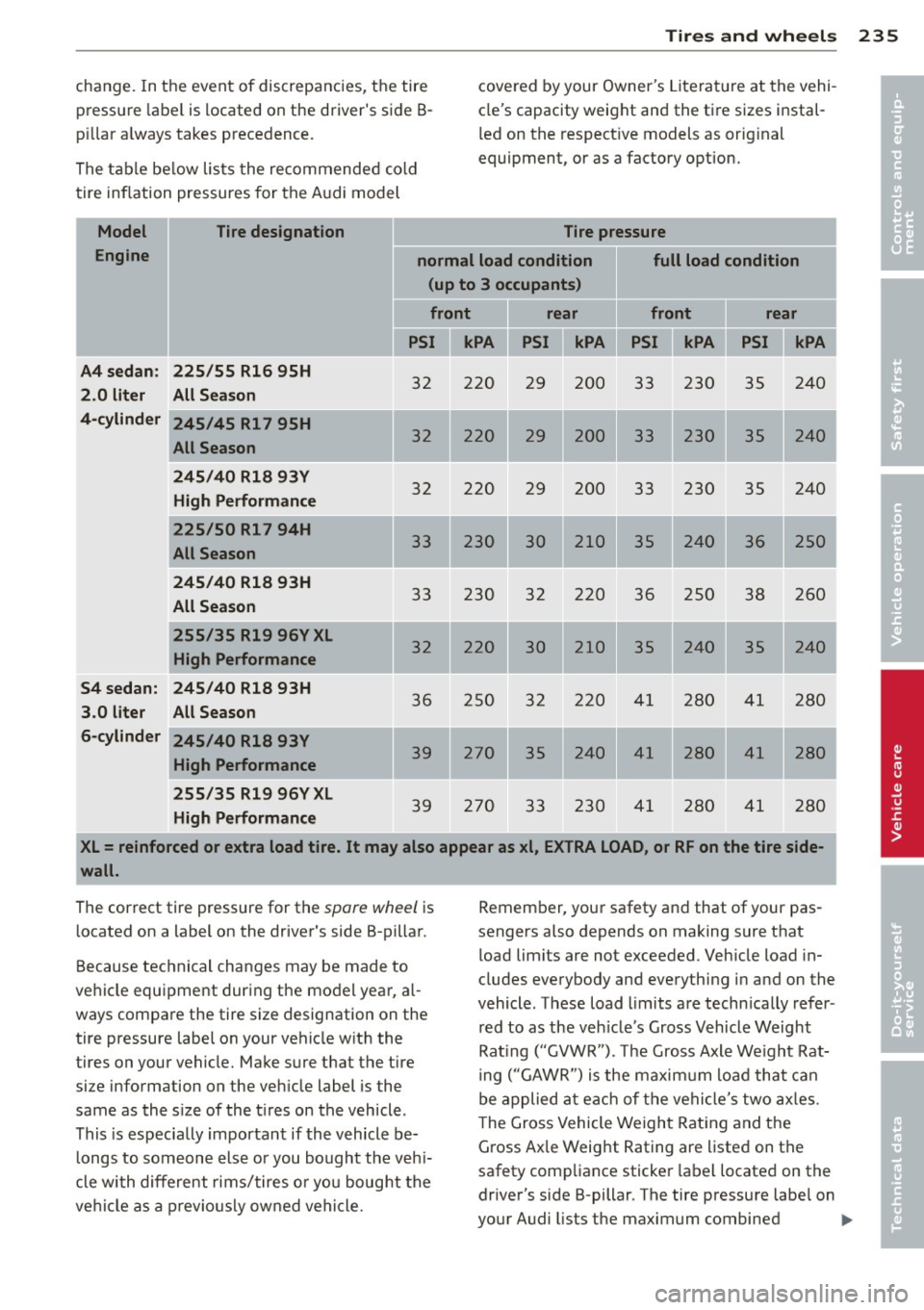
Note t hat the f ollowing ta ble is ac curate at
th e time of goi ng to press and i s sub ject to
Page 237 of 294
Tires and wheels 235
change. In the event of discrepancies, the tire
pressure label is located on the driver's side B
p ill ar a lways takes precedence.
The table below lists the recommended cold
tire inflation pressures for the Audi model
I Model II Tire designation
covered by your Owner 's Literature at the vehi
cle's capacity weight and the tire sizes instal
led on the respective models as orig inal
equipment, or as a factory option.
Tire pressure
Engine normal load condition full load condition
(up to 3 occupants)
front rear
front rear I
PSI Jl kPA PSI Jl kPA PSI Jl kPA
PSI ll kPA
A4 sedan: 225/55 R16 95H
2.0 liter All Season
4-cylinder
245/45 R17 95H
All Season
245/40 R18 93V
High Performance
225/50 Rl 7 94H
All Season
245/40 R18 93H
All Season
255 /35 R19 96V XL
I High Performance
S4 sedan: 245/40 R18 93H
3.0 liter All Season
6-cylinder
245/40 R18 93Y
High Performance
255/35 R19 96V XL
High Performance
32 220
32 220
32 220 33 230
33 230
32
220
36 250
39 270
--. -
39
270 29
200 33 230 35 240
'
29 200 33 230 35 240
J
29 200 33 230 35 240
'
30 210 35 2
40 36 250
32 220 36 250 38 260
30 210 35 240 35 240
I
32
220 41 280 41 280
35 240 41 280 41 280
. -. -
33 230 41 280 41 280
XL= reinforced or extra load tire. It may also appear as xl, EXTRA LOAD, or RF on the tire side·
wall.
The correct tire pressure for the spore wheel is
l ocated on a label on the driver's side 8-pillar.
Because technical changes may be made to
vehicle equipment during the model year, a l
ways compare the tire size designation on the
tire p ressure label on your vehicle with the
tires on your vehicle. Make sure that the tire
size information on the vehicle label is the
same as the size of the t ires on the vehicle .
This is especially important if the vehicle be
longs to someone else or you bought the veh i
cle with different rims/tires or you bought the
vehicle as a previously owned vehicle. Remember, your safety and that of your pas
sengers also depends on making sure that load limits are not exceeded . Veh icle load in
cludes everybody and everything in and on the
vehicle . These load limits are technically refer
red to as the veh icle 's Gross Vehicle Weight
Rat ing ("GVWR") . The Gross Axle We ight Rat
ing (" GAWR") is the maximum load that can
be applied at each of the vehicle 's two axles.
T he Gross Vehicle Weight Rating and the
Gross Axle Weight Rating are listed on the
safety compliance sticker label located on the
driver's side 8-pillar. The tire pressure label on
your Audi lists the maximum combined .,.
•
•
Page 238 of 294
236 Tires and wheels
weight of all of the occupants and luggage or
other cargo that the vehicle can carry. For the
location of the tire pressure label¢
fig. 174.
_& WARNING
Overloading a vehicle can cause loss of ve
hicle control, a crash or other accident, se
rious personal injury, and even death .
- Carrying more weight than your vehicle
was designed to carry will prevent the
vehicle from handling properly and in
crease the risk of a loss of vehicle con
tro l.
- The brakes on a veh icle that has been
overloaded may not be able to stop the
vehicle within a safe distance.
- Tires on a vehicle that has been overload
ed can fail suddenly causi ng loss of con
tro l and a crash.
- Always make sure that the total load be
ing transported -including the we ight of
a trailer hitch and the tongue weight of a
loaded trailer -does not make the vehi
cle heavier than the vehicle's Gross Vehi
cle Weight Rating.
A WARNING
-Incorrect tire pressures and/or underin
flation can lead to a serious or fatal acci dent.
- Incorrect tire pressures and/or underin
flation cause increased tire wear and can
affect the handling of the vehicle.
- Incorrect tire pressures and/or underin
flation can also lead to sudden tire fa il
ure, including a blowout and sudden de
flation, causing loss of vehicle control.
Checking tire pressure
-
The correct tire pressure for the tires original
ly installed on your vehicle is listed on the tire
pressure label located on driver's side 8-pil
lar .
The recommended tire pressures are on the
tire pressure label and in the table
¢ page 234, Cold tire inflation pressure .This
means that the pressure m ust be checked and
adjusted when the tire has not been driven for
more than a couple of miles (kilometers) at
low speeds during the previous three hours.
Air in the tires expands when the tire heats up
as a result of internal frict ion as it flexes in
use. The tire pressure is higher when the tire
has warmed up than when it is "co ld ."
It is the inflation pressure in a "cold" tire that
counts. Therefore, you should never let a ir out
of a warm tire to match "Cold t ire inflat ion
pressure" recommendations ¢
page 234. The
tires would then be underinflated and could
fail suddenly .
The tire pressure label on your Audi lists the
recommended cold tire inflation pressures at
maximum capacity for the new, original
equipmen t tires that were on your vehicle at
the time it was manufactured. For the loca
tion of the labe l
¢page 234, fig. 174.
Most tires lose air naturally over t ime. They
can also lose some air if yo u drive over a pot
hole or hit a curb while parking. It is usually
not possible to see whether the radial tires
used today are underinflated just by looking
at them.
T here fore, be sure to check ti re pressures at
least once a month and a lways before going
on a long trip . Make sur e to take the number
of peop le and the amount of luggage into ac
count when adjust ing tire pressure for a trip -
even one that you would not consider to be
"long ." See ¢
page 238, Tires and vehicle
load limits
for more important information .
Always use an accurate tire pressure gauge
when checking and adjusting inflat ion pres
sures. Check all of the tires and be sure not to
forget the spare tire.
If the pressure in any tire
i s too h igh when the tire is "cold", let air out
of the tire slowly with the edge of the tire
gauge and keep check ing the pressure until
you reach the pressure that is correct for the
load (passengers and luggage) and kind of
driving you plan to do.
If the pressure in any tire is too low, note the
difference between the pressure in the cold .,..
Page 239 of 294

tire and the pressure you need and add the a ir
that you need to reach the correct pressure for
the vehicle load (passengers and luggage) for
the tires on your vehicle as listed on the on
your veh icle and in this manual and the kind
of dr iving you plan to do .
Never ex ceed the ma ximum infl ation pres
su re list ed on the t ire s ide wall for an y rea
son.
Remember that the vehicle manufacturer, not
the t ire manufacturer, determ ines the correct
tire pressure for the t ires on your vehicle.
It is important to check the tire pressure when
the tires are cold.
- Read the req uired ti re press ure from the tire
pressure label. The tire pressu re labe l is lo
cated on the drive r's side 8 -p ill ar . The tire
pressure label lists the recommended cold
t ire inflation pressures for the vehicle at its
maximum capacity weight and the tires that
were on your vehicle at the time it was man
ufactured . For recommended t ire pressures
for normal load condit ions, please see chap
ter ¢
page 234.
- Turn the valve stem cap counter-clockwise
to remove it from the tire valve .
- Place the air pressure gauge on the valve.
- The tire pressures should only be checked
and adjusted when the tires are cold. The
slightly raised pressures of warm tires must
not be reduced.
- Adjust the tire pressure to the load you are
carrying.
- Re install the valve stem cap on the valve.
When should I ch eck th e tir e pre ssure?
The correct tire pressure is especially impor
tant at high speeds . The pressure should
therefore be checked at least once a month
and always before start ing a journey. Do not
forget to check the tire pressure for the spare
wheel.
Wh en should I adjust th e tire p re ss ures ?
Ad just the tire pressure to the load you are
carry ing . After changing a wheel
or replacing
Tires an d wheel s 237
whee ls you have to adjust the ti re pressu res
on all whee ls. In addition, yo u m ust then initi
a lize the new tire pressures in the t ire pres
sure monitoring system*¢
page 248.
A WARNING
Incorrect tire pressures and/or underinfla
tion can lead sudden tire fa ilure, loss of
control, collision, serious personal injury
or even death.
- When the
ti] warning symbol appears in
the instrument cluster, stop and inspect
the t ires.
- Inco rrect tire pressure and/or underinfla
tion can cause increased tire wear and can affect the handling of the vehicle and
stopping ability.
- Inco rrect tire pressures and/or unde rin
flation can a lso lead to sudden t ire fail
ure, including a blowou t and sudden de
f lation, caus ing loss of veh icle contro l.
- The drive r is responsib le for the correct
tire pressures for all tires on the veh icle.
The applicable pressure values are locat
ed on a sticke r on the driver's side 8-pil
lar.
- On ly when all tires on the vehicle are fil
led to the correct pressure, the tire pres
sure mon itor ing system* can work cor
rectly.
- The use of incorrect tire pressu re va lues
can lead to acc idents or other damage.
Therefore it is essential that the driver
observe the spec ified t ire pressure values
for the t ires and the correct pressures for
the function of the t i re p ress ure monito r
ing system*.
- Always inf late t ires to the recommended
and correct t ire p ressure before dr iv ing
off.
- Driving with unde rinflated tires bend
mo re, lett ing t hem get too hot resulting
in tre ad separation, sudden tire failure
and loss of cont rol.
- Excessive speed and/overloading can
cause heat b uild- up, sudden tire failure
and loss of cont rol.
•
•
Page 240 of 294
238 Tires and wheels
-If the tire pressure is too low or too high,
the tires will wear prematurely and the
vehicle will not handle well.
- If the tire is not flat and you do not have
to change a wheel immediately, drive at
reduced speed to the nearest service sta
t ion to check the tire pressure and add
air as required.
(D Note
Driving without valve stem caps can cause
damage to the tire va lves. To prevent this,
always make sure that facto ry installed
valve stem caps on all wheels are securely mounted on the valve.
@ For the sake of the environment
Underinflated tires will also increase the
fuel consumption .
Tires and vehicle load limits
There are limits to the amount of load or
weight that any vehicle and any tire can carry.
A vehicle that is overloaded w ill not handle
well and is more difficult to stop. Overloading
can not only lead to loss of vehicle control,
but can a lso damage important parts of the
vehicle and can lead to sudden tire failure, in
cluding a blowout and sudden deflation that
can cause the vehicle to crash .
Your safety and that of your passengers a lso
depends on making sure that load limits are
not exceeded. Vehicle load includes everybody
and everything in and on the vehicle . These
load limits are techn ically referred to as the
vehicle's
Gross Vehicle Weight Rating
("GVWR").
The "GVWR" includes the weight of the basic
vehicle, all factory installed accessories , a full
tank of fuel , oi l, coolant and other fluids plus
maximum load. The maximum load includes
the number of passengers that the vehicle is
intended to carry ("seating capacity") with an
assumed weight of 150 lbs . (68 kg) for each
passenger at a designated seating position
and the tota l weight of any luggage in the ve- hide.
If you tow a trai ler, the weight of the
trailer hitch and the tongue weight of the loaded trailer must be included as part of the
vehicle load.
T he
Gross Axle Weight Rating ("GAWR") is
the maximum load that can be applied at each
of the vehicle's two axles .
T he Gross Vehicle Weight Rating and the
Gross Axle Weight Rating are listed on the
safety compliance sticker label located on the
driver's side B-pillar.Your Audi has 5 seating
positions, 2 in the front and 3 in the rear for
total seating capacity of 5. Each seating posi
tion has a seat belt <=>
page 136, Safety belts .
The fact that there is an upper limit to yo ur
vehicle's Gross Vehicle Weight Rating means
that the to tal weight of wha tever is being car
ried in the vehicle ( including the weight of a
tra iler hitch and the tongue weight of the
loaded trailer) is lim ited. The more passen
gers in the vehicle or passengers who are
heavier than the standard we ights assumed
mean that less we ight can be carried as lug
gage.
T he tire pressure label on your Audi also lists
the maximum combined weight of all of the
occupants and luggage or other cargo that
the vehicle can carry. For the location of the
label <=>page234 , fig.174.
A WARNING
-Overloading a vehicle can cause loss of ve-
hicle control, a crash or other accident, se
rious personal injury, and even death.
- Carrying more we ight than your vehicle
was des igned to carry will prevent the
veh icle from handling properly and in
crease the risk of the loss of vehicle con
trol.
- The brakes on a vehicle that has been
overloaded may not be able to stop the
veh icle with in a safe distance .
- Tires on a vehicle that has been overload
ed can fail suddenly, incl uding a blowout
and sudden deflation, causing loss of
con trol and a crash .
Page 241 of 294
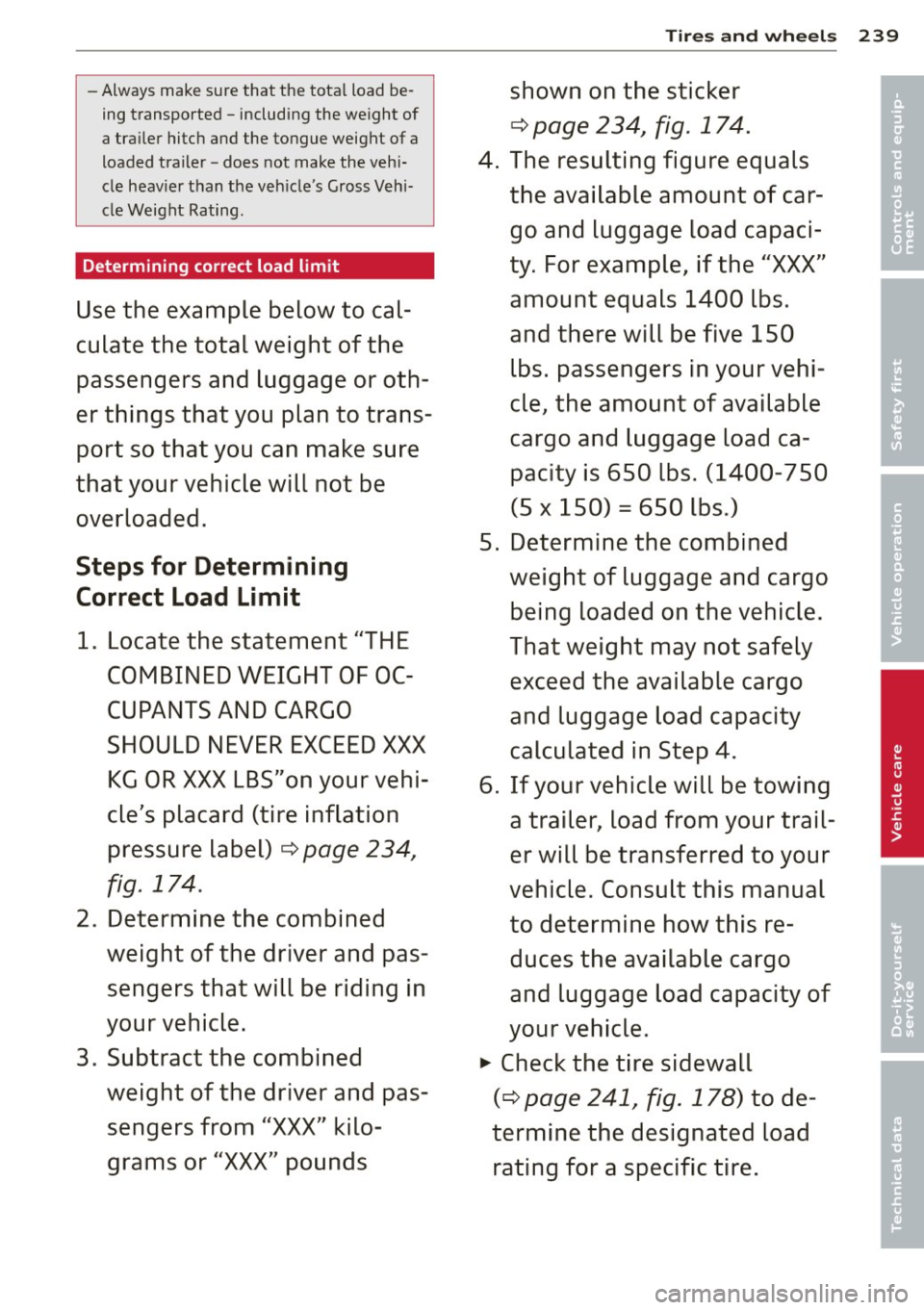
-Always make sure that the total load be
ing transported - including the weight of
a trailer hitch and the tongue weight of a
loaded trailer -does not make the vehi
cle heav ier than the vehicle's Gross Vehi
cle Weight Rating.
Determining correct load limit
Use the example below to cal
culate the total weight of the
passengers and luggage or oth
er things that you plan to trans
port so that you can make sure
that your vehicle will not be
overloaded.
Steps for Determining Correct Load Limit
1. Locate the statement "THE
COMBINED WEIGHT OF OC
CUPANTS AND CARGO
SHOULD NEVER EXCEED XXX KG OR XXX LBS"on your vehi
cle's placard (tire inflation pressure label)
¢ page 234,
fig. 174.
2. Determine the combined
weight of the driver and pas sengers that will be riding in
your vehicle.
3. Subtract the combined
weight of the driver and pas sengers from
"XXX" kilo
grams or
"XXX" pounds
Tires and wheels 239
shown on the sticker
¢ page 234, fig. 174.
4. The resulting figure equals
the available amount of car
go and luggage load capaci
ty. For example, if the
"XXX"
amount equals 1400 lbs.
and there will be five
150
lbs. passengers in your vehi
cle, the amount of available
cargo and luggage load ca
pacity is
650 lbs. (1400-7 50
(5
X 150) = 650 lbs.)
5. Determine the combined
weight of luggage and cargo being loaded on the vehicle.
That weight may not safely
exceed the available cargo
and luggage load capacity
calculated in Step
4.
6. If your vehicle will be towing
a trailer, load from your trail
er will be transferred to your
vehicle. Consult this manual
to determine how this re duces the available cargo
and luggage load capacity of
your vehicle.
.,. Check the tire sidewall
(¢ page 241, fig. 178) to de
termine the designated load rating for a specific tire.
•
•
'
Page 242 of 294

240 Tires and wheels
Tire service life
The service life of tires depends on a lot of
different things including proper installation
and balancing, correct tire pressure and driv
ing style.
F ig. 176 Tire tread: tre ad wea r ind icators (TWI)
_____ __,.J)
F ig. 1 77 Rotat ing t ires for more ev en wea r
Tread Wear Indicator (TWI)
The o rigi na l t ires on your veh icle have
1/16 inch (1.6 mm) high "wear indicators"
c::> fig . 176 running across the tread. Depend
i ng on the make, there will be six to eight of
them evenly p laced around the t ire. Marks on
the tire sidewa ll (for example "TWI" or other
symbols) indicate the positions of the tread
wear ind icators . Worn t ires must be replaced .
Different fig ures may apply in o ther countries
c::> & .
Tire p ressure
Incorrect tire pressure causes premature wear
a nd can cause sudden t ire blow-out. For th is
reason, tire pressure must be checked at least
once a month
c::> page 236.
Driving style
Driving fast aro und curves, heavy acce leration
and hard braking increase tire wear.
Rotating tires for more even wear
F or all four tires on your ve hicl e to h ave the
same service life, we recommen d that t he
front and rear t ires are rotated according to
the tire manufact urer's suggested tire rota
tion intervals. Please remember the follow ing :
- Tire rotation intervals may differ from the
vehicle service inte rva ls o utlined in your
Ma intenance and Warranty Book let .
- The longer one tire is used in one location
on the vehicle, the more it wears at certain
points; therefore, we recommend that you
follow the tire manufact urer's suggested
tire rotation intervals .
- Vehi cles w ith front-wheel dr ive experience
more tread wear on the fro nt w heels com
pa red to all wheel d rive (quattro ®).
- Please rotate tires as shown
c::> fig. 177.
-Extra care must be taken when rotating di-
rection-specific tires
c::> page 2 5 7 .
Wheel balancing
The wheels on new ve hicles are balanced .
However, various situations during everyday
driving can cause them to become unba l
anced, re sulting in vibrat ions you can usually
feel through the steer ing wheel.
Un balanced whee ls must be rebalanced to
avoid excessive wear on steering, suspension
and t ires. A whee l m ust also be reba lanced
when a new tire is insta lled.
Incorrect wheel alignment
Incor rect wheel alig nment can cause exces
sive tire wear, impairing the safety of the veh i
cle . If tires show excessive wear, have the
whee l alignment checked by an aut hori zed
Audi dealer or qualif ied workshop .
All wheel drive
Vehicles with q uattro ® mus t always have tires
of the same size, construction and tread type .
For details see
c::> page 189. ..,.
Page 243 of 294

A WARNING
Sudden tire failure can lead to loss of con
trol, a crash and serious personal injury!
- Never drive a vehicle when the tread on
any tire is worn down to the wear indica
tors.
- Worn tires are a safety hazard, they do
not grip well on wet roads and increase
your risk of "hydroplaning" and loss of
control.
- Always keep chemicals that can cause
tire damage, such as grease, oil, gasoline
and brake fluid away from t ires.
- Tires age even if they are not be ing used
and can fail suddenly, especially at high
speeds . Tir es that are more than 6 years
old can only be used in an emergency
and then with special care and at lower
speeds.
- Never mount used tires on your vehicle if
you are not sure of their" previous histo
ry ." Old used tires may have been dam
aged even though the damage cannot be
seen that can lead to sudden tire failure
and loss of vehicle control. Tires and wheels 241
New tires and replacing tires and wheels
New tires and wheels have to be broken in
.
Fig. 178 Tir e specificat ion codes on t he s idewall o f a
tire
No. Description
CD Passenger car tire (where applicable)
@ Nominal width of tire in millimeters
® Ratio of height to width (aspect ratio)
© Radial
® Rim diameter code
® Load index and speed rat ing
(f) U.S. DOT tire identification number
® Audi Original tire
® Sever snow conditions
@ Tire ply composition and materials
used
@ Maximum load rating
@ Treadwear, traction and temperature
grades
@ Maximum permissible inflation pres-
sure
The tires and rims are essential parts of the
vehicle's design . The ti res and rims approved
by Audi are spec ially matched to the charac
teristics of the vehicle and can make a major .,.
•