2013 AUDI A4 SEDAN ESP
[x] Cancel search: ESPPage 128 of 294
126 Driving Saf ely
Driving Safely
General notes
Safe driving habits
Please remember -safety first!
This chapter contains important information,
tips, instructions and warnings that you need
to read and observe for your own safety, the
safety of your passengers and others. We have
summarized here what you need to know
about safety belts, a irbags, ch ild restra ints as
well as child safety. Your safety is for us
priori
ty number 1.
Always observe the info rmat ion
and warn ings in th is sect ion -fo r yo ur own
safety as well as that of your passengers .
The information in this se ction app lies to all
model ve rsions of your veh icle. Some of the
feat ures described in this sec tions may be
standard equipment on some models, or may
be optional equipment on others. If you are
not sure, ask your authorized Audi dealer.
A WARNING
-Always make sure that you follow the in
struct ions and heed the WARNINGS in
this Manual. It is in your interest and in
the inte rest of you r passengers.
- Always keep the complete Owner's Liter
ature in your Audi when you lend or sell
your vehicle so that this important info r
mation will always be ava ilable to the
dr iver and passengers.
- Always keep the Owner's literature handy
so that you can find i t eas ily if you have
ques tions.
Safety equipment
The safety features are part of the occupant
restraint system and work together to help
redu ce the risk of injury in a wide variety of
accident situations.
Your safety and the safety of your passenge rs
should not be left to chance. Advances in
technology have made a varie ty o f fea tures
avai la bl e to he lp re duce the risk of injury in an accident
. The following is a list of just a few of
the safety features in your Audi:
- sophis tic ated s afety be lts fo r drive r and a ll
passenger sea ting pos it ions,
- be lt fo rce limi ters fo r the seats,
- belt p retensioners for the seats,
- head restra ints for each seating positio n,
- front airbags,
- side airbags in the front seats,
- side curtain a irbags,
- specia l LATCH anchorages for child re-
s tr aints,
- ad justab le steer ing colum n.
These ind iv idual safety features, can work to
gether as a system to he lp protect you and
you r passengers in a w ide range of accidents.
T hese fe atures canno t work as a system if
they a re not always correct ly adjusted and co r
rect ly used.
Safety i s everybody' s respon sibility!
Important things to do before driving
Safety is everybody's job! Vehicle and occu
pant safety always depends on the informed and careful driver.
Fo r yo ur safety and the safety of your passen
gers,
before driv ing alway s:
.,. Make sure that all lights and signals a re op
erati ng correctly .
.,. Make su re that the tire pressu re is co rrect.
.,. Make su re that all w indows are clean and
afford good v is ib il ity to the o utside.
.,. Sec ure a ll lugg age and o ther items caref ully
qpage 60 .
.,. Make s ure that nothing can interfere with
the peda ls .
.,. Adjust front seat, head restraint and mir
rors correctly for your height.
.,. Instruct rear seat passengers to adjust the
head restra ints according to their he ight.
.,. Make su re to use the right child restraint
co rrectly to p rotect chi ldren¢
page 165,
Child Safety. "'
Page 129 of 294
.. Sit properly in your seat and make sure that
your passengers do the same
¢page 54,
Seats and storage.
.. Fasten your safety belt and wear it properly.
Also instruct your passengers to fasten their
safety belts properly¢
page 136 .
What impairs driving safety?
Safe driving is directly related to the condi
tion of the vehicle , the driver as well as the
driver's ability to concentrate on the road
without being distracted .
The driver is responsible for the safety of the
vehicle and all of its occupants. If your ability
to drive is impaired, safety r isks for everybody
in the vehicle increase and you a lso become a
hazard to everyone else on the road
~ .&_.
Therefo re:
.. Do not let yourself be distracted by passen
gers or by using a cellular telephone .
.. NEVE R drive when yo ur driv ing ability is im
paired (by medicat ions, alcohol, drugs, etc.).
.. Observe all traffic laws, rules of the road
and speed limits and plain common sense .
.. ALWAYS adjust your speed to road, traffic
and weather conditions .
.,. Take frequent breaks on long trips. Do not
drive for more than two hours at a stretch.
.. Do NOT drive when you are tired, under
pressure or when you are stressed .
& WARNING
Impaired driving safety increases the risk
of serious personal injury and death when
ever a vehicle is being used.
Driving Safely 12 7
Proper occupant
seating positions
Proper seating position for the driver
The proper driver seating position is impor
tant for safe, relaxed driving.
Fig. 126 Correct seat ing pos it ion
For your own safety and to reduce the risk of
injury in the event of an accident, we recom
mend that you adjust the driver's seat to the
follow ing pos ition:
.. Adjust the driver's seat so that you can easi
ly push the pedals all the way to the floor
wh ile keeping your knee(s) slightly bent
¢&_ .
.. Adjust the angle of the seatback so that it is
in an upr ight position so that your back
comes in full contact w ith it when you drive.
.. Adjust the steering wheel so that there is a
distance of at least 10 inches (25 cm) be
tween the steering wheel and yo ur breast
bone
~ fig. 126. If not possible, see your au
thorized Audi dealer about adaptive equip
ment.
.. Adjust the steer ing wheel so that the steer
ing wheel and airbag cover points at your
chest and not at your face .
.,. Grasp the top of the steering whee l with
your elbow(s) slightly bent .
.. App lies to vehicles with adjustable head re
s tra ints: Ad just the head restraint so the up
per edge is as even as possible with the top
of your head. If that is not possible, try to
adjust the head restraint so that it is as
close to this pos it ion as possible .
.. Fasten and wear safety be lts correctly
¢ page 139 . .,._
Page 132 of 294

130 Driving Safely
Proper adjustment of head restraints
Applies to vehicles: with adj ustable head restraints
Correctly adjusted head restraints ore on im
portant port of your vehicle's occupant re
straint system and con help to reduce the risk of injuries in occident situations.
Fig. 127 H ead re str ain t: vi ew ed fro m the front
The head restraints must be correctly adjust
ed to achieve the best protection .
.. Adjust the head restraints so the upper
edge is as even as possible with the top of
your head. If that is not possible, try to ad
just the head restraint so that it is as close
to this position as possible
e> fig. 12 7 .
.. If there is a passenger on the rear center
seating position, slide the center head re
straint upward at least to the next notch .
Adjusting head restraints
e> page 57 .
A WARNING
All seats are equipped with head re
straints. Driving without head restraints or
with head restraints that are not properly
adjusted increases the risk of serious or fa
tal neck injury dramatically. To help reduce
the risk of injury:
- Always drive with the head restraints in
place and properly adjusted.
- Every person in the vehicle must have a
properly adjusted head restraint.
-Always make sure each person in the ve
hicle properly adjusts their head re
straint. Adjust the head restraints so the
upper edge is as even as possible with
the top of your head.
If that is not possi
ble, try to adjust the head restraint so that
it is as close to this position as pos
sible.
- Never attempt to adjust head restraint
while driving. If you have driven off and
must adjust the driver headrest for any
reason, first stop the vehicle safely be
fore attempting to adjust the head re
straint .
- Children must always be properly re
strained in a child restraint that is appro
priate for their age and size
e> page 165.
Examples of improper seating positions
The occupant restraint system con only re
duce the risk of injury if vehicle occupants ore
properly seated .
Improper seating positions can cause serious
injury or death. Safety belts can only work
when they are properly positioned on the body . Improper seating positions reduce the
effectiveness of safety belts and will even in
crease the risk of injury and death by moving
the safety belt to critical areas of the body.
Improper seating positions also increase the
risk of serious injury and death when an air
bag deploys and strikes an occupant who is
not in the proper seating position. A driver is
responsible for the safety of all vehicle occu
pants and especially for children . Therefore :
.. Never allow anyone to assume an incorrect
seating position when the vehicle is being
used
e> _& .
The following bulletins list only some sample
positions that will increase the risk of serious
injury and death . Our hope is that these exam
ples will make you more aware of seating po
sitions that are dangerous .
Therefore, whenever the vehicle is
moving :
-never stand up in the vehicle
- never stand on the seats
- never kneel on the seats
- never ride with the seatback reclined
- never lie down on the rear seat
- never lean up against the instrument panel ..,.
Page 135 of 294

A WARNING
Always make sure that the doors, all windows, the sunroof and the rear lid are se
curely closed and locked to reduce the risk
of injury when the vehicle is not being
used.
- After closing the rear lid, always make
sure that it is properly closed and locked.
- Never leave your vehicle unattended es
pecially with the rear lid left open . A
child could crawl into the vehicle through
the luggage compartment and close the
rear lid becoming trapped and unable to
get out. Being trapped in a vehicle can
lead to serious personal injury.
- Never let children play in or around the
vehicle .
- Never let passengers ride in the luggage
compartment. Vehicle occupants must
always be properly restrained in one of
the vehicle's seating positions.
(D Tips
- Air circulation helps to reduce window
fogging. Stale air escapes to the outside
through vents in the trim panel. Be sure
to keep these slots free and open .
- The tire pressure must correspond to the
load. The tire pressure is shown on the
tire pressure label. The tire pressure la
bel is located on the driver's side B-pillar.
The tire pressure label lists the recom
mended cold tire inflation pressures for
the vehicle at its maximum capacity
weight and the tires that were on your
vehicle at the time it was manufactured.
For recommended tire pressures for nor
mal load conditions, please see chapter
c>poge234.
Driving Safely
Tie-downs
The luggage comportment is equipped with
four tie-downs to secure luggage and other
items .
Use the tie-downs to secure your cargo prop
erly
c> page 132, Loading the luggage com
portment .
In a collision, the laws of physics mean that
even smaller items that are loose in the vehi
cle will become heavy missiles that can cause
serious injury. Items in the vehicle possess en
ergy which vary with vehicle speed and the
weight of the item. Vehicle speed is the most
significant factor.
For example, in a frontal collision at a speed
of 30 mph (48 km/h), the forces acting on a 10-lb (4.5 kg) object are about 20 times the
normal weight of the item . This means that
the weight of the item would suddenly be
about 200 lbs. (90 kg). You can imagine the
injuries that a 200 lbs. (90 kg) item flying
freely through the passenger compartment
could cause in a collision like this.
A WARNING
Weak, damaged or improper straps used
to secure items to tie-downs can fail dur
ing hard braking or in a collision and cause
serious personal injury.
- Always use suitable mounting straps and
properly secure items to the tie-downs in
the luggage compartment to help pre
vent items from shifting or flying for
ward as dangerous missiles.
- When the rear seat backrest is folded
down, always use suitable mounting
straps and properly secure items to the
tie-downs in the luggage compartment
to help prevent items from flying for
ward as dangerous missiles into the pas
senger compartment .
- Never attach a child safety seat tether
strap to a tie-down .
133
•
•
Page 144 of 294
142 Safet y belt s
• Let the belt wind up on the retractor as you
gu ide the belt tongue to its stowed pos ition .
A WARNING
Never unfasten safety belt while the veh i
cle is moving. Doing so will increase your
r isk of being injured or killed .
Adjusting safety belt height
-
With the aid of the safety belt height adjust
men t, the three point safety belt strap rout
ing can be fitted to the shoulder area, accord
ing to body size .
~ 0 0 6
Fig. 139 Safety be lt he ig ht a dju stme nt for t he front
sea ts - loop -a rou nd fit tings
.. (0
The shoulder belt should lie as close to the
center of the collar bone as possib le and
should fit well on the body
c:> .&. in Safety belt
position on page 141 .
• Push
the loop-around fittings up c:> fig . 139
@ , or
• squeeze together the (D button, and push
the loop-around fitt ings down @.
• Pull the belt to make sure that the upper at
tachment is properly engaged.
.&, WARNING
Alw ays read and heed all WARNINGS and
other impo rtant informat ion
¢ page 139.
(D Tips
With the front seats, the height adjust
ment of the seat can also be used to adjus t
the posit ion of the safety be lts.
Improperly worn safety belts
Incorrectly positioned safety belts can cause
severe injuries .
Wearing safety belts improperly can cause se
rious injury or death. Safety belts can only
work when they are correctly positioned on
the body . Improper seat ing pos itions reduce
the effectiveness of safety be lts and will even
i ncrease the risk of inju ry and death by mov
ing the safety be lt to crit ical areas o f the
body. Improper seating positions also in
crease the risk of serious injury and death
when an airbag deploys and strikes an occu pant who is not in the cor rect seating posi
tion. A driver is responsible for the safety of
all veh icle occupants and especially for chil
dren . Therefore:
• Never permit anyone to assume an incorrect
sitting position in the vehicle while traveling
c:> ,&. .
.&, WARNING
Improperly worn safety belts increase the
r isk of ser ious persona l injury and death
whenever a vehicle is being used.
- Always make sure that all vehicle occ u
pants are correctly restrained and stay in
a correc t seating position whe never the
veh icle is being used .
- Always read and heed all WARNINGS and
other important information
¢ page 139.
Safety belt preten
sioners
How safety belt pretensioners work
In front, side and rear -end collisions above a
particular severity, safety belts are tensioned automatically .
The safety belts are equipped with safety belt
pretensioners . The system is act ivated by sen
sors in front, side and rear-end collisions of
great severity. This tightens the belt and takes
u p belt slack
c:> .&. in Service and disposal of .,._
Page 146 of 294
144 Airbag sys tem
Airbag system
Important things to know
Importance of wearing safety belts and
sitting properly
Airbags are only supplemental restraints. For
airbags to do their job , occupants must al
ways properly wear their safety belts and be
in a proper seating position.
F or your safety and the safety of your passen
gers, before driving off, a lways:
• Adjust the dr iver's seat and steering wheel
properly ¢
page 12 7,
• Adjust the front passenger's seat properly
r=;page 55,
• Wear safety be lts properly r=:; page 139,
• Always properly use the proper child re-
stra int to protect children¢
page 165.
In a collision airbags must inflate within the
blink of an eye and with considerable force .
The supplementa l airbags can cause injuries if
the dr iver or the front seat passenger is not
seated properly . T herefore in order to he lp the
a irbag to do its job, it is important, both as a
d river and as a passenge r to s it properly at all
times.
By keeping room between your body and the
steering wheel and the front of the passenge r
compartment, the airbag ca n inflate fully and
comp letely and provide supp lemen tal p rotec
tion in ce rtain frontal collisions
r=:; page 127,
Proper occupant seating positions .
For detai ls
on the operat ion of the seat adjustment con
trols ¢
page 56.
It's especially important that children a re
properly restrained
r=:; page 165.
There is a lot tha t the driver and the passen
ge rs can and must do to help the individua l
safety features ins talled in your A udi work to
gether as a system.
Prope r seat ing pos ition is important so that
the front airbag on the driver s ide can do i ts
job. If yo u have a physical impa irment or con- dition that prevents yo
u from sitting properly
on the driver seat with the safety belt properly
fastened and reaching the peda ls , spec ial
modifications to your vehicle may be necessa
ry.
Contact your a uthorized Audi dea ler, or call
Audi C ustomer Re lations at 1-800-822-2834 .
When the airbag sys tem dep loys, a gas gener
ator will f ill the ai rbags, break open the pad
ded covers, and inf late between the steering
whee l and the dr iver and between the instru
ment pane l and the front passenger. The air
bags will deflate immediately after dep loy
ment so that the front occupants can see
th rough the w indshield aga in without inter
ruption .
All of th is take s place in the blink of an eye, so
fast that many people don't even realize that
the a irbags have dep loyed . The airbags also
inflate with a g reat dea l of force and nothing
sho uld be in their way when they deploy.
F ron t air bags in combination w ith properly
worn safety bel ts slow down and lim it the oc
c u pant's forward movement. Together they
help to prevent the drive r and front seat pas
senger from hitting parts of the inside the ve
hicle while reducing the forces acting on the
occupant dur ing the crash. In this way they
help to reduce the risk of injury to the head
and uppe r body i n the c rash . A irbags do not
protect the a rms or the lower parts of the
body.
Both front a irbags w ill not i nflate in all fronta l
collisions . The t rigge ring of the a irbag system
depends on the vehicle dece lerat ion rate
c a u sed by the co llision and reg istered by the
elect ron ic cont ro l u nit. If thi s rate is below
the re ference value programmed into the con
trol unit, the airbags will not be trigge red ,
even though the car may be bad ly damaged as
a res ult of the collision . Veh icle damage, re
pair costs or even the lack of veh icle damage
is no t necessarily an indication of whether an
airbag should inflate or not .
It is not possible to define a range of vehicle
speeds that w ill cover every possib le kind and .,.
Page 148 of 294
146 Airbag system
Even though your vehicle is equipped with an
Advanced Airbag System, make certain that
all chi ldren, especially those 12 years and
younger, a lways ride in the back seat properly
restrained for their age and size. The airbag
on the passenger side makes the front seat a potentially dangerous place for a ch ild to ride.
The front seat is not the safest place for a
child in a forward-facing child safety seat. It
can be a very dangerous place for an infant or
a child in a rearward-facing seat.
The Advanced Airbag System in your veh icle
has been certified to comply with the Requ ire
ments of United States Federal Motor Vehicle
Safety Standard 208 as applicable at the time
your vehicle was manufactured.
The Standard requires the front a irbag on the
passenger side to be turned off ("sup
pressed") if a child up to about one year of
age restrained in one of the rear-facing or for
ward -facing infant restraints listed in Federal
Motor Vehicle Safety Standard 208 with which
the Advanced Airbag System in your vehicle
was certified has been installed on the front passenger seat . For a listing of the child re
strai nts that we re used to certify compliance
with the US Safety Standard
r=v page 167.
The PASSENGER AIR BAG OFF light in the in
strument panel te lls you when the front Ad
vanced A irbag on the passenger side has been
turned off by the e lectronic control unit.
Each t ime you turn on the ignition, the
PAS
SENGER AIR BAG OFF
light will come on for a
few seconds and:
- will stay on if the front passenger seat is not
occupied,
- will stay on if there is a small child or child restraint on the front passenger seat,
- wi ll go off if the front passenger seat is oc
cupied by an adult as registered by the
weight-sensing mat
r=v page 155, Monitor
ing the Advanced Airbag System .
The PASSENGER AIR BAG OFF light comes on
when the control un it detects a total weight
on the front passenger seat that requires the
front airbag to be turned off.
If the total weight on the front passenge r
seat is more than that of a typica l 1 year -old
chi ld but less than the weight of a small
adult, the front airbag on the passenger side
can deploy (the
PASSENGER AIR BAG OFF
light does not come on). If the PASSENGER
AIR BAG OFF
light does not come on, the
front airbag on the passenger side has not
been turned off by the electronic con trol unit
and can deploy if the control unit senses an
impact that meets the cond itions stored in its
memory .
For example, the airbag may deploy if:
-a small ch ild that is heav ier than a typical 1
year-old ch ild is on the front passenger seat
( re gard less of whether the child is in one of
the child safety seats listed
r=v page 167), or
- a child who has outgrown ch ild restraints is
on the front passenger seat.
If the front passenger airbag is turned off, the
PASSENGER AIR BAG OFF light comes on in
the instrument cluster and stays on.
The front airbag on the passenger s ide may
not deploy (the PASSENGER AIR BAG OFF
light does not illum inate and stay lit) even if a
small adult or teenager, or a passenger who is
not sitt ing upright with their back against a
non-reclined backrest with their feet on the
vehicle floor in front of the seat is on the front
passenger seat
r=v page 12 7, Proper seating
position for the driver.
If the front passenger airbag deploys, the
Federal Standard requires the airbag to meet
the "low risk" deployment criteria to reduce
the risk of injury t hroug h interaction with the
airbag. "Low risk" deployment occurs in those
crashes that take place at lower dece lerat ions
as defined in the electronic control unit
r=v page 155, PASSENGER AIR BAG OFF light .
Always remember, a child safety seat or infant
carr ier installed on the front seat may be
struck and knocked out of posit ion by the rap
idly inflat ing passenger's airbag in a frontal
collision . The air bag could greatly reduce the
effectiveness of the ch ild restraint and even
seriously injure the child during inflation .
Page 150 of 294
148 Airbag system
-Never place additional items on the seat
that can increase the total weight regis
tered by the weight-sensing mat and can
cause injury in a crash .
Front airbags
Description of front airbags
The airbag system can provide supplemental
protection to properly restrained front seat
occupants.
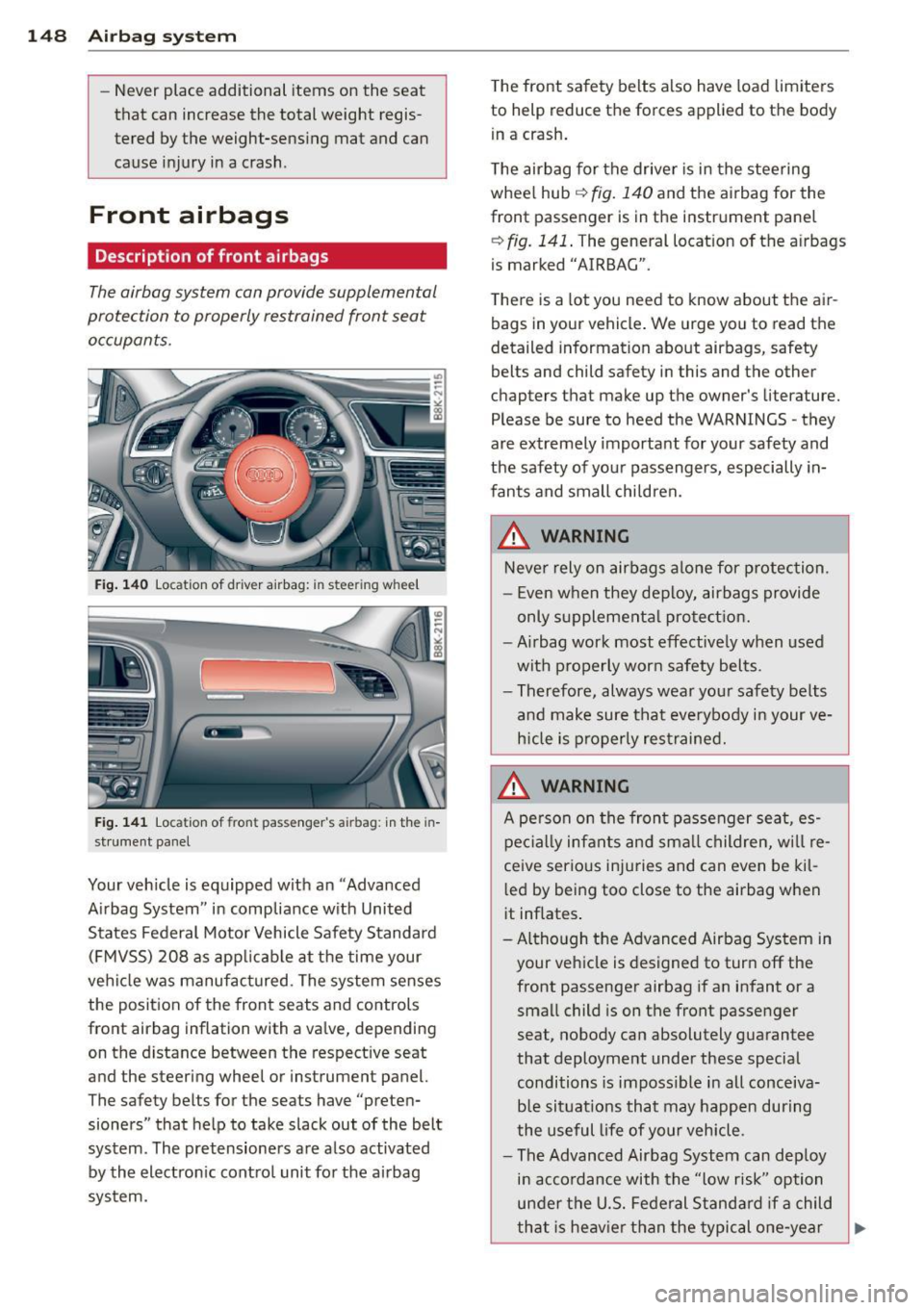
Fig. 140 Locat ion of dr iver airbag: in stee ring wheel
Fig. 141 Loca tion of front pass enger's a irbag: in the in
strument panel
Your veh icle is equipped with an "Advanced
Airbag System" in compliance with United
States Federal Motor Vehicle Safety Standard (FMVSS) 208 as applicable at the time your
vehicle was manufactured . The system senses
the position of the front seats and controls
front airbag inflation with a valve, depend ing
on the distance between the respective seat
and the steering wheel or instrument panel.
The safety belts for the seats have "preten
sioners" that help to take slack out of the belt
system. The pretensioners are also activated by the electronic contro l unit for the airbag
system. The
front safety belts also have load limiters
to help reduce the forces applied to the body
in a crash.
The airbag for the driver is in the steering
wheel hub ¢
fig. 140 and the airbag for the
front passenger is in the instrument panel
~ fig. 141 . The general locat ion of the a irbags
i s marked "AIRBAG".
There is a lot you need to know about the air
bags in your vehicle . We urge you to read the
detailed information about airbags, safety
belts and child safety in this and the other
ch apters that make up the owner 's literature.
Please be sure to heed the WARNINGS -they
are extremely important for your safety and
the safety of your passengers, especially in
fants and small children.
_&. WARNING
Never rely on airbags alone for protection.
- Even when they deploy, airbags provide
only supplemental protection.
-Airbag work most effectively when used
with properly worn safety bel ts.
- Therefore, always wear your safety belts
and make sure that everybody in your ve
h icle is properly restrained.
_&. WARNING
A person on the front passenger seat, es
pecially infants and sma ll children, will re
ceive serious injuries and can even be kil
led by being too close to the airbag when
it inflates .
- Although the Advanced Airbag System in
your vehicle is designed to turn off the
front passenger airbag if an infant or a
small child is on the front passenger
seat, nobody can absolutely guarantee
that deployment under these special
conditions is imposs ible in all conceiva
b le situat ions that may happen during
the useful life of your vehicle .
- The Advanced Airbag System can deploy
in accordance with the "low risk" option
under the U.S. Federal Standard if a child
that is heav ier than the typical one-year
-
.