2012 VOLKSWAGEN GOLF lights
[x] Cancel search: lightsPage 245 of 516
Roof rack
Introduction
this sectio n find informa tion about:
Mo unt in g the roof rack base carrier and roof
rack
................................... 147
Securing a load on the roof rack . . . . . . . . . . . 148
The ro of o f your vehicle has been designed to
approv ed base carrie r mounts and roof racks can
be used .
When should the roof rack be removed?
When it is no longer needed .
Before driving through an automatic car was h.
When the vehic le wou ld otherwise be too high
t o ach ieve min imum clearanc e to enter, for
ple, a garage .
More information:
Lights
Transporting 137
Saving fuel and helping the envi ronment
Tires and wheels 258
283
Transporting heavy or bulky loads on the roof rack will change the way the vehicle handles by shifting the vehicle's center of gravity and
increasing the wind drag area.
146 Before driving
able and undam ag ed straps so that the load
have a negative effect on the vehicle's
aerodynamics , center of gravity and ove rall
Your vehicle is higher when the roof rack is installed , especially when it is loaded. Compare
the vehicl e he ight with existing clear ance
heights , such as underpasses and garage doors.
creases due to increased air resis ta nce.
Page 248 of 516
Introduction
this section
..
L oading the trailer
.............. ........ .
Driving with a trailer ..... . .. .. ........... .
mount .... . .
Retrofitting a trai l
er hitch ................ .
Max imum permissible trailer weight ... . 150
151
151
152
154
155
156
for
more concentratio n from the
dr iver . Always the ope rat ing and driving in
stru ctions given , and use common sense.
Un der winter conditions ,
win ter tires on the
vehicle and the trailer.
Tongue weight
The m aximum permissible tow bar tongue weight
exerted on the mount should not exceed kg).
More information:
Anti-theft a larm system
Lights page 122
Startin g assistance systems 195
Tires and wheels page 258
Parts, accessories, repairs and modifications
Riding in a trailer is dangerous and may be il
incorrect, or damaged trailer hitch can
cause the trailer to separate from the towing vehicle and cause serious personal injuries.
use an undamaged, properly mount
ed trail er hitch.
mount when you are not towing a trailer.
properly with suitable and undamaged straps so that the not shift.
and under unfavorable weather, or wind conditions.
careful when passing other vehicles.
Transporting 149
Page 249 of 516
some area s, speed
is higher.
you are driv ing a new vehicle or a ve hicle with a new or rebui lt engine, do not tow a during the break-in period, about 283.
Technical requirements
tory informatio n an d heed the WARNon page 149.
Use only a weight-car rying
hitch must be suitable for
you r
a "weight -dis
tributing " or "load-equalizing " trailer hitch on your The vehicle is not designed for this kind of trailer hitch
Do not use a bumper-mounted traile r hitch
Never
a trailer hitch on the bumper or on the
bumper attachments. The trailer hitch must not in
terfe re with the impact-absorbing bumper system.
Do not make any changes to the vehicle exhaust
and brake systems. From time to time, check that trailer hitch mounting bolts are secure ly fas
tened. When you are not towing, remove the trailer
hitch. This
helps keep the trailer hitch from causing damage if your vehicle is hit from behind.
Engine cooling syste m
Tow i
ng a trailer makes the engine and its cooling
system work harder.
Before driving
maintenance more often because of the extra
load it has to move.
When you are not towing , remove the trailer hitch
Some models need a trailer hitch to tow or tow-start other vehicles. after it has
been removed. Be sure to stow it securely.
your trailer has its own brakes , make sure it
meets
151 .
T ra
iler
Trailer lights must meet regulations 151.
Never connect the trailer lights directly to the elec
t rical system
of your
Outside mirrors
you cannot see the traffic behind you using the
r egular outside mirrors, then you must ex
t ended mirrors. Extended mirrors may also be re
quired by law in some countries
I states I provin
ces . Always adjust the outside mirrors befo re dr iving. It's vital that you always have a clear view to
the rear of the veh icle .
Maximum po w er con sumption fo r the trailer
Do not exceed the power ratings listed in the chart
b elow.
E l
ectr ica l load Maximum power
Taillights total
Page 250 of 516
An improperly or incorrect trailer hitch can cause a trailer to separate from the tow vehicle and cause serious personal ries.
you don't have to tow a trailer any more, remove the entire trailer hitch. Always seal bolt holes to prevent water and deadly haust fum es from getting into the vehicle .
the trailer lights are not connected ly, the ve hicle 's ele ctronics may be damaged .
Hitching up and connecting a trailer
on page 149.
Safety chains
Always make sure t hat the safe ty c hai ns a re er ly attac hed to the tow ing ve hic le. Leave enough
s lack in the chain s so th a t yo u ca n go aroun d ners witho ut stre tc hin g the c hai ns. Th e safe ty
c h ai ns must not drag on the groun d, h owever .
Trailer
mum power consumptio n for th e traile r
connections to the vehicle electrical system can cause malfunctions that affect the entire vehicle electrical system, which can lead to accide nts and se rious personal injury.
Loading the trailer
tory information and heed the WARN -on page 149.
the trail er uses too much electricity, the vehicle's electronics may be damaged.
Never connect the electrical system for the trailer directly to the electrical connections for the rear lights or to any other unsuitable power sources. Us e only a suitable connector to vide power to the trailer.
if you tow a trailer freq uently, recom mends havi ng t he vehicle serviced
tervals because of the extr a load it has to pu ll.
some countries an addit ional fire guisher must be carried if the tota l weig ht of
the traile r excee ds 5 ,5 12 lbs. kg ).
Never attach a
trailer to the vehicle or leave it attached to the vehicle when the trailer is
things (such as a change in trailer or vehicle
load or a fla t tire ) can lower or raise the vehicle. This subjects the trailer hitch and the trailer to strong forces that can damage the ve h icle or the trailer.
the engin e is swi tc h ed off and accessories in the tr ailer are o n and use elec tricity from
the vehicl e, th e ve hicl e battery be drained as
l o ng as t he e lec trical sys te m s o f th e an d
the t railer are c onn ecte d .
Page 253 of 516
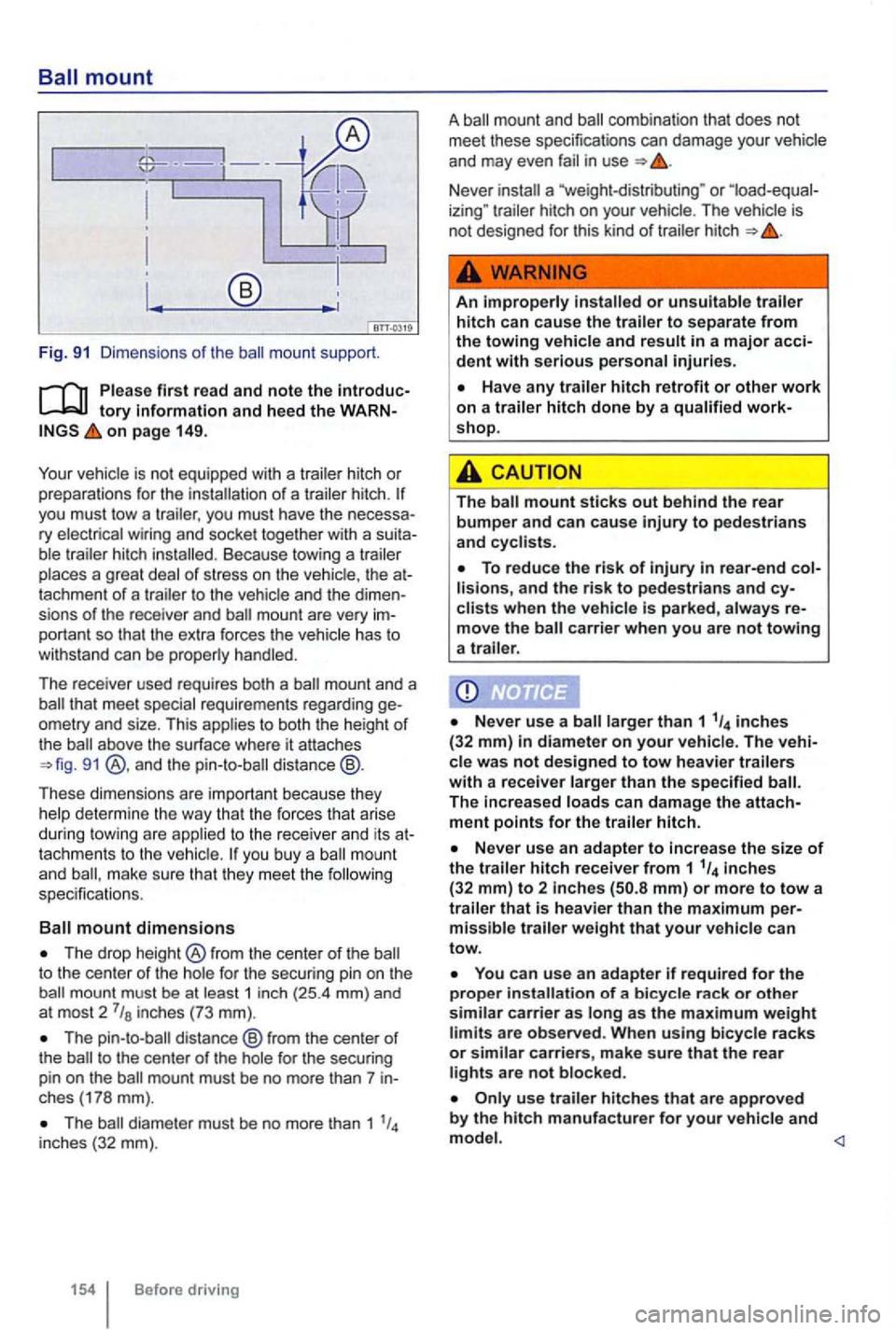
mount support .
tory Information and heed the on page 149.
Your vehicle
is not equipped with a trai ler hitch or p reparations for the in stalla tion of a trailer hitch. tf
you must tow a trailer , you must have the
ry electrical wiring and socket together with a Because towing a traile r
pl aces a great dea l of stress on the vehicle, the
sions of the receive r and
ometry and size . T his app lies to both the height of th e above the surface where it attaches
m ount
and m ake sure that th ey meet th e
The drop height ® from the center of the
The distance @from the center of
the
T he
Never izing " trailer hitch on your vehicle . T he vehicle is
not designed for this kind of trailer hitch .
An improperly or unsuitable trailer hitch can cau se the trailer to s eparate from the towing vehicle and result in a major acci-dent with serious personal injuries.
carrier when you are not towing a trailer.
cle was not designed to tow heavier trailers with a receiver larger than the specified ball.
The increased loads can damage the
ment points for the trailer hitch.
Never use an adapter to the size of the trailer hitch receiver from 1 1
/4 inches (32 mm) to 2
weight that your vehicle can tow.
You can use an adapter if require d for the proper ins ta llation of a bicycle rack or o th er similar carrier as long as the maximum weight limits are observed . When using bicyc le rack s or simil a r carri ers, mak e sure th at the rear lights are not blo cked .
use trail er hitches that are approved by the hitch manufacturer for your vehicle and
model.
Page 270 of 516
Shifting
Introduction
this section find information about:
Warning
and i ndicator ... .. . .
Pedals
............. ........... .
Manual transmission: Gearshift lever
172
173
174
Automat ic transm ission :
lever.... 175
Sh ifting with nptro nic ® . . . . . . . . . . . . . . . . . . 176
Driving with automatic transmiss ion 177
Automat ic transmission malfunction . . . . . . . . 178
Explanatory
notes in this sec tion regarding
Direct
The backup lights come on.
Climatronic switches to air culation mode.
The rear window wiper switches on when the
windshield wipers are switched on.
More information:
Braking , stoppi ng and parking 179
Climate control
Engine control and emission control system
Emergency
Rapid acceleration can cause skidding and loss of traction , especially on slippery roads,
re sulting in a loss of vehicle control, sions, and seriou s personal injury.
use the kick-down feature or fast cele ration if visibility, weather, road, and
Constant braking causes the brakes to and se rious personal injury.
the brakes or apply the brake
pedal too often or too long.
substantially reduce braking performance, increase stopping
the brakes by keeping your foot on the brake pedal when you do not want to brake . Thi s make the brakes wear faster.
gine braking and reduce the load on the brakes. Otherwise , the brake system could overheat and even
Page 271 of 516
Warning and indica tor lights
on page 171.
L
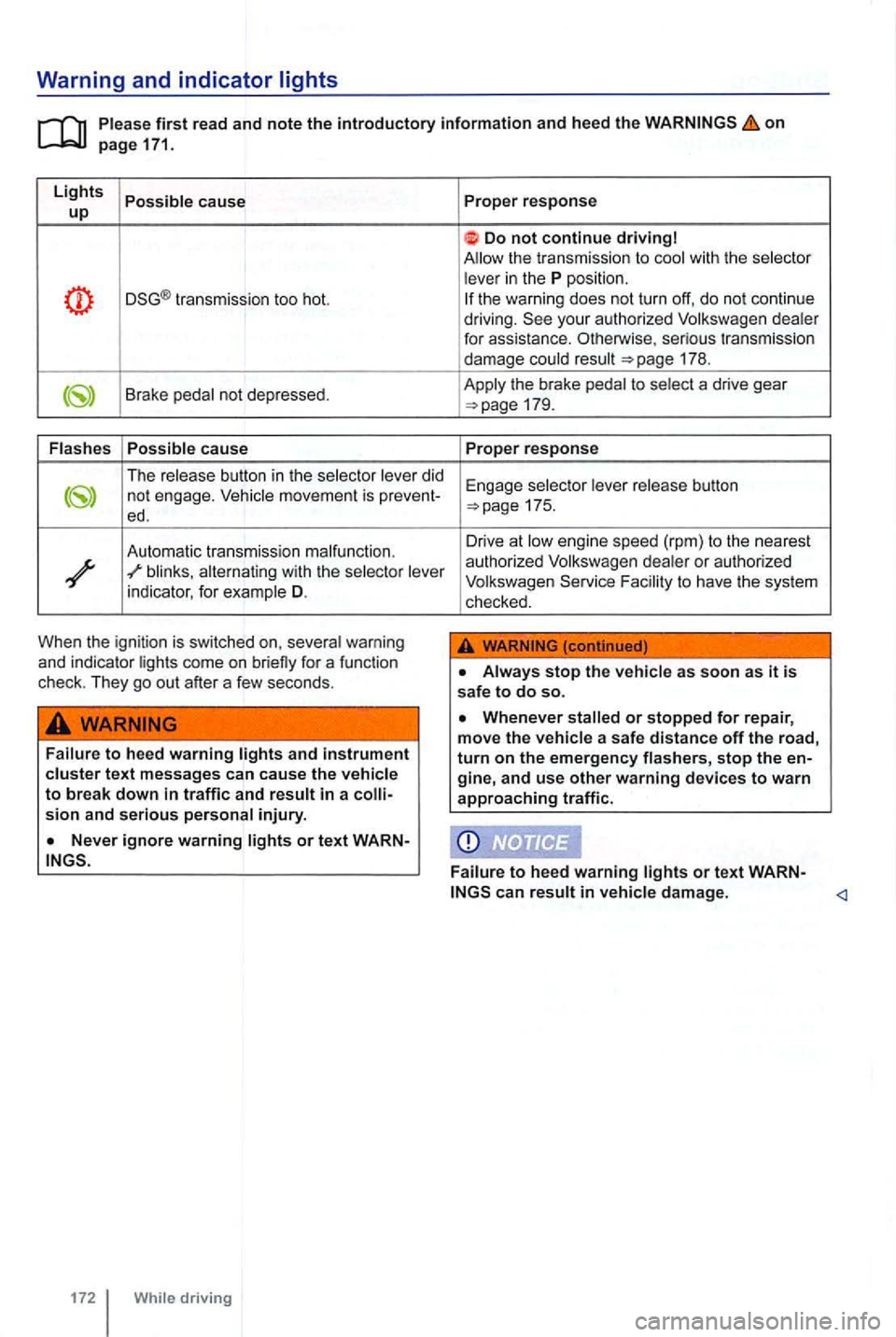
ights Possible cause up
transmission too hot.
Brake pedal not depressed.
Flash es Possible
cause
The release button in the selector lever did not engage.
blinks, alternating with the selector lever
indicator , for example D.
When the ignition is switched on, several warning
and indicator lights come on briefly for a funct ion
check . They go out after a few seconds .
Failure to heed warning text messages can cause the vehicle to break down in traffic and result in a injury.
or t ext WARN
172 While driving Proper
response
Do not continue driving
the warni ng does not turn off, do not continue
driving.
175.
Drive at low en gine speed (rpm) to th e nearest
autho rized Vol kswagen dealer or authorized
Volkswagen F acility to have th e system
checked .
Always stop the vehicle as soon as it is safe to do so.
damage.
Page 278 of 516
Braking, stopping, and parking
this sectio n
Parking brake . . . . . . . . . . . 182
P arking . . . . . . . . . . . . . .
. . . . . . . . . . . . . . . . . 182
About the brakes . . . . . . . . . . . . . . . . . . . . . . . . 183
Braking assistance systems
Switching
L ock Brake System (ABS) . Br ak e Assist System
(BAS ), Ele ctronic Differential Lock (EDL), R eg ulatio n (ASR) and Electronic C ontrol
(ESC).
More information:
Trai ler towi ng 149
Starting assistance systems 1 95
Tires and whee ls 258
Driving with bad brakes or worn brake pads can cause a and serious personal
injury.
lights up in the instrument cluster display, whether alone or together with a text message, immediately contact an authorized Volkswagen dealer or authorized Facility to have the brake pads checked and, if necessa
ry, replaced .
Parking improperly can cause serious sonal injury.
lock and you
haust system or catalytic converter could
fu el, etc.
riously injure you and your passengers.
sonal injury.
mote control vehicle key, trapping passengers in the vehicle in an emergency. For ample, depending on the time of year, people trapp ed in the vehicle can be exposed to very high or very low temperatures.
children.
Starting, shifting, parking 179