Page 304 of 588
304
3-1. Using the air conditioning system and defogger
VERSO_WE_OM64524E
Power heater
: If equipped
Power heater can be operated when
The engine is running.
The engine coolant temperature is low.
Normal characteristics of power heater operation
The following cases do not indicate a malfunction.
When the power heater is turned on or off, some white smoke and a
slight odor may be emitted from the power heater exhaust that is located
under the floor.
When the power heater is being used under extremely cold conditions,
vapor may be visible from its exhaust.
When the power heater is turned off, you may hear a sound in the engine
compartment for about 2 minutes until the power heater turns off com-
pletely.
After the heater is off
We recommend not restarting the heater for 10 minutes after you turn it off.
Otherwise, a noise may be heard as the heater ignites.
When refueling your vehicle
The engine must be turned off. Turning the engine off turns the power heater
off.
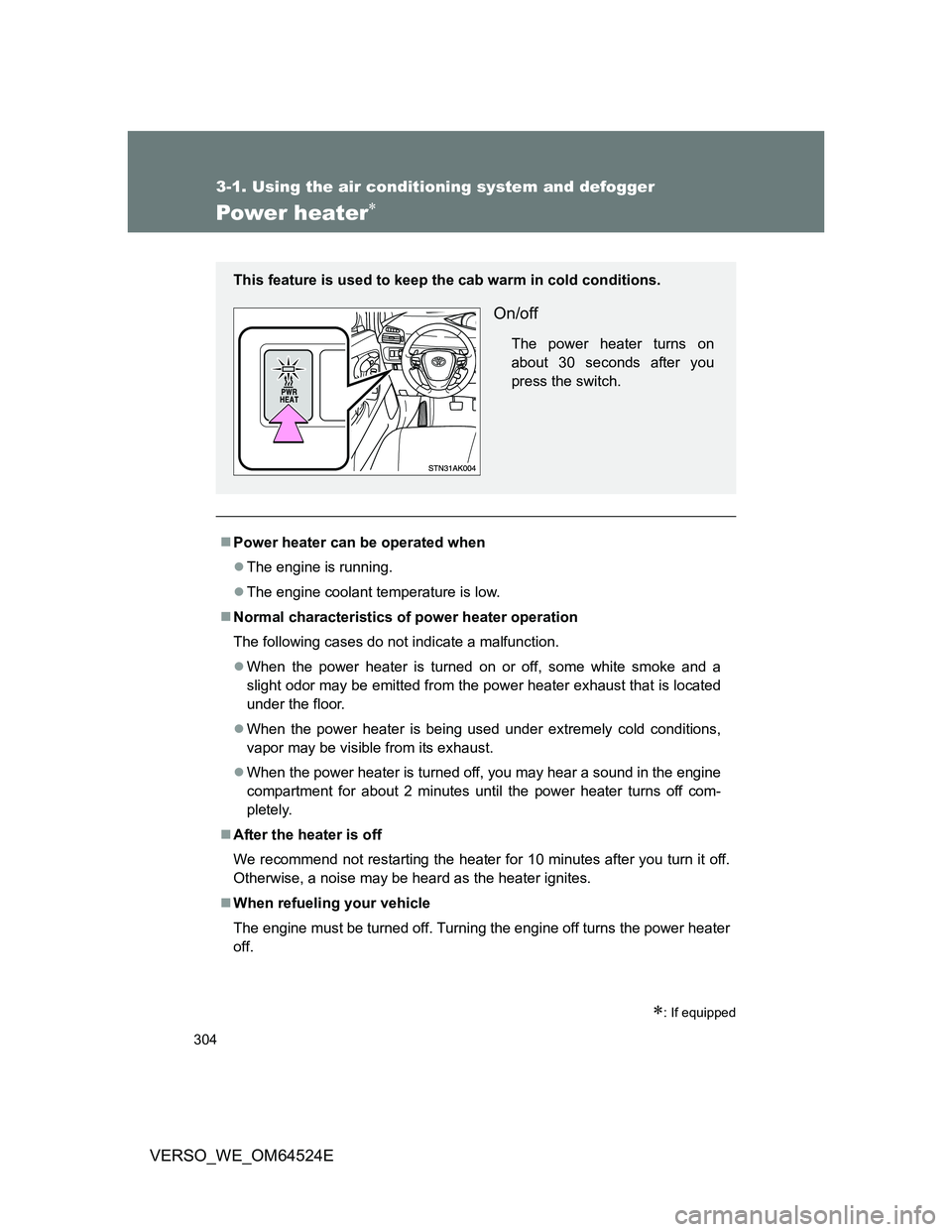
This feature is used to keep the cab warm in cold conditions.
On/off
The power heater turns on
about 30 seconds after you
press the switch.
Page 305 of 588
305 3-1. Using the air conditioning system and defogger
3
Interior features
VERSO_WE_OM64524E
CAUTION
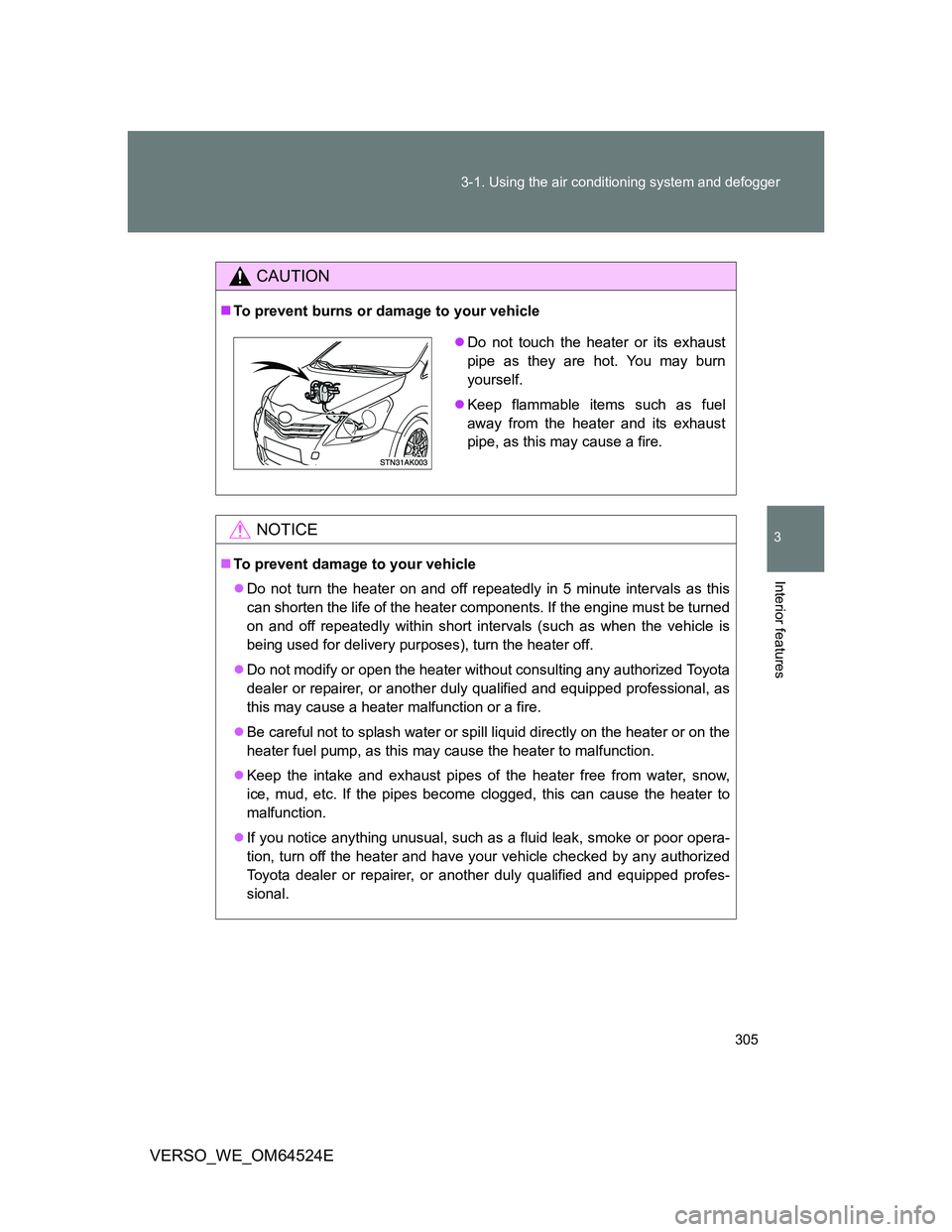
To prevent burns or damage to your vehicle
NOTICE
To prevent damage to your vehicle
Do not turn the heater on and off repeatedly in 5 minute intervals as this
can shorten the life of the heater components. If the engine must be turned
on and off repeatedly within short intervals (such as when the vehicle is
being used for delivery purposes), turn the heater off.
Do not modify or open the heater without consulting any authorized Toyota
dealer or repairer, or another duly qualified and equipped professional, as
this may cause a heater malfunction or a fire.
Be careful not to splash water or spill liquid directly on the heater or on the
heater fuel pump, as this may cause the heater to malfunction.
Keep the intake and exhaust pipes of the heater free from water, snow,
ice, mud, etc. If the pipes become clogged, this can cause the heater to
malfunction.
If you notice anything unusual, such as a fluid leak, smoke or poor opera-
tion, turn off the heater and have your vehicle checked by any authorized
Toyota dealer or repairer, or another duly qualified and equipped profes-
sional.
Do not touch the heater or its exhaust
pipe as they are hot. You may burn
yourself.
Keep flammable items such as fuel
away from the heater and its exhaust
pipe, as this may cause a fire.
Page 306 of 588
306
3-1. Using the air conditioning system and defogger
VERSO_WE_OM64524E
Rear window and outside rear view mirror defoggers
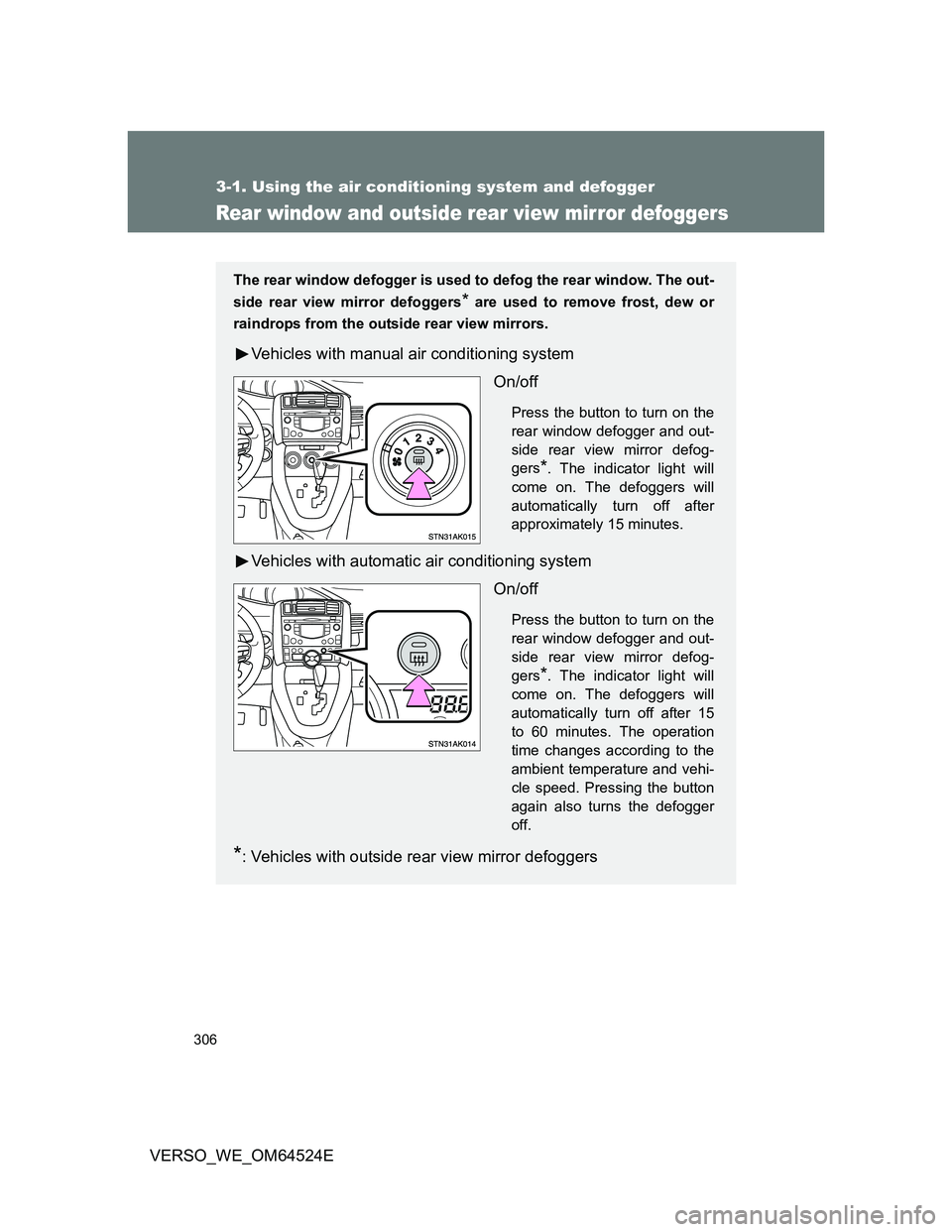
The rear window defogger is used to defog the rear window. The out-
side rear view mirror defoggers
* are used to remove frost, dew or
raindrops from the outside rear view mirrors.
Vehicles with manual air conditioning system
On/off
Press the button to turn on the
rear window defogger and out-
side rear view mirror defog-
gers
*. The indicator light will
come on. The defoggers will
automatically turn off after
approximately 15 minutes.
Vehicles with automatic air conditioning system
On/off
Press the button to turn on the
rear window defogger and out-
side rear view mirror defog-
gers
*. The indicator light will
come on. The defoggers will
automatically turn off after 15
to 60 minutes. The operation
time changes according to the
ambient temperature and vehi-
cle speed. Pressing the button
again also turns the defogger
off.
*: Vehicles with outside rear view mirror defoggers
Page 307 of 588
307 3-1. Using the air conditioning system and defogger
3
Interior features
VERSO_WE_OM64524E
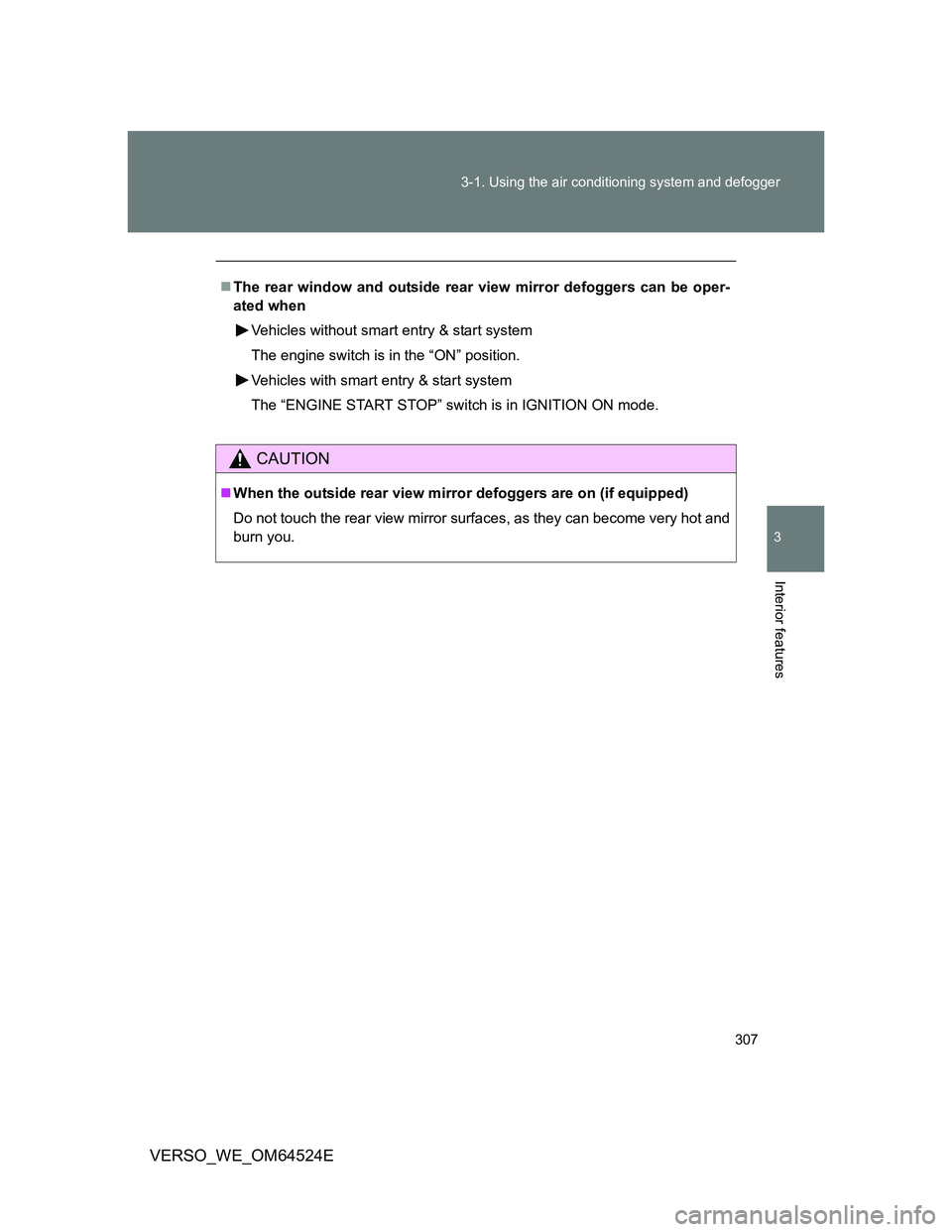
The rear window and outside rear view mirror defoggers can be oper-
ated when
Vehicles without smart entry & start system
The engine switch is in the “ON” position.
Vehicles with smart entry & start system
The “ENGINE START STOP” switch is in IGNITION ON mode.
CAUTION
When the outside rear view mirror defoggers are on (if equipped)
Do not touch the rear view mirror surfaces, as they can become very hot and
burn you.
Page 359 of 588
359 3-4. Using the storage features
3
Interior features
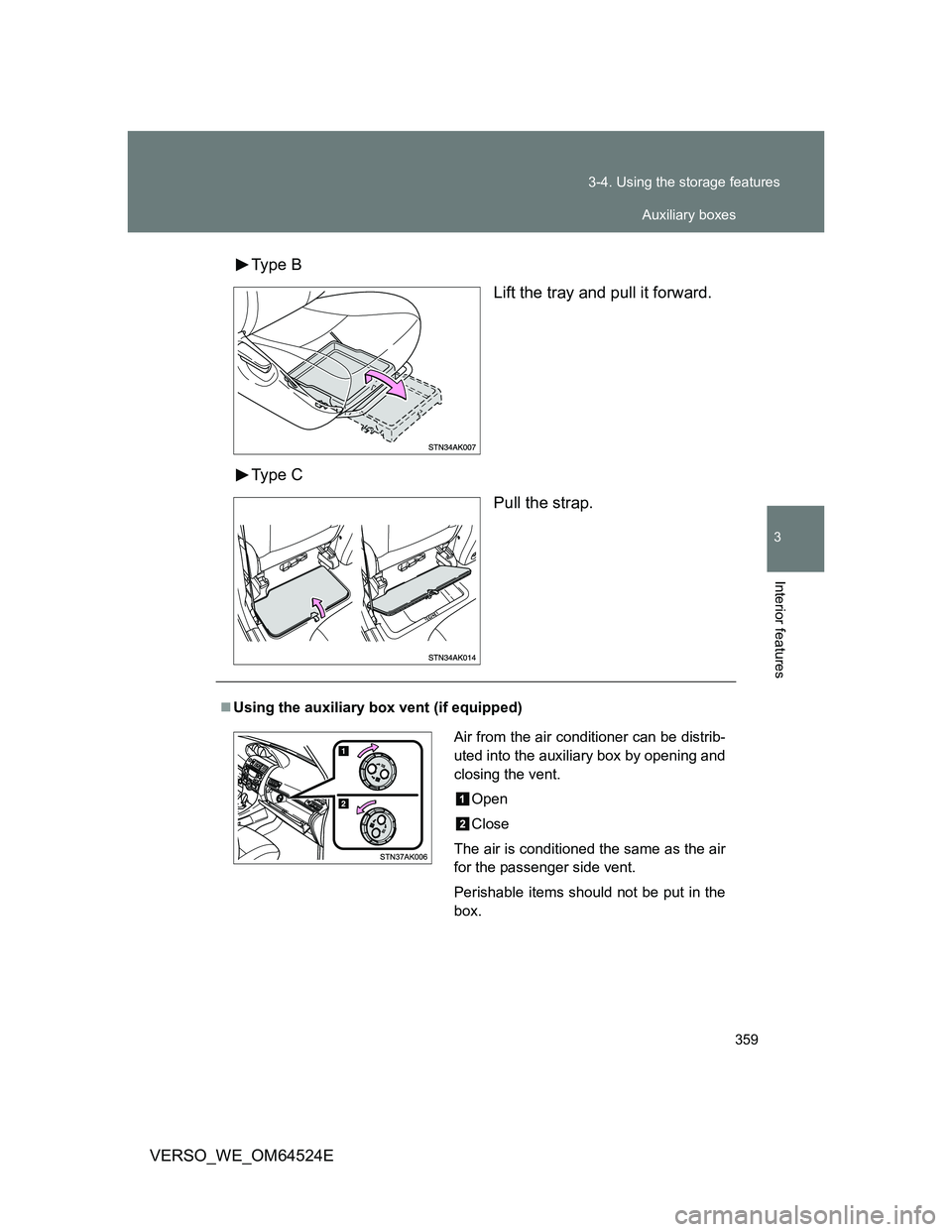
VERSO_WE_OM64524EType B
Lift the tray and pull it forward.
Type C
Pull the strap.
Using the auxiliary box vent (if equipped)
Air from the air conditioner can be distrib-
uted into the auxiliary box by opening and
closing the vent.
Open
Close
The air is conditioned the same as the air
for the passenger side vent.
Perishable items should not be put in the
box.
Auxiliary boxes
Page 387 of 588
4Maintenance and care
387
VERSO_WE_OM64524E
4-1. Maintenance and care
Cleaning and protecting
the vehicle exterior ......... 388
Cleaning and protecting
the vehicle interior .......... 392
4-2. Maintenance
Maintenance
requirements................... 395
4-3. Do-it-yourself maintenance
Do-it-yourself service
precautions ..................... 398
Hood ................................. 401
Positioning a floor jack ...... 403
Engine compartment......... 405
Tires .................................. 421
Tire inflation pressure ....... 424
Wheels .............................. 426
Air conditioning filter ......... 428
Key battery........................ 432
Checking and replacing
fuses ............................... 436
Light bulbs ........................ 450
Page 396 of 588

396 4-2. Maintenance
VERSO_WE_OM64524E
Where to go for service?
In order to maintain your vehicle in the highest possible condition, Toyota
recommends that all repairs and service operations be carried out by autho-
rized Toyota dealers or repairers or other duly qualified and equipped profes-
sionals. For repairs and services covered by your warranty, please visit an
authorized Toyota dealer or repairer, who will use genuine Toyota parts in
repairing any difficulties you may encounter. There can also be advantages
in utilizing authorized Toyota dealers or repairers for non-warranty repairs
and services, as members of the Toyota network will be able to expertly
assist you with any difficulties you may encounter.
Your Toyota dealer or repairer, or another duly qualified and equipped pro-
fessional service department will perform all of the scheduled maintenance
on your vehicle-reliably and economically due to their experience with
Toyota vehicles.
Does your vehicle need repair?
Be on the alert for changes in performance and sounds, and visual tip-offs
that indicate service is needed. Some important clues are:
Engine missing, stumbling, or pinging
Appreciable loss of power
Strange engine noises
A fluid leak under the vehicle (However, water dripping from the air condi-
tioning after use is normal.)
Change in exhaust sound (This may indicate a dangerous carbon mon-
oxide leak. Drive with the windows open and have the exhaust system
checked immediately.)
Flat-looking tires, excessive tire squeal when cornering, uneven tire wear
Vehicle pulls to one side when driving straight on a level road
Strange noises related to suspension movement
Loss of brake effectiveness, spongy feeling brake pedal, pedal almost
touches the floor, vehicle pulls to one side when braking
Engine coolant temperature continually higher than normal
If you notice any of these clues, take your vehicle to any authorized Toyota
dealer or repairer, or another duly qualified and equipped professional, as
soon as possible. Your vehicle may need adjustment or repair.
Page 398 of 588
398
VERSO_WE_OM64524E
4-3. Do-it-yourself maintenance
Do-it-yourself ser vice precautions
If you perform maintenance yourself, be sure to follow the correct
procedures as given in these sections.
ItemsParts and tools
Battery condition (P. 415)•Warm water
• Baking soda
• Grease
• Conventional wrench
(for terminal clamp bolts)
Engine coolant level (P. 413)• Toyota Super Long Life Coolant
or similar high quality ethylene
glycol based non-silicate, non-
amine, non-nitrite and non-borate
coolant with long-life hybrid
organic acid technology. Toyota
Super Long Life Coolant is pre-
mixed with 50% coolant and 50%
deionized water.
Engine oil levelP. 408)• Toyota Genuine Motor Oil or
equivalent
• Rag or paper towel, funnel
(used only for adding oil)
Fuses (P. 436)• Fuse with same amperage rating
as original
Radiator, condenser and inter-
cooler (P. 415)
Tire inflation pressure (P. 424)• Tire pressure gauge
• Compressed air source
Washer fluid (P. 418)• Water washer fluid containing
antifreeze (for winter use)