Page 725 of 860
5
When trouble arises
725
5-1. Essential information
SIENNA_U (OM45477U)
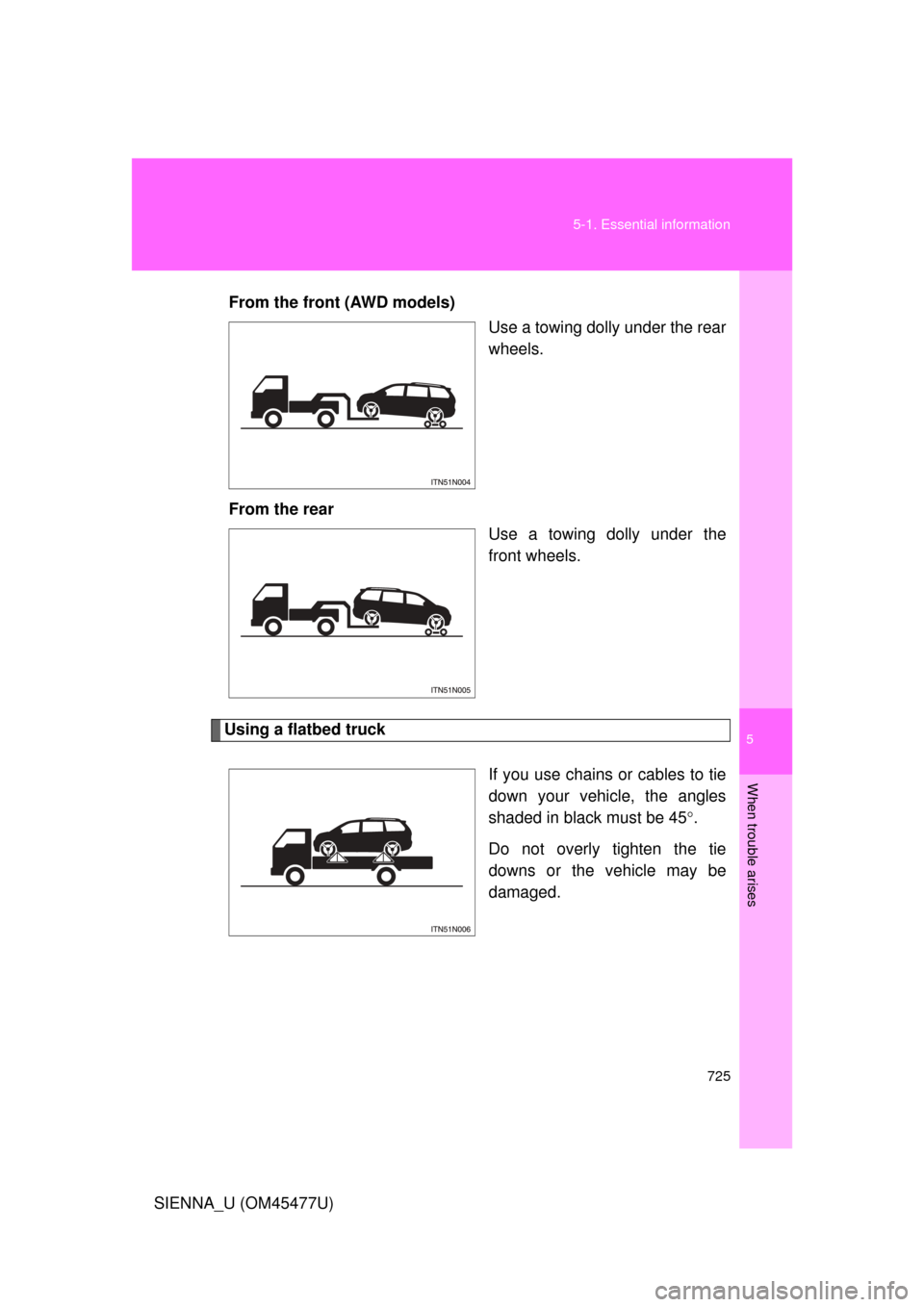
From the front (AWD models)
Use a towing dolly under the rear
wheels.
From the rear Use a towing dolly under the
front wheels.
Using a flatbed truck
If you use chains or cables to tie
down your vehicle, the angles
shaded in black must be 45.
Do not overly tighten the tie
downs or the vehicle may be
damaged.
Page 726 of 860
726 5-1. Essential information
SIENNA_U (OM45477U)
NOTICE
■To prevent body damage when towing with a sling-type truck
Do not tow with a sling-type truck, either from the front or rear.
■ To prevent causing serious damage to the transaxle and Active Torque
Control 4WD system (AWD models) wh en towing using a wheel-lift type
truck
■ To prevent damaging the vehicle wh en towing using a wheel-lift type
truck
When raising the vehicle, ensure adequate ground clearance for towing at
the opposite end of the raised vehicle. Without adequate clearance, the
vehicle could be damaged while being towed.
■ Recreational towing (beh ind motor home, etc.)
Never dinghy tow your vehicle to prevent causing serious damage to the
Active Torque Control 4WD system (AWD models) and transaxle. ( P. 376)
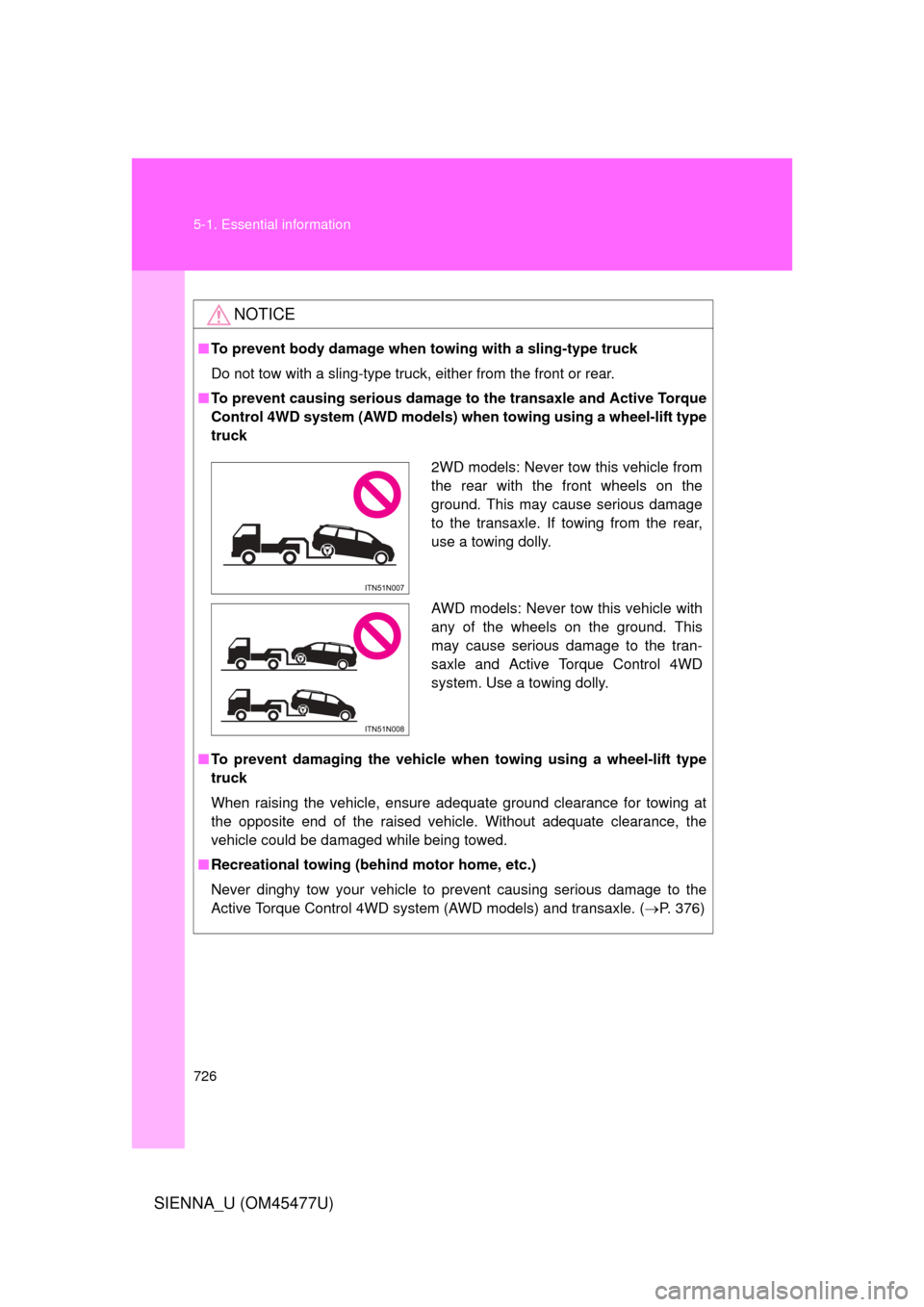
2WD models: Never tow this vehicle from
the rear with the front wheels on the
ground. This may cause serious damage
to the transaxle. If towing from the rear,
use a towing dolly.
AWD models: Never tow this vehicle with
any of the wheels on the ground. This
may cause serious damage to the tran-
saxle and Active Torque Control 4WD
system. Use a towing dolly.
ITN51N007
ITN51N008
Page 736 of 860

736 5-2. Steps to take in an emergency
SIENNA_U (OM45477U)
*1:Open door warning buzzer:A buzzer will sound if the vehicle reaches a speed of 3 mph (5 km/h) with any
door open.
*2:Driver’s and front passenger’s seat belt warning buzzers:The driver’s and front passenger’s seat belt warning buzzers sound to alert
the driver and front passenger that his or her seat belt is not fastened. The
buzzer sounds intermittently for 10 seconds after the vehicle has reached a
speed of 12 mph (20 km/h). Then, if the seat belt is still unfastened, the
buzzer will sound at a different tone for 20 more seconds.
*3:Refer to the separate “Scheduled Maintenance Guide” or “Owner’s ManualSupplement” for the maintenance interval applicable to your vehicle.
Warning lightWarning light/DetailsCorrection procedure
(AWD models) Active Torque Control
4WD system warning light
When the light blinks: The
system has been over-
loaded and front-wheel
drive has been automati-
cally engaged. Drop your speed or stop the
vehicle until the light stops
blinking. (Do not stop the
engine.)
When the light comes on:
Malfunction in the Active
Torque Control 4WD sys-
tem. Have the system checked
by your Toyota dealer.
Page 739 of 860

5
When trouble arises
739
5-2. Steps to take in an emergency
SIENNA_U (OM45477U)
■If the tire pressure warning system is inoperative
The tire pressure warning system will be disabled in the following condi-
tions:
(When the condition be
comes normal, the system will work properly.)
●If tires not equipped with tire pressure warning valves and transmit-
ters are used.
●If the ID code on the tire pressure warning valves and transmitters is
not registered in the tire pressure warning computer.
The tire pressure warning system may be disabled in the following condi-
tions:
(When the condition be comes normal, the system will work properly.)
●If electronic devices or facilities using similar radio wave frequencies
are nearby.
●If a radio set at similar frequencies is in use in the vehicle.
●If there is a lot of snow or ice on the vehicle, in particular around the
wheels or wheel housings.
●If non-genuine Toyota wheels are used. (Even if you use Toyota
wheels, the tire pressu re warning system may not work properly with
some types of tires.)
●If tire chains are used.
Page 741 of 860

5
When trouble arises
741
5-2. Steps to take in an emergency
SIENNA_U (OM45477U)
CAUTION
■When the electric power steering system warning light comes on
The steering wheel may become extremely heavy.
If the steering wheel becomes heavier than usual when operating, hold
firmly and operate using more force than usual.
■If the tire pressure warning light comes on
Be sure to observe the following precautions. Failure to do so could
cause loss of vehicle control and result in death or serious injury.
●Vehicles with standard tires:
• Stop your vehicle in a safe place as soon as possible. Adjust the
tire inflation pressure immediately.
• If the tire pressure warning light comes on even after tire inflation pressure adjustment, it is probable that you have a flat tire. Check
the tires. If a tire is flat, change it with the spare tire and have the
flat tire repaired by the nearest Toyota dealer.
• Avoid abrupt maneuvering and brak ing. If the vehicle tires deterio-
rate, you could lose control of th e steering wheel or the brakes.
●Vehicles with run-flat tires:
• Decelerate to the lowest appropr iate speed as soon as possible.
Do not drive over 55 mph (90 km/h).
• Check and adjust the tire inflation pressure immediately.
• If the tire pressure warning light comes on even after tire inflation pressure adjustment, it is probable that you have a flat tire. Have
the tire replaced by the nearest Toyota dealer.
• Avoid abrupt maneuvering and brak ing. If the vehicle tires deterio-
rate, you could lose control of th e steering wheel or the brakes.
Page 743 of 860

5
When trouble arises
743
5-2. Steps to take in an emergency
SIENNA_U (OM45477U)
CAUTION
Your vehicle has also been equipped with a TPMS (tire pressure warning
system) malfunction indicator to indi
cate when the system is not operat-
ing properly. The TPMS (tire pressure warning system) malfunction indi-
cator is combined with the low tire pressure telltale (tire pressure
warning light). When the system det ects a malfunction, the telltale will
flash for approximately one minute an d then remain continuously illumi-
nated. This sequence will continue upon subsequent vehicle start-ups as
long as the malfunction exists. When the malfunction indi cator is illumi-
nated, the system may not be able to detect or signal low tire pressure
as intended.
TPMS (tire pressure warning system) malfunctions may occur for a vari-
ety of reasons, including the installati on of replacement or alternate tires
or wheels on the vehicle that prevent the TPMS (tire pressure warning
system) from functioning properly. Always check the TPMS (tire pres-
sure warning system) malfunction te lltale after replacing one or more
tires or wheels on your vehicle to ensure that the replacement or alter-
nate tires and wheels allow the TPMS (tire pressure warning system) to
continue to function properly.
NOTICE
■Precaution when installing a different tire
When a tire of a different specification or maker is installed, the tire pres-
sure warning system may not operate properly.
Page 746 of 860
746 5-2. Steps to take in an emergency
SIENNA_U (OM45477U)
NOTICE
■When replacing the tires
When removing or fitting the wheels, tires or the tire pressure warning
valve and transmitter, contact your Toyota dealer as the tire pressure
warning valve and transmitter may be damaged if not handled correctly.
■When driving over bumps
If a vehicle has a flat tire, the ve hicle height will be lower than usual.
Ensure that nothing strikes the bottom of the vehicle.
■To avoid damaging the tire pressure warning valves and transmit-
ters
Do not use liquid sealants on flat tires.
Page 747 of 860
5
When trouble arises
747
5-2. Steps to take in an emergency
SIENNA_U (OM45477U)
If you have a flat tire (vehicles with standard tires)
Remove the flat tire and replace it with the spare tire provided.
■Before jacking up the vehicle
●Stop the vehicle on a hard, flat surface.
● Set the parking brake.
● Shift the shift lever to P.
● Stop the engine.
● Turn on the emergency flashers.
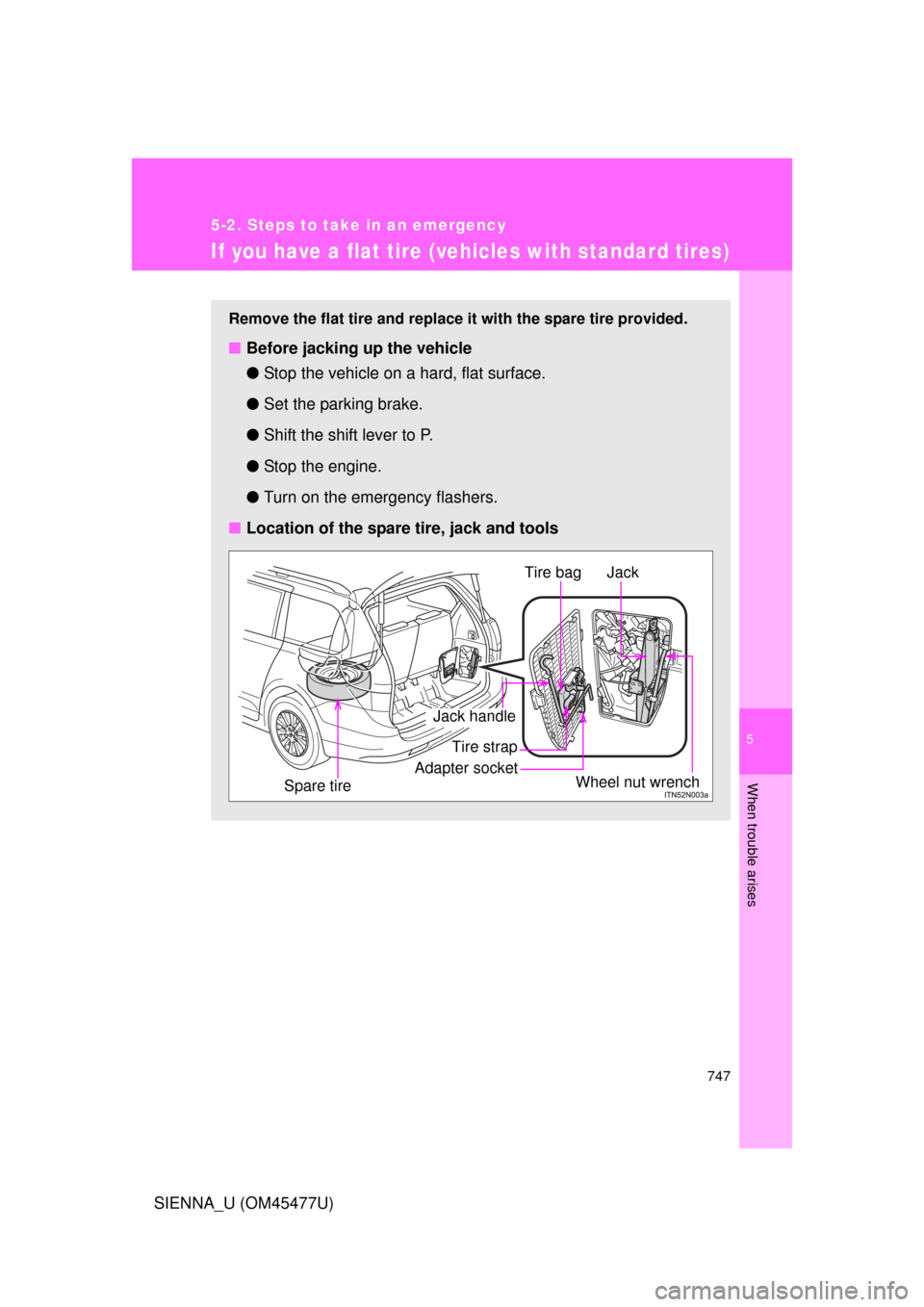
■ Location of the spare tire, jack and tools
Spare tire Jack
Wheel nut wrench
Jack handle Tire bag
Adapter socket
Tire strap