Page 755 of 860
5
When trouble arises
755
5-2. Steps to take in an emergency
SIENNA_U (OM45477U)
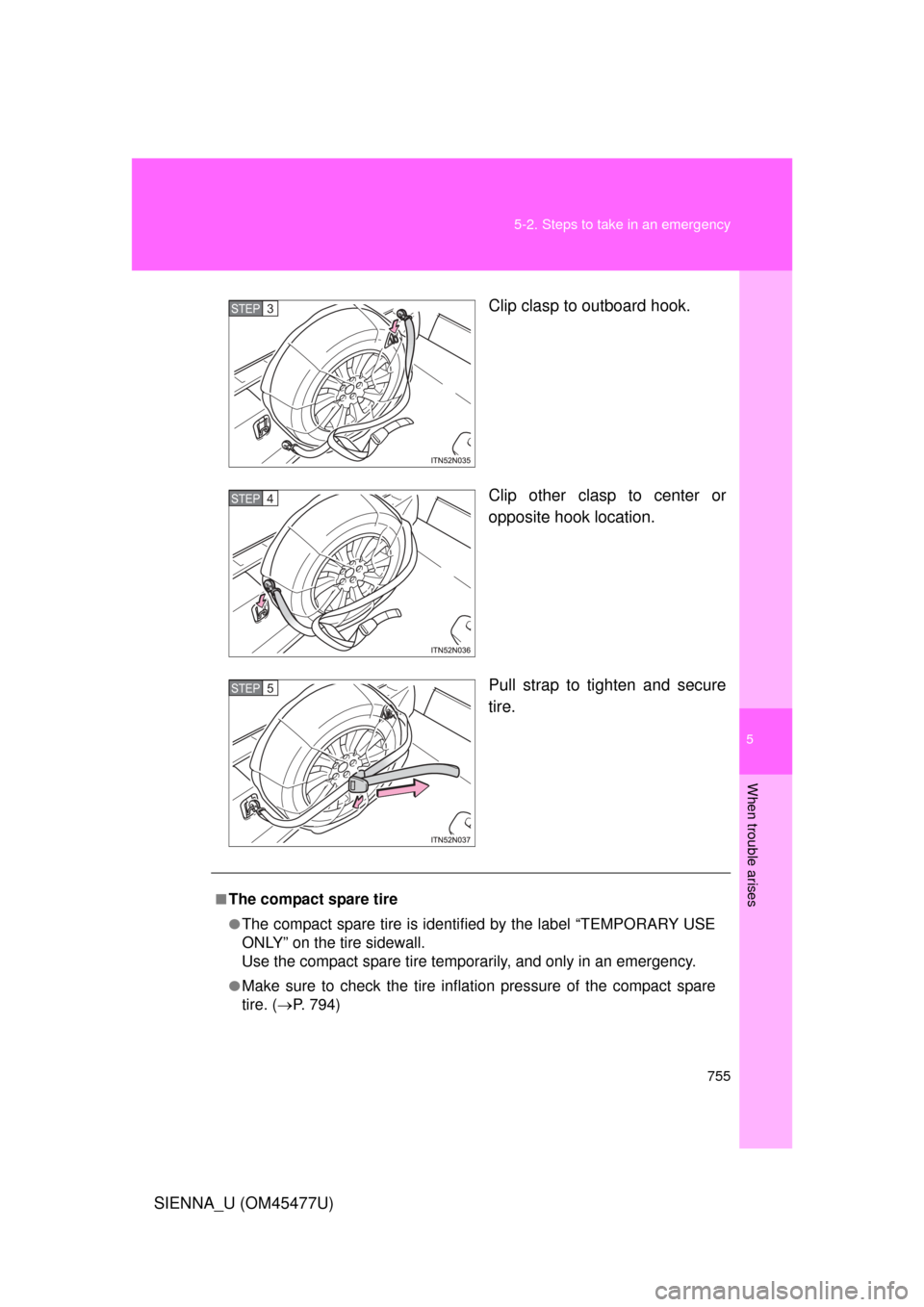
Clip clasp to outboard hook.
Clip other clasp to center or
opposite hook location.
Pull strap to tighten and secure
tire.
STEP3
STEP4
STEP5
■The compact spare tire
●The compact spare tire is identifi
ed by the label “TEMPORARY USE
ONLY” on the tire sidewall.
Use the compact spare tire temporarily, and only in an emergency.
●Make sure to check the tire inflation pressure of the compact spare
tire. ( P. 794)
Page 758 of 860
758 5-2. Steps to take in an emergency
SIENNA_U (OM45477U)
CAUTION
■Speed limit when using the compact spare tire
Do not drive at speeds in excess of 50 mph (80 km/h) when a compact
spare tire is installed on the vehicle.
The compact spare tire is not designed for driving at high speeds. Failure
to observe this precaution may lead to an accident causing death or seri-
ous injury.
■Using the tire jack
Improper use of the tire jack may cause the vehicle to suddenly fall off
the jack, leading to death or serious injury.
●Do not use the tire jack for any pu rpose other than replacing tires or
installing and removing tire chains.
●Only use the tire jack that comes with this vehicle for replacing a flat
tire. Do not use it on other vehicles, and do not use other tire jacks for
replacing tires on this vehicle.
●Always check that the tire jack is securely set to the jack point.
●Do not put any part of your body under the vehicle while it is supported
by the jack.
●Do not start or run the engine while your vehicle is supported by the
jack.
●Do not raise the vehicle while someone is inside.
●When raising the vehicle, do not put an object on or under the jack.
●Do not raise the vehicle to a hei ght greater than that required to
replace the tire.
●Use a jack stand if it is necessary to get under the vehicle.
Take particular care when lowering the vehicle to ensure that no one
working on or near the vehicle may be injured.
Page 760 of 860
760 5-2. Steps to take in an emergency
SIENNA_U (OM45477U)
CAUTION
■Replacing a flat tire for vehicles with power sliding door and/or
power back door
In cases such as when re placing tires, make sure to turn off the power
sliding door main switch ( P. 70) and/or the power back door main
switch ( P. 84). Failure to do so may cause the sliding door and/or the
back door to operate unintentionally if the power sliding door switch and/
or the power back door switch is ac cidentally touched, resulting in hands
and fingers being caught and injured.
■When stowing the flat tire
●Make sure the third seats ar e in their original position.
●Secure it using a tire strap. Otherwis e, the flat tire may fly out in case
of sudden braking or an accident, resulting in death or serious injury.
NOTICE
■When loosening or tightening the spare tire clamp bolt
Do not use an impact wrench. Use the adapter socket and jack handle.
■Do not drive the vehicle with a flat tire
Do not continue driving with a flat tire.
Driving even a short distance with a flat tire can damage the tire and the
wheel beyond repair.
■Be careful when driving over bumps with the compact spare tire
installed on the vehicle
The vehicle becomes lower when driving with the compact spare tire
compared to when drivin g with standard tires. Be careful when driving
over uneven road surfaces.
Page 761 of 860
5
When trouble arises
761
5-2. Steps to take in an emergency
SIENNA_U (OM45477U)
NOTICE
■Driving with tire chains and the compact spare tire
Do not fit tire chains to the compact spare tire.
Tire chains may damage the vehicle body and adversely affect driving
performance.
■When replacing the tires
When removing or fitting the wheels, tires or the tire pressure warning
valve and transmitter, contact your
Toyota dealer as the tire pressure
warning valve and transmitter may be damaged if not handled correctly.
■To avoid damage to the tire pressure warning valves and transmit-
ters
When a tire is repaired with liquid sealants, the tire pressure warning
valve and transmitter may not operate properly. If a liquid sealant is
used, contact your Toyota dealer or other qualified service shop as soon
as possible. Make sure to replace the tire pressure warning valve and
transmitter when replacing the tire. ( P. 674)
■After taking out or stowing the spare tire
Make sure to secure the tire carrier by tightening the clamp bolt to pre-
vent the holding bracket from hitting the under body of the vehicle during
driving.
■Using the tire carrier
●As the tire carrier is designed fo r use with the compact spare tire, it
cannot be used with standard tires.
●If the spare tire is flat, do not use th e tire carrier, as the tire may not be
held securely.
Page 772 of 860
772 5-2. Steps to take in an emergency
SIENNA_U (OM45477U)
Start the engine of the second vehicle. Increase the engine
speed slightly and maintain at that level for approximately 5
minutes to recharge the battery of your vehicle.
Vehicles with a smart key system only: Open and close any
of the doors of your vehicle with the “ENGINE START
STOP” switch off.
Maintain the engine speed of the second vehicle and start
the engine of your vehicle by turning the engine switch to
the “ON” position (vehicles without a smart key system) or
turning the “ENGINE START STOP” switch to IGNITION
ON mode (vehicles with a smart key system).
Once the vehicle’s engine has started, remove the jumper
cables in the exact reverse or der from which they were con-
nected.
Vehicles with a 2GR-FE engine only: To install the engine
cover, conduct the removal procedure in reverse. After
installing, check that the fixed pins are inserted securely.
Once the engine starts, have the vehicle inspected at your Toyota
dealer as soon as possible.STEP3
STEP4
STEP5
STEP6
STEP7
Page 781 of 860
5
When trouble arises
781
5-2. Steps to take in an emergency
SIENNA_U (OM45477U)
CAUTION
■
If the engine has to be turned off while driving
● Power assist for the brakes and steering wheel will be lost, making the
brake pedal harder to depress and the steering wheel heavier to turn.
Decelerate as much as possible before turning off the engine.
● Vehicles without a smart key system: Never attempt to remove the key, as
doing so will lock the steering wheel.
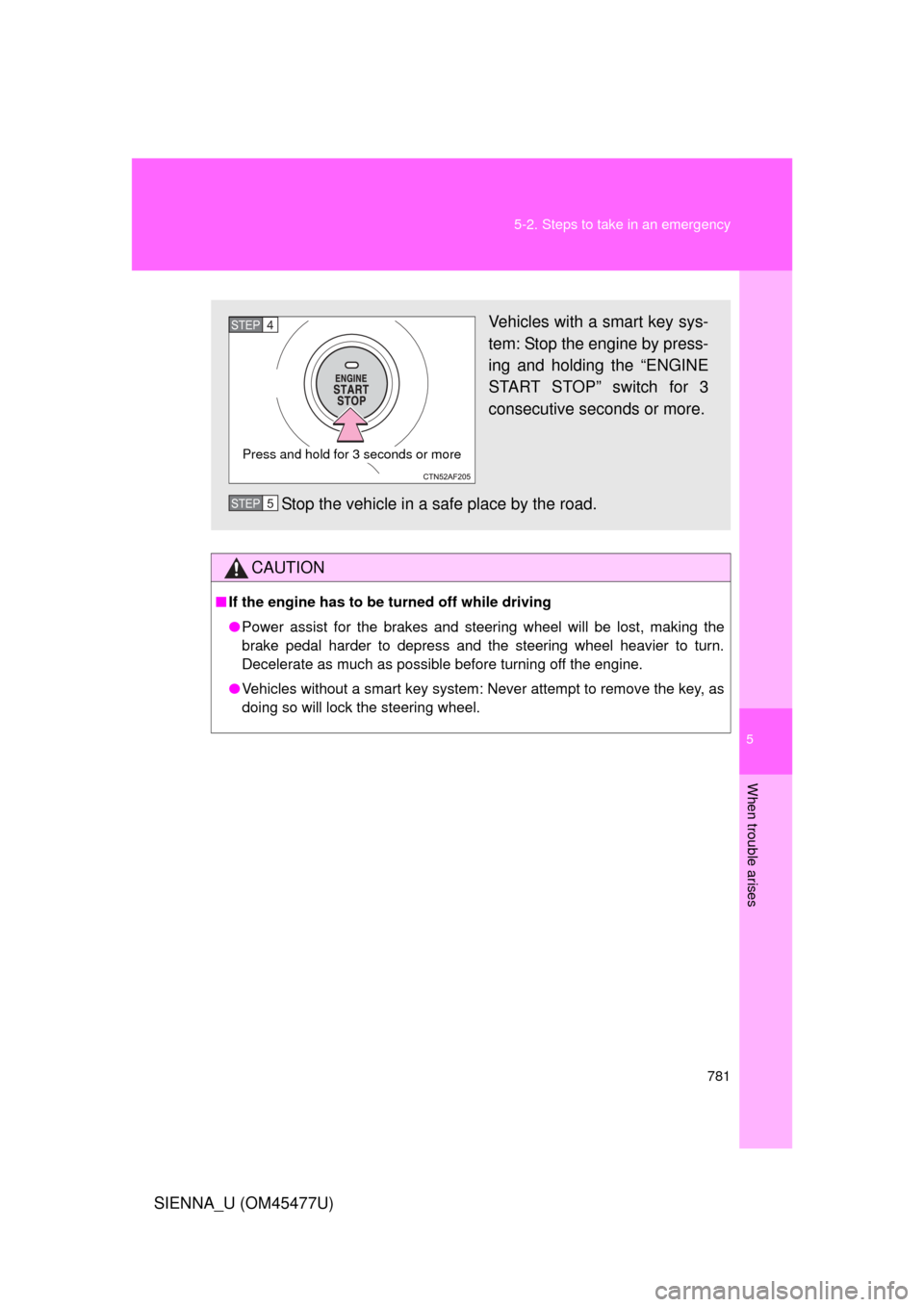
Vehicles with a smart key sys-
tem: Stop the engine by press-
ing and holding the “ENGINE
START STOP” switch for 3
consecutive seconds or more.
Stop the vehicle in a safe place by the road.
Press and hold for 3 seconds or more
STEP4
STEP5
Page 814 of 860
814 6-1. Specifications
SIENNA_U (OM45477U)
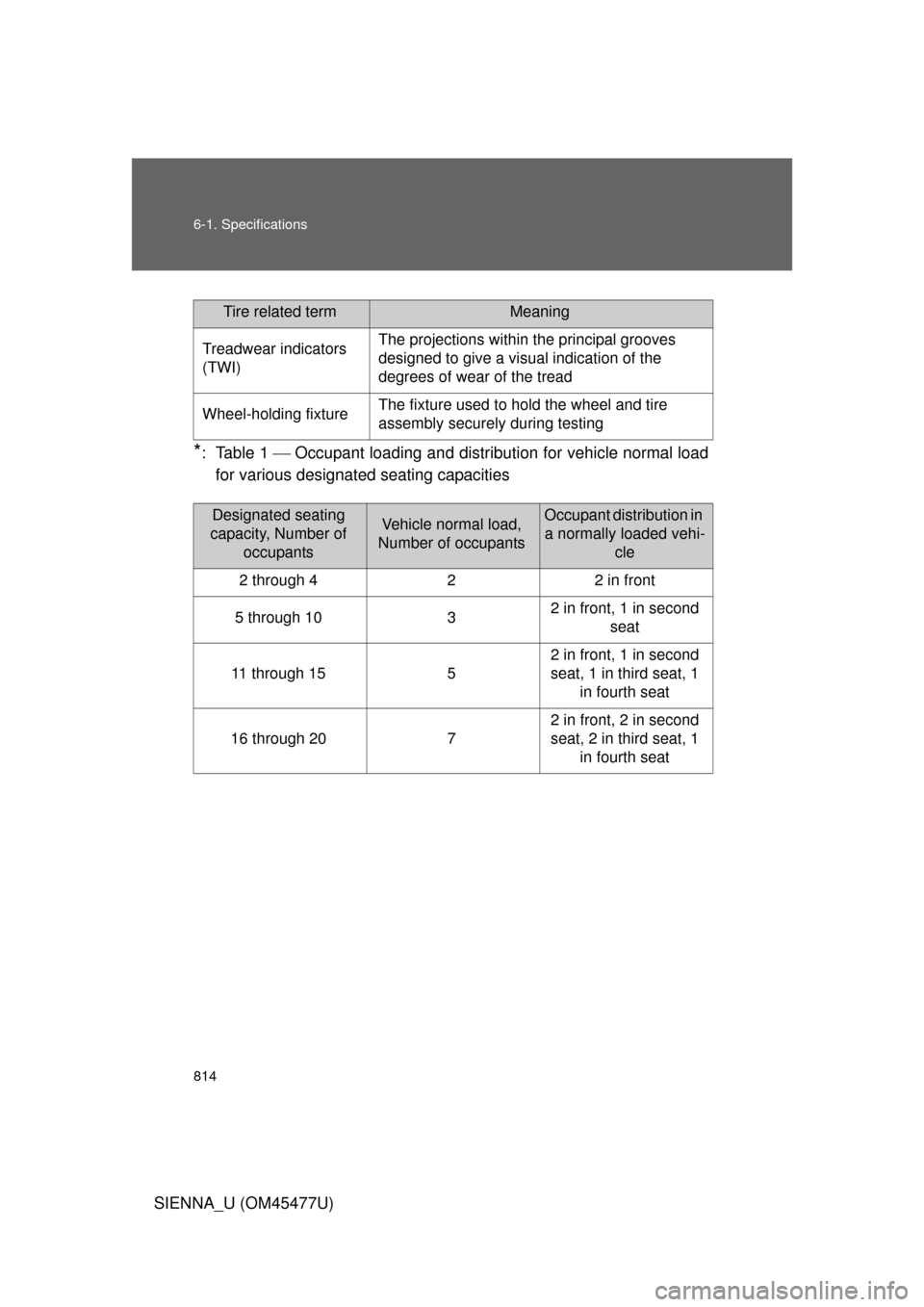
*: Table 1 Occupant loading and distri bution for vehicle normal load
for various designated seating capacities
Tire related termMeaning
Treadwear indicators
(TWI) The projections within the principal grooves
designed to give a visual indication of the
degrees of wear of the tread
Wheel-holding fixture The fixture used to hold the wheel and tire
assembly securely
during testing
Designated seating
capacity, Number of occupantsVehicle normal load,
Number of occupantsOccupant distribution in a normally loaded vehi- cle
2 through 4 2 2 in front
5 through 10 3 2 in front, 1 in second
seat
11 through 15 5 2 in front, 1 in second
seat, 1 in third seat, 1
in fourth seat
16 through 20 7 2 in front, 2 in second
seat, 2 in third seat, 1
in fourth seat
Page 834 of 860
834
SIENNA_U (OM45477U)
AT T E N T I O N
■Précautions relatives aux coussins gonflables SRS
● Le coussin gonflable SRS du passager avant se déploie également avec
une force considérable et peut occasionner des blessures graves, voire
mortelles, notamment lorsque le passager avant se trouve très près du
coussin gonflable. Le siège du passager avant doit se trouver le plus loin
possible du coussin gonflable et le dossier doit être réglé de manière à ce
que le passager avant soit assis bien droit.
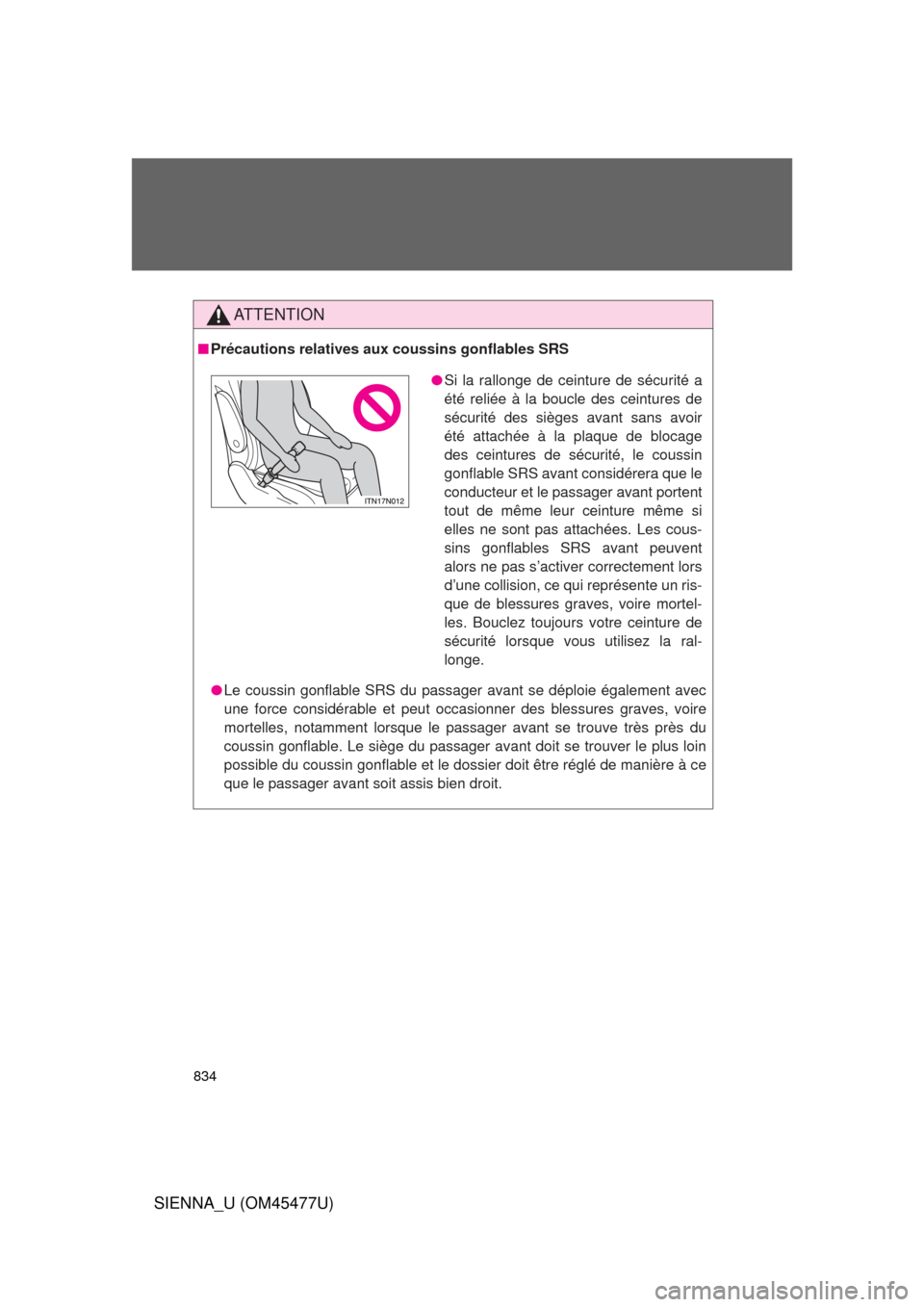
●Si la rallonge de ceinture de sécurité a
été reliée à la boucle des ceintures de
sécurité des sièges avant sans avoir
été attachée à la plaque de blocage
des ceintures de sécurité, le coussin
gonflable SRS avant considérera que le
conducteur et le passager avant portent
tout de même leur ceinture même si
elles ne sont pas attachées. Les cous-
sins gonflables SRS avant peuvent
alors ne pas s’activer correctement lors
d’une collision, ce qui représente un ris-
que de blessures graves, voire mortel-
les. Bouclez toujours votre ceinture de
sécurité lorsque vous utilisez la ral-
longe.