Page 131 of 692
131 1-6. Theft deterrent system
1
Before driving
L/C200_EE (OM60G38E)
Alarm-operated door lock
When the alarm is operating, the doors are locked automatically to pre-
vent intruders.
Do not leave the key inside the vehicle when the alarm is operating, and
make sure the key is not inside the vehicle when recharging or replacing
the battery.
Canceling and automatic re-enabling of the intrusion sensor and tilt
sensor
The alarm will still be set even when the intrusion sensor and tilt sensor
are canceled.
After the intrusion sensor and tilt sensor are canceled, pressing the
“ENGINE START STOP” switch or unlocking the doors using the entry
function or wireless remote control will re-enable the intrusion sensor and
tilt sensor.
When the alarm system is set again, the intrusion sensor and tilt sensor
will be set.
Page 150 of 692
150 1-7. Safety information
L/C200_EE (OM60G38E)
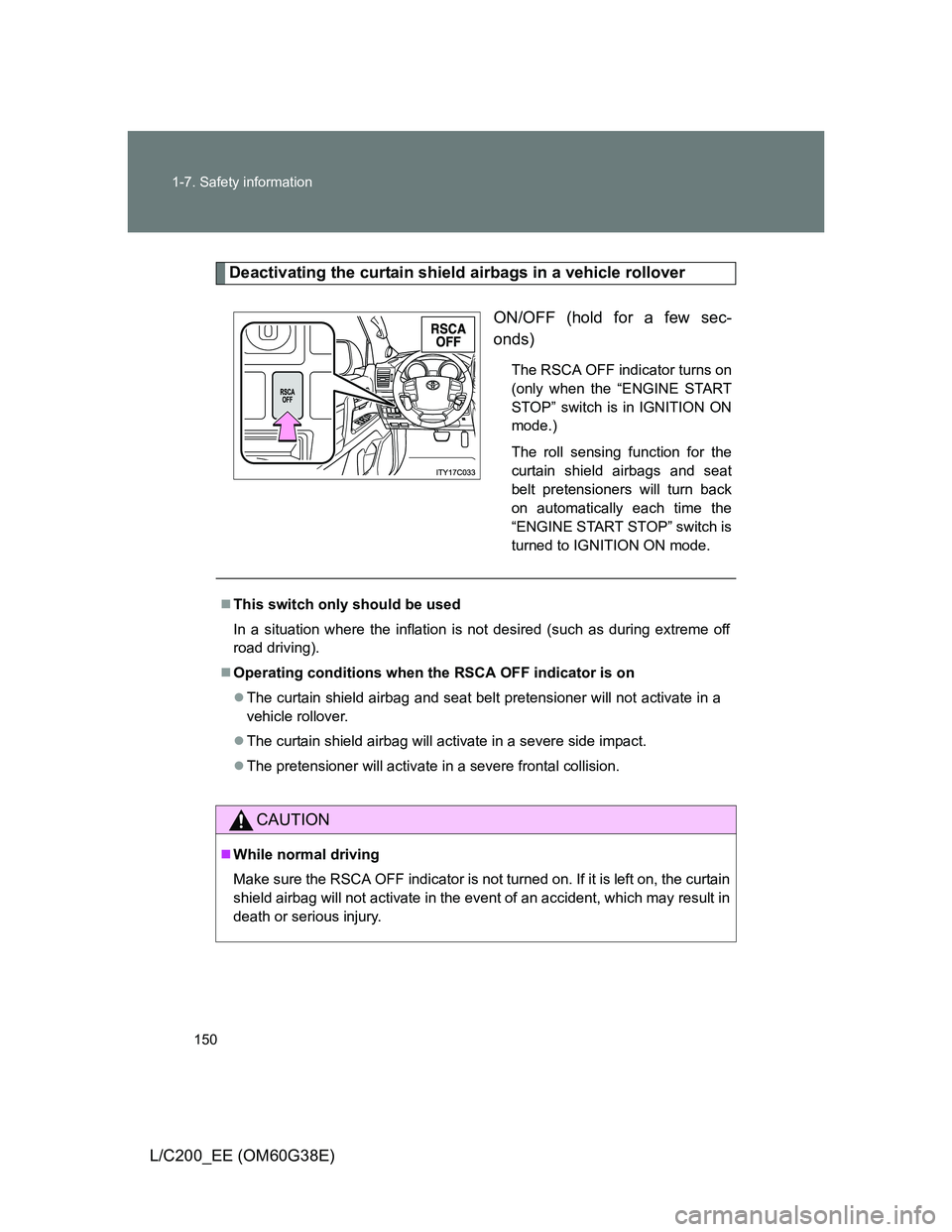
Deactivating the curtain shield airbags in a vehicle rollover
ON/OFF (hold for a few sec-
onds)
The RSCA OFF indicator turns on
(only when the “ENGINE START
STOP” switch is in IGNITION ON
mode.)
The roll sensing function for the
curtain shield airbags and seat
belt pretensioners will turn back
on automatically each time the
“ENGINE START STOP” switch is
turned to IGNITION ON mode.
This switch only should be used
In a situation where the inflation is not desired (such as during extreme off
road driving).
Operating conditions when the RSCA OFF indicator is on
The curtain shield airbag and seat belt pretensioner will not activate in a
vehicle rollover.
The curtain shield airbag will activate in a severe side impact.
The pretensioner will activate in a severe frontal collision.
CAUTION
While normal driving
Make sure the RSCA OFF indicator is not turned on. If it is left on, the curtain
shield airbag will not activate in the event of an accident, which may result in
death or serious injury.
Page 174 of 692
174
1-7. Safety information
L/C200_EE (OM60G38E)
Airbag manual on-off system
Deactivating the front seat passenger airbag, front passenger
side airbag and front passenger knee airbag
Insert the mechanical key into
the cylinder and rotate to the
“OFF” position.
The “OFF” indicator turns on.
(Only when the “ENGINE START
STOP” switch is in IGNITION ON
mode.)
This system deactivates the front passenger airbag, front passenger
side airbag and front passenger knee airbag.
Only deactivate the airbags when using a child restraint system on
the front passenger seat.
Airbag manual on-off indica-
tor
This indicator turns on when
the airbag system is ON. (Only
when the “ENGINE START
STOP” switch is in IGNITION
ON mode.)
Airbag manual on-off switch
ITY17C068
Page 177 of 692
2When driving
177
L/C200_EE (OM60G38E)
2-1. Driving procedures
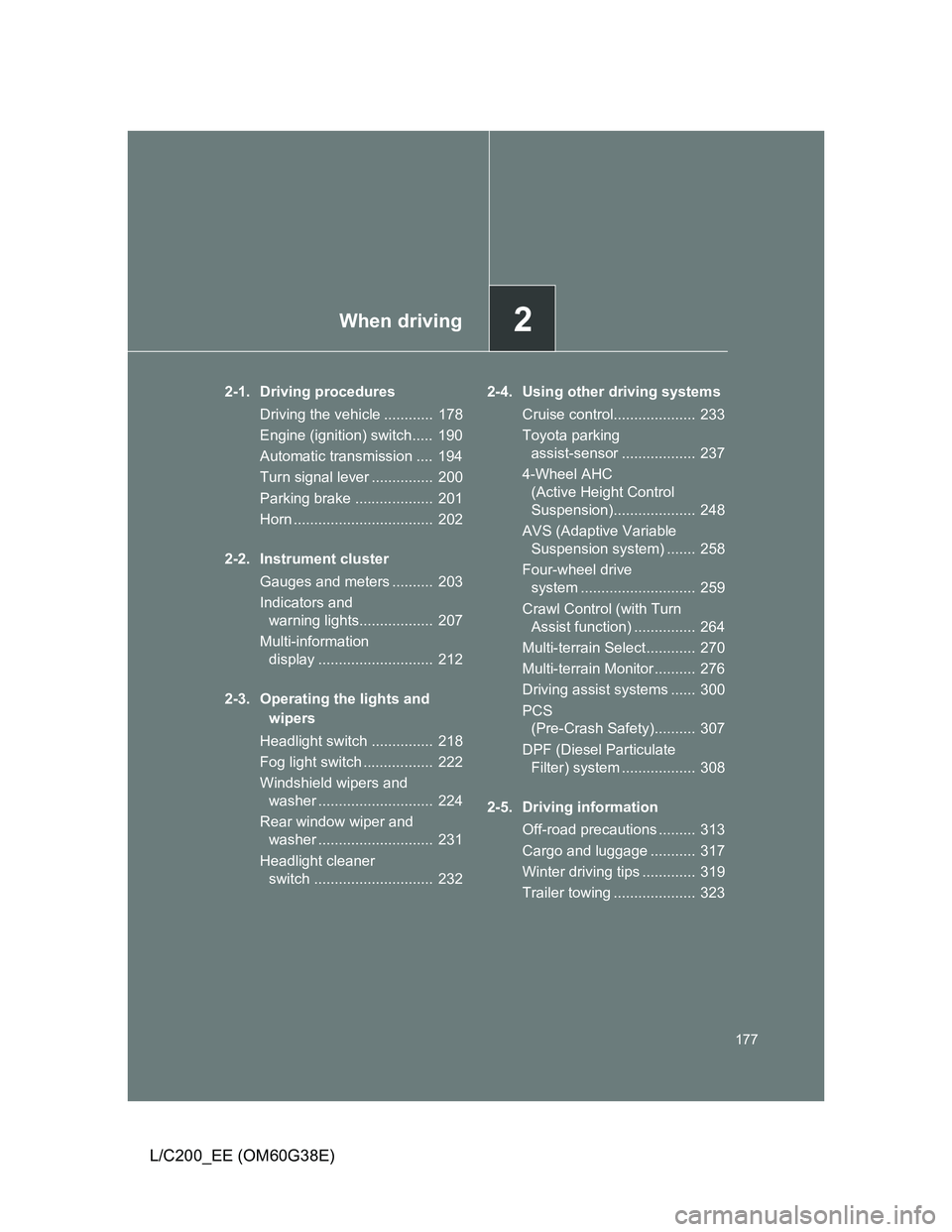
Driving the vehicle ............ 178
Engine (ignition) switch..... 190
Automatic transmission .... 194
Turn signal lever ............... 200
Parking brake ................... 201
Horn .................................. 202
2-2. Instrument cluster
Gauges and meters .......... 203
Indicators and
warning lights.................. 207
Multi-information
display ............................ 212
2-3. Operating the lights and
wipers
Headlight switch ............... 218
Fog light switch ................. 222
Windshield wipers and
washer ............................ 224
Rear window wiper and
washer ............................ 231
Headlight cleaner
switch ............................. 2322-4. Using other driving systems
Cruise control.................... 233
Toyota parking
assist-sensor .................. 237
4-Wheel AHC
(Active Height Control
Suspension).................... 248
AVS (Adaptive Variable
Suspension system) ....... 258
Four-wheel drive
system ............................ 259
Crawl Control (with Turn
Assist function) ............... 264
Multi-terrain Select ............ 270
Multi-terrain Monitor .......... 276
Driving assist systems ...... 300
PCS
(Pre-Crash Safety).......... 307
DPF (Diesel Particulate
Filter) system .................. 308
2-5. Driving information
Off-road precautions ......... 313
Cargo and luggage ........... 317
Winter driving tips ............. 319
Trailer towing .................... 323
Page 178 of 692
178
L/C200_EE (OM60G38E)
2-1. Driving procedures
Driving the vehicle
The following procedures should be observed to ensure safe driv-
ing.
Starting the engine (P. 190)
Driving
With the brake pedal depressed, shift the shift lever to “D”.
(P. 194)
Release the parking brake. (P. 201)
Gradually release the brake pedal and gently push the
accelerator pedal to accelerate the vehicle.
Stopping
With the shift lever in “D”, push the brake pedal.
If necessary, set the parking brake.
When the vehicle is stopped for an extended period of time, shift
the shift lever to “P” or “N”. (P. 194)
Parking the vehicle
With the shift lever in “D”, push the brake pedal.
Set the parking brake. (P. 201)
Shift the shift lever to “P”. (P. 194)
When parking on a hill, if necessary, block the wheels.
Press the “ENGINE START STOP” switch to stop the
engine.
Lock the door, making sure that you have the electronic key
on your person.
STEP1
STEP2
STEP3
STEP1
STEP2
STEP1
STEP2
STEP3
STEP4
STEP5
Page 179 of 692
179 2-1. Driving procedures
2
When driving
L/C200_EE (OM60G38E)
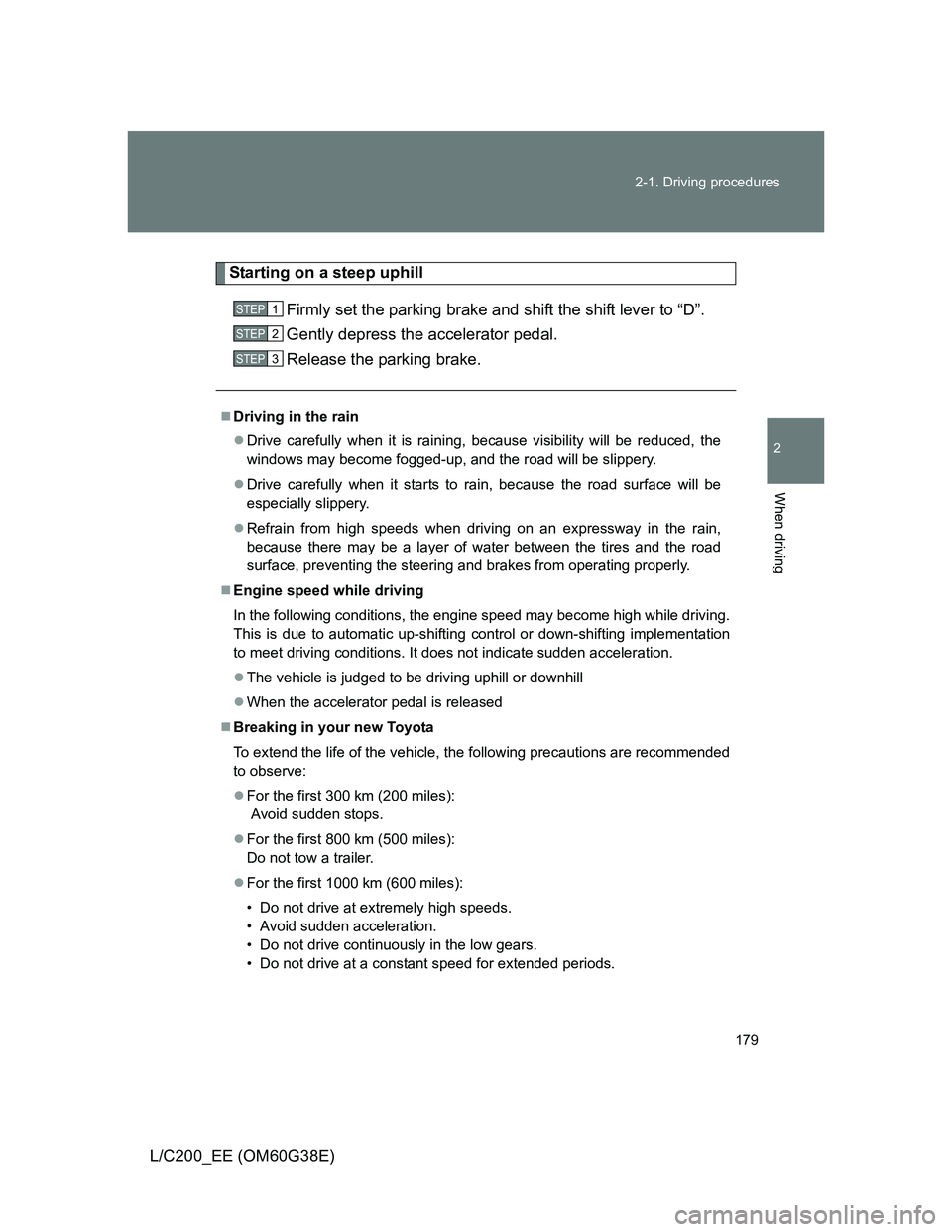
Starting on a steep uphill
Firmly set the parking brake and shift the shift lever to “D”.
Gently depress the accelerator pedal.
Release the parking brake.
Driving in the rain
Drive carefully when it is raining, because visibility will be reduced, the
windows may become fogged-up, and the road will be slippery.
Drive carefully when it starts to rain, because the road surface will be
especially slippery.
Refrain from high speeds when driving on an expressway in the rain,
because there may be a layer of water between the tires and the road
surface, preventing the steering and brakes from operating properly.
Engine speed while driving
In the following conditions, the engine speed may become high while driving.
This is due to automatic up-shifting control or down-shifting implementation
to meet driving conditions. It does not indicate sudden acceleration.
The vehicle is judged to be driving uphill or downhill
When the accelerator pedal is released
Breaking in your new Toyota
To extend the life of the vehicle, the following precautions are recommended
to observe:
For the first 300 km (200 miles):
Avoid sudden stops.
For the first 800 km (500 miles):
Do not tow a trailer.
For the first 1000 km (600 miles):
• Do not drive at extremely high speeds.
• Avoid sudden acceleration.
• Do not drive continuously in the low gears.
• Do not drive at a constant speed for extended periods.
STEP1
STEP2
STEP3
Page 180 of 692
180 2-1. Driving procedures
L/C200_EE (OM60G38E)
Drum-in-disc type parking brake system
Your vehicle has a drum-in-disc type parking brake system.
This type of brake system needs bedding-down of the brake shoes periodi-
cally or whenever the parking brake shoes and/or drums are replaced.
Have any authorized Toyota dealer or repairer, or another duly qualified and
equipped professional, perform the bedding-down.
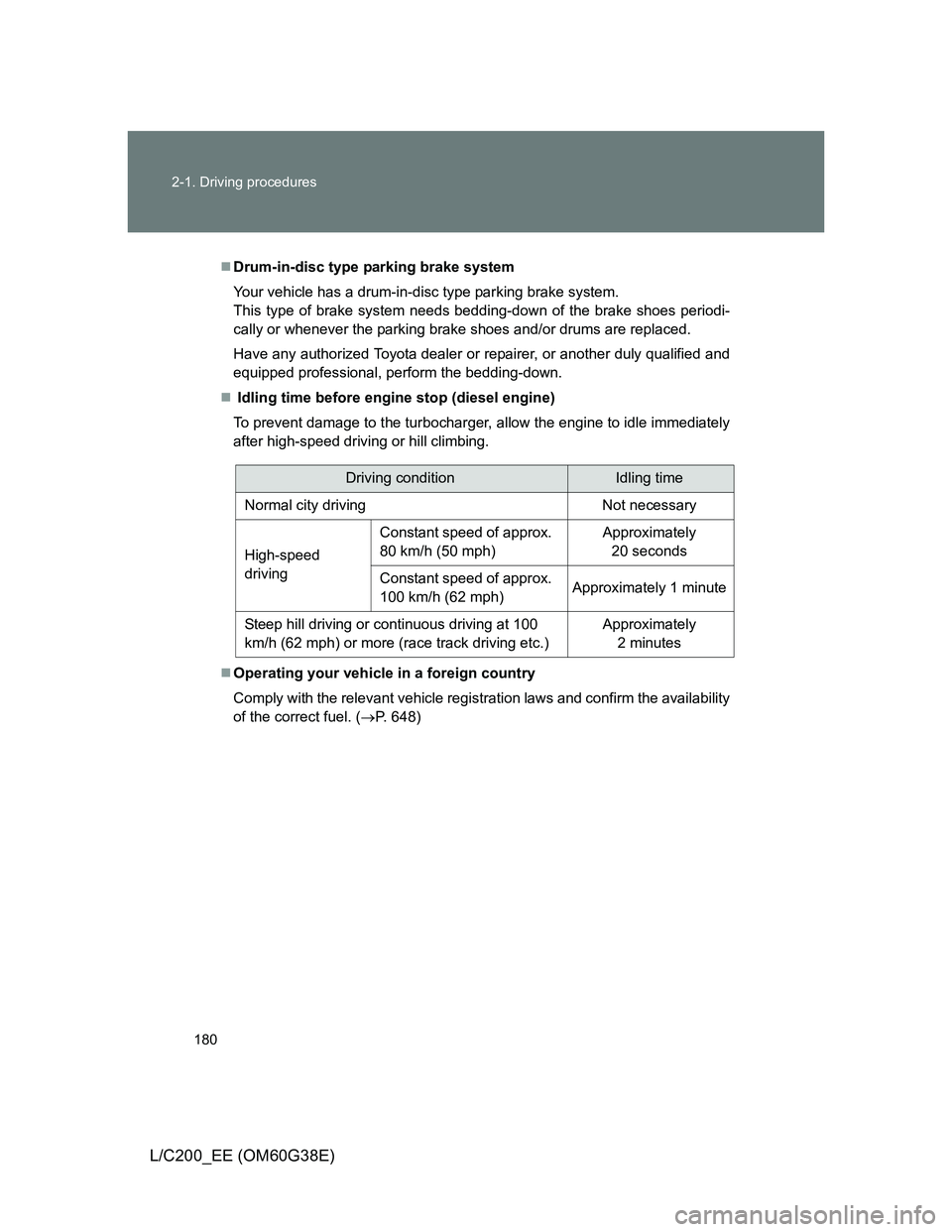
Idling time before engine stop (diesel engine)
To prevent damage to the turbocharger, allow the engine to idle immediately
after high-speed driving or hill climbing.
Operating your vehicle in a foreign country
Comply with the relevant vehicle registration laws and confirm the availability
of the correct fuel. (P. 648)
Driving conditionIdling time
Normal city driving Not necessary
High-speed
drivingConstant speed of approx.
80 km/h (50 mph)Approximately
20 seconds
Constant speed of approx.
100 km/h (62 mph)Approximately 1 minute
Steep hill driving or continuous driving at 100
km/h (62 mph) or more (race track driving etc.)Approximately
2 minutes
Page 182 of 692
182 2-1. Driving procedures
L/C200_EE (OM60G38E)
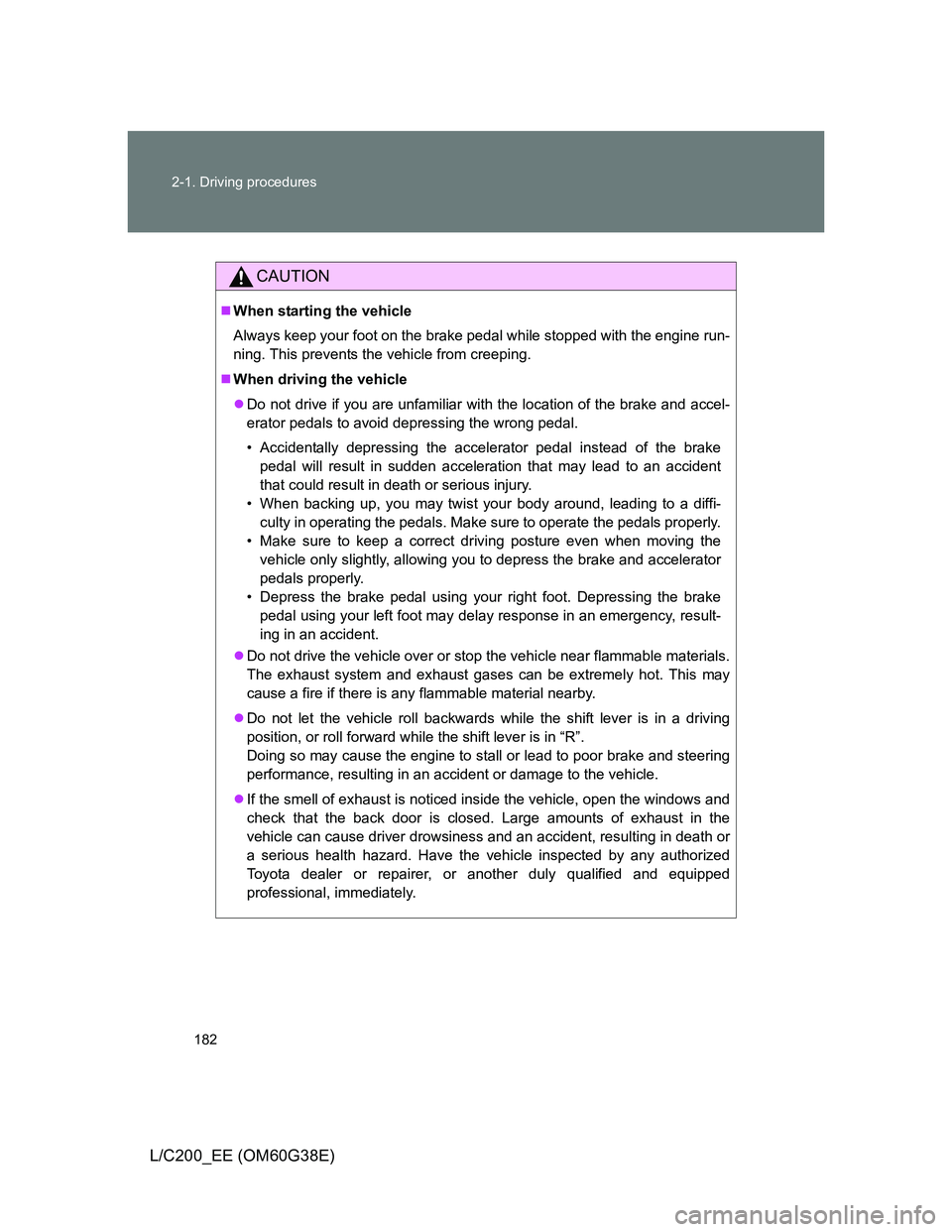
CAUTION
When starting the vehicle
Always keep your foot on the brake pedal while stopped with the engine run-
ning. This prevents the vehicle from creeping.
When driving the vehicle
Do not drive if you are unfamiliar with the location of the brake and accel-
erator pedals to avoid depressing the wrong pedal.
• Accidentally depressing the accelerator pedal instead of the brake
pedal will result in sudden acceleration that may lead to an accident
that could result in death or serious injury.
• When backing up, you may twist your body around, leading to a diffi-
culty in operating the pedals. Make sure to operate the pedals properly.
• Make sure to keep a correct driving posture even when moving the
vehicle only slightly, allowing you to depress the brake and accelerator
pedals properly.
• Depress the brake pedal using your right foot. Depressing the brake
pedal using your left foot may delay response in an emergency, result-
ing in an accident.
Do not drive the vehicle over or stop the vehicle near flammable materials.
The exhaust system and exhaust gases can be extremely hot. This may
cause a fire if there is any flammable material nearby.
Do not let the vehicle roll backwards while the shift lever is in a driving
position, or roll forward while the shift lever is in “R”.
Doing so may cause the engine to stall or lead to poor brake and steering
performance, resulting in an accident or damage to the vehicle.
If the smell of exhaust is noticed inside the vehicle, open the windows and
check that the back door is closed. Large amounts of exhaust in the
vehicle can cause driver drowsiness and an accident, resulting in death or
a serious health hazard. Have the vehicle inspected by any authorized
Toyota dealer or repairer, or another duly qualified and equipped
professional, immediately.