Page 162 of 692
162 1-7. Safety information
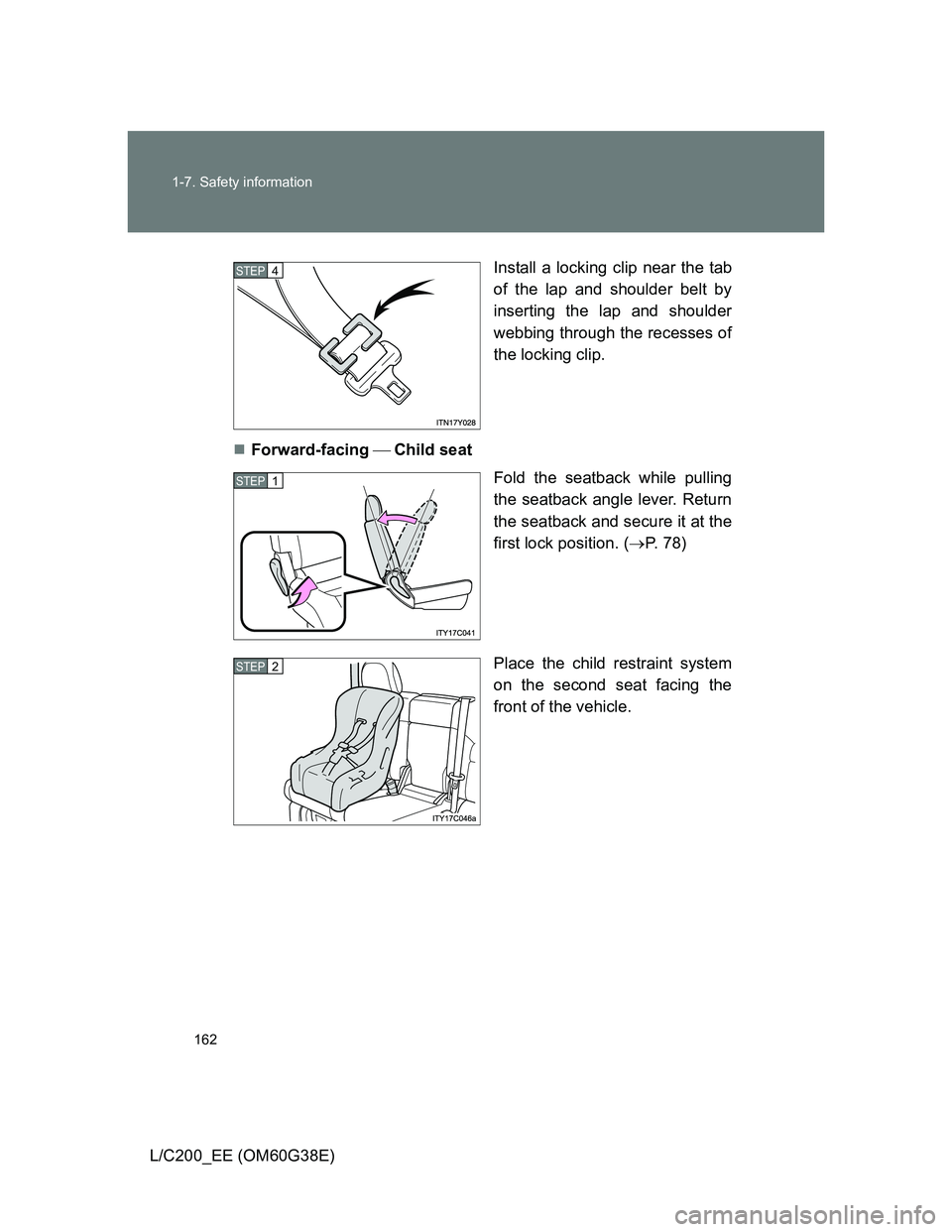
L/C200_EE (OM60G38E)Install a locking clip near the tab
of the lap and shoulder belt by
inserting the lap and shoulder
webbing through the recesses of
the locking clip.
Forward-facing Child seat
Fold the seatback while pulling
the seatback angle lever. Return
the seatback and secure it at the
first lock position. (P. 78)
Place the child restraint system
on the second seat facing the
front of the vehicle.
STEP4
STEP1
STEP2
Page 164 of 692
164 1-7. Safety information
L/C200_EE (OM60G38E)Junior seat
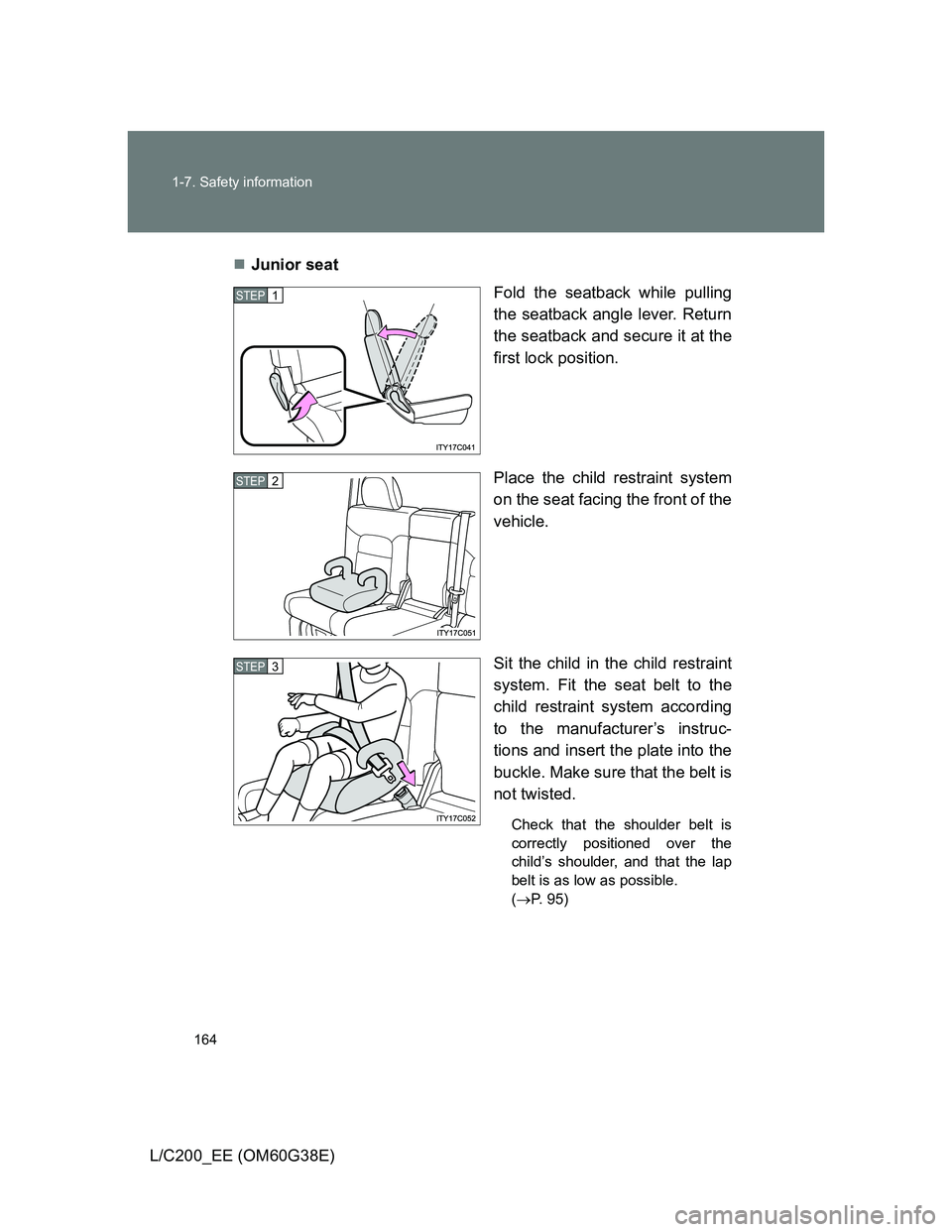
Fold the seatback while pulling
the seatback angle lever. Return
the seatback and secure it at the
first lock position.
Place the child restraint system
on the seat facing the front of the
vehicle.
Sit the child in the child restraint
system. Fit the seat belt to the
child restraint system according
to the manufacturer’s instruc-
tions and insert the plate into the
buckle. Make sure that the belt is
not twisted.
Check that the shoulder belt is
correctly positioned over the
child’s shoulder, and that the lap
belt is as low as possible.
(P. 95)
STEP1
STEP2
STEP3
Page 167 of 692
167 1-7. Safety information
1
Before driving
L/C200_EE (OM60G38E)
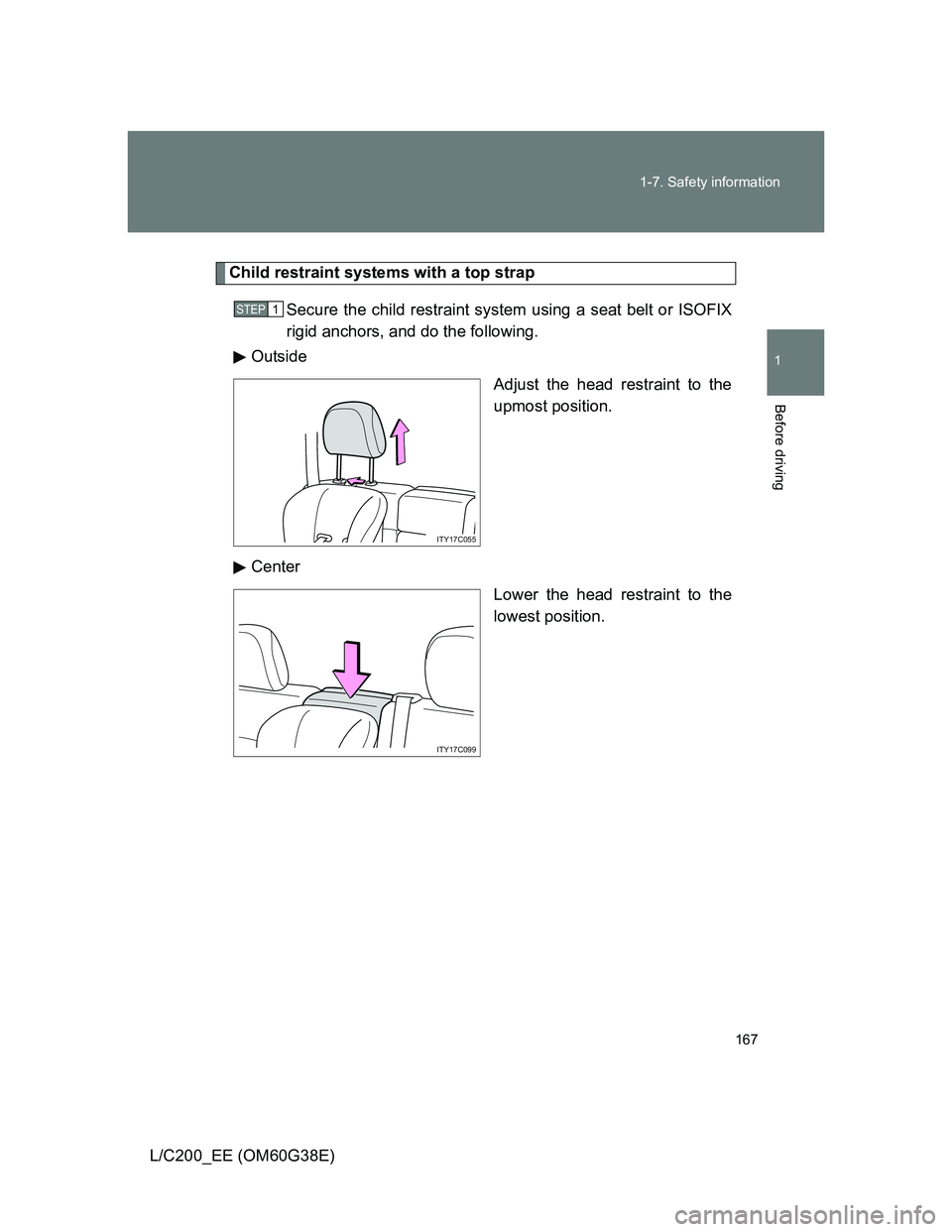
Child restraint systems with a top strap
Secure the child restraint system using a seat belt or ISOFIX
rigid anchors, and do the following.
Outside
Adjust the head restraint to the
upmost position.
Center
Lower the head restraint to the
lowest position.
STEP1
ITY17C055
ITY17C099
Page 168 of 692
168 1-7. Safety information
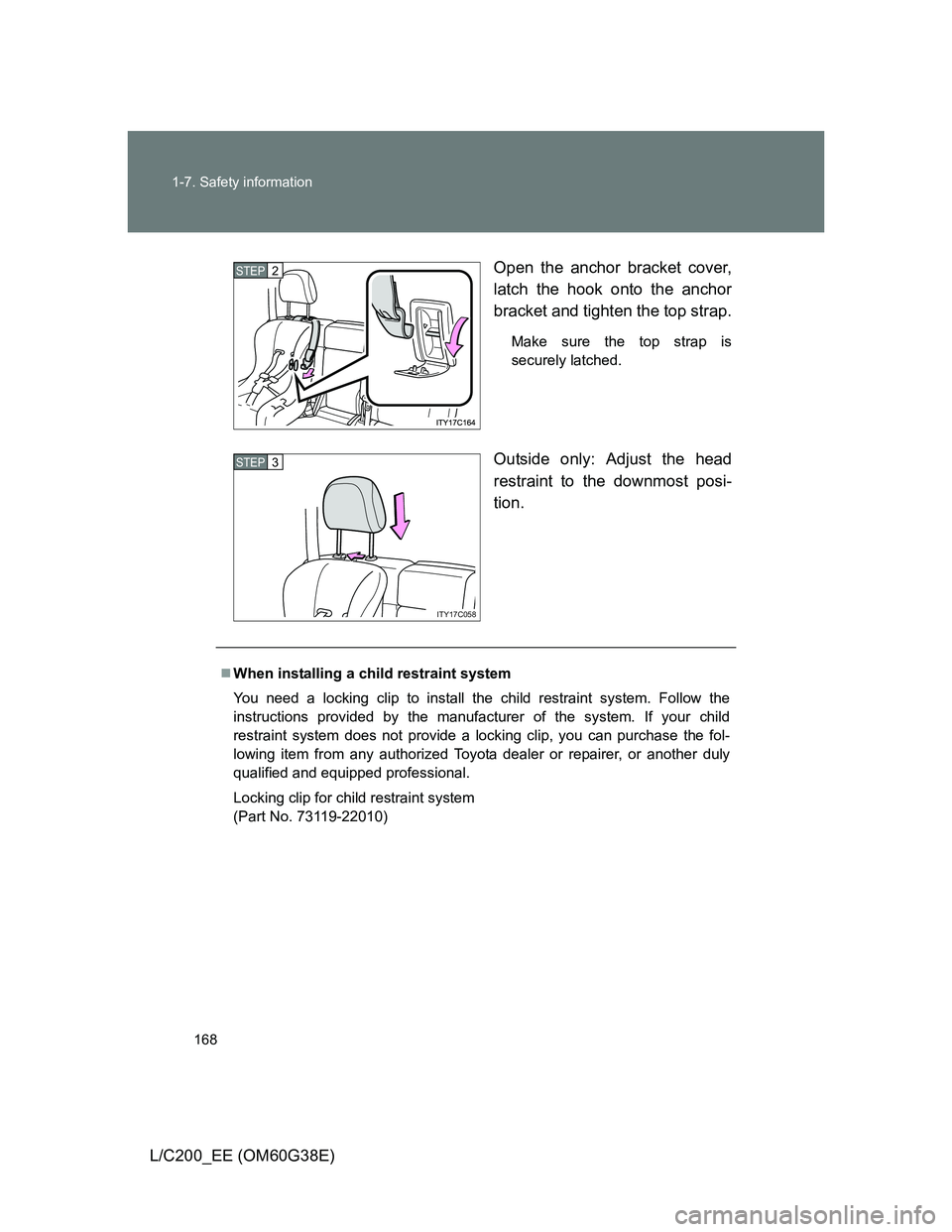
L/C200_EE (OM60G38E)Open the anchor bracket cover,
latch the hook onto the anchor
bracket and tighten the top strap.
Make sure the top strap is
securely latched.
Outside only: Adjust the head
restraint to the downmost posi-
tion.
STEP2
ITY17C058
STEP3
When installing a child restraint system
You need a locking clip to install the child restraint system. Follow the
instructions provided by the manufacturer of the system. If your child
restraint system does not provide a locking clip, you can purchase the fol-
lowing item from any authorized Toyota dealer or repairer, or another duly
qualified and equipped professional.
Locking clip for child restraint system
(Part No. 73119-22010)
Page 169 of 692
169 1-7. Safety information
1
Before driving
L/C200_EE (OM60G38E)
CAUTION
When installing a child restraint system
Follow the directions given in the child restraint system installation manual
and fix the child restraint system securely in place.
If the child restraint system is not correctly fixed in place, the child or other
passengers may be seriously injured or even killed in the event of sudden
braking, sudden swerving or an accident.
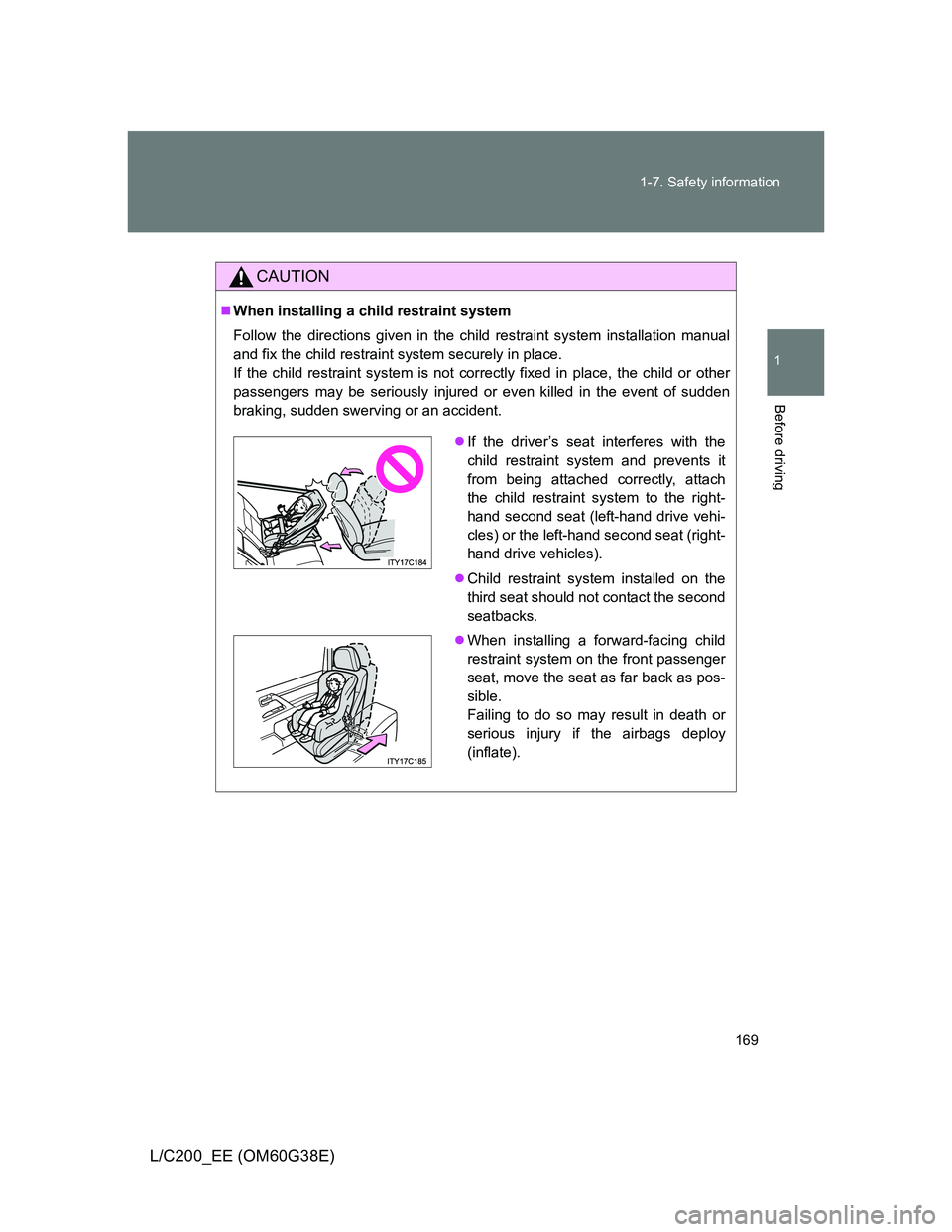
If the driver’s seat interferes with the
child restraint system and prevents it
from being attached correctly, attach
the child restraint system to the right-
hand second seat (left-hand drive vehi-
cles) or the left-hand second seat (right-
hand drive vehicles).
Child restraint system installed on the
third seat should not contact the second
seatbacks.
When installing a forward-facing child
restraint system on the front passenger
seat, move the seat as far back as pos-
sible.
Failing to do so may result in death or
serious injury if the airbags deploy
(inflate).
Page 173 of 692
173 1-7. Safety information
1
Before driving
L/C200_EE (OM60G38E)
CAUTION
When a junior seat is installed, always ensure that the shoulder belt is
positioned across the center of the child’s shoulder. The belt should be
kept away from the child’s neck, but not so that it could fall off the child’s
shoulder. Failing to do so may result in death or serious injury in the event
of sudden braking, sudden swerving or an accident.
Ensure that the belt and tab are securely locked and the seat belt is not
twisted.
Shake the child restraint left and right, and forward and back to ensure that
it has been securely installed.
Follow all installation instructions provided by the child restraint system
manufacturer.
To correctly attach a child restraint system to the anchors
When using the ISOFIX rigid anchors, be sure that there are no foreign
objects around the anchors and that the seat belt is not caught behind the
child restraint system. Make sure the child restraint system is securely
attached, or it may cause death or serious injury to the child or other passen-
gers in the event of a sudden stop, sudden swerve or accident.
Page 185 of 692
185 2-1. Driving procedures
2
When driving
L/C200_EE (OM60G38E)
CAUTION
When the vehicle is stopped
Do not race the engine.
If the vehicle is in any gear other than “P” or “N”, the vehicle may acceler-
ate suddenly and unexpectedly, and may cause an accident.
Do not leave the vehicle with the engine running for a long time.
If such a situation cannot be avoided, park the vehicle in an open space
and check that exhaust fumes do not enter the vehicle interior.
In order to prevent accidents due to the vehicle rolling away, always keep
depressing the brake pedal while the engine is running, and apply the
parking brake as necessary.
If the vehicle is stopped on an incline, in order to prevent accidents caused
by the vehicle rolling forward or backward, always depress the brake pedal
and securely apply the parking brake as needed.
Avoid revving or racing the engine.
Running the engine at high speed while the vehicle is stopped may cause
the exhaust system to overheat, which could result in a fire if combustible
material is nearby.
When the vehicle is parked
Do not leave glasses, cigarette lighters, spray cans, or soft drink cans in
the vehicle when it is in the sun.
Failure to do so may result in the following:
• Gas may leak from a cigarette lighter or spray can, and may lead to a
fire.
• The temperature inside the vehicle may cause the plastic lenses and
plastic material of eye glasses to deform or crack.
• Soft drink cans may fracture, causing the contents to spray over the
interior of the vehicle, and may also cause a short circuit in the vehi-
cle’s electrical components.
Always apply the parking brake, shift the shift lever to “P”, stop the engine
and lock the vehicle.
Do not leave the vehicle unattended while the engine is running.
Page 187 of 692
187 2-1. Driving procedures
2
When driving
L/C200_EE (OM60G38E)
CAUTION
When taking a nap in the vehicle
Always turn the engine off. Otherwise, you may accidentally move the shift
lever or depress the accelerator pedal, which could cause an accident or fire
due to engine overheating. Additionally, if the vehicle is parked in a poorly
ventilated area, exhaust gases may collect and may enter the vehicle, lead-
ing to death or a serious health hazard.
When braking the vehicle
When the brakes are wet, drive more cautiously.
Braking distance increases when the brakes are wet, and may cause one
side of the vehicle to brake differently than the other side. Also the parking
brake may not securely hold the vehicle.
If the power brake assist function does not operate, do not follow other
vehicles closely and avoid downhills or sharp turns that require braking.
In this case, braking is still possible, but it will require more force on the
pedal than usual. Braking distance may also increase.
Do not pump the brake pedal if the engine stalls.
Each push on the brake pedal uses up the reserve for the power-assisted
brakes.
The brake system consists of 2 individual hydraulic systems: If one of the
systems fails, the other will still operate. In this case, the brake pedal
should be depressed more firmly than usual and braking distance
becomes longer.
Do not drive your vehicle with only a single brake system. Have your
brakes fixed immediately.