Page 163 of 476

2When driving
163
iQ_WE_74014E
2-1. Driving procedures
Driving the vehicle ............ 164
Engine (ignition) switch
(vehicles without smart
entry & start system)....... 176
Engine (ignition) switch
(vehicles with smart
entry & start system)....... 179
Multidrive .......................... 185
Manual transmission......... 189
Turn signal lever ............... 193
Parking brake ................... 194
Horn .................................. 196
2-2. Instrument cluster
Gauges and meters .......... 197
Indicators and warning
lights ............................... 199
Multi-information display ... 205
2-3. Operating the lights and
wipers
Headlight switch ............... 211
Fog light switch ................. 216
Windshield wipers and
washer ............................ 218
Rear window wiper and
washer ............................ 2222-4. Using other driving systems
Driving assist systems ...... 224
2-5. Driving information
Cargo and luggage ........... 229
Winter driving tips ............. 231
Trailer towing .................... 235
Page 166 of 476
166 2-1. Driving procedures
iQ_WE_74014E
Starting on a steep uphill
Multidrive
With the brake pedal depressed, firmly set the parking brake
and shift the shift lever to D.
Gently depress the accelerator pedal.
Release the parking brake.
Manual transmission
With the parking brake firmly set and the clutch pedal fully
depressed, shift the shift lever to 1.
Lightly depress the accelerator pedal at the same time as
gradually releasing the clutch pedal.
Release the parking brake.
Driving in the rain
Drive carefully when it is raining, because visibility will be reduced, the
windows may become fogged-up, and the road will be slippery.
Drive carefully when it starts to rain, because the road surface will be
especially slippery.
Refrain from high speeds when driving on an expressway in the rain,
because there may be a layer of water between the tires and the road
surface, preventing the steering and brakes from operating properly.
Page 168 of 476

168 2-1. Driving procedures
iQ_WE_74014E
CAUTION
When starting the vehicle (vehicles with a Multidrive)
Always keep your foot on the brake pedal while stopped with the engine run-
ning. This prevents the vehicle from creeping.
When driving the vehicle
Do not drive if you are unfamiliar with the location of the clutch, brake and
accelerator pedals to avoid depressing the wrong pedal.
• Accidentally depressing the accelerator pedal instead of the brake
pedal will result in sudden acceleration that may lead to an accident
that could result in death or serious injury.
• When backing up, you may twist your body around, leading to a diffi-
culty in operating the pedals. Make sure to operate the pedals properly.
• Make sure to keep a correct driving posture even when moving the
vehicle only slightly, allowing you to depress the brake and accelerator
pedals properly.
• Depress the brake pedal using your right foot. Depressing the brake
pedal using your left foot may delay response in an emergency, result-
ing in an accident.
Do not drive the vehicle over or stop the vehicle near flammable materials.
The exhaust system and exhaust gases can be extremely hot. This may
cause a fire if there is any flammable material nearby.
Do not let the vehicle roll backward while the shift lever is in a driving posi-
tion, or roll forward while the shift lever is in R.
Doing so may cause the engine to stall or lead to poor brake and steering
performance, resulting in an accident or damage to the vehicle.
If the smell of exhaust is noticed inside the vehicle, open the windows and
check that the back door is closed. Large amounts of exhaust in the
vehicle can cause driver drowsiness and an accident, resulting in death or
a serious health hazard. Have the vehicle inspected by any authorized
Toyota dealer or repairer, or another duly qualified and equipped
professional immediately.
On vehicles with a Multidrive, do not shift the shift lever to P while the vehi-
cle is moving.
Doing so can damage the transmission and may result in a loss of vehicle
control.
Page 222 of 476
222
2-3. Operating the lights and wipers
iQ_WE_74014E
Rear window wiper and washer
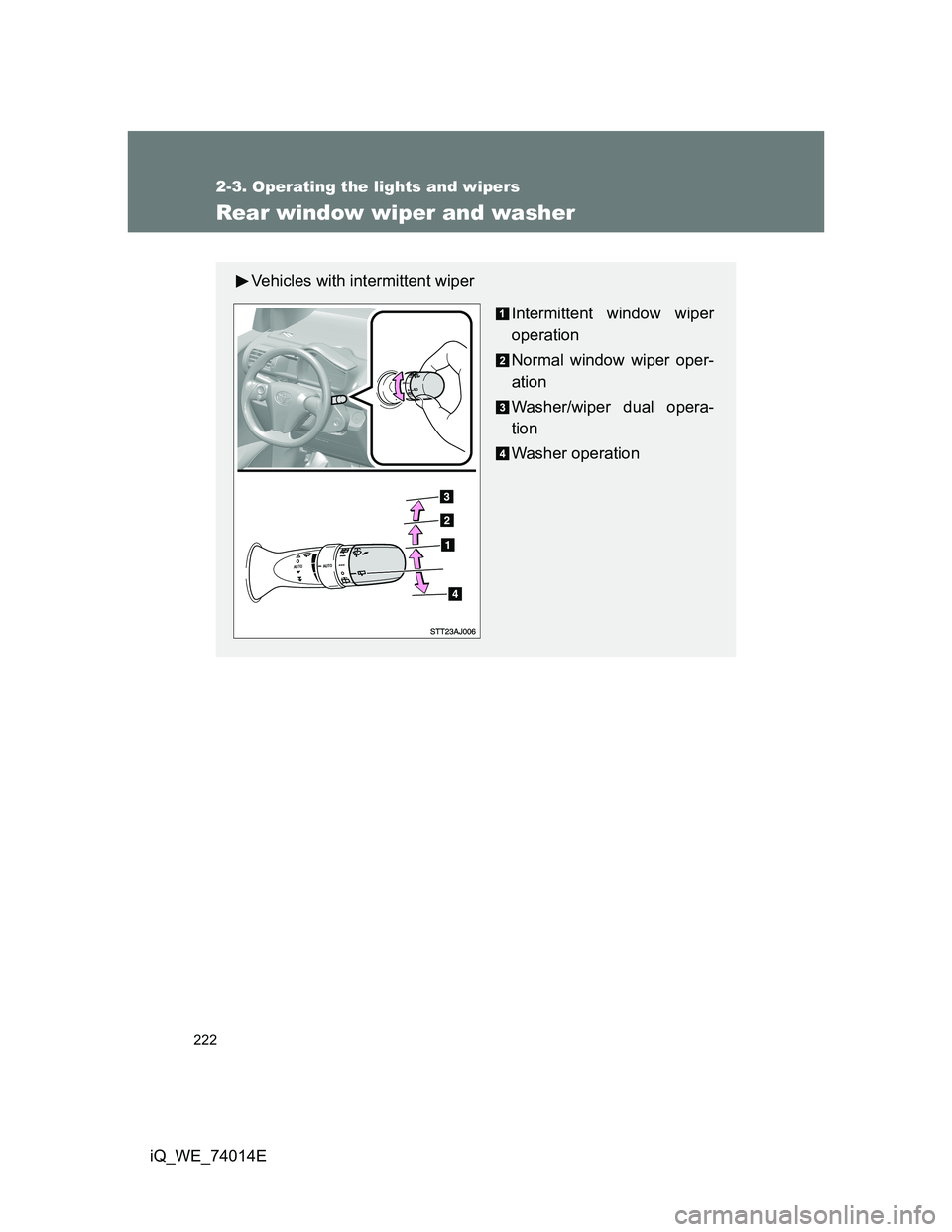
Vehicles with intermittent wiper
Intermittent window wiper
operation
Normal window wiper oper-
ation
Washer/wiper dual opera-
tion
Washer operation
Page 223 of 476
223 2-3. Operating the lights and wipers
2
When driving
iQ_WE_74014E
The rear window wiper and washer can be operated when
Vehicles without smart entry & start system
The engine switch is in the ON position.
Vehicles with smart entry & start system
The “ENGINE START STOP” switch is in IGNITION ON mode.
NOTICE
When the rear window is dry
Do not use the wipers, as they may damage the rear window.
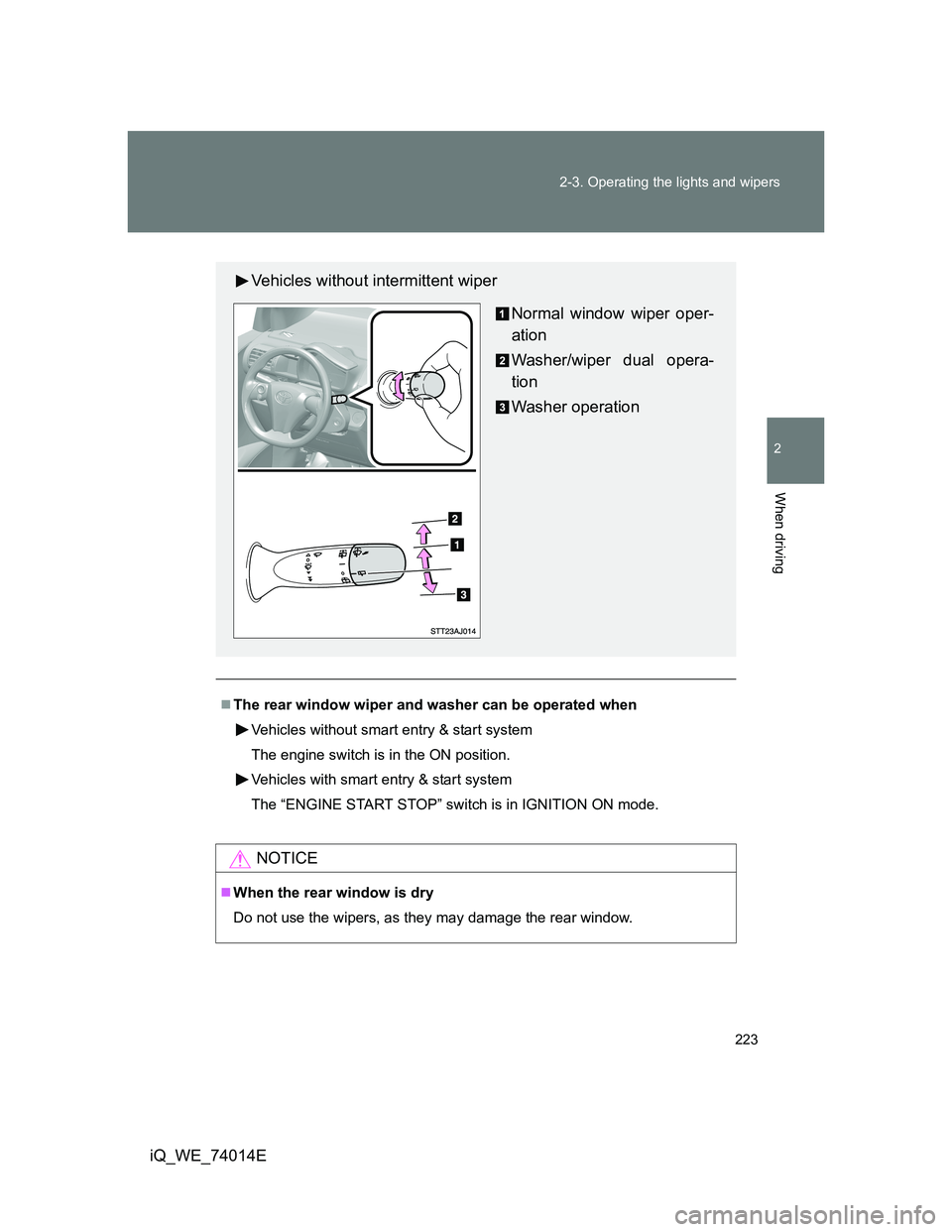
Vehicles without intermittent wiper
Normal window wiper oper-
ation
Washer/wiper dual opera-
tion
Washer operation
Page 231 of 476

231
2-5. Driving information
2
When driving
iQ_WE_74014E
Winter driving tips
Carry out the necessary preparations and inspections before driving
the vehicle in winter. Always drive the vehicle in a manner appropri-
ate to the prevailing weather conditions.
Pre-winter preparations
Use fluids that are appropriate to the prevailing outside tem-
peratures.
• Engine oil
• Engine coolant
• Washer fluid
Have a service technician inspect the level and specific grav-
ity of battery electrolyte.
Have the vehicle fitted with four snow tires or purchase a set
of tire chains for the front tires.
Ensure that all tires are the same size and brand, and that chains
match the size of the tires.
Before driving the vehicle
Perform the following according to the driving conditions.
Do not try to forcibly open a window, scrape an outside rear
view mirror surface or move a wiper or outside rear view mir-
ror that is frozen. Pour warm water over the frozen area to
melt the ice. Wipe away the water immediately to prevent it
from freezing.
To ensure proper operation of the climate control system fan,
remove any snow that has accumulated on the air inlet vents
in front of the windshield.
Remove any ice that has accumulated on the vehicle chassis.
Periodically check for and remove any excess ice or snow
that may have accumulated in the wheel well or on the
brakes.
Page 237 of 476

3Interior features
237
iQ_WE_74014E
3-1. Using the air conditioning
system and defogger
Manual air conditioning
system ............................ 238
Automatic air conditioning
system ............................ 244
Rear window defogger...... 252
Rear window and outside
rear view mirror
defoggers ....................... 254
3-2. Using the audio system
Audio system type ............ 257
Using the radio ................. 260
Using the CD player ......... 265
Playing back MP3 and
WMA discs...................... 272
Optimal use of the audio
system ............................ 280
Using the AUX port ........... 282
Using the steering wheel
audio switches ................ 284
3-3. Using the interior lights
Interior lights list................ 286
• Interior light ..................... 2873-4. Using the storage features
List of storage features ..... 288
• Cup holder ...................... 289
• Bottle holders.................. 289
• Auxiliary box ................... 290
3-5. Other interior features
Sun visors ......................... 293
Vanity mirrors.................... 294
Power outlet ...................... 295
Seat heaters ..................... 296
Assist grips ....................... 298
Floor mat........................... 299
Luggage compartment
features........................... 301
Page 240 of 476
240 3-1. Using the air conditioning system and defogger
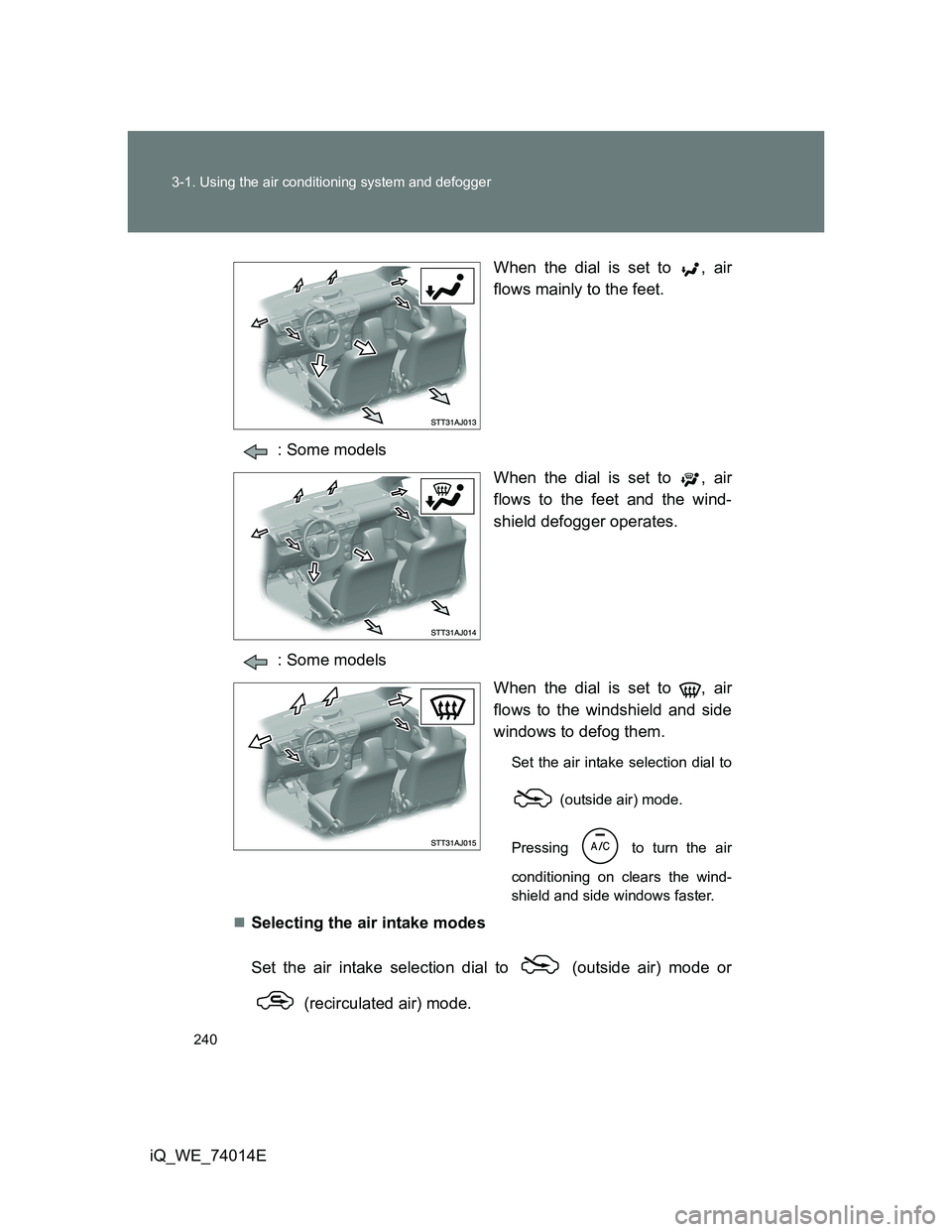
iQ_WE_74014EWhen the dial is set to , air
flows mainly to the feet.
: Some models
When the dial is set to , air
flows to the feet and the wind-
shield defogger operates.
: Some models
When the dial is set to , air
flows to the windshield and side
windows to defog them.
Set the air intake selection dial to
(outside air) mode.
Pressing
to turn the air
conditioning on clears the wind-
shield and side windows faster.
Selecting the air intake modes
Set the air intake selection dial to (outside air) mode or
(recirculated air) mode.