Page 428 of 476
428 5-2. Steps to take in an emergency
iQ_WE_74014EVehicles with a manual transmission
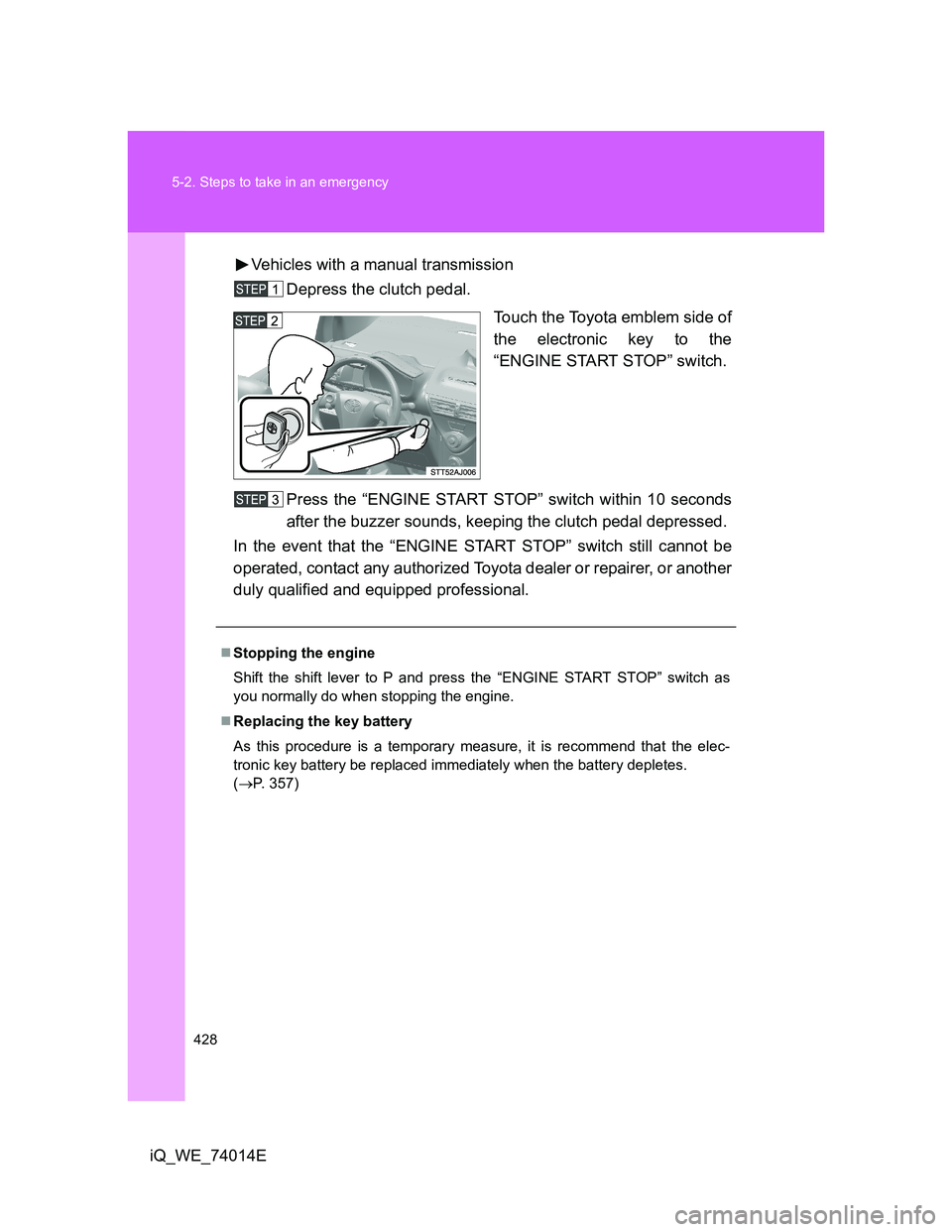
Depress the clutch pedal.
Touch the Toyota emblem side of
the electronic key to the
“ENGINE START STOP” switch.
Press the “ENGINE START STOP” switch within 10 seconds
after the buzzer sounds, keeping the clutch pedal depressed.
In the event that the “ENGINE START STOP” switch still cannot be
operated, contact any authorized Toyota dealer or repairer, or another
duly qualified and equipped professional.
Stopping the engine
Shift the shift lever to P and press the “ENGINE START STOP” switch as
you normally do when stopping the engine.
Replacing the key battery
As this procedure is a temporary measure, it is recommend that the elec-
tronic key battery be replaced immediately when the battery depletes.
(P. 357)
Page 429 of 476
5
429 5-2. Steps to take in an emergency
When trouble arises
iQ_WE_74014E
Changing “ENGINE START STOP” switch modes
Vehicles with a Multidrive
Within 10 seconds of the buzzer sounding, release the brake pedal and
press the “ENGINE START STOP” switch.
The engine does not start and modes will be changed each time the switch
is pressed. (P. 181)
Vehicles with a manual transmission
Within 10 seconds of the buzzer sounding, release the clutch pedal and
press the “ENGINE START STOP” switch.
The engine does not start and modes will be changed each time the switch
is pressed. (P. 181)
Page 430 of 476
430
5-2. Steps to take in an emergency
iQ_WE_74014E
If the vehicle batter y is discharged
The following procedures may be used to start the engine if the vehi-
cle’s battery is discharged.
You can call any authorized Toyota dealer or repairer, or another duly
qualified and equipped professional.
If you have a set of jumper (or booster) cables and a second vehi-
cle with a 12-volt battery, you can jump start your Toyota following
the steps below.
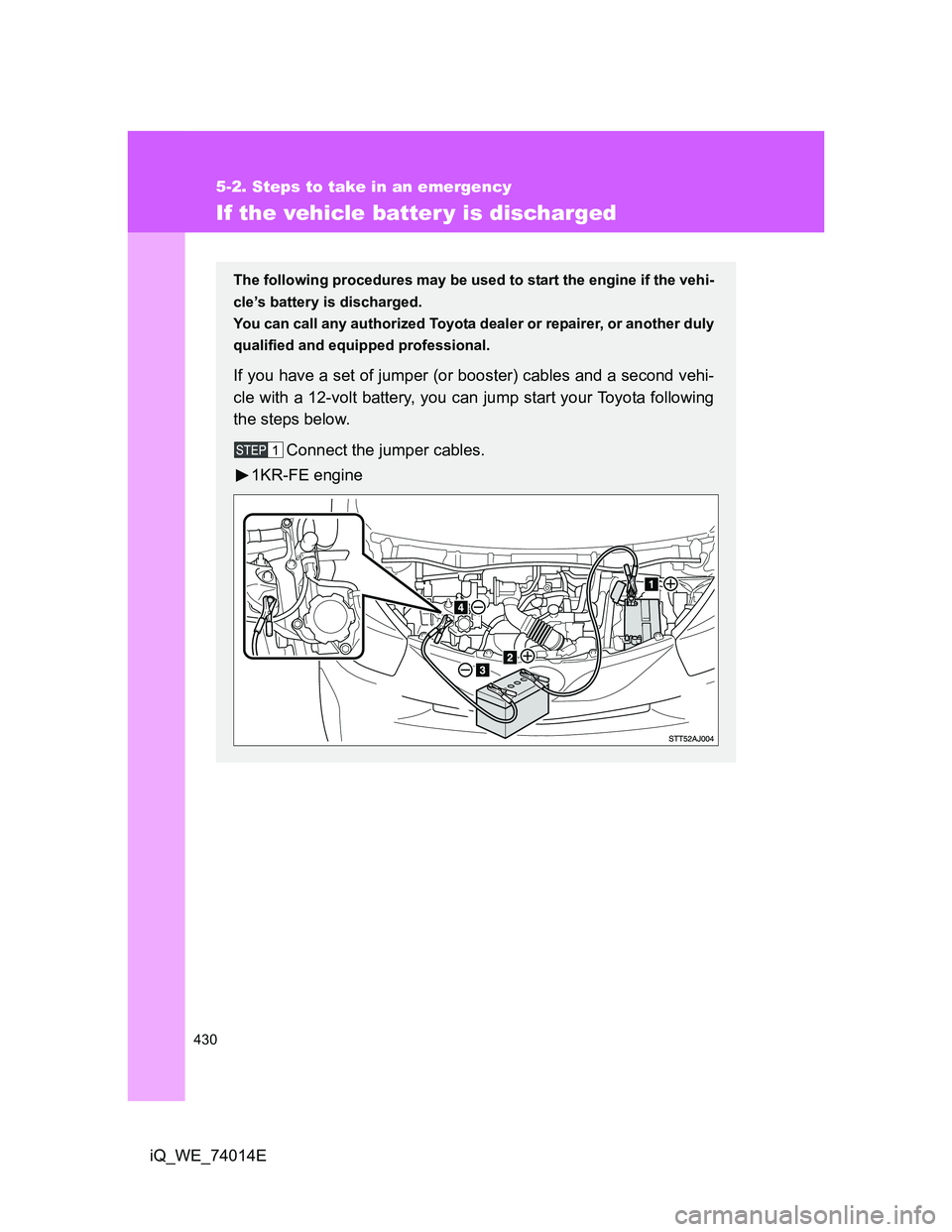
Connect the jumper cables.
1KR-FE engine
Page 431 of 476
5
431 5-2. Steps to take in an emergency
When trouble arises
iQ_WE_74014E
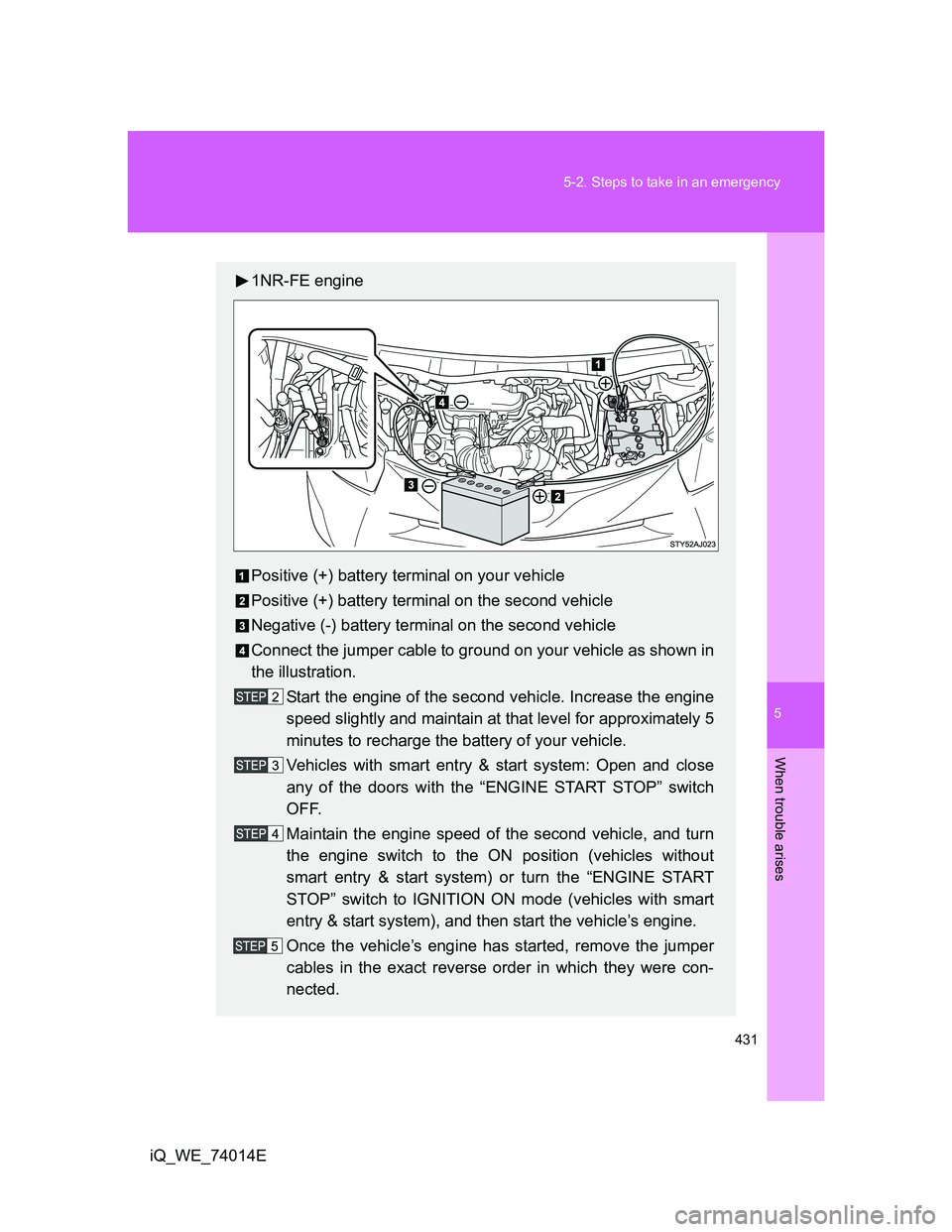
1NR-FE engine
Positive (+) battery terminal on your vehicle
Positive (+) battery terminal on the second vehicle
Negative (-) battery terminal on the second vehicle
Connect the jumper cable to ground on your vehicle as shown in
the illustration.
Start the engine of the second vehicle. Increase the engine
speed slightly and maintain at that level for approximately 5
minutes to recharge the battery of your vehicle.
Vehicles with smart entry & start system: Open and close
any of the doors with the “ENGINE START STOP” switch
OFF.
Maintain the engine speed of the second vehicle, and turn
the engine switch to the ON position (vehicles without
smart entry & start system) or turn the “ENGINE START
STOP” switch to IGNITION ON mode (vehicles with smart
entry & start system), and then start the vehicle’s engine.
Once the vehicle’s engine has started, remove the jumper
cables in the exact reverse order in which they were con-
nected.
Page 432 of 476

432 5-2. Steps to take in an emergency
iQ_WE_74014E
Starting the engine when the battery is discharged (vehicles with a
Multidrive)
The engine cannot be started by push-starting.
Avoiding a discharged battery
Turn off the headlights and the audio system while the engine is turned
off.
Turn off any unnecessary electrical components when the vehicle is run-
ning at a low speed for an extended period, such as in heavy traffic, etc.
When the vehicle battery is removed or discharged
Any data stored in the computer will be erased. When the vehicle battery
is discharged, have the vehicle checked at any authorized Toyota dealer
or repairer, or another duly qualified and equipped professional.
Vehicles with alarm: Make sure that the key is not inside the vehicle
when recharging or replacing the battery. The key may be locked in the
vehicle if the alarm is activated. (P. 120)
Reminders when the vehicle battery is discharged (vehicles with smart
entry & start system)
When the doors are attempted to be unlocked via the smart entry & start
system just after the vehicle battery has been discharged, it may fail. If
the doors cannot be unlocked, unlock the doors using a wireless remote
controller or a mechanical key.
The first engine start after the battery has been discharged may fail.
However, the engine should start after the second attempt, so it is not a
malfunction.
Once the engine starts, have the vehicle checked at any autho-
rized Toyota dealer or repairer, or another duly qualified and
equipped professional, as soon as possible.
Page 433 of 476
5
433 5-2. Steps to take in an emergency
When trouble arises
iQ_WE_74014E
The status of the “ENGINE START STOP” switch remains stored in the
vehicle memory. When the vehicle battery is discharged, the vehicle
returns to the status before the battery was discharged after disconnect-
ing and reconnecting the battery. When the battery needs to be discon-
nected, turn the “ENGINE START STOP” switch off before disconnecting
the battery. If the “ENGINE START STOP” switch status before the bat-
tery discharge is unknown, pay due attention to the vehicle when the bat-
tery is reconnected.
Charging the battery
The electricity stored in the battery will discharge gradually even when the
vehicle is not in use, due to natural discharge and the draining effects of cer-
tain electrical appliances. If the vehicle is left for a long time, the battery may
discharge, and the engine may be unable to start. (The battery recharges
automatically during driving.)
CAUTION
Avoiding battery fires or explosions
Observe the following precautions to prevent accidentally igniting the flam-
mable gas that may be emitted from the battery.
Make sure the jumper cable is connected to the correct terminal and that it
is not unintentionally in contact with any part other than the intended termi-
nal.
Do not allow the jumper cables to come into contact with the “+” and “-” ter-
minals.
Do not allow open flame or use matches, cigarette lighters or smoke near
the battery.
Battery precautions
The battery contains poisonous and corrosive acidic electrolyte, while
related parts contain lead and lead compounds. Observe the following pre-
cautions when handling the battery.
When working with the battery, always wear safety glasses and take care
not to allow any battery fluids (acid) to come into contact with skin, clothing
or the vehicle body.
Do not lean over the battery.
Page 435 of 476
5
435
5-2. Steps to take in an emergency
When trouble arises
iQ_WE_74014E
If your vehicle overheats
Correction procedures
Stop the vehicle in a safe place and turn off the air condition-
ing system, and then stop the engine.
If you see steam:
Carefully lift the hood after the steam subsides.
If you do not see steam:
Carefully lift the hood.
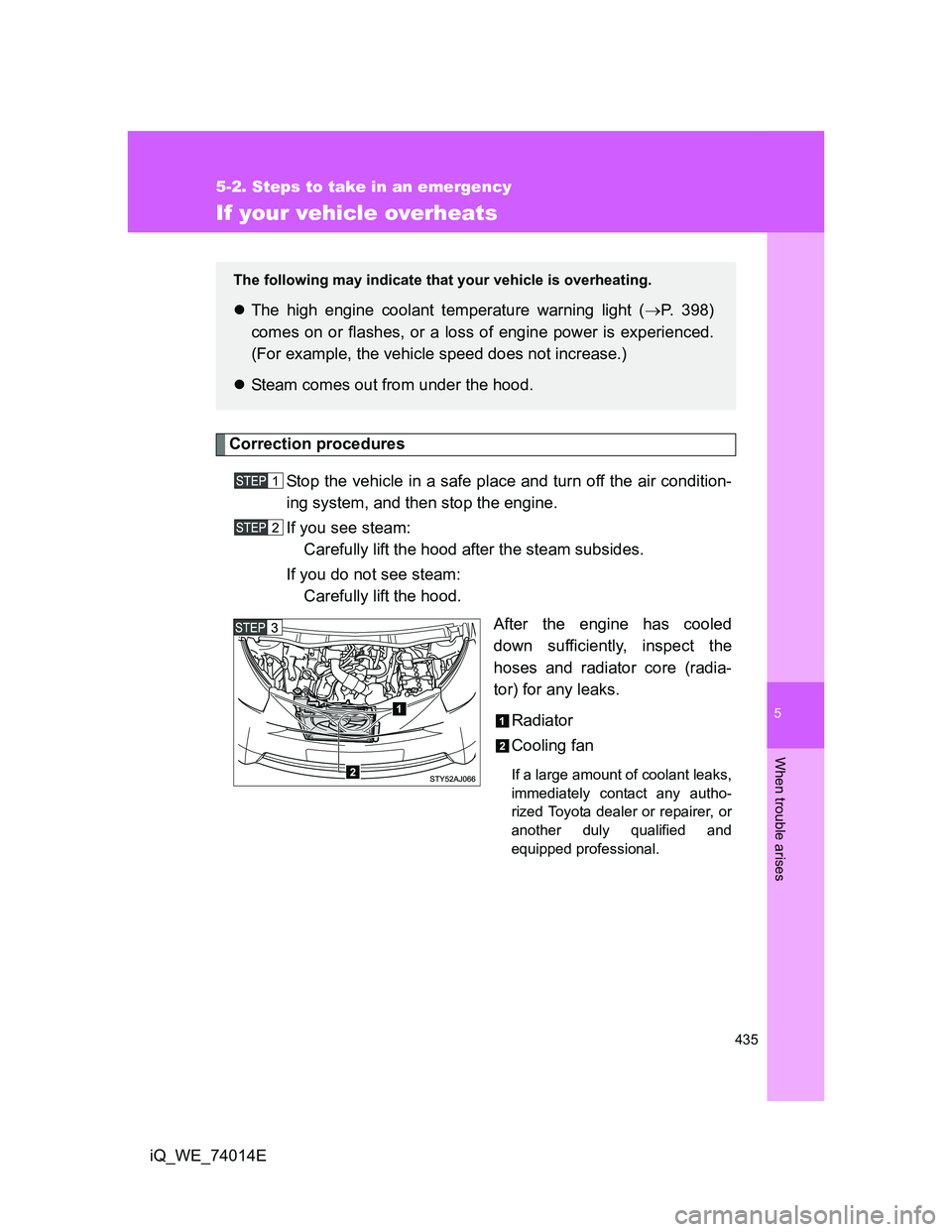
After the engine has cooled
down sufficiently, inspect the
hoses and radiator core (radia-
tor) for any leaks.
Radiator
Cooling fan
If a large amount of coolant leaks,
immediately contact any autho-
rized Toyota dealer or repairer, or
another duly qualified and
equipped professional.
The following may indicate that your vehicle is overheating.
The high engine coolant temperature warning light (P. 398)
comes on or flashes, or a loss of engine power is experienced.
(For example, the vehicle speed does not increase.)
Steam comes out from under the hood.
Page 436 of 476

436 5-2. Steps to take in an emergency
iQ_WE_74014EThe coolant level is satisfactory if
it is between the FULL and LOW
lines on the reservoir.
Reservoir
FULL
LOW
Radiator cap
Add coolant if necessary.
Water can be used in an emer-
gency if coolant is unavailable.
Start the engine and turn the air conditioning system on to
check that the radiator cooling fan operates and to check for
coolant leaks from the radiator or hoses.
The fan operates when the air conditioning system is turned on
immediately after a cold start. Confirm that the fan is operating by
checking the fan sound and air flow. If it is difficult to check these,
turn the air conditioning system on and off repeatedly.
(The fan may not operate in freezing temperatures.)
If the fan is not operating:
Stop the engine immediately and contact any authorized
Toyota dealer or repairer, or another duly qualified and
equipped professional.
If the fan is operating:
Have the vehicle inspected at the nearest authorized Toy-
ota dealer or repairer, or another duly qualified and
equipped professional.