Page 168 of 532
168
2-1. Driving procedures
Hor n
■After adjusting the steering wheel
Make sure that the steering wheel is securely locked.
The horn may not sound if the steering wheel is not securely locked.
(P. 76)
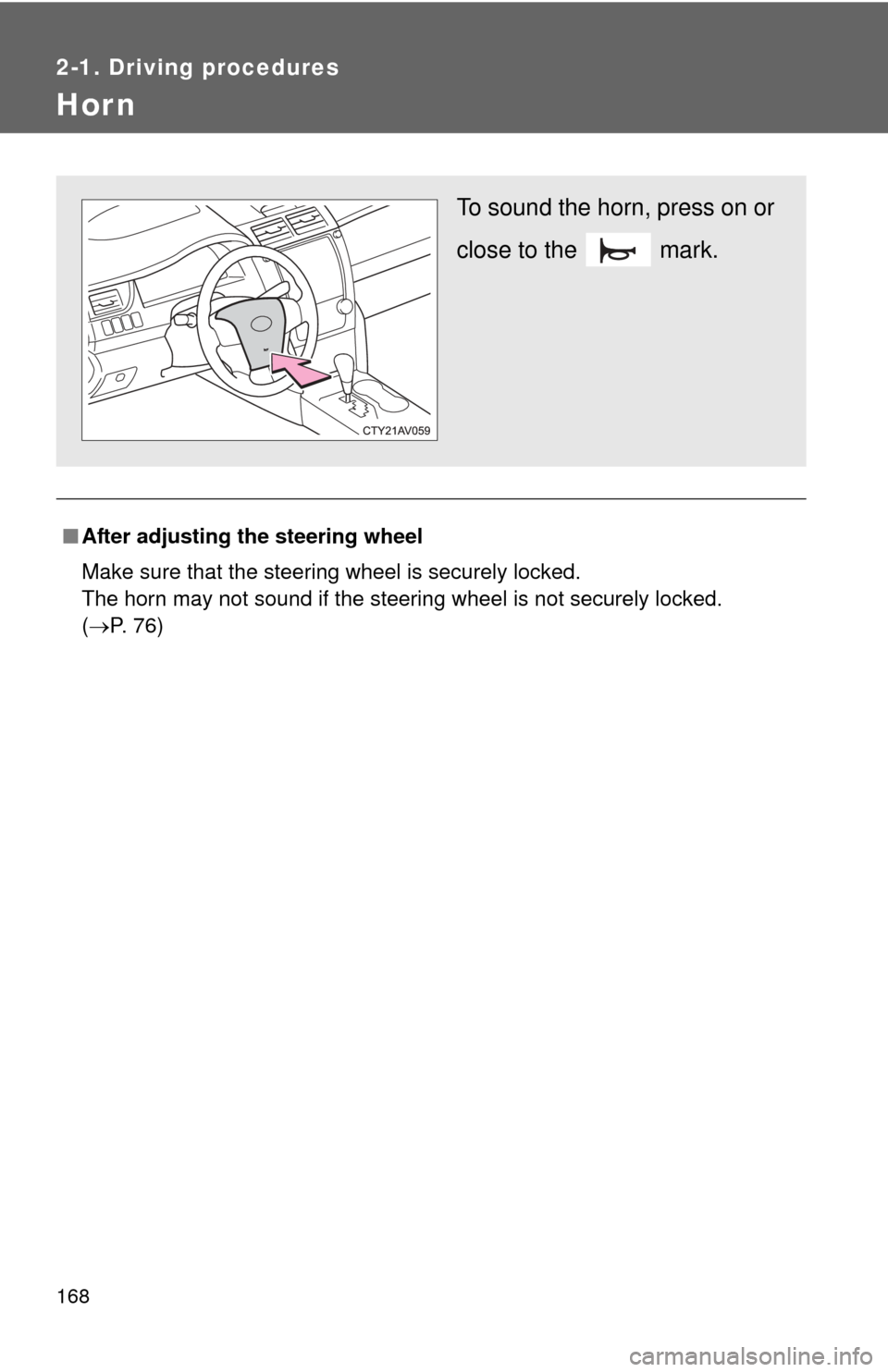
To sound the horn, press on or
close to the mark.
Page 203 of 532

203
2-4. Using other driving systems
2
When driving
Driving assist systems
When the TRAC/VSC systems are operatingIf the vehicle is in danger of slip-
ping or if any of the drive wheels
spins, the slip indicator light
flashes to indicate that the VSC/
TRAC systems are operating.
To help enhance driving safety and performance, the following sys-
tems operate automatically in res ponse to various driving situations.
Be aware, however, that these systems are supplementary and
should not be relied upon too heavi ly when operating the vehicle.
■ABS (Anti-lock Brake System)
Helps to prevent wheel lock when the brakes are applied suddenly, or if
the brakes are applied while driving on a slippery road surface.
■Brake assist
Generates an increased level of braking force after the brake pedal is
depressed when the system detects a panic stop situation.
■VSC (Vehicle Stability Control)
Helps the driver to control skidding when swerving suddenly or turning
on slippery road surfaces.
■TRAC (Traction Control)
Helps to maintain drive power and prevent the drive wheels from spin-
ning when starting the vehicle or accelerating on slippery roads.
■EPS (Electric Power Steering)
Employs an electric motor to reduce the amount of effort needed to turn
the steering wheel.
■BSM (Blind Spot Monitor) (if equipped)
P. 208
Page 205 of 532

205
2-4. Using other
driving systems
2
When driving
■When the “TRAC OFF” indicator light comes on even if the VSC OFF
switch has not been pressed
TRAC cannot be operated. Contact your Toyota dealer.
■ Sounds and vibrations caused by the ABS, brake assist, VSC and
TRAC
● A sound may be heard from the engine compartment when the engine is
started or just after the vehicle begins to move. This sound does not indi-
cate that a malfunction has occurred in any of these systems.
● Any of the following conditions may occur when the above systems are
operating. None of these indicates that a malfunction has occurred.
• Vibrations may be felt through the vehicle body and steering.
• A motor sound may be heard after the vehicle comes to a stop.
• The brake pedal may pulsate slightly after the ABS is activated.
• The brake pedal may move down slightly after the ABS is activated.
■ EPS operation sound
When the steering wheel is operated, a motor sound (whirring sound) may
be heard. This does not indicate a malfunction.
■ Reactivation of the TRAC /VSC systems after turning off the engine
Turning off the engine after turning off the TRAC/VSC systems will automati-
cally reactivate them.
■ Reactivation of the TRAC system linked to vehicle speed
When only the TRAC system is turned off, the TRAC system will turn on
when vehicle speed increases. However, when both TRAC and VSC sys-
tems are turned off, the systems will not turn on even when vehicle speed
increases.
■ Reduced effectiveness of the EPS system
The effectiveness of the EPS system is reduced to prevent the system from
overheating when there is frequent steering input over an extended period of
time. The steering wheel may feel heavy as a result. Should this occur,
refrain from excessive steering input or stop the vehicle and turn the engine
off. The EPS system should return to normal within 10 minutes.
■ If the slip indicator comes on...
It may indicate a malfunction in the TRAC and VSC. Contact your Toyota
dealer.
Page 344 of 532
344 4-2. Maintenance
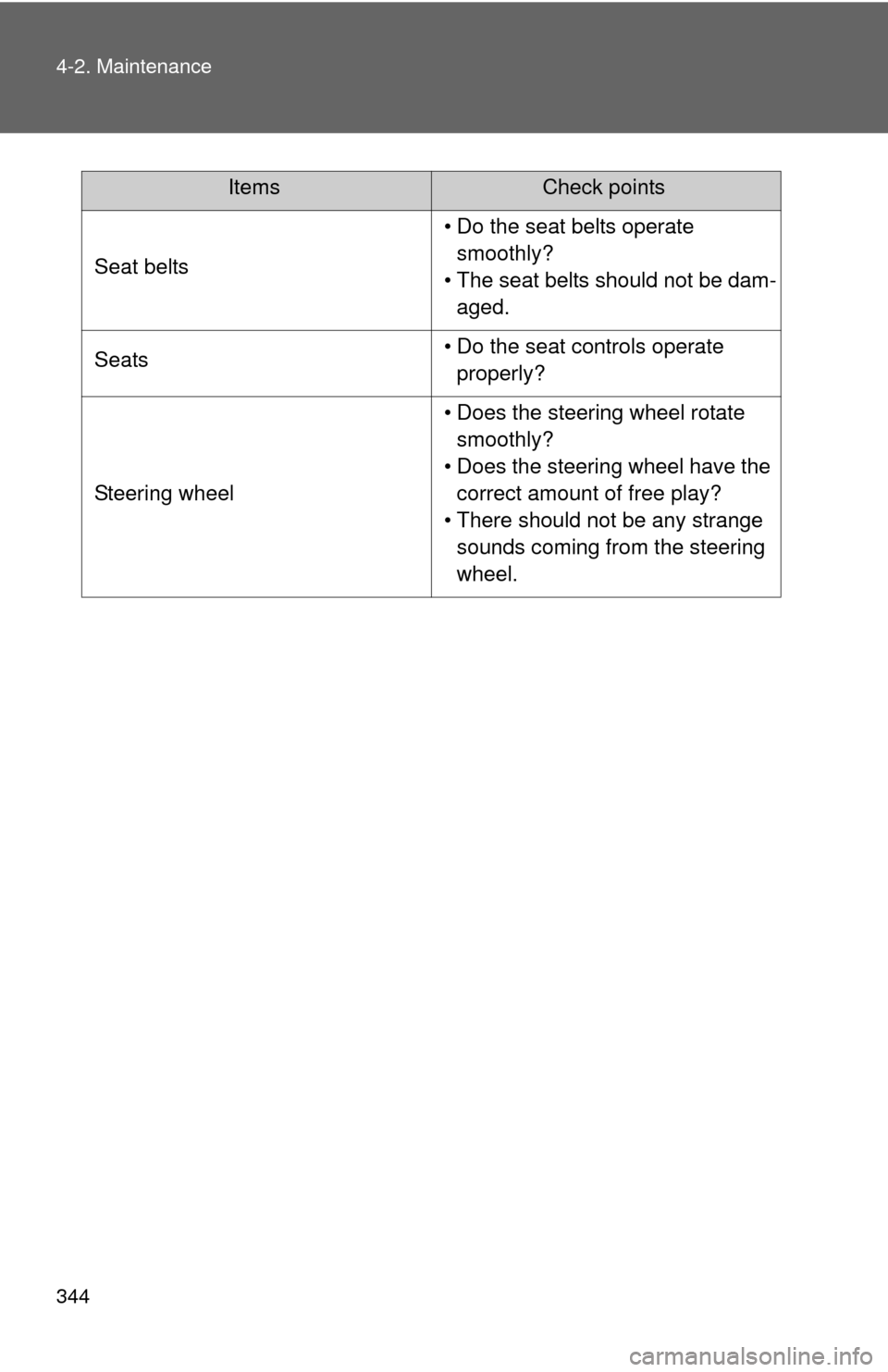
Seat belts• Do the seat belts operate
smoothly?
• The seat belts should not be dam- aged.
Seats • Do the seat controls operate
properly?
Steering wheel • Does the steering wheel rotate
smoothly?
• Does the steering wheel have the correct amount of free play?
• There should not be any strange sounds coming from the steering
wheel.
ItemsCheck points
Page 403 of 532
403
4-3. Do-it-yourself maintenance
4
Maintenance and care
■
Headlight low beam (halogen bulb)
Turn the bulb base counterclock-
wise.
Unplug the connector while
depressing the lock release.
■ Fog light (if equipped)
Turn the steering wheel in the
opposite direction of the fog light
that you wish to replace.
For example, if you wish to
replace the fog light on the left
side, turn the steering wheel to
the right.
STEP1
STEP2
STEP1
Page 432 of 532

432 5-2. Steps to take in an emergency
■If the tire pressure warning light frequently comes on after blinking
for 1 minute (vehicles with a tire pressure warning system)
If the tire pressure warning light frequently comes on after blinking for 1
minute when the engine switch (vehicles without a smart key system) or
the “ENGINE START STOP” switch (vehicles with a smart key system) is
turned on, have it checked by your Toyota dealer.
■Electric power steering system warning light (warning buzzer)
The electric power steering system warning light may come on and the
warning buzzer may sound when the voltage is low or the voltage drops.
■ Customization that can be co nfigured at Toyota dealer
The vehicle speed linked seat belt reminder buzzer can be disabled.
(Customizable features P. 493) However, Toyota recommends that the
seat belt reminder buzzer be operational to alert the driver and front passen-
ger that the seat belts are not fastened.
CAUTION
■ When the electric power steerin g system warning light comes on
The steering wheel may become extremely heavy.
If the steering wheel becomes heavier than usual when operating, hold
firmly and operate using more force than usual.
■
If the tire pressure warning light comes on (vehicles with a tire
pressure warning system)
Be sure to observe the following precautions. Failure to do so could
cause loss of vehicle control and re sult in death or serious injury.
●Stop your vehicle in a safe place as soon as possible. Adjust the tire
inflation pressure immediately.
●If the tire pressure warning light comes on even after tire inflation pres-
sure adjustment, it is pr obable that you have a flat tire. Check the tires.
If a tire is flat, change it with th e spare tire and have the flat tire
repaired by the nearest Toyota dealer.
●Avoid abrupt maneuvering and braking. If the vehicle tires deteriorate,
you could lose control of the steering wheel or the brakes.
Page 464 of 532
464 5-2. Steps to take in an emergency
CAUTION
■If the engine has to be turned off while driving
●Power assist for the brakes and steering wheel will be lost, making the
brake pedal harder to depress and the steering wheel heavier to turn.
Decelerate as much as possible before turning off the engine.
● Vehicles without a smart key system: Never attempt to remove the key, as
doing so will lock the steering wheel.
Vehicles with a smart key sys-
tem: To stop the engine, press
and hold the “ENGINE START
STOP” switch for 2 consecu-
tive seconds or more, or press
it briefly 3 times or more in
succession.
Stop the vehicle in a safe place by the road.STEP4
Press and hold for 2 seconds or more,
or press briefly 3 times or more
STEP5
Page 474 of 532
474 6-1. Specifications
Steering
Tires and wheels16-inch tires
Free play Less than 1.2 in. (30 mm)
Tire sizeP205/65R16 94S, T155/70D17 110M
Tire inflation pressure
(Recommended cold tire
inflation pressure)Driving under normal conditions
Front: 35 psi (240 kPa, 2.4 kgf/cm
2 or bar)
Rear: 35 psi (240 kPa, 2.4 kgf/cm2 or bar)
Spare:
60 psi (420 kPa, 4.2 kgf/cm
2 or bar)
Driving at high speeds (above 100 mph
[160 km/h]) (in countries where such
speeds are permitted by law) Add 3 psi (20 kPa, 0.2 kgf/cm
2 or bar) to
the front tires and rear tires. Never
exceed the maximum co ld tire inflation
pressure indicated on the tire sidewall.
Wheel size 16 6 1/2 JJ, 17 4 T (compact spare)
Wheel nut torque 76 ft•lbf (103 N•m, 10.5 kgf•m)