Page 7 of 532
7
Tires
●Rotation
● Replacement
● Inflation pressure
● Information
P. 367
P. 435
P. 474
P. 481
Trunk P. 58
Doors P. 52
Rear turn signal lights P. 166
Rear window defoggerP. 240
Stop/tail lights P. 185
Rear side marker light P. 185
Fuel filler door P. 88
: If equipped
*1: For vehicles with a navigation system, refe r to “Navigation System Owner’s Manual”.
*2: For vehicles with a Display Audio system, re fer to “Display Audio System Owner’s Manual”.
Camera , *1, *2
License plate lights P. 185
Page 13 of 532
13
Gauges and meters P. 169
Tilt and telescopic steering rock release lever
P. 76
Pictorial indexInstrument panel
Audio system
Navigation system
, *3
Display Audio system , *4
P. 242
Windshield wiper and washer switch P. 194
Clock P. 300
Tire pressure warning
reset switch
P. 368
Parking brake pedal P. 167Hood lock release
lever
P. 350: If equipped
*3: Refer to “Navigation System Owner’s Manual”.
*4: Refer to “Display Audio System Owner’s Manual”.
Horn
P. 168
Engine (ignition) switch (vehicles
with a smart key system)
P. 148
Headlight switch
Turn signal lever
Fog light switch
P. 185
P. 166
P. 192
Fuel filler door opener
P. 88
Trunk opener P. 58
Floor mat P. 311
Page 334 of 532
334
4-1. Maintenance and care
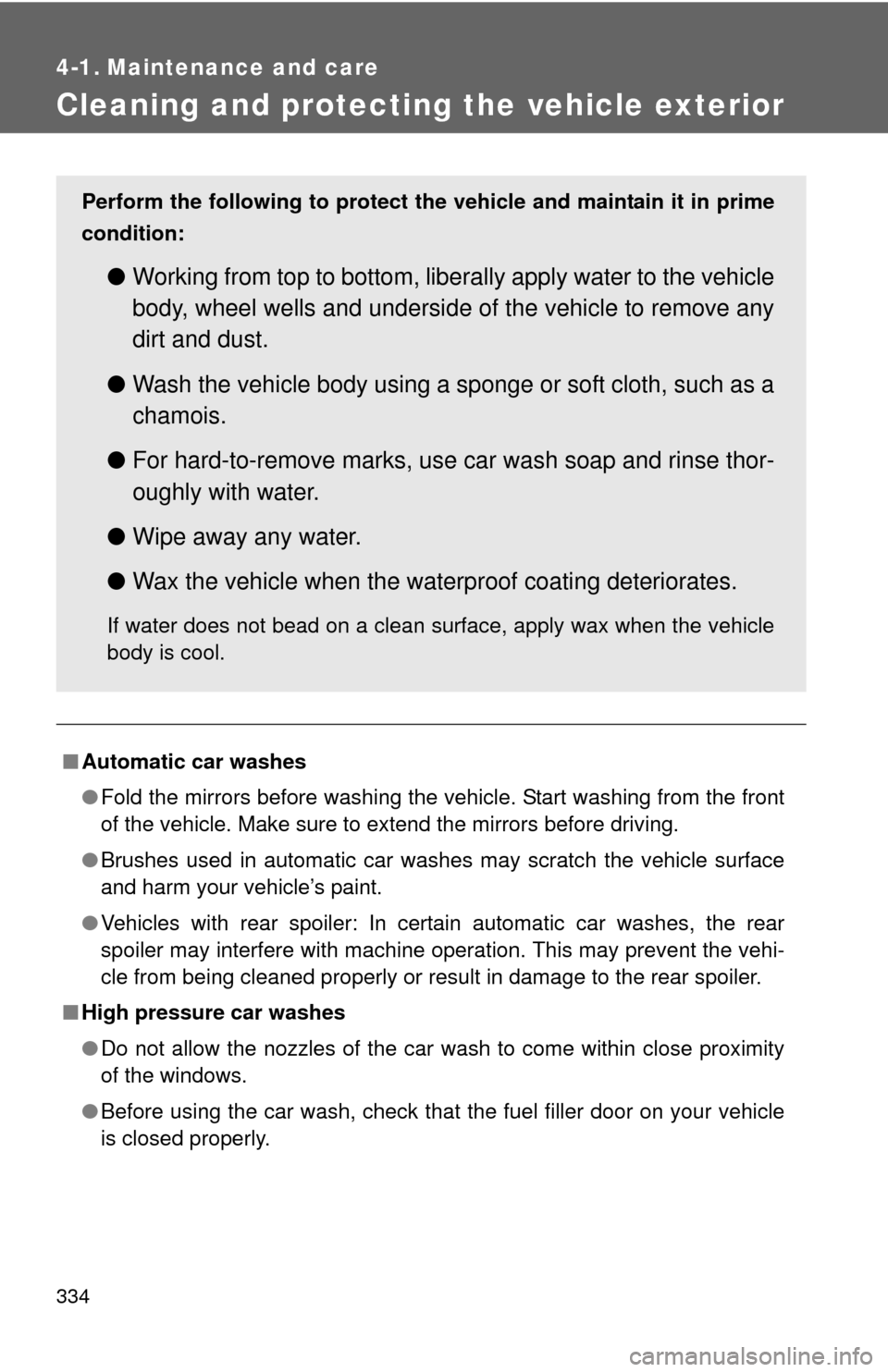
Cleaning and protecting the vehicle exterior
■Automatic car washes
●Fold the mirrors before washing the vehicle. Start washing from the front
of the vehicle. Make sure to extend the mirrors before driving.
● Brushes used in automatic car washes may scratch the vehicle surface
and harm your vehicle’s paint.
● Vehicles with rear spoiler: In certain automatic car washes, the rear
spoiler may interfere with machine operation. This may prevent the vehi-
cle from being cleaned properly or result in damage to the rear spoiler.
■ High pressure car washes
●Do not allow the nozzles of the car wash to come within close proximity
of the windows.
● Before using the car wash, check that the fuel filler door on your vehicle
is closed properly.
Perform the following to protect the vehicle and maintain it in prime
condition:
● Working from top to bottom, liber ally apply water to the vehicle
body, wheel wells and underside of the vehicle to remove any
dirt and dust.
● Wash the vehicle body using a sponge or soft cloth, such as a
chamois.
● For hard-to-remove marks, use car wash soap and rinse thor-
oughly with water.
● Wipe away any water.
● Wax the vehicle when the waterproof coating deteriorates.
If water does not bead on a clean surface, apply wax when the vehicle
body is cool.
Page 377 of 532

377
4-3. Do-it-yourself maintenance
4
Maintenance and care
■Effects of incorrect tire inflation pressure
Driving with incorrect ti
re inflation pressure ma y result in the following:
●Reduced fuel efficiency
●Reduced driving comfort and tire life
●Reduced safety
●Damage to the drive train
If a tire needs frequent inflating, have it checked by your Toyota dealer.
■Instructions for checking tire inflation pressure
When checking tire inflation pressure, observe the following:
●Check only when the tires are cold.
If your vehicle has been parked for at least 3 hours or has not been
driven for more than 1 mile or 1.5 km, you will get an accurate cold
tire inflation pressure reading.
●Always use a tire pressure gauge.
The appearance of the tire can be mi sleading. In addition, tire infla-
tion pressure that is even just a few pounds off can affect ride quality
and handling.
●Do not reduce tire inflation pressure after driving. It is normal for tire
inflation pressure to be higher after driving.
●Never exceed the vehicle capacity weight.
Passengers and luggage weight should be placed so that the vehicle
is balanced.
Page 396 of 532
396 4-3. Do-it-yourself maintenance
■Under the instrument panel
FuseAmpereCircuit
1 ECU-IG1 NO.2 10 A Shift lock control system, seat
heaters, smart key system, tire
pressure warning system, wireless
remote control, multiplex communi-
cation system, audio system, navi-
gation system, moon roof, auto
anti-glare inside rear view mirror
2 ECU-IG1 NO.1 10 A Vehicle stability control system,
electric cooling fans, steering sen-
sor, multiport fuel injection system/
sequential multiport fuel injection
system, charging system, rear win-
dow defogger, outside rear view
mirror defoggers, Blind Spot Moni-
tor
3 PANEL 10 A Switch illumination, air condition-
ing system, shift lever light, glove
box light, interior lights, personal
lights, audio system, navigation
system
Page 397 of 532
397
4-3. Do-it-yourself maintenance
4
Maintenance and care
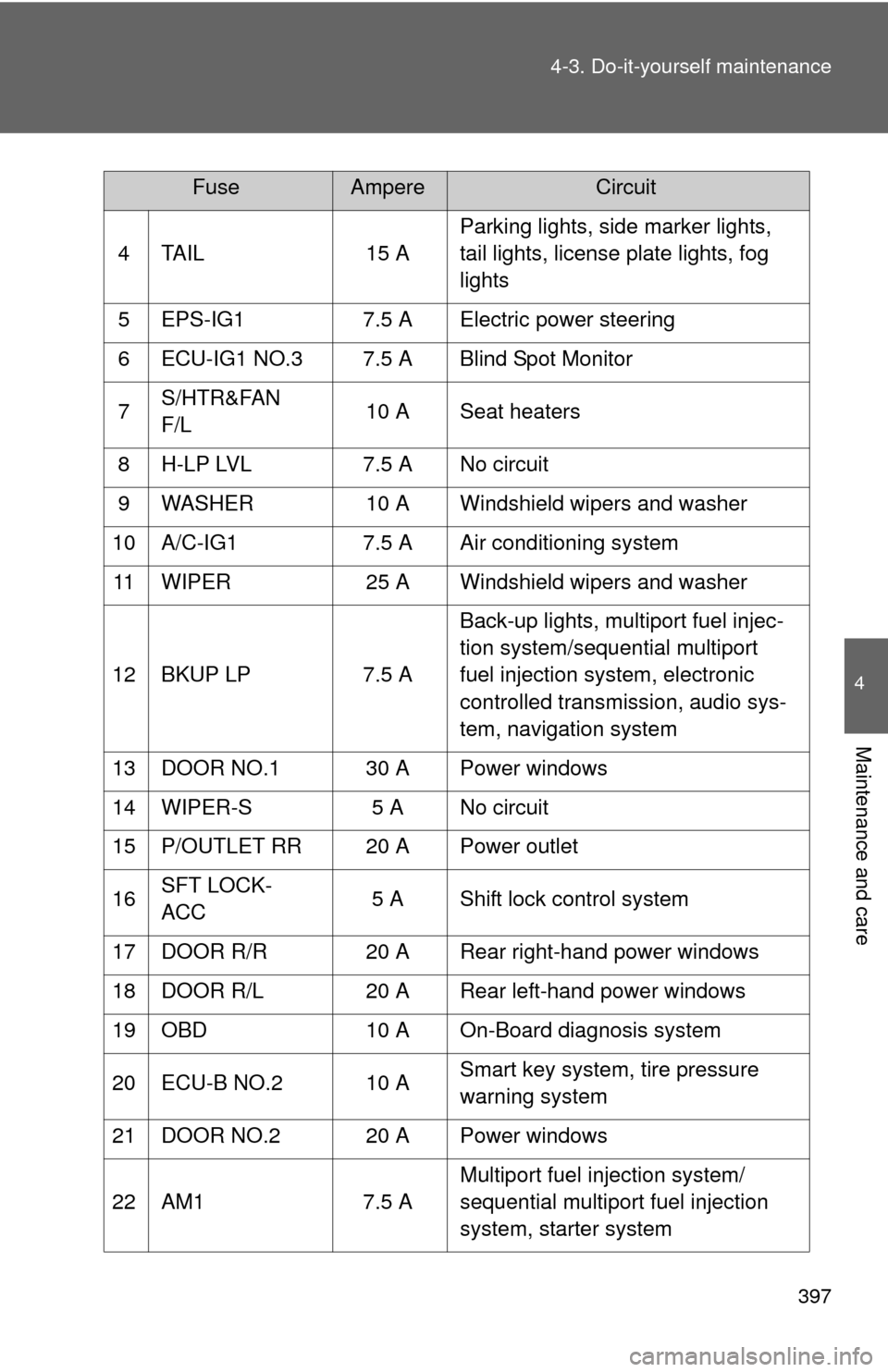
4 TAIL
15 AParking lights, side marker lights,
tail lights, license plate lights, fog
lights
5 EPS-IG1 7.5 A Electric power steering
6 ECU-IG1 NO.3 7.5 A Blind Spot Monitor
7 S/HTR&FAN
F/L 10 A Seat heaters
8 H-LP LVL 7.5 A No circuit
9 WASHER 10 A Windshield wipers and washer
10 A/C-IG1 7.5 A Air conditioning system
11 WIPER 25 A Windshield wipers and washer
12 BKUP LP 7.5 ABack-up lights, multiport fuel injec-
tion system/sequential multiport
fuel injection system, electronic
controlled transmission, audio sys-
tem, navigation system
13 DOOR NO.1 30 A Power windows
14 WIPER-S 5 A No circuit
15 P/OUTLET RR 20 A Power outlet
16 SFT LOCK-
ACC 5 A Shift lock control system
17 DOOR R/R 20 A Rear right-hand power windows
18 DOOR R/L 20 A Rear left-hand power windows
19 OBD 10 A On-Board diagnosis system
20 ECU-B NO.2 10 A Smart key system, tire pressure
warning system
21 DOOR NO.2 20 A Power windows
22 AM1 7.5 AMultiport fuel injection system/
sequential multiport fuel injection
system, starter system
FuseAmpereCircuit
Page 430 of 532

430 5-2. Steps to take in an emergency
■If the malfunction indicator lamp comes on while driving
First check the following:
● Is the fuel tank empty?
If it is, fill the fuel tank immediately.
● Is the fuel tank cap loose?
If it is, tighten it securely.
The malfunction indicator lamp will go off after several driving trips.
If the malfunction indicator lamp does not go off even after several trips, con-
tact your Toyota dealer as soon as possible.
■
When the tire pressure warning light comes on (if equipped)
Check the tire inflation pressure and adjust to the appropriate level.
Pushing the tire pressure warning reset switch will not turn off the tire
pressure warning light.
■The tire pressure warning light may come on due to natural causes
(vehicles with a tire pressure warning system)
The tire pressure warning light may come on due to natural causes such
as natural air leaks and tire inflat ion pressure changes caused by tem-
perature. In this case, adjusting the tire inflation pressure will turn off the
warning light (after a few minutes).
Page 433 of 532

5
When trouble arises
433
5-2. Steps to take in an emergency
CAUTION
■If a blowout or sudden air leakage
should occur (vehicles with a tire
pressure warning system)
The tire pressure warning syste m may not activate immediately.
■Maintenance of the tires (vehicles with a tire pressure warning sys-
tem)
Each tire, including the spare (if provided), should be checked monthly
when cold and inflated to the inflation pressure recommended by the
vehicle manufacturer on the vehicle placard or tire inflation pressure
label (tire and load information label). (If your vehicle has tires of a differ-
ent size than the size indicated on the vehicle placard or tire inflation
pressure label [tire and load information label], you should determine the
proper tire inflation pr essure for those tires.)
As an added safety feature, your vehicle has been equipped with a tire
pressure monitoring system (TPMS-ti re pressure warning system) that
illuminates a low tire pressure telltal e (tire pressure warning light) when
one or more of your tires is significantly under-inflated. Accordingly,
when the low tire pressure telltale (tire pre ssure warning light) illumi-
nates, you should stop and check your tires as soon as possible, and
inflate them to the proper pressure. Driving on a significantly under-
inflated tire causes the tire to overheat and can lead to tire failure.
Under-inflation also reduces fuel effi ciency and tire tread life, and may
affect the vehicle's hand ling and stopping ability.
Please note that the TPMS (tire pressure warning system) is not a sub-
stitute for proper ti re maintenance, an d it is the driver's responsibility to
maintain correct tire pressure, even if under-inflation has not reached the
level to trigger illu mination of the TPMS low ti re pressure telltale (tire
pressure warning light).


