Page 395 of 580
395
4-2. Maintenance
4
Maintenance and care
General maintenance
Engine compartment
ItemsCheck points
Battery • Maintenance-free ( P. 417)
Brake fluid • At the correct level? ( P. 414)
Engine coolant • At the correct level? ( P. 412)
Engine oil • At the correct level? ( P. 408)
Exhaust system • No fumes or strange sounds?
Power steering fluid • At the correct level? ( P. 415)
Radiator/condenser/hoses • Not blocked with foreign matter?
(P. 413)
Washer fluid • At the correct level? ( P. 420)
Listed below are the general maintenance items that should be per-
formed at the intervals specified in the “Scheduled Maintenance
Guide” or “Owner’s Manual Supp lement”. It is recommended that
any problem you notice should be brought to the attention of your
Toyota dealer or qualified service shop for advice.
Page 396 of 580
396 4-2. Maintenance
Vehicle interior
ItemsCheck points
Accelerator pedal • Moves smoothly (without uneven pedal
effort or catching)?
Automatic transmission
“Park” mechanism • Can the vehicle be hold securely on an
incline with the shift lever in “P”?
Brake pedal • Moves smoothly?
• Does it have appropriate clearance and
correct amount of free play?
Brakes • Pulls to one side when applied?
• Loss of brake effectiveness?
• Spongy feeling brake pedal?
• Pedal almost touches floor?
Head restraints • Move smoothly and lock securely?
Indicators/buzzers • Function properly?
Lights • Do all the lights come on?
• Headlights aimed correctly? (
P. 453)
Parking brake • Moves smoothly?
• Can hold the vehicle securely on an
incline?
Seat belts • Does the seat belt system operate
smoothly?
• Are the belts undamaged?
Seats • Do the seat controls operate properly?
Steering wheel • Moves smoothly?
• Has correct free play?
• No strange noises?
Page 397 of 580
397
4-2. Maintenance
4
Maintenance and care
Vehicle exterior
ItemsCheck points
Doors/trunk • Operate smoothly?
Engine hood • The lock system works properly?
Fluid leaks • Is there any leakage after parking?
Tire • Inflation pressure is correct?
• Tire surfaces not worn or damaged?
• Tires rotated according to the mainte-
nance schedule?
• Wheel nuts are not loose?
CAUTION
■ If the engine is running
Turn off the engine and ensure that there is adequate ventilation before per-
forming maintenance checks.
Page 403 of 580
403
4-3. Do-it-yourself maintenance
4
Maintenance and care
Hood
CAUTION
■Pre-driving check
Check that the hood is fully closed and locked.
If the hood is not locked properly it may open while the vehicle is in motion
and cause an accident, which may result in death or serious injury.
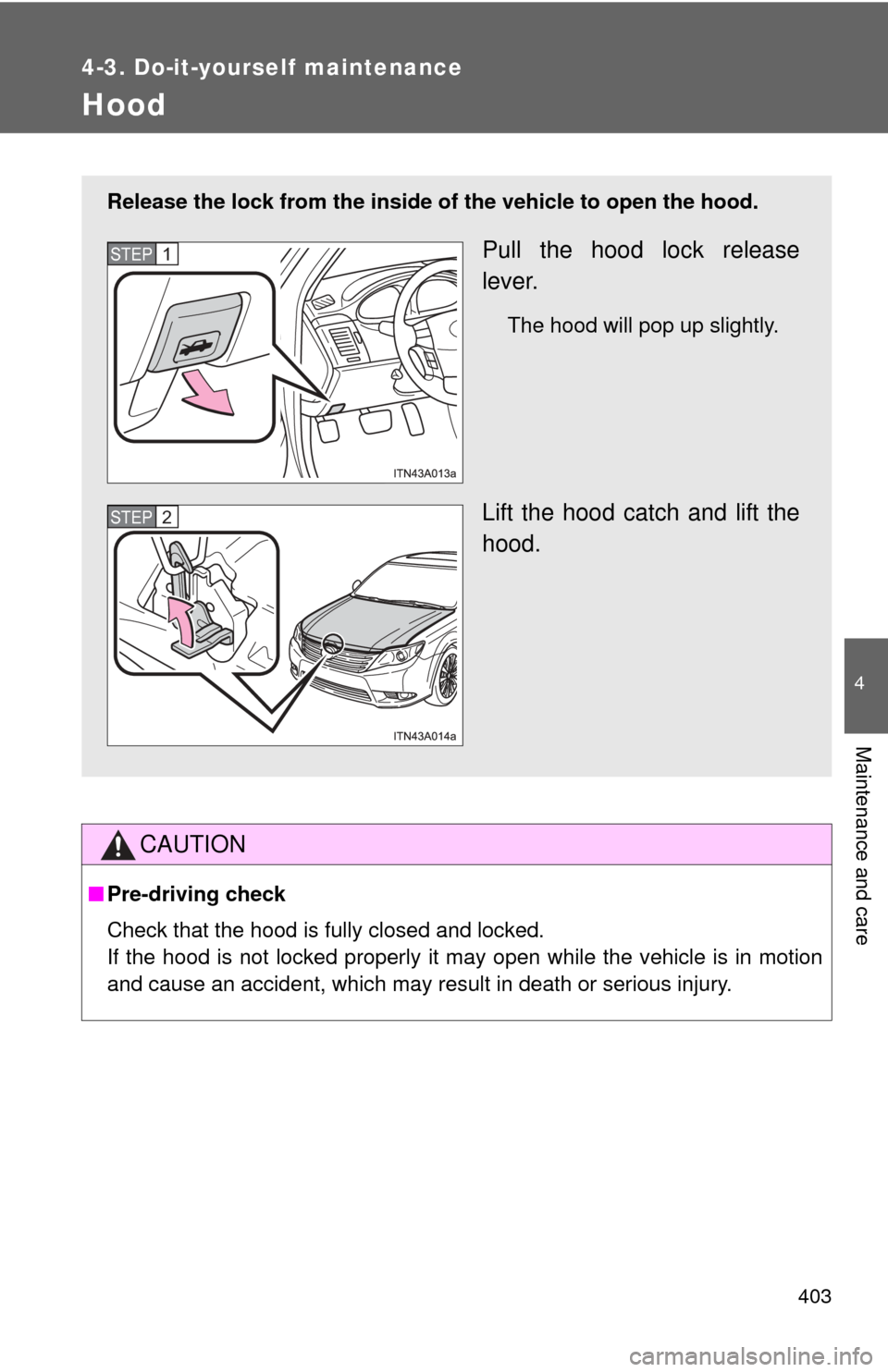
Release the lock from the inside of the vehicle to open the hood.
Pull the hood lock release
lever.
The hood will pop up slightly.
Lift the hood catch and lift the
hood.
STEP1
STEP2
Page 409 of 580
4
Maintenance and care
409
4-3. Do-it-yourself maintenance
■
Adding engine oil
If the oil level is below or near
the low level mark, add engine
oil of the same type as already in
the engine.
Make sure to check the oil type and prepare the items needed before
adding oil.
Remove the oil filler cap.
Add engine oil slowly, checking the dipstick.
Install the filler cap, turning it clockwise.
Engine oil selectionP. 522
Oil quantity
(Low Full) 1.6 qt. (1.5 L, 1.3 Imp.qt.)
Items Clean funnel
STEP1
STEP2
STEP3
Page 416 of 580
416 4-3. Do-it-yourself maintenance
■Checking the fluid level
Make sure to check the fluid type and prepare the necessary items.
Clean all dirt off the reservoir.
Remove the cap by turning it counterclockwise.
Wipe the dipstick clean.
Reinstall and remove the reservoir cap again.
Check the fluid level.
Fluid typeAutomatic transmission fluid DEXRON® II or III
ItemsRag or paper, clean funnel (only for adding fluid)
CAUTION
■ When checking the reservoir
Take care, as the reservoir may be hot.
NOTICE
■When adding fluid
Avoid overfilling, or the power steering may be damaged.
■ After replacing the reservoir cap
Check the steering box case, vane pump and hose connections for leaks or
damage.
STEP1
STEP2
STEP3
STEP4
STEP5
Page 423 of 580

4
Maintenance and care
423
4-3. Do-it-yourself maintenance
■
How to initialize the tire pressure warning system
Park the vehicle in safe place and turn the “ENGINE START
STOP” switch or the engine switch OFF.
While the vehicle is moving, in itialization is not performed.
Adjust the tire inflation pressure to the specified cold tire infla-
tion pressure level. ( P. 526)
Make sure to adjust the tire pressure to the specified cold tire
inflation pressure level. The ti re pressure warning system will
operate based on this pressure level.
Turn the “ENGINE START STOP” switch to IGNITION ON
mode (vehicles with smart key sy stem) or the engine switch to
the “ON” position (vehicles without smart key system).
Push and hold the tire pressure
warning reset switch until the tire
pressure warning light blinks
slowly 3 times.
Vehicles with smart key system: Wait for a few minutes with
the “ENGINE START STOP” swit ch in IGNITION ON mode,
and then turn the “ENGINE START STOP” switch OFF.
Vehicles without smart key system: Wait for a few minutes
with the engine switch in the “O N” position, and then turn the
engine switch to the “LOCK” position.
STEP1
STEP2
STEP3
STEP4
STEP5
Page 446 of 580
446 4-3. Do-it-yourself maintenance
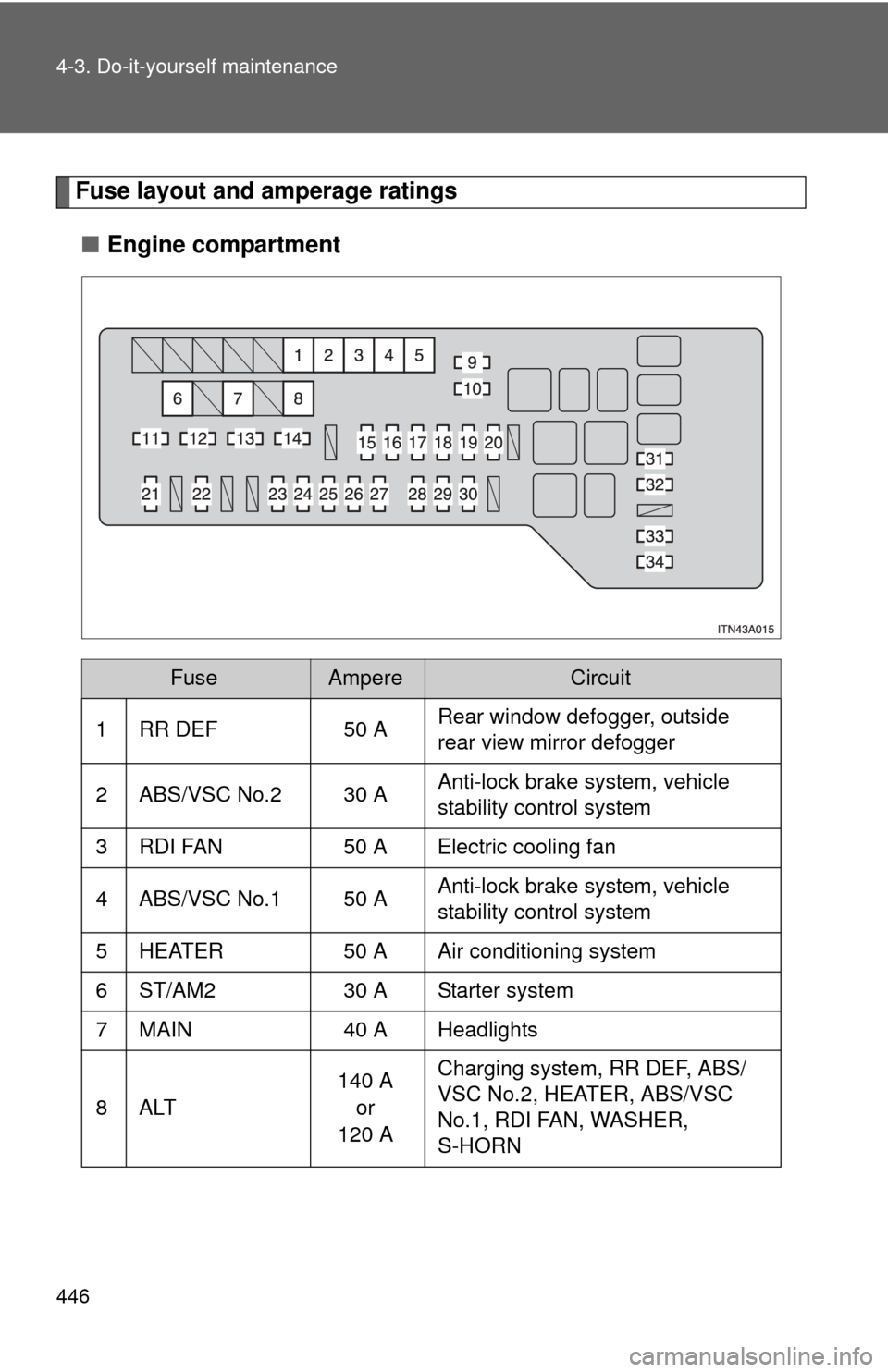
Fuse layout and amperage ratings■ Engine compartment
FuseAmpereCircuit
1 RR DEF 50 A Rear window defogger, outside
rear view mirror defogger
2 ABS/VSC No.2 30 A Anti-lock brake system, vehicle
stability control system
3 RDI FAN 50 A Electric cooling fan
4 ABS/VSC No.1 50 A Anti-lock brake system, vehicle
stability control system
5 HEATER 50 A Air conditioning system
6 ST/AM2 30 A Starter system
7 MAIN 40 A Headlights
8ALT 140 A
or
120 A Charging system, RR DEF, ABS/
VSC No.2, HEATER, ABS/VSC
No.1, RDI FAN, WASHER,
S-HORN