2012 TOYOTA AURIS warning
[x] Cancel search: warningPage 295 of 750
2934-2. Driving procedures
UK_AURIS/AURIS_HV_EE (OM12E33E)
4
Driving
Using engine braking
To use engine braking, select the B position.
During high speed driving, you may feel that deceleration by engine braking
is less than that of a conventional vehicle.
Do not continue normal driving with the transmission in B for a long time.
This may cause decreased fuel economy. To prevent this, use D for normal
driving.
Reverse warning buzzer
When shifting into R, a buzzer will sound to inform the driver that the shift
lever is in R.
When the accelerator pedal is depressed while the shift position is in N
A buzzer will sound to inform the driver that the shift position is in N.
Eco drive mode
When the accelerator pedal is depressed in Eco drive mode, it may take more
time to accelerate than usual. This is normal operation.
For the shift positions
When the power switch is off, the shift position cannot be changed.
When the power switch is in ON mode (the hybrid system is not operating),
the shift position can only be changed to N. The shift position will be
changed to N even if the shift lever is shifted to D or R and held in that posi-
tion.
When the “READY” indicator is on, the shift position can be changed from P
to D, N or R.
When the “READY” indicator is flashing, the shift position cannot be
changed from P to another position even if the shift lever is operated.
Wait until the “READY” indicator changes from a flashing to a solid light, and
then operate the shift lever again.
The shift position can only be changed to B directly from D.
Page 296 of 750
2944-2. Driving procedures
UK_AURIS/AURIS_HV_EE (OM12E33E)Alarms
If an attempt is made to change the shift position by moving the shift lever in
any of the following situations, a buzzer will sound and the shifting operation
will be disabled or the shift position will automatically change to N. When this
happens, select an appropriate shift position.
Situations where the shifting operation will be disabled:
• When an attempt is made to change the shift position from P to another
position by moving the shift lever without depressing the brake pedal.
• When an attempt is made to change the shift position from P or N to B
by moving the shift lever.
Situations where the shift position will automatically change to N:
• When the P position switch is pressed while the vehicle is running.
*1
• When an attempt is made to select the R position by moving the shift
lever when the vehicle is moving forward.
*2
• When an attempt is made to select the D position by moving the shift
lever when the vehicle is moving in reverse.
*3
• When an attempt is made to change the shift position from R to B by
moving the shift lever.
*1: Shift position may be changed to P when driving at extremely low speeds.
*2: Shift position may be changed to R when driving at low speeds.
*3: Shift position may be changed to D when driving at low speeds.
When driving with cruise control activated (if equipped)
Even if switching the driving mode to power mode with the intent of enabling
engine braking, engine braking will not activate because cruise control will not
be canceled. (P. 322)
Customization
Settings (e. g. Reverse warning buzzer) can be changed. (Customizable fea-
ture P. 719)
Page 298 of 750

2964-2. Driving procedures
UK_AURIS/AURIS_HV_EE (OM12E33E)
NOTICE
Situations where P position control system malfunctions are possible
If any of the following situations occurs, P position control system malfunc-
tions are possible.
Immediately stop the vehicle in a safe place on level ground, apply the park-
ing brake, and then contact any authorized Toyota dealer or repairer, or
another duly qualified and equipped professional.
When a warning message indicating malfunction appears on the multi-
information display. (P. 599)
When the shift position indicator remains off.
Hybrid battery (traction battery) charge
If shift position N is selected, the hybrid battery (traction battery) will not be
charged. To help prevent the battery from discharging, avoid leaving the N
position selected for an extended period of time.
If the vehicle cannot be shifted out of P
There is a possibility that the 12-volt battery is discharged. Check the 12-
volt battery in this situation.
Notes regarding shift lever and P position switch operation
Avoid repeatedly operating the shift lever and P position switch in quick suc-
cession.
The system protection function may activate and it will not be temporarily
possible to shift the shift position other than P. If this happens, please wait
for a while before attempting to change the shift position again.
Page 300 of 750
2984-2. Driving procedures
UK_AURIS/AURIS_HV_EE (OM12E33E)
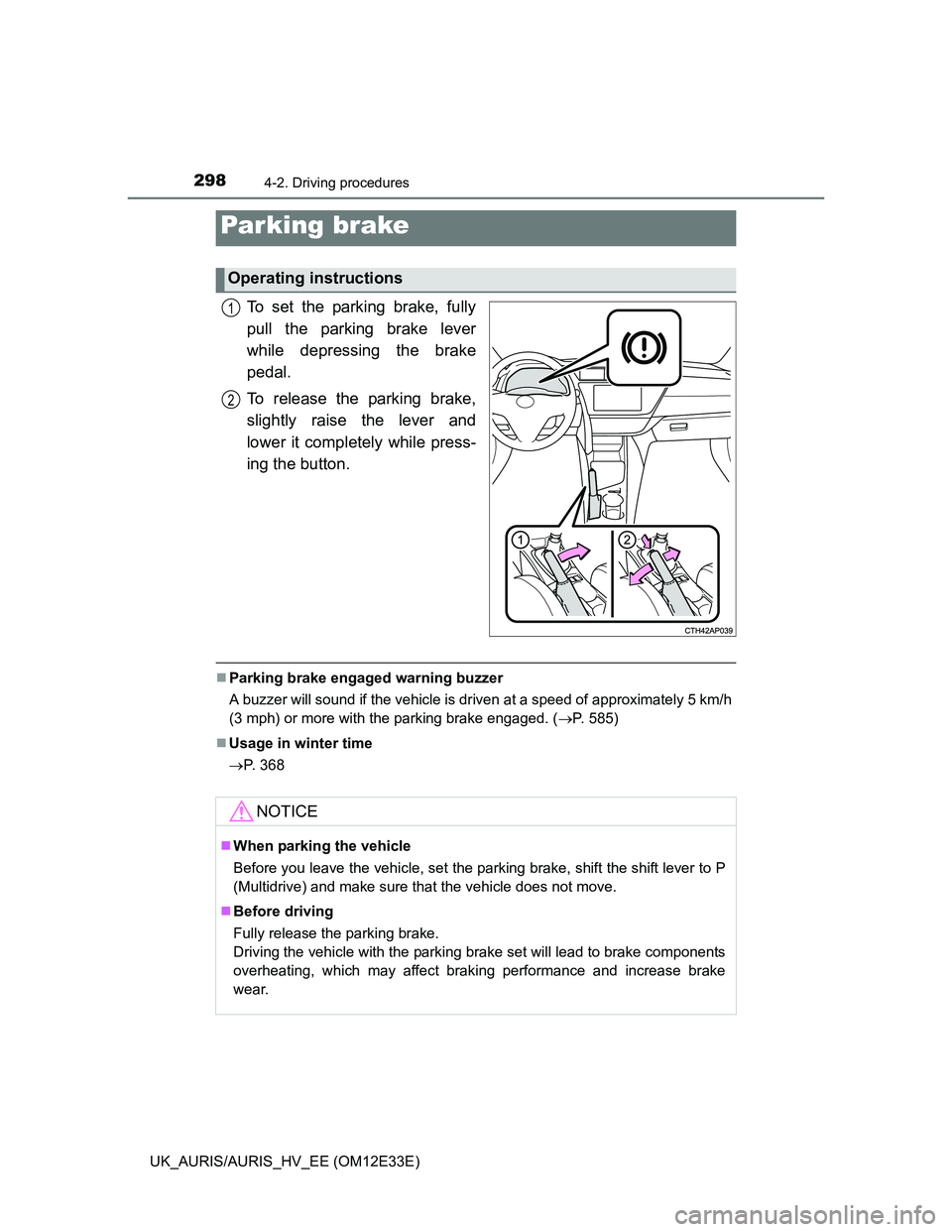
To set the parking brake, fully
pull the parking brake lever
while depressing the brake
pedal.
To release the parking brake,
slightly raise the lever and
lower it completely while press-
ing the button.
Parking brake engaged warning buzzer
A buzzer will sound if the vehicle is driven at a speed of approximately 5 km/h
(3 mph) or more with the parking brake engaged. (P. 585)
Usage in winter time
P. 368
Parking brake
Operating instructions
1
2
NOTICE
When parking the vehicle
Before you leave the vehicle, set the parking brake, shift the shift lever to P
(Multidrive) and make sure that the vehicle does not move.
Before driving
Fully release the parking brake.
Driving the vehicle with the parking brake set will lead to brake components
overheating, which may affect braking performance and increase brake
wear.
Page 327 of 750

3254-5. Using the driving support systems
UK_AURIS/AURIS_HV_EE (OM12E33E)
4
Driving
Cruise control can be set when
The shift lever is in D. (Multidrive)
The shift position is in D. (Hybrid transmission)
Gear step 4 or higher of M has been selected. (Multidrive)
Gear step 4 or higher of D has been selected by using the paddle shift.
(vehicles with a paddle shift switch)
Vehicle speed is above approximately 40 km/h (25 mph).
Accelerating after setting the vehicle speed
The vehicle can be accelerated normally. After acceleration, the set speed
resumes.
Even without canceling the cruise control, the set speed can be increased
by first accelerating the vehicle to the desired speed and then pushing the
lever down to set the new speed.
Automatic cruise control cancelation
Cruise control will stop maintaining the vehicle speed in any of the following
situations.
Actual vehicle speed falls more than approximately 16 km/h (10 mph) below
the preset vehicle speed.
At this time, the memorized set speed is not retained.
Actual vehicle speed is below approximately 40 km/h (25 mph).
VSC is activated.
Speed limiter is activated (if equipped)
If the cruise control indicator light comes on in yellow (vehicles without
a multi-information display) or warning message for the cruise control is
shown on the multi-information display (vehicles with a multi-informa-
tion display)
Press the “ON-OFF” button once to deactivate the system, and then press
the button again to reactivate the system.
If the cruise control speed cannot be set or if the cruise control cancels imme-
diately after being activated, there may be a malfunction in the cruise control
system. Have the vehicle inspected by any authorized Toyota dealer or
repairer, or another duly qualified and equipped professional.
Page 342 of 750

3404-5. Using the driving support systems
UK_AURIS/AURIS_HV_EE (OM12E33E)
When the rear Toyota parking
assist-sensor’s warning buzzer
sounds continuously, com-
pletely stop the vehicle immedi-
ately.
The multi-information display will
change when the warning buzzer
starts sounding continuously.
Except hybrid model: Shift the shift lever to D (Multidrive), E, M
(multi-mode manual transmission) or 1 (manual transmission).
Hybrid model: Shift the shift position to D.
While the steering wheel is turning, keep the vehicle at a complete stop.
When the steering wheel stops turning, move the vehicle forward slowly
while checking the safety of the area in front of the vehicle.
When the front Toyota parking
assist-sensor’s warning buzzer
sounds continuously, com-
pletely stop the vehicle immedi-
ately.
The multi-information display will
change when the warning buzzer
starts sounding continuously.
7
8
9
Page 354 of 750
3524-5. Using the driving support systems
UK_AURIS/AURIS_HV_EE (OM12E33E)
Operating conditions
The Stop & Start system is operational when all of the following conditions
are met:
• The engine is adequately warmed up.
• The 12-volt battery is sufficiently charged.
• The driver's door is closed.
• The driver's seat belt is fastened.
• The hood is closed.
• The accelerator pedal is not being depressed.
• The shift lever is not in R.
In the following circumstances the engine may not be stopped by the Stop &
Start system. This is not a malfunction of the Stop & Start system.
• Engine coolant temperature is too low or too high.
• Diesel model: DPF system warning light is comes on.
• The air conditioning system is being used when the vehicle interior tem-
perature is extremely high such as after the vehicle was parked under
the hot sun.
• Vehicles with an automatic air conditioning system only: The windshield
defogger is being used.
• The 12-volt battery is not sufficiently charged, or is undergoing a peri-
odic recharge.
• Due to traffic or other circumstances the vehicle is stopped repeatedly,
resulting in the amount of time the engine is stopped by the Stop & Start
system to become excessively high.
• The brake booster vacuum is low.
• A large amount of electricity is being used.
• At high altitude.
When the above conditions improve, the Stop & Start system will stop and
restart the engine from the next time the vehicle is stopped.
In the following situations, the engine may start even without the clutch
pedal being depressed.
• The brake pedal is pumped or strongly depressed.
• The air conditioning system is being used or turned on.
• Vehicles with an automatic air conditioning system only: The windshield
defogger is turned on.
• The 12-volt battery is not sufficiently charged.
• The vehicle starts to roll on an incline.
• The accelerator pedal is depressed.
• A large amount of electricity is being used.
• The driver’s door is opened.
• The driver’s seat belt is unfastened.
Page 356 of 750

3544-5. Using the driving support systems
UK_AURIS/AURIS_HV_EE (OM12E33E)When to use the Stop & Start system
Use the Stop & Start system when stopping the vehicle temporarily at red
lights, intersections, etc. When stopping the vehicle for a longer period of
time, turn off the engine completely.
Stop & Start system warning buzzer
If the engine is stopped by the Stop & Start system and the following action is
performed, a buzzer will sound and will flash. This indicates that the
engine is only stopped by the Stop & Start system, not that the engine has
been turned off completely.
The shift lever is shifted into a position other than N with the clutch pedal
released.
If the Stop & Start cancel indicator continues to flash
The Stop & Start system may be malfunctioning. Contact any authorized
Toyota dealer or repairer, or another duly qualified and equipped professional.
If the windshield is fogged up while the engine is stopped by the Stop &
Start system
Turn the windshield defogger on. (The engine will start due to the automatic
engine start function.) (P. 379, 388)
If the windshield fogs up frequently, press the Stop & Start cancel switch to
deactivate the system.
The Stop & Start system operation time and Stop & Start system total
operation time display
P. 124, 130
Replacing 12-volt battery
The installed 12-volt battery is specific to the Stop & Start system. It should
only be replaced with a 12-volt battery of identical type and rating.
Ask any authorized Toyota dealer or repairer, or another duly qualified and
equipped professional for further details.