2012 SKODA YETI lock
[x] Cancel search: lockPage 95 of 225

Note
■ The engine can only be started with a genuine ŠKODA key with the matching
code. ■ The engine running noises may louder at first be louder for a short time after
starting the cold engine. This is quite normal and is not an operating problem. ■ After switching off the ignition, the radiator fan can intermittently continue to
operate for approx. 10
minutes.
■ If the engine does not start up after a second attempt, the fuse for the fuel
pump/glow plug system (Diesel engines) may have a fault. Check the fuse and re-
place, if necessary » page 201 or seek assistance from a
ŠKODA specialist garage.
■ We recommend locking the steering wheel whenever leaving the vehicle. This
acts as a deterrent against the attempted theft of your car. ÐAdjusting the steering wheel position
Fig. 94
Adjustable steering wheel: Lever next to the steering column/safe
distance to the steering wheel
First read and observe the introductory information and safety warn-
ings on page 92.
The height and forward/back position of the steering wheel can be adjusted.
›
First of all adjust the driver's seat
» page 56.
› Pull the lever below the steering wheel down
» Fig. 94 - .
› Adjust the steering wheel to the desired position (with regard to the height and
forward/back position).
› Push the lever upwards to the stop. Ð
ä Electromechanical power steering
First read and observe the introductory information and safety warn-
ings on page 92.
The power steering enables you to steer the vehicle with less physical force.
With the electromechanical power steering, the steering assist is automatically
adapted to the speed and to the steering angle.
It is still possible to fully steer the vehicle if the power steering fails or if the en-
gine is not running (vehicle being towed in). However, greater physical effort is
required to turn the steering wheel.
If there is a fault in the power steering, the indicator light or lights up in the
instrument cluster » page 21. Ð Electronic immobiliser
First read and observe the introductory information and safety warn-
ings on page 92.
An electronic chip is integrated in the head of the key. The immobiliser is deacti-
vated with the aid of this chip when the key is inserted in the ignition lock. The
electronic immobiliser is automatically activated when the ignition key is with-
drawn from the lock.
The engine will not start if a non-authorized ignition key is used.
The following is displayed in the information display: Immobilizer active. Ð
ä
ä
93
Starting-off and Driving
Page 96 of 225

Ignition lock
Fig. 95
Positions of the vehicle key in
the ignition lock
First read and observe the introductory information and safety warn-
ings on page 92.
Petrol engines
Ignition switched off, engine off, the steering can be locked
Ignition switched on
Starting engine
Diesel engines Fuel supply interrupted, ignition switched off, engine switched off, the steer-
ing can be locked.
Heating glow plugs on, ignition switched on
Starting engine
To lock the steering , with the ignition key withdrawn, turn the steering wheel
until the steering locking pin engages audibly.
If the steering is locked and the key cannot or can only be turned with difficulty
into the position 2
» Fig. 95, move the steering wheel back and forth and the
steering lock will unlock. ÐStarting engine
First read and observe the introductory information and safety warn-
ings on page 92.
Vehicles with a diesel engine are equipped with a glow plug system. The pre-
glow indicator light comes on after the ignition has been switched on. The en-
gine should be started immediately after the preglow indicator light goes out. ä 1
2
3
1
2
3
ä You should not switch on any major electrical components during the heating
period otherwise the vehicle battery will be drained unnecessarily.
Procedure for starting the engine
› Before starting the engine, place the gearshift lever into neutral or place the se-
lector lever in the position P or N and firmly put on the handbrake.
› Fully depress and hold the clutch pedal, switch on the ignition 2
» Fig. 95 on
page 94
and start 3
- do not operate the accelerator. Depress the clutch pedal
until the engine starts.
› Let go of the key as soon as the engine starts. After letting go, the vehicle key
will return to position 2
.
› If the engine does not start within 10
seconds, abort the start-up process and
turn the key to position 1
. Repeat the start-up process after approx. half a mi-
nute.
› Release the handbrake before starting off.
The engine will not start if the clutch pedal is not depressed.
The following is displayed in the information display:
Depress clutch to start!
The following is shown in the information display of the information cluster:
CLUTCH Ð Switching the engine off
First read and observe the introductory information and safety warn-
ings on page 92.
Switch off the engine by turning the ignition key into position 1
» Fig. 95
on
page 94. Ð Brakes and brake assist systems
ä
Introduction
This chapter contains information on the following subjects:
Information for braking 95
Handbrake 96
Stabilisation Control (ESC) 96
£
ä
94 Using the system
Page 97 of 225

Antilock brake system (ABS) 97
Traction control system (TCS) 97
Electronic differential lock (EDL) 98
WARNING
■ The brake booster only operates when the engine is running. Greater physi-
cal effort for braking is required when the engine is switched off - risk of acci-
dent!
■ Depress the clutch pedal when stopping or braking a vehicle with a petrol
engine and manual transmission in the low rev range. If you fail to do so, the
functionality of the brake booster can be impaired - risk of accident!
■ If a front spoiler, full wheel trim, etc. is mounted retrospectively, it must be
ensured that the air supply to the front wheel brakes is not reduced. Other-
wise, the functionality of the brake system could be impaired - risk of acci-
dent! ■ Please note that the handbrake must be fully released. A handbrake which
is only partially released can result in the rear brakes overheating, which can
have a negative effect on the operation of the brake system - risk of accident!
■ Never leave children unattended in the vehicle. The children might, for ex-
ample, release the handbrake or take the vehicle out of gear. The vehicle
might then move off - risk of accident!
■ A lack of fuel can cause irregular engine running or cause the engine to shut
down. The brake assist systems would then be without function - risk of acci-
dent! ■ Adjust the speed and driving style to the current visibility, weather, road and
traffic conditions. The increased safety offered by the brake assist systems
must not tempt you to take greater risks than otherwise - risk of an accident!
■ The normal braking system is still fully functional if there is an ABS fault.
Visit a ŠKODA specialist garage immediately and adjust your style of driving
according to the damage to the ABS as you will not know how great the dam-
age is and the limitation it is placing on the braking efficiency. CAUTION
■ Observe the recommendations on the new brake pads » page 146.
■ Never let the brakes slip with light pressure on the pedal if braking is not neces-
sary. This causes the brakes to overheat and can also result in a longer braking
distance and excessive wear. ■ All four wheels must be fitted with the same tyres approved by the manufactur-
er to ensure the brake assist systems operate correctly. Note
■ If the brakes are applied in full and the control unit for the braking system con-
siders the situation to be dangerous for the following traffic, the brake light
flashes automatically. After the speed was reduced below around 10 km/h or the
vehicle was stopped, the brake light stops flashing and the hazard warning light
system switches on. The hazard warning light system is switched off automatical-
ly after accelerating or driving off again. ■ Before negotiating a steep downhill section, reduce the speed, shift down into
the next lower gear (manual gearbox) or select a lower drive position (automatic
gearbox). As a result, the braking effect of the engine will be used, reducing the
load on the brakes. Any additional braking should be completed intermittently,
not continuously. ■ Changes to the vehicle (e.g. to the engine, brakes, chassis or another combina-
tion of tyres and wheels) can influence the functionality of the brake assist sys-
tems »
page 189 , Accessories, changes and replacement of parts .
■ If a fault occurs in the ABS system, the ESC, ASR and EDL also do not work. A
indicator light » page 22 comes on if a fault occurs in the ABS system. Ð Information for braking
First read and observe the introductory information and safety warn-
ings on page 94.
Wear-and-tear
The wear of the brake pads is dependent on the operating conditions and driving
style. The brake pads wear more quickly if a lot of journeys are completed in
towns and over short distances or if a very sporty style of driving is adopted. If
operated under severe conditions, the thickness of the brake pads must be
checked by a ŠKODA specialist garage before the next service appointment.
Wet roads or road salt
The performance of the brakes can be delayed as the brake discs and brake pads
may be moist or have a coating of ice or layer of salt on them in winter. The
brakes are cleaned and dried by applying the brakes several times.
Corrosion
Corrosion on the brake discs and dirt on the bake pads occur if the vehicle has
been parked for a long period and if you do not make much use of the braking
system. If the brake system is not used much or if there is corrosion on the sur-
face, we recommend cleaning the brake discs by firmly applying the brakes from a
fairly high speed. £
ä
95
Starting-off and Driving
Page 98 of 225
Faults in the brake surface
If it is found that the braking distance has suddenly become longer and that the
brake pedal can be depressed further, the brake system may be faulty. Visit a
ŠKODA specialist garage immediately and adjust your style of driving appropriate-
ly as you will not know how great the damage is.
Low brake fluid level
An insufficient level of brake fluid may result in problems in the brake system. The
level of the brake fluid is monitored electronically
» page 19, Brake system .
Brake booster
The brake booster increases the pressure generated with the brake pedal. The
brake booster only operates when the engine is running. ÐHandbrake
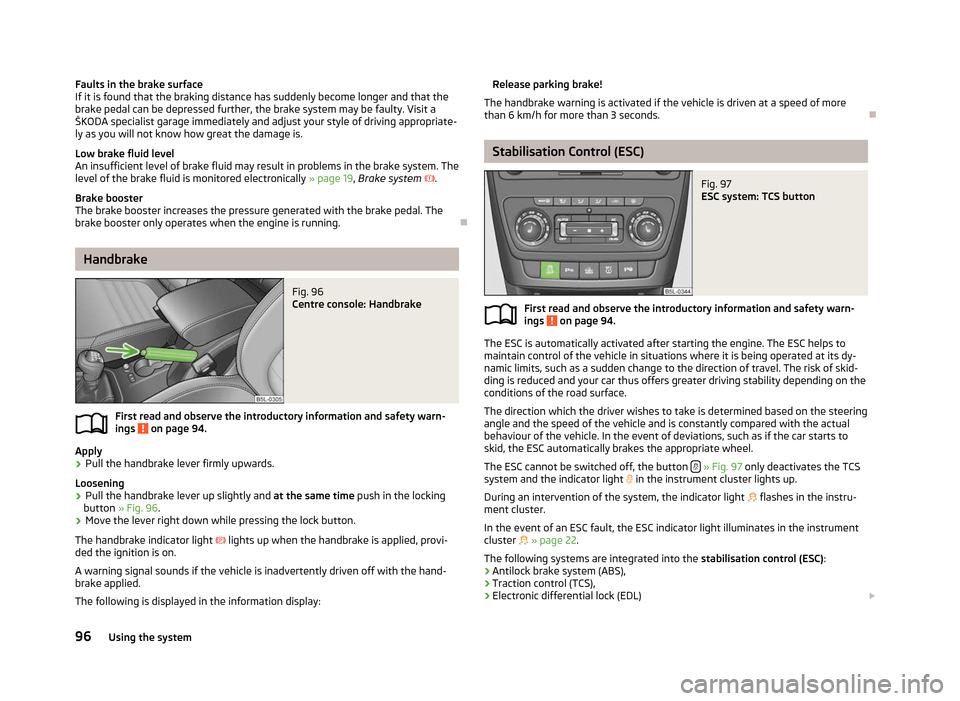
Fig. 96
Centre console: Handbrake
First read and observe the introductory information and safety warn-
ings on page 94.
Apply
›
Pull the handbrake lever firmly upwards.
Loosening
› Pull the handbrake lever up slightly and
at the same time push in the locking
button » Fig. 96 .
› Move the lever right down while pressing the lock button.
The handbrake indicator light lights up when the handbrake is applied, provi-
ded the ignition is on.
A warning signal sounds if the vehicle is inadvertently driven off with the hand-
brake applied.
The following is displayed in the information display: ä Release parking brake!
The handbrake warning is activated if the vehicle is driven at a speed of more
than 6 km/h for more than 3
seconds. Ð Stabilisation Control (ESC)
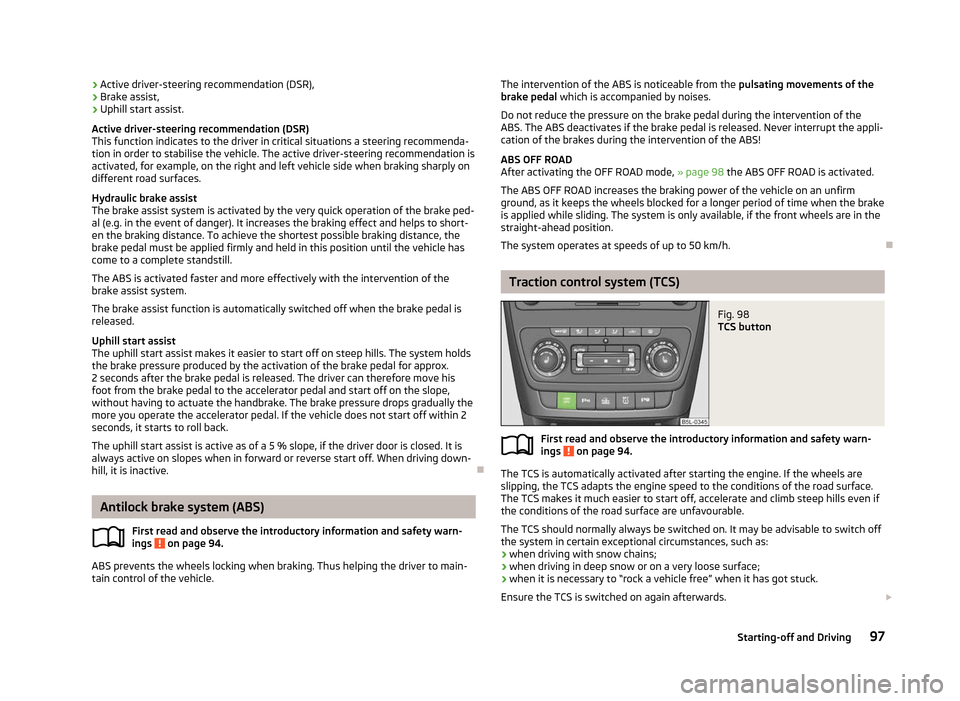
Fig. 97
ESC system: TCS button
First read and observe the introductory information and safety warn-
ings on page 94.
The ESC is automatically activated after starting the engine. The ESC helps to
maintain control of the vehicle in situations where it is being operated at its dy-
namic limits, such as a sudden change to the direction of travel. The risk of skid-
ding is reduced and your car thus offers greater driving stability depending on the
conditions of the road surface.
The direction which the driver wishes to take is determined based on the steering
angle and the speed of the vehicle and is constantly compared with the actual
behaviour of the vehicle. In the event of deviations, such as if the car starts to
skid, the ESC automatically brakes the appropriate wheel.
The ESC cannot be switched off, the button » Fig. 97 only deactivates the TCS
system and the indicator light in the instrument cluster lights up.
During an intervention of the system, the indicator light flashes in the instru-
ment cluster.
In the event of an ESC fault, the ESC indicator light illuminates in the instrument
cluster » page 22.
The following systems are integrated into the stabilisation control (ESC):
› Antilock brake system (ABS),
› Traction control (TCS),
› Electronic differential lock (EDL)
£
ä
96 Using the system
Page 99 of 225
›
Active driver-steering recommendation (DSR),
› Brake assist,
› Uphill start assist.
Active driver-steering recommendation (DSR)
This function indicates to the driver in critical situations a steering recommenda-
tion in order to stabilise the vehicle. The active driver-steering recommendation is
activated, for example, on the right and left vehicle side when braking sharply on
different road surfaces.
Hydraulic brake assist
The brake assist system is activated by the very quick operation of the brake ped-
al (e.g. in the event of danger). It increases the braking effect and helps to short-
en the braking distance. To achieve the shortest possible braking distance, the
brake pedal must be applied firmly and held in this position until the vehicle has
come to a complete standstill.
The ABS is activated faster and more effectively with the intervention of the
brake assist system.
The brake assist function is automatically switched off when the brake pedal is
released.
Uphill start assist
The uphill start assist makes it easier to start off on steep hills. The system holds
the brake pressure produced by the activation of the brake pedal for approx.
2 seconds after the brake pedal is released. The driver can therefore move his
foot from the brake pedal to the accelerator pedal and start off on the slope,
without having to actuate the handbrake. The brake pressure drops gradually the
more you operate the accelerator pedal. If the vehicle does not start off within 2
seconds, it starts to roll back.
The uphill start assist is active as of a 5 % slope, if the driver door is closed. It is
always active on slopes when in forward or reverse start off. When driving down-
hill, it is inactive. ÐAntilock brake system (ABS)
First read and observe the introductory information and safety warn-
ings on page 94.
ABS prevents the wheels locking when braking. Thus helping the driver to main-
tain control of the vehicle.
ä The intervention of the ABS is noticeable from the
pulsating movements of the
brake pedal which is accompanied by noises.
Do not reduce the pressure on the brake pedal during the intervention of the
ABS. The ABS deactivates if the brake pedal is released. Never interrupt the appli-
cation of the brakes during the intervention of the ABS!
ABS OFF ROAD
After activating the
OFF ROAD mode, » page 98 the ABS OFF ROAD is activated.
The ABS OFF ROAD increases the braking power of the vehicle on an unfirm
ground, as it keeps the wheels blocked for a longer period of time when the brake
is applied while sliding. The system is only available, if the front wheels are in the
straight-ahead position.
The system operates at speeds of up to 50 km/h. Ð Traction control system (TCS)
Fig. 98
TCS button
First read and observe the introductory information and safety warn-
ings on page 94.
The TCS is automatically activated after starting the engine. If the wheels are
slipping, the TCS adapts the engine speed to the conditions of the road surface.
The TCS makes it much easier to start off, accelerate and climb steep hills even if
the conditions of the road surface are unfavourable.
The TCS should normally always be switched on. It may be advisable to switch off
the system in certain exceptional circumstances, such as:
› when driving with snow chains;
› when driving in deep snow or on a very loose surface;
› when it is necessary to
“rock a vehicle free” when it has got stuck.
Ensure the TCS is switched on again afterwards. £
ä
97
Starting-off and Driving
Page 100 of 225

During an intervention of the system, the TCS indicator light
flashes in the in-
strument cluster.
The TCS indicator light »
page 22 lights up in the instrument cluster when
there is a fault on the TCS.
If necessary, the TCS can be switched off and on again by pressing the button » Fig. 98
, or on vehicles with ESP, by pressing the button » Fig. 97 on
page 96
. The TCS indicator light lights up in the instrument cluster when the
TCS is switched off.
TCS OFF ROAD
After activating the OFF ROAD mode, » page 98 the ASR OFF ROAD is activated.
The TCS OFF ROAD provides a more effective acceleration of the vehicle on an
unfirm ground, as it allows higher traction between the slipping wheels and the
ground.
The system operates when starting off or at low speeds. ÐElectronic differential lock (EDL)
First read and observe the introductory information and safety warn-
ings on page 94.
If one of the wheels starts to spin, the EDL system brakes the spinning wheel and
transfers the driving force to the other wheels. This ensures the stability of the
vehicle and a quick journey.
The EDL switches off automatically if unusually severe stresses exist in order to
avoid excessive heat generation in the disc brake on the wheel which is being
braked. The vehicle can continue to be driven and has the same characteristics as
a vehicle not fitted with EDL. The EDL switches on again automatically as soon as
the brake has cooled down.
EDL OFF ROAD
After activating the OFF ROAD
mode, » page 98 the EDL OFF ROAD is activated.
The EDL OFF ROAD supports the vehicle traction when driving on unfirm ground.
EDL is activated earlier in the OFF ROAD mode than in the normal mode. The
brake pressure builds up more quickly on the faster moving wheel, on one axle, as
well as diagonally. Ð
ä OFF ROAD mode
Fig. 99
OFF ROAD button
The OFF ROAD mode comprises functions which assist off-road driving.
The following functions are integrated in the
OFF ROAD mode:
› Start-Off Assist
› Downhill Drive Support,
› ABS OFF ROAD » page 97;
› ASR OFF ROAD » page 98
;
› EDL OFF ROAD » page 98
.
Switching on OFF ROAD
The OFF ROAD mode is switched on by pressing the button » Fig. 99
. The indi-
cator light in the button lights up. The warning light lights up in the instrument
cluster if the system is switched on » page 25.
Switching off
OFF ROAD
Pressing the button switches the OFF ROAD mode off. The indicator light in the
button goes out. When switching off the ignition, the OFF ROAD mode is also
switched off and can be switched on again, if necessary, after switching on the
ignition. If the engine is switched off by accident and restarted within 30 seconds,
the OFF ROAD mode remains switched on.
Start-Off Assist
When the vehicle is stationary, the Start-Off Assist is activated after switching it
on using the button for the OFF ROAD mode» Fig. 99 .
When depressing the accelerator pedal fully, the engine speed required for the
start-up procedure of the stationary vehicle is restricted. The overspeed trip unit
is automatically deactivated after terminating the start-up procedure. As part of
the Assist System, the accelerator pedal is adapted in its characteristics for an
easier start-off on slippery and loose soil. £
98 Using the system
Page 101 of 225

Downhill Drive Support
The Downhill Drive Support maintains a constant speed on a steep downhill sec-
tion when driving forwards and backwards by automatically intervening in the
brake system of all wheels. It prevents the wheels locking because the ABS re-
mains active. The warning light in the instrument cluster indicates that the
Downhill Drive Support is available » page 25.
The vehicle speed, which is maintained by the Assist System, is selected by the
driver while driving on a downhill section as of the moment the first intervention
of the Assist System is performed or else, while driving on a downhill section, the
driver must control the vehicle speed until the Assist System intervenes for the
first time. When the Assist System actively intervenes, this is indicated by the
warning light flashing or by a pulsating movement of the brake pedal, similar to
the intervention of the ABS.
You can increase or reduce the speed, even when no gear is engaged, by operat-
ing the accelerator or brake pedal. Thus the function is always interrupted and is
reactivated afterwards.
The Downhill Drive Support is activated automatically if the following conditions
are met:
› the
OFF ROAD mode is switched on and the warning light lights up in the in-
strument cluster,
› the engine of the vehicle is running and either the 1st, 2nd, 3rd gear, the reverse
gear or no gear is engaged,
› the engine of the vehicle is running, the selector lever of the automatic gearbox
is in the position R, N, D, S or Tiptronic,
› the speed is less than 30 km/h,
› the downhill gradient is at least 10 % (when driving over sleepers, the limit can
briefly drop to 8 %),
› neither the accelerator nor the brake pedal is operated.
It is however a requirement that the vehicle has sufficient grip on the soil. The
Downhill Drive Support cannot properly fulfil its function on slushy soil due to
physical reasons (ice or mud).
The Downhill Drive Support is deactivated when braking or accelerating or if the
downhill gradient is less than 8 %. The vehicle speed is steadily regulated by the Assist System in vehicles with a
manual gearbox
depending on the type of gearbox or engine:
› 1st gear - approx. 8 1)
- 30 km/h
› 2nd gear - approx. 13 1)
- 30 km/h
› 3rd gear - approx. 22 1)
- 30 km/h
› Reverse gear - approx. 9 1)
- 30 km/h
› Neutral for driving forwards - as well as driving backwards - approx. 2 1)
- 30 km/
h
Vehicles with automatic gearbox :
› Selector lever in position D, S or Tiptronic (for 1st, 2nd, 3rd gear) for driving for-
wards - approx. 2-30 km/h
› Selector lever in position R for driving backwards - approx. 2 - 30 km/h
› Selector lever in position N for driving forwards and backwards - approx. 2 - 30
km/h WARNING
■ A lack of fuel can cause irregular engine running or cause the engine to shut
down. The
OFF ROAD mode would lose its effectiveness - risk of accident!
■ Adjust the speed and driving style to the current visibility, weather, road and
traffic conditions. The increased safety offered by the
OFF ROAD mode must
not tempt you to take greater risks than otherwise - risk of an accident! CAUTION
■ The OFF ROAD
mode is not designed for the use on common roads.
■ All four wheels must be fitted with the same tyres approved by the manufactur-
er to ensure the OFF ROAD mode operates correctly. Note
■ During an intervention of the Downhill Drive Support, the brake lights do not
light up. ■ Do not switch the OFF ROADmode while the assistant is in effect. Ð1)
The indicated values represent the average of the lower speed limits if a gear is engaged (depending
on the type of gearbox or engine).
99
Starting-off and Driving
Page 111 of 225

Automatic gearbox
Automatic gearbox
ä
Introduction
This chapter contains information on the following subjects:
Introductory information 109
Starting-off and driving 110
Selector lever positions 110
Manual shifting of gears (Tiptronic) 111
Selector lever lock 111
Kickdown function 112
Dynamic shift programme 112
Emergency programme 112
Selector lever-emergency unlocking 113
WARNING
■ Do not depress the accelerator if changing the position of the selector lever
when the vehicle is stationary and the engine is running - risk of accident!
■ Never move the selector lever into position R or P when driving - risk of an
accident!
■ When the engine is running and the vehicle is stationary, it is necessary to
hold the car with the brake pedal in all the positions of the selector lever (ex-
cept P and N) since the power transmission is never completely interrupted,
also not when the engine is idling - the vehicle creeps.
■ The selector lever must be placed into position P and the handbrake firmly
applied before the bonnet can be opened and work on the running engine can
be completed - risk of accident! The safety guidelines must always be ob-
served » page 169 , Engine compartment .
■ If stopping on a hill (downhill gradient), never try to maintain the vehicle sta-
tionary with the gear engaged by means of the “accelerator pedal”, i.e. by let-
ting the clutch slip. This can lead to overheating of the clutch. If there is a risk
of overheating of the clutch due to overload, the clutch is opened automati-
cally and the vehicle rolls backward - risk of accident! WARNING (Continued)
■ If you have to stop on a slope, depress and hold the brake pedal to prevent
the vehicle from rolling back.
■ On a smooth or slippery road surface using the kickdown function can cause
the driven wheels to spin - risk of skidding! CAUTION
■ The double clutch on the automatic gearbox DSG is equipped with an overload
protection. If the uphill function is used when the vehicle is stationary or driving
slowly uphill, the thermal stress on the clutches is increased. ■ If the clutch system overheats, the symbol is shown in the information dis-
play along with the message Gearbox overheated. Stop! Owner's man.! appears.
An audible signal sounds as a warning signal. Stop the vehicle, switch off the en-
gine, and wait until the symbol disappears - risk of gearbox damage! You can
continue your journey as soon as the symbol disappears. Ð Introductory information
First read and observe the introductory information and safety warn-
ings on page 109.
Shifting up and down through the gears is performed automatically. The gearbox
can also be switched to
Tiptronic mode. This mode makes it possible for you to
also shift gears manually » page 111.
The engine can only be started when the selector lever is in position P or N . If
the selector lever is not in the P or N positions when locking the steering, switch-
ing the ignition on or off or when leaving the engine on, the following message
will appear in the Information display Move selector lever to position P/N! or, in
the instrument cluster display: P/N .
At temperatures below -10 °C the engine can only be started in the selector lever
position P.
When parking on a level road surface, it suffices to engage selector lever position
P. When parking on a slope, the handbrake should be applied firmly before the
park position is selected. This ensures that there is no excessive pressure on the
lock mechanism and that it is subsequently easier to move the selector lever out
of position P. £
ä
109
Automatic gearbox