2012 SKODA SUPERB heating
[x] Cancel search: heatingPage 66 of 235

Exterior mirror
Fig. 52
Inner part of door: Rotary knob
Adjust the rear mirror before commencing to drive so that there is a clear view to
the rear.
Heating of the external mirror
› Place the rotary knob into the position
» Fig. 52.
The exterior mirror heater only operates when the engine is running and up to an
outside temperature of +20 °C.
Adjusting left and right exterior mirrors simultaneously
› Place the rotary knob into the position
. The movement of the mirror surface is
identical to the movement of the rotary knob.
The adjustment of both mirrors simultaneously or each individual mirror is possi-
ble in the Information display » table on page 17
in the menu point Mirror adjust. .
Adjusting the right-hand exterior mirror
› Place the rotary knob into the position
. The movement of the mirror surface is
identical to the movement of the rotary knob.
Switching off operating control
› Place the rotary knob into the position
.
Folding-in both of the exterior mirrors with the rotary knob
› Place the rotary knob into the position
.
The mirrors are folded back into the driving position after the rotary knob is
turned from the position to a different one.
It is only possible to fold in both exterior mirrors when the ignition is switched on
and at a speed of up to 15
km/h. Folding-in both of the exterior mirrors using the remote control key
› If all of the windows are closed, press and hold the lock button 3
» Fig. 12 on
page 31 on the radio remote control for approx. 2
seconds.
The exterior mirrors are folded back into the driving position after opening the
door or switching on the ignition.
Tilting surface of front passenger exterior mirror
On vehicles fitted with the memory function for the driver seat, the surface of the
mirror tilts down slightly when the reverse gear is engaged and the rotary knob is
in the position » Fig. 52. This provides an aid in seeing the kerb of the pavement
when parking the car.
The mirror returns into its initial position, after the rotary knob is moved out of
the position and put into another position or if the speed is more than 15 km/h.
Memory for exterior mirrors
On vehicles fitted with a memory function for the driver seat, the relevant setting
for the exterior mirrors is also stored automatically when the seat position is stor-
ed » page 68. WARNING
■ Convex (curved outward) or a spherical exterior mirrors increase the vision
field. They do, however, make objects appear smaller in the mirror. These mir-
rors are therefore only of limited use for estimating distances to the following
vehicles.
■ Whenever possible use the interior mirror for estimating the distances to
the following vehicles. CAUTION
Never mechanically fold in or fold back the exterior mirrors with the fold-in func-
tion by hand as this will damage the electric drive. Note
■ If the exterior mirrors were folded in using the rotary knob, they can only be fol-
ded back into the driving position using the rotary knob. ■ If the exterior mirrors were folded in using the remote control key and if the ro-
tary knob was in the fold-in position before the ignition was switched on, the mir-
rors will remain in the fold-in position the next time the ignition is switched on.
The mirrors are folded back into the driving position after the rotary knob is
turned from the position to a different one. £
64 Using the system
Page 71 of 235

Seat heaters
Fig. 56
Regulator for heating the front seats/rear seats
The seat backrests and surfaces of the front seats and the two outer rear seats
can be heated electrically.
› The seat heaters on the driver's and front passenger's seat can be switched on
and regulated by pressing the button in the area of the symbol or »
Fig. 56 -
.
› The heaters on the left or right rear seats can be switched on and regulated by
pressing the regulator or
» Fig. 56 -
.
By pressing the button once, the heating is switched to the highest intensity -
level 3, which is indicated by all three of the indicator lights in the switch lighting
up.
With repeated pressing of the switch, the intensity of the heating is down-regula-
ted up to the switch-off. The intensity of the heating is indicated by the number
of illuminated indicator lights in the switch. WARNING
If, as an occupant, you have a subdued pain and/or temperature sensitivity,
e.g. through medication, paralysis or because of chronic illness (e.g. diabetes),
we recommend not to use the seat heating. This can lead to burns on the
back, the posterior and the legs which are difficult to heal. If the seat heating
is used, we recommend to make regular breaks in your journey when driving
long distances, so that the body can recuperate from the stress of the jour-
ney. Please consult your doctor, who can evaluate your specific condition. CAUTION
■ Do not kneel on the seats or otherwise apply pressure at specific points to
avoid damaging the heating elements for the seat heaters.
■ Do not use the seat heaters if the seats are not occupied by persons or if ob-
jects, such as a child seat, bag, etc., are fastened or stored on them. A fault of the
heating elements in the seat heating can occur.
■ Do not clean the seats using moisture » page 172, Fabric covers on electrically
heated seats. Note
■ The seat heating should only be switched on when the engine is running. This
has a significant effect of saving on the battery capacity. ■ If the on-board voltage drops, the seat heating is switched off automatically, in
order to provide sufficient electrical energy for the engine control » page 186.
■ If the heaters for the rear seats are set to the highest intensity - level 3, they
are automatically switched over to level 2 after 10 minutes (two indicator lights
are illuminated on the switch). Ð Ventilated front seats
Fig. 57
Rocker switch for the seat venti-
lation
Heat and condensation can be removed from the seat cushions and seat backr-
ests on the front seats.
The ventilation is operated using the rocker switch » Fig. 57 in the front part of
the seat cushion, in front of the seat control elements for the electric front seat
adjustment.
› Thew ventilation of the front seat is switch on by toggling the rocker switch in-
to position 1 - lower intensity, or position 2 - higher intensity.£
69
Seats and Stowage
Page 72 of 235

›
To switch off the ventilation shift the rocker switch into the horizontal position
. WARNING
If you or a passenger have limited pain and/or temperature sensitivity, e.g.
caused by medication, paralysis or because of chronic illness (e.g. diabetes),
we recommend that you consult your physician before using the ventilated
front seat. CAUTION
■ Do not kneel on the seats or otherwise apply pressure at specific points to
avoid damaging the electronic seat elements or the fan.
■ The fan is located underneath the front seat cushion. Do not place any objects
in this area - it may damage the fan.
■ Do not clean the seats using moisture » page 172, Fabric covers on electrically
heated seats. Note
■ The ventilation should only be switched on when the engine is running. This
has a significant effect of saving on the battery capacity. ■ We do not recommend using the front seat ventilation and heating at the same
time. Using the ventilation to cool the seat surface considerably reduces the
heating capacity, at the same time affecting the ability of the control unit to de-
tect the right seat surface temperature. ÐHead restraints
ä
Introduction
This chapter contains information on the following subjects:
Adjusting, removing and installing a head restraint 70
Middle rear head restraint 71
Best protection is achieved if the top edge of the head restraint is at the same
level as the upper part of your head.
The position of the front and rear outer head restraints is adjustable in height.
The middle rear head restraint is adjustable in two positions. The head restraints must be adjusted to match the size of the seat occupant. Cor-
rectly adjusted head restraints together with the seat belts offer effective protec-
tion for the occupants » page 141, Correct seated position . WARNING
■ The head restraints must be correctly adjusted in order to offer effective
protection for the occupants in the event of an accident.
■ Never drive with the head restraints removed - risk of injury.
■ If the rear seats are occupied, the rear head restraint must not be in the
lower position. Ð Adjusting, removing and installing a head restraint
Fig. 58
Head restraint: adjusting/removing
First read and observe the introductory information and safety warn-
ings on page 70.
Adjusting the height of a head restraint
› Grasp the side of the head restraint with both hands and push it upwards as
required » Fig. 58 - .
› To move the head restraint downwards, press and hold the safety but-
ton » Fig. 58 - with one hand and press the head restraint downwards with
the other hand.
Removing and installing a head restraint
› Pull the head restraint up out of the seat backrest as far as the stop (for the
rear head restraints fold the seat backrest forward).
› Press the locking button in direction of the arrow
» Fig. 58 - and pull the
head restraint out. £
ä
70 Using the system
Page 75 of 235
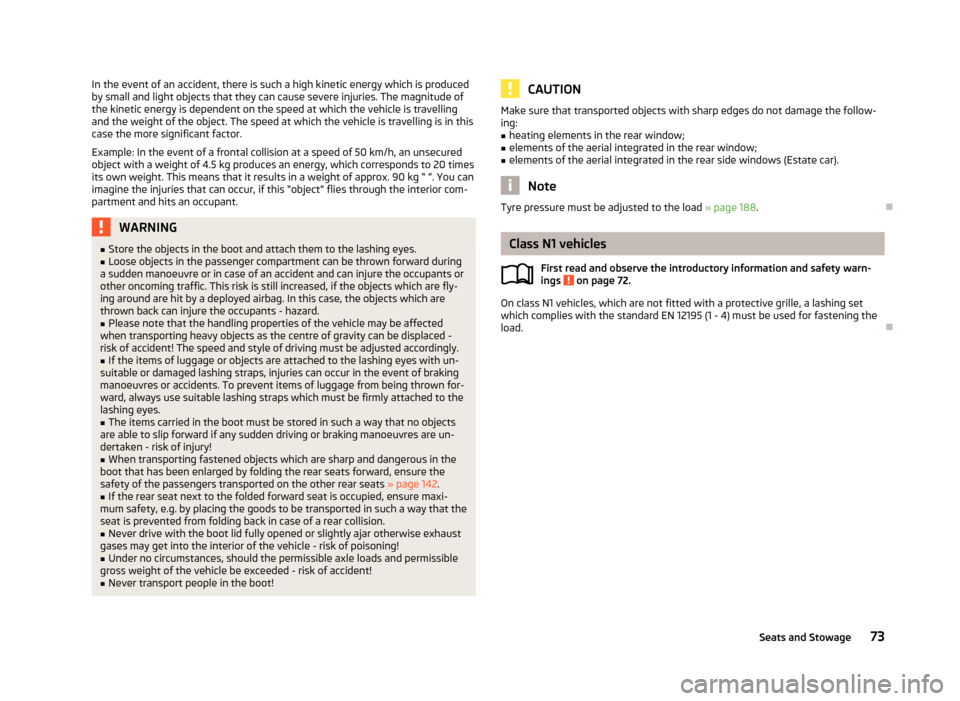
In the event of an accident, there is such a high kinetic energy which is produced
by small and light objects that they can cause severe injuries. The magnitude of
the kinetic energy is dependent on the speed at which the vehicle is travelling
and the weight of the object. The speed at which the vehicle is travelling is in this
case the more significant factor.
Example: In the event of a frontal collision at a speed of 50 km/h, an unsecured
object with a weight of 4.5 kg produces an energy, which corresponds to 20 times
its own weight. This means that it results in a weight of approx. 90 kg
“ ”. You can
imagine the injuries that can occur, if this “object” flies through the interior com-
partment and hits an occupant. WARNING
■ Store the objects in the boot and attach them to the lashing eyes.
■ Loose objects in the passenger compartment can be thrown forward during
a sudden manoeuvre or in case of an accident and can injure the occupants or
other oncoming traffic. This risk is still increased, if the objects which are fly-
ing around are hit by a deployed airbag. In this case, the objects which are
thrown back can injure the occupants - hazard. ■ Please note that the handling properties of the vehicle may be affected
when transporting heavy objects as the centre of gravity can be displaced -
risk of accident! The speed and style of driving must be adjusted accordingly. ■ If the items of luggage or objects are attached to the lashing eyes with un-
suitable or damaged lashing straps, injuries can occur in the event of braking
manoeuvres or accidents. To prevent items of luggage from being thrown for-
ward, always use suitable lashing straps which must be firmly attached to the
lashing eyes. ■ The items carried in the boot must be stored in such a way that no objects
are able to slip forward if any sudden driving or braking manoeuvres are un-
dertaken - risk of injury!
■ When transporting fastened objects which are sharp and dangerous in the
boot that has been enlarged by folding the rear seats forward, ensure the
safety of the passengers transported on the other rear seats »
page 142.
■ If the rear seat next to the folded forward seat is occupied, ensure maxi-
mum safety, e.g. by placing the goods to be transported in such a way that the
seat is prevented from folding back in case of a rear collision.
■ Never drive with the boot lid fully opened or slightly ajar otherwise exhaust
gases may get into the interior of the vehicle - risk of poisoning!
■ Under no circumstances, should the permissible axle loads and permissible
gross weight of the vehicle be exceeded - risk of accident!
■ Never transport people in the boot! CAUTION
Make sure that transported objects with sharp edges do not damage the follow-
ing:
■ heating elements in the rear window;
■ elements of the aerial integrated in the rear window;
■ elements of the aerial integrated in the rear side windows (Estate car). Note
Tyre pressure must be adjusted to the load »
page 188. Ð Class N1 vehicles
First read and observe the introductory information and safety warn-
ings on page 72.
On class N1 vehicles, which are not fitted with a protective grille, a lashing set
which complies with the standard EN
12195 (1 - 4) must be used for fastening the
load. Ð
ä
73
Seats and Stowage
Page 78 of 235

CAUTION
Please ensure that the heating elements for the rear window heater are not dam-
aged as a result of objects placed in this area. Note
Opening the boot lid also lifts up the boot cover. ÐFoldable boot cover (Combi)
Fig. 69
Boot: foldable boot cover/removing foldable boot cover
First read and observe the introductory information and safety warn-
ings on page 72.
Pulling out
›
Pull the foldable boot cover as far as the stop into the secured position 2
» Fig. 69
.
Folding
› Press the cover in the handle area in the direction of the arrow 3
» Fig. 69
,
and the cover automatically rolls up into position 1
. The cover is fully rolled up
by pressing once again.
Removing
› The fully folded boot cover can be removed to transport bulky goods by press-
ing on the side of the cross rod in the direction of the arrow 4
» Fig. 69
and
taking it out by moving it in the direction of the arrow 5
.
ä WARNING
No objects should be placed on the foldable boot cover. Ð Automatic foldable boot cover (Combi)
First read and observe the introductory information and safety warn-
ings on page 72.
The automatic rolling up of the foldable boot cover enables an easier entry into
the boot.
›
Open the boot lid. The foldable boot cover rolls up automatically in the position 1
to » Fig. 69
on page 76.
› The cover rolls up fully by pressing the cover in the handle area in direction of
arrow 3
.
When the boot lid is opened quickly, the automatic rolling up of the foldable boot
cover is blocked for a delay time of approx. 2 seconds.
The function to automatically roll up the foldable boot cover can be activated/de-
activated via the information display in the menu:
■ Settings
■ Autom. blind Ð Variable loading floor in the boot
Introductory information
The variable loading floor makes handling of bulky items of luggage easier. CAUTION
The maximum permissible load of the variable loading floor is 75 kg. Note
The room under the variable loading floor can be used to stow objects. Ð
ä
76 Using the system
Page 88 of 235

Cooling the storage compartment on the front passenger side
Fig. 88
Storage compartment: Using
cooling system
› Open the air supply by pulling the lever in the direction of the arrow
» Fig. 88.
› The air supply is closed by pressing the lever.
Opening the air supply when the air conditioning system is switched on allows
cooled air to flow into the storage compartment.
Opening the air inlet when the air conditioning system is on causes fresh or inte-
rior air to flow into the storage compartment.
We recommend closing the air supply if it is operated in heating mode or the cool-
ing system for the storage compartment is not being used. ÐStorage compartment on the driver's side
Fig. 89
Dash panel: Storage compart-
ment on the driver's side
› The storage compartment is opened by lifting the handle and folding open in
the direction of arrow » Fig. 89. Ð Stowage compartment in front centre console
Fig. 90
Front centre console: Stowage
compartment
› Press on the bottom part of the storage compartment in the area A
» Fig. 90
in the direction of the arrow, and the lid folds in. WARNING
The storage compartment is not a substitute for the ashtray and must also
not be used for such purposes - risk of fire! Ð Storage net in the front centre console
Fig. 91
Front centre console: Storage
net WARNING
Only store soft objects with a total weight of 0.5 kg in the storage net. Heavy
objects are not secured sufficiently - risk of injury! £
86 Using the system
Page 95 of 235

The air conditioning system
Air conditioning system
Introductory information
The heating effect is dependent upon the coolant temperature, thus full heat
output only occurs when the engine has reached its operating temperature.
If the cooling system is switched on, the temperature and air humidity drops in
the vehicle. The well-being of the occupants of the car is enhanced as a result of
this particularly at high outside temperatures and a high air humidity. The system
prevents the windows misting up during the cold season of the year.
It is possible to briefly activate recirculated air mode to enhance the cooling ef-
fect.
Please refer to the information regarding recirculated air mode for the air-condi-
tioning system » page 96 or for Climatronic » page 98 .
The air inlet in front of the windscreen must be free of ice, snow or leaves to en-
sure that the heating and cooling system operates properly.
After switching on the cooling Condensation from the evaporator of the air condi-
tioning may drip down and form a puddle below the vehicle. This is quite normal
and not an indication of a leak! WARNING
■ For your own safety and that of other road users, ensure that all the win-
dows are free of ice, snow and misting. Please familiarize yourself about how
to correctly operate the heating and ventilation systems, how to demist and
defrost the windows, as well as with the cooling mode.
■ Do not leave recirculated air mode on over a longer period of time, as “stale”
air can cause fatigue of the driver and passengers, reduce attention levels and
also cause the windows to mist up. The risk of having an accident increases.
Switch off recirculated air mode as soon as the windows start to mist up. Note
■ The used air streams out through the vents in the boot.
■ We recommend that you do not smoke in the vehicle when the recirculating air
mode is operating since the smoke which is drawn at the evaporator from the in-
terior of the vehicle forms deposits in the evaporator of the air conditioning sys-
tem. This produces a permanent odour when the air conditioning system is oper-
ating which can only be eliminated through considerable effort and expense (re-
placement of compressor). ■ To ensure that the air conditioning system works properly, do not block up the
air outlet vents with any objects. Ð Using the air conditioning system economically
The compressor on the air conditioning system uses power from the engine when
in cooling mode which will effect the fuel consumption.
It recommended to open the windows or the doors of a vehicle for which the inte-
rior has been strongly heated through the effect of direct sunlight in order to al-
low the heated air to escape.
The cooling system should not be switched on while travelling when the window
is open.
If the desired interior temperature can also be achieved without activating the
cooling system, fresh air mode should be selected. For the sake of the environment
Pollutant emissions are also reduced when fuel is saved. Ð Operational problems
If the cooling system does not operate at outside temperatures higher than +5 °C,
there is a problem in the system. The reasons for this may be.
› One of the fuses has blown. Check the fuse and replace if necessa-
ry »
page 207.
› The cooling system has switched off automatically for a short time because the
coolant temperature of the engine is too hot » page 9.
If you cannot rectify the functional fault yourself, or the cooling capacity decrea-
ses, the cooling system must be switched off. Visit a ŠKODA specialist garage. Ð
93
The air conditioning system
Page 97 of 235

Using the system
Fig. 108
The air conditioning system: Control elements
Setting temperature
› Turn the control dial A
» Fig. 108 to the right to increase the temperature.
› Turn the control dial A
to the left to decrease the temperature.
Controlling blower
› Turn the blower switch B
into one of the positions, 1 to 4, to switch the blower
on.
› Turn the blower switch B
into position 0 to switch the blower off.
› Press the button
4
to close the fresh air supply
» Fig. 108.
Regulating the air distribution
› The direction of the inlet air flow is controlled with air distribution regulator C
» page 94.
Switching the cooling system on and off
› Press the button
AC 1
» Fig. 108 . The indicator light lights up in the button.
› When you again press the button
AC , the air conditioning system is switched
off. The indicator light in the button goes out.
Rear window heater › Press the button
2
. Further information
» page 58.
Auxiliary heating (parking heating)
› Press the button
3
to directly switch on/off the auxiliary heating (auxiliary
heating and ventilation). Further information » page 100. Note
■ The whole heat output will be needed to defrost the windscreen and side win-
dows. No warm air will be fed to the footwell. This can lead to restriction of the
heating comfort. ■ The indicator light AC lights after activation, even if not all of the conditions for
the function of the cooling system have been met » page 94, Introductory infor-
mation . By lighting up of the indicator light in the button, the operational readi-
ness of the cooling system is signalled. Ð 95
The air conditioning system