2012 SKODA FABIA battery
[x] Cancel search: batteryPage 167 of 196

Jump-starting
ä
Introduction
This chapter contains information on the following subjects:
Jump-starting 165
Jump-starting in vehicles with the START-STOP system 166
The battery of another vehicle can be used to jump-start your vehicle if the en-
gine will not start because the battery is flat. Jump-start cables are required for
this purpose.
Both batteries must have a rated voltage of 12 V. The capacity (Ah) of the battery
supplying the power must not be significantly less than the capacity of the dis-
charged battery in your vehicle.
Jump-start cables
Only use jump-start cables which have an adequately large cross-section and in-
sulated terminal clamps. Observe the manufacturer's instructions.
Positive cable - colour coding in the majority of cases is red.
Negative cable - colour coding in the majority of cases is black. WARNING
■ A discharged vehicle battery may already freeze at temperatures just below
0 °C. In case of frozen battery carry out no jump-starting - risk of explosion! ■ Pay attention to the warning instructions relating to working in the engine
compartment »
page 138, Engine compartment .
■ The non-insulated parts of the terminal clamps must never make contact
with each other. In addition, the jump-start cable connected to the positive
terminal of the battery must not come into contact with electrically conduct-
ing parts of the vehicle - risk of short circuit! ■ Do not clamp the jump-start cable to the negative terminal of the dis-
charged battery. There is the risk of detonating gas seeping out the battery
being ignited by the strong spark which results from the engine being started. ■ Route the jump-start cables so that they cannot be caught by any rotating
parts in the engine compartment. ■ Do not bend over the battery - risk of caustic burns!
■ The vent screws of the battery cells must be tightened firmly. WARNING (Continued)
■ Keep any sources of ignition (naked flame, smouldering cigarettes, etc.)
away from the battery - risk of an explosion! ■ Never jump-start vehicle batteries with an electrolyte level that is too low -
risk of explosion and caustic burns. Note
■ There must not be any contact between the two vehicles otherwise current
may flow as soon as the negative terminals are connected. ■ The discharged battery must be properly connected to the system of the vehi-
cle. ■ We recommend you buy jump-start cables from a car battery specialist. Ð Jump-starting
Fig. 138
Jump-starting using the battery
from another vehicle: A - flat ve-
hicle battery, B - battery provid-
ing current
First read and observe the introductory information and safety warn-
ings on page 165.
The jump-start cables must be attached in the following sequence.
Connecting positive terminals
›
Attach one end 1
»
Fig. 138
to the positive terminal of the discharged battery A
.
› Attach the other end 2
to the positive terminal of the battery supplying the
power B
.
Connecting negative terminal and engine block
› Attach one end 3
»
Fig. 138
to the negative terminal of the battery supplying
the power B
.
£
ä
165
Do-it-yourself
Page 168 of 196
›
Attach the other end 4
to a solid metal part which is connected firmly to the
engine block, or to the engine block itself.
Starting engine
› Start the engine on the vehicle providing the power and allow it to idle.
› Now start the engine of the vehicle with the discharged battery.
› If the engine does not start, terminate the attempt to start the engine after
10 seconds and wait for about 30 seconds before repeating the process.
› Disconnect the cables in exactly the
reverse order to the one described above. ÐJump-starting in vehicles with the START-STOP system
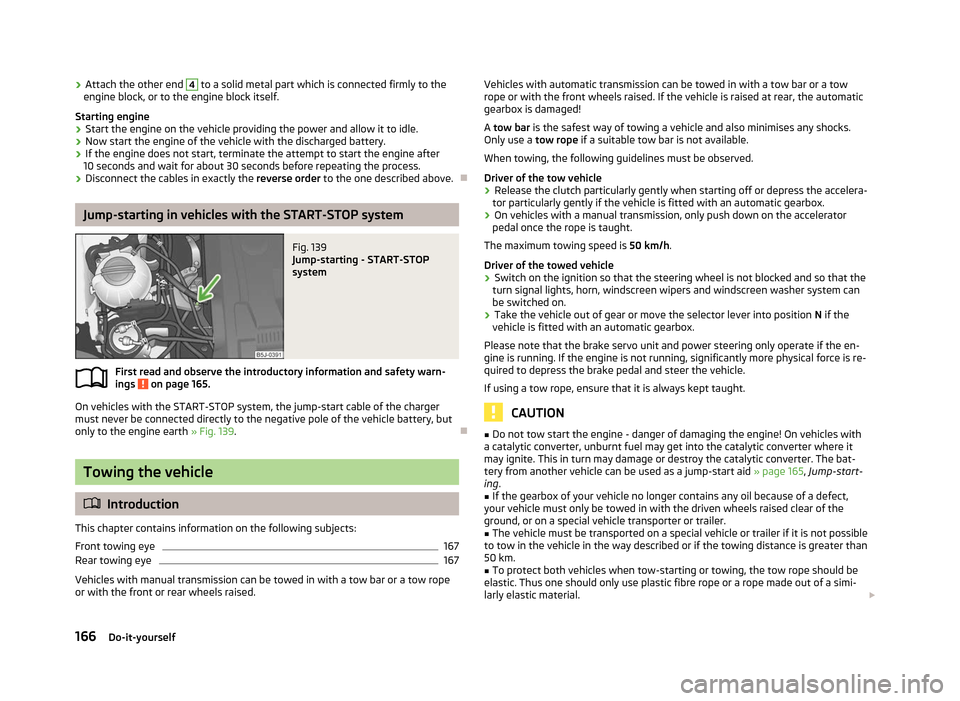
Fig. 139
Jump-starting - START-STOP
system
First read and observe the introductory information and safety warn-
ings on page 165.
On vehicles with the START-STOP system, the jump-start cable of the charger
must never be connected directly to the negative pole of the vehicle battery, but
only to the engine earth » Fig. 139. ÐTowing the vehicle
ä
Introduction
This chapter contains information on the following subjects:
Front towing eye 167
Rear towing eye 167
Vehicles with manual transmission can be towed in with a tow bar or a tow rope
or with the front or rear wheels raised.
ä Vehicles with automatic transmission can be towed in with a tow bar or a tow
rope or with the front wheels raised. If the vehicle is raised at rear, the automatic
gearbox is damaged!
A tow bar
is the safest way of towing a vehicle and also minimises any shocks.
Only use a tow rope if a suitable tow bar is not available.
When towing, the following guidelines must be observed.
Driver of the tow vehicle
› Release the clutch particularly gently when starting off or depress the accelera-
tor particularly gently if the vehicle is fitted with an automatic gearbox.
› On vehicles with a manual transmission, only push down on the accelerator
pedal once the rope is taught.
The maximum towing speed is 50 km/h.
Driver of the towed vehicle
› Switch on the ignition so that the steering wheel is not blocked and so that the
turn signal lights, horn, windscreen wipers and windscreen washer system can
be switched on.
› Take the vehicle out of gear or move the selector lever into position
N if the
vehicle is fitted with an automatic gearbox.
Please note that the brake servo unit and power steering only operate if the en-
gine is running. If the engine is not running, significantly more physical force is re-
quired to depress the brake pedal and steer the vehicle.
If using a tow rope, ensure that it is always kept taught. CAUTION
■ Do not tow start the engine - danger of damaging the engine! On vehicles with
a catalytic converter, unburnt fuel may get into the catalytic converter where it
may ignite. This in turn may damage or destroy the catalytic converter. The bat-
tery from another vehicle can be used as a jump-start aid » page 165, Jump-start-
ing .
■ If the gearbox of your vehicle no longer contains any oil because of a defect,
your vehicle must only be towed in with the driven wheels raised clear of the
ground, or on a special vehicle transporter or trailer.
■ The vehicle must be transported on a special vehicle or trailer if it is not possible
to tow in the vehicle in the way described or if the towing distance is greater than
50 km. ■ To protect both vehicles when tow-starting or towing, the tow rope should be
elastic. Thus one should only use plastic fibre rope or a rope made out of a simi-
larly elastic material. £
166 Do-it-yourself
Page 172 of 196

No. Power consumer
32 High pressure fuel pump, pressure valve
33 Engine control unit
34 Engine control unit, vacuum pump 35 Power supply of ignition lock
36 Main beam 37 Rear fog light, DC/DC converter START-STOP
38 Fog lights 39 Air blower for heating
40-41 Not assigned 42 Rear window heater
43 Horn
44 Windscreen wipers 45 Central control unit for convenience system
46 Engine control unit, fuel pump 47 Cigarette lighter, power socket in the luggage compartment
48 ABS, START-STOP (DC/DC) converter ESP 49 Turn signal lights, brake lights50 START-STOP (DC/DC) converter infotainment, radio 51 Electrical power window (front and rear) - left side
52 Electrical power window (front and rear) - right side
53 Parking light = left side, electrical sliding/tilting roof
54 START-STOP (instrument cluster), alarm 55 Control unit for automatic gearbox
56 Headlight cleaning system, parking light - right side 57 Left low beam, headlight range adjustment
58 Low beam on the right Ð Fuses in the engine compartment
Fig. 144
Vehicle battery: Distribution board cover. Fig. 145
Schematic representation of
fuse box in engine compartment
First read and observe the introductory information and safety warn-
ings on page 168.
›
Press together the circlips in the fuse box cover at the same time in the direc-
tion of arrow A
» Fig. 144
and remove the cover in the direction of arrow B
.
› Release the fixtures in the openings C
using a flat screwdriver and fold the
cover upwards in direction of arrow D
.
Fuse assignment in engine compartment No. Power consumer
1 Generator
2 Not assigned
3 Interior
4 Electrical auxiliary heating system 5 Interior £ ä
170 Do-it-yourself
Page 188 of 196

Index
A
ABS 84
Warning light 21
Accessories 157
Adjusting Exterior mirror 48
Adjusting seats 104
Adjustment Seats 50
Aerial 130
see Radio reception 132
Airbag 111
Deployment 111
Front airbag 112
Head airbag 114
Side airbag 113
Airbag system 111
Air conditioning system Air outlet vents 71
Climatronic 76
Manual air conditioning system 73
Alarm 31
Anti-theft alarm system 31
Antilock brake system 84
Armrest 68
Ashtray 64
Assistance systems ESC 83
Assist systems ABS 21, 84
Cruise control systems (CCS) 86
EDS and XDS 84
ESC 20
Parking aid 85
START/STOP 88
TCS 21, 84Auto Check Control 16
Automatic gearbox 90
Dynamic shift programme 93
Emergency programme 94
Information for driving 90
Kickdown 93
Manual shifting of gears on the multifunction steering wheel 92
Parking 91
Selector lever-emergency unlocking 94
Selector lever lock 93
Selector lever positions 91
Starting off 91
Stopping 91
Tiptronic 92
Automatic load deactivation 149
AUX-IN 102
Avoiding damage to your vehicle 125
B
Before setting off 103
Belts 107
Belt tensioners 110
Bicycle carrier 60
Bonnet Closing 140
Opening 140
Boot Class
N1 vehicles 54
Cover 55
Emergency unlocking 33
Fastening elements 54
Fixing nets 55
foldable boot cover (Combi) 56
Folding hooks 54
Light 44
see Boot lid 33
Unlocking the boot lid 33
Boot lid 33
Automatic locking 33Brake assist 83
Brake booster 83
Brake fluid Checking 144
Brakes Brake booster 83
Handbrake 83
Running in 121
Warning light 18
Braking Brake fluid 144
Breakdown kit 162
Bulbs Replacing 171
Button in the driver's door Electrical power windows 34
C
Car computer see Multifunction display 12
Car jack 158
Carrier 62
Catalytic converter 121
Central locking button 29
Central locking system 27
lock 28
unlock 28
Changes 157
Changing Engine oil 142
Wheel 159
Charging a vehicle battery 148
Checking Battery electrolyte level 147
Brake fluid 144
Coolant level 143
Engine oil 141
Oil level 141
Windscreen washer fluid 145
186 Index
Page 189 of 196

Children and safety 117
Child safety Side airbag 118
Child safety lock 26
Child seat Classification 118
ISOFIX 119
on the front passenger seat 117
Suitability 119
TOP TETHER 119
Chrome parts refer to Taking care of your vehicle 131
Cigarette lighter 64
Cleaning 129
Artificial leather 134
Headlight lenses 132
Material coverings 134
Materials 134
Natural leather 134
Plastic parts 131
Wheels 133
Climatronic Recirculated air mode 77
Clock 11
Clothes hooks 69
Cockpit 12-volt power socket 65
Ashtray 64
Cigarette lighter 64
General view 7
Light 43
Storage compartments 65
Compartments 65
Computer see Multifunction display 12
Coolant Checking 143
Indicator light 19
Replenishing 143
Temperature gauge 9
Correct seated position 104Counter for distance driven 10
Cruise control system (CCS) 86
Cup holders 63
D
Daylight driving light 39
Deactivating an airbag 115
Defrsoting rear window 44
Delayed locking of the boot lid see Boot lid 33
Diesel refer to Fuel 138
Diesel fuel Operation in winter 138
Diesel particulate filter 22
Digital clock 11
Dipstick 141
Display Coolant temperature 9
Service interval 10
Distance driven 10
Door Child safety lock 26
Doors Emergency locking 32
Driving Abroad 125
Driving through water on the street 126
Emissions 177
Fuel consumption 177
Maximum speed 180
E
Economical and environmentally friendly driving 122
EDS 84
Electrical power windows Button in the driver's door 34
Button in the rear door 34Central locking system 35
Operational faults 35
Electric sliding/tilting roof 36
Electronic Differential Lock 84
Electronic immobiliser 80
Emergency Automatic gearbox 94
Changing a wheel 159
Hazard warning light system 42
Jump-starting 165
locking of the doors 32
Selector lever-unlocking 94
Sliding roof 37
Towing the vehicle 166
Tyre repair 162
Unlocking the boot lid 33
Emissions 177
Engine Running in 121
Starting and stopping the engine 79
Starting engine 81
Switching off the engine 81
Engine compartment Brake fluid 144
Coolant 142
Overview 140
Vehicle battery 145
Engine oil Capacity 179
Changing 142
Checking 141
Replenishing 141
Specification 179
Warning light 19
Engine revolutions counter 9
Environment 122
Environmental compatibility 124
Environmentally friendly driving 122
ESC Function 83
Warning light 20
187
Index
Page 191 of 196

N
Net partition 58
O
Oil refer to Engine oil 141
Onboard computer see Multifunction display 12
Operation in winter De-icing windows 132
Diesel fuel 138
Vehicle battery 147
Outside temperature 13
Overview Engine compartment 140
Warning lights 17
P
Paint see Paint damage 131
Paint damage 131
Parking Parking aid 85
Parking ticket holder 69
Passive Safety 103
Periodic wiping 45
Petrol refer to Fuel 137
Polishing the paintwork refer to Taking care of your vehicle 131
Power steering 80
Preservation refer to Taking care of your vehicle 131
R
Radiator fan 144Radio reception
Aerial 132
Functional fault 132
Raise vehicle 161
Rear mirror Exterior mirror 48
Manual dimming interior mirror 47
Recirculated air mode Manual air conditioning system 75
Recommended gear 11
Refuelling 136
Fuel 136
Regulation Headlight beam 41
Remote control 29
Synchronisation process 30
Remote control key Replacing the battery 25
Replacement of parts 157
Replacing bulbs 171
Fuses 168
Vehicle battery 148
Windscreen wiper blade 46
Replenishing Coolant 143
Engine oil 141
Windscreen washer fluid 145
Roof luggage rack Attachment points 63
Roof rack system Roof load 63
Running in Brake pads 121
Engine 121
The first 1 500 km 121
Tyres 121
S
Safe securing system 27Safety 103
Child safety 117
Child safety seats 117
Head restraints 51
ISOFIX 119
TOP TETHER 119
Save electrical energy 122
Seat Adjusting 50
Seat belt Warning light 18
Seat belt height adjuster 110
Seat belts 107
Cleaning 135
fastening and unfastening 109
Height adjustment 110
Seats folding forward 52
Head restraints 51
Heating 50
Removing the seats 52
Selector lever see selector lever positions 91
Selector lever positions 91
Service display 10
Setting Manual air conditioning system 75
Manual dimming interior mirror 47
Steering wheel 80
Setting temperature Heating 71
Setting the clock Clock 11
Shifting Diving economically 122
Gearshift lever 85
Side airbag 113
Sliding/tilting roof see Electric sliding/tilting roof 36
Snow chains 156
189
Index
Page 192 of 196

Spare wheel 153
Speedometer 9
START/STOP Function 88
Starting and stopping the engine 79
Starting engine 81
Jump-starting 165
START STOP Jump-starting 166
Steering force assistance 80
Steering wheel 80
Storage 65
Storage compartment Lighting 43
Storage compartments 65
Sun visors 44
Switching lights on and off 38
Switching off the engine 81
T
Taking care of the vehicle Artificial leather 134
Material coverings 134
Materials 134
Natural leather 134
Seat belts 135
Taking care of your vehicle 129
Automatic car wash system 130
Chrome parts 131
Cleaning the wheels 133
Door lock cylinders 132
Headlight lenses 132
High-pressure cleaner 130
Plastic parts 131
Polishing the paintwork 131
Preservation 131
Rubber seals 132
Washing 130
Washing by hand 130
Wash system 130TCS 84
Warning light 21
Technical data 177
Telephone 95
Tilting roof see Electric sliding/tilting roof 36
Tiptronic 90
see automatic gearbox 92
Tool 158
TOP TETHER 119
Towing 166
Towing a trailer 127
Towing eye 167
Towing protection 31
Traction control system (TCS) 84
Trailer 127
Towing a trailer 127
Transport Boot 53
Roof rack system 62
Transporting children safely 117
Two-way radio systems 95
Type plate 177
Tyre repair 162
Tyres see Wheels and tyres 152
U
Underbody protection 133
unlock Central locking system 28
Unlocking Remote control 30
without central locking 26
Uphill start assist 83 V
Vehicle battery Automatic load deactivation 149
Charging 148
Checking the electrolyte level 147
Operation in winter 147
Replacing 148
Safety instructions 145
Vehicle Condition see Auto Check Control 16
Vehicle data sticker 177
Vehicle dimensions 178
Vehicle key 25
Vehicle tool kit 158
Visors 44
W
Warning lights 17
Warning symbols see Warning lights 17
Warning triangle 158
Washing 129
Automatic car wash system 130
by hand 130
Chrome parts 131
High-pressure cleaner 130
Weights 177
Wheel bolts Anti-theft wheel bolt 162
Caps 154
Loosening and tightening 161
Wheels 150
Wheels and tyres Changing a wheel 159
Full wheel trim 154
General information 150
Handling wheels and tyres 152
new tyres 152
190 Index