2012 Seat Leon 5D wheel
[x] Cancel search: wheelPage 241 of 289

240Emergencies
To benefit from the advantages of tyres with this type of tread pattern, the
defective tyre should be replaced as soon as possible so that all tyres again
rotate in the correct direction.
After changing a wheel
– On alloy wheels: replace the wheel bolt caps.
– On plate wheels: replace the wheel hubcap ⇒ page 236.
– Put the tools and jack back in the luggage compartment.
– If the replaced wheel does not fit in the spare wheel housing,
store it safely in the luggage compartment ⇒ page 17.
– Check the tyre pressure of the newly mounted tyre as soon as
possible.
– In vehicles fitted with a tyre pressure indicator, adjust the pres-
sure and store the reading in the radio/Easy Connect system*
⇒ page 175.
– The wheel bolts should be tightened to 120 Nm. Check the tor-
que as soon as possible with a torque wrench. Meanwhile, drive
carefully.
– Have the flat tyre replaced as quickly as possible. Spare wheel
General information
Fig. 125 Compact tem-
porary spare wheel:
raised floor panel
The temporary spare wheel has been designed to be used for short
periods of time. Have the tyres checked, and if necessary, replaced
as soon as possible at a SEAT Official Service or at a specialised
workshop.
Please note the following restrictions when using the compact tem-
porary spare wheel. The compact temporary spare wheel is de-
signed specifically for this model. For this reason, do not use a
temporary spare wheel from a different type of vehicle.
Removing the temporary spare wheel
– Lift and hold up the floor panel to remove the temporary spare
wheel ⇒ Fig. 125.
– Turn the thumb wheel anti-clockwise.
Page 242 of 289

241
Emergencies
– Take out the temporary spare wheel.
Chains
For technical reasons, snow chains must not be used on the temporary
spare wheel.
If you have a puncture on one of the front wheels when using snow chains,
fit the temporary spare wheel in place of one of the rear wheels. Fit the snow
chains on the rear wheel that you have removed and replace the punctured
front wheel with this wheel.
WARNING
● After fitting the temporary spare wheel, check the tyre pressures as
soon as possible. Failure to do so may cause an accident. The tyre pres-
sures are listed on the inside of the fuel tank flap.
● Do not drive at over 80 km/h (50 mph) when the temporary spare
wheel is fitted on the vehicle: risk of accident!
● Avoid heavy acceleration, hard braking and fast cornering: risk of ac-
cident!
● Never use more than one temporary spare wheel at the same time,
risk of accident.
● No other type of tyre (normal summer or winter tyre) may be fitted on
the compact temporary spare wheel rim.
Jump starting
Jump leads
The jump lead must have a sufficient wire cross section.
If the engine fails to start because of a discharged battery, the battery can
be connected to the battery of another vehicle to start the engine.
Jump leads
Jump leads must comply with standard DIN 72553 (see cable manufactur-
er's instructions). The wire cross section must be at least 25 mm 2
for petrol
engines and at least 35 mm 2
for diesel engines.
Note
● The vehicles must not touch each other, otherwise electricity could flow
as soon as the positive terminals are connected.
● The discharged battery must be properly connected to the on-board net-
work.
Safety FirstOperating instructionsPractical TipsTechnical specifications
Page 245 of 289

244Emergencies
Towing and tow-starting the vehicle
General information
Points to observe when tow-starting or towing away If you use a tow rope:
Notes for the driver of the towing vehicle
– The tow rope must be taut before you drive off.
– Release the clutch very carefully when starting the vehicle
(manual gearbox), or accelerate gently (automatic gearbox).
Notes for the driver of the towed vehicle
– The ignition should be switched on so that the turn signals,
horn, windscreen wipers and washers can be used. Please en-
sure that the steering wheel is unlocked when you switch on the
ignition, and that it moves freely.
– Put the gearbox lever in neutral (manual gearbox) or move the
selector lever to position N (automatic gearbox).
– The brake servo only works when the engine is running. Consid-
erably more effort is required on the brake pedal when the en-
gine is switched off.
– Remember that the brake servo only works when the ignition is
switched on and the vehicle is moving 1)
. Otherwise, considera-
bly more strength than usual will be required when steering. –
Ensure that the tow rope remains taut at all times.
Tow rope or tow bar
It is easier and safer to tow a vehicle with a tow bar. You should only use a
tow rope if you do not have a tow bar.
A tow rope should be slightly elastic to avoid damage to both vehicles. It is
advisable to use a tow rope made of synthetic fibre or similarly elastic mate-
rial.
Only attach the tow rope or the tow bar to the towing rings ⇒ page 245.
Driving style
Towing requires some experience, especially when using a tow rope. Both
drivers should be familiar with the technique required for towing. Inexper-
ienced drivers should not attempt to tow.
Do not pull too hard with the towing vehicle and take care to avoid jerking
the tow rope. When towing on an unpaved road, there is always a risk of
overloading and damaging the anchorage points.
WARNING
If the vehicle has no electrical power, the brake lights, turn signals and
all other lights will no longer function. Do not have the vehicle towed
away. Failure to do so could result in an accident.
CAUTION
If there is no oil in the gearbox or no lubricant in the automatic transmission
the car may only be towed with the driven wheels lifted clear of the road, or
transported on a special car transporter or trailer.
1)
Important: the battery must be correctly charged.
Page 246 of 289

245
Emergencies
Note
● Please observe legal requirements when doing so.
● Switch on the hazard warning lights of both vehicles. However, observe
any regulations to the contrary.
● The tow rope must not be twisted. Otherwise the front towline anchor-
age could be pulled off the vehicle.
Towline anchorage at the front of the vehicle
The front towline anchorage is only mounted if the vehicle
has to be towed.
Fig. 128 Right side of
the front bumper: towline
anchorage screwed in
There is a cover with an opening into which the towline anchorage
is screwed on the right part of the front bumper.
– To remove the bumper cover, just press the upper left side in-
wards. –
Take the towline anchorage out of the vehicle tool kit
⇒ page 232.
– Screw the towline anchorage into the screw connection as far as
it will go ⇒ Fig. 128 and tighten with the wheel brace.
After use, unscrew the towline anchorage and fit the cover back on the
bumper. Put the towline anchorage back in the vehicle tool kit. The towline
anchorage should always be kept in the vehicle.
Safety FirstOperating instructionsPractical TipsTechnical specifications
Page 247 of 289

246Emergencies
Rear towline anchorage
The rear towline anchorage should only be mounted if you
wish to tow another vehicle.
Fig. 129 Right side of
the rear bumper: cover
cap
Fig. 130 Right side of
the rear bumper: towline
anchorage screwed in Vehicles with towline anchorage
On the right of the rear bumper there is a cover which covers a
threaded hole.
–
Take the towline anchorage out of the vehicle tool set
⇒ page 232.
– To remove the bumper cover, press the upper side of the cover
inwards -arrow- and remove the cover by levering on the left
side ⇒ Fig. 129.
– Screw the towline anchorage into the screw connection as far as
it will go ⇒ Fig. 130 and tighten with the wheel brace.
After use, unscrew the towline anchorage and put it back in the vehicle tool
kit. Replace the cover on the bumper. The towline anchorage should always
be kept in the vehicle.
WARNING
● If the towline anchorage is not screwed in as far as the stop, there is a
risk of the screw connection shearing off during towing (accident risk).
● If your car has a towing bracket, only use special towing ropes. Risk
of accident!
CAUTION
In vehicles fitted with a towing bracket, only use special tow bars to prevent
damage to the ball joint. These tow bars have been specially approved for
use with towing brackets.
Note
If the vehicle is fitted with a towing hook, the ball must be fitted in it when
towing the vehicle.
Page 248 of 289

247
Emergencies
Tow-starting
As a general rule, tow-starting is not recommended.
– Engage 2nd or 3rd gear before moving off.
– Press the clutch and hold the pedal down.
– Switch the ignition on.
– Once both vehicles are moving, release the clutch.
– As soon as the engine starts: press the clutch and put the gear
lever in neutral.
If the engine will not start, it is best to try starting it using the battery of an-
other vehicle ⇒ page 241 before attempting to tow start. You should only try
to tow-start the engine if jump starting is not successful. Tow-starting is an
attempt to start the engine via the movement of the wheels.
When tow-starting a vehicle with a petrol engine, do not tow it more than a
short distance, otherwise sunburnt fuel can enter the catalytic converter and
cause damage.
WARNING
The risk of accidents is high when tow-starting, as the towed vehicle can
easily be driven into the towing vehicle.
CAUTION
Do not tow vehicles for more than 50 m. Risk of damage to the catalytic con-
verter. Towing vehicles with a manual gearbox
Towing is relatively straightforward.
Please observe the relevant instructions ⇒ page 244.
The vehicle can be towed using a tow bar or tow rope in the normal way,
with all four wheels on the road; it can also be towed with either the front or
rear wheels lifted off the road. The maximum towing speed is 50 km/h (30
mph).
Towing a vehicle equipped with automatic gearbox
Certain restrictions must be observed when towing your ve-
hicle. Please observe the relevant instructions ⇒ page 244.
The vehicle can be towed with a tow bar or tow rope in the normal way, with
all four wheels on the ground. When doing so, please note the following
points:
● Make sure the selector lever is in the N position.
● The vehicle must not be towed faster than 50 km/h (30 mph).
● The vehicle must not be towed further than 50 km (30 miles). Reason:
when the engine is not running, the gearbox oil pump does not work and
the gearbox is not adequately lubricated for higher speeds or longer distan-
ces.
If the vehicle has to be towed with a breakdown truck, it must only be sus-
pended at the front wheels. Reason: the drive shafts are located on the front
wheels. If the car is towed with the rear wheels lifted off the road (I.e. travel-
ling backwards), the drive shafts also turn backwards. The planetary gears
in the automatic gearbox then turn at such high speeds that the gearbox
will be severely damaged in a short time.
Safety FirstOperating instructionsPractical TipsTechnical specifications
Page 251 of 289

250Fuses and bulbs
–Unlock the fuse cover ⇒ Fig. 132.
– Remove the clips from the fuse cover.
– Use the plastic clip to pull out the fuse and replace the blown
fuse with a fuse of the same rating.
The individual electrical circuits are protected by fuses. Fuses are located
under a cover below the steering wheel on the left side of the engine com-
partment.
WARNING
Do not repair fuses, and never replace a blown fuse with a higher amper-
age fuse. The electrical system could be damaged, with risk of fire.
CAUTION
● Multiple fuse values on the same line (for example, 5/10/20) in the fol-
lowing tables indicate equipment-related differences. Replace the blown
fuse with a fuse of the same amperage.
● If a newly replaced fuse blows again after a short time, the electrical sys-
tem must be checked by a specialised workshop as soon as possible.
Note
● Positions are not occupied by a fuse do not appear in the following ta-
bles.
● Some of the equipment listed in the tables below pertain only to certain
versions of the model or are an optional extra. Fuses in the vehicle interior
No.Electrical consumerAmpsF2Vacant-F4Alarm10F5Gateway5F6Anti-theft alarm system5
F7Air conditioner/heating control panel, selector
lever (automatic gearbox), relay coil, rear win-
dow heating, additional heating10
F8Diagnosis, handbrake switch, light switch, re-
verse light, interior lighting10
F9Vacant-F10Radio display10F11Vacant-F12Radio20F13Vacant-F14Air conditioner fan40F15Vacant-F16Vacant-F17Instrument panel5F18Vacant-F19Vacant-F20Vacant-F23Right lights40F24Sunroof30F25Left door30F26Heated seats30F27Vacant-F28Vacant-
Page 265 of 289
264Technical specifications
Vehicle identification data
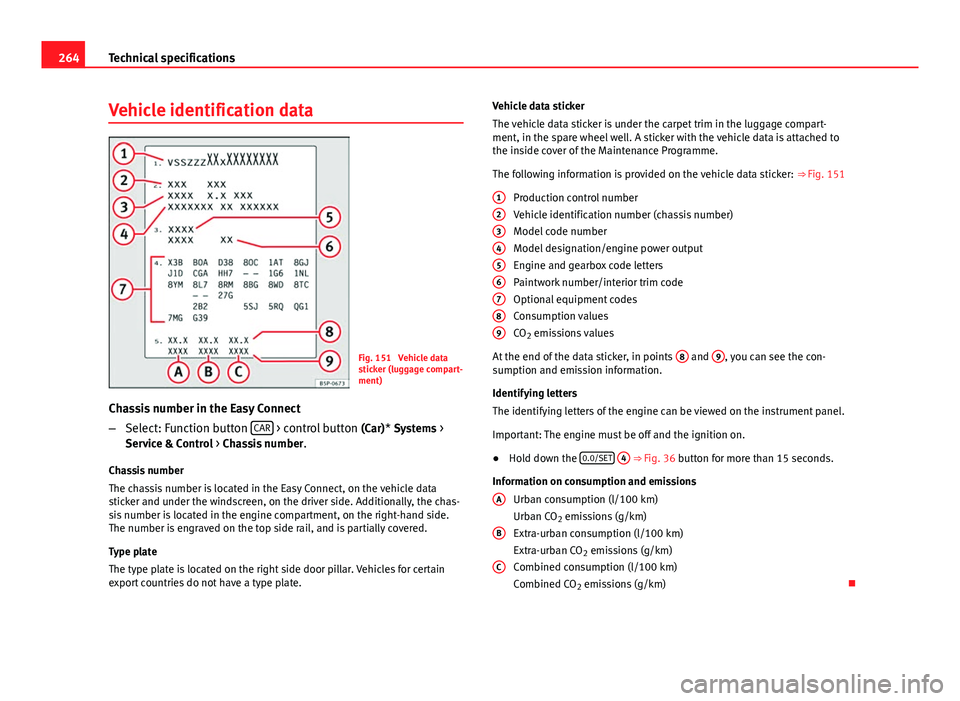
Fig. 151 Vehicle data
sticker (luggage compart-
ment)
Chassis number in the Easy Connect
– Select: Function button CAR
> control button
(Car)* Systems >
Service & Control > Chassis number .
Chassis number
The chassis number is located in the Easy Connect, on the vehicle data
sticker and under the windscreen, on the driver side. Additionally, the chas-
sis number is located in the engine compartment, on the right-hand side.
The number is engraved on the top side rail, and is partially covered.
Type plate
The type plate is located on the right side door pillar. Vehicles for certain
export countries do not have a type plate. Vehicle data sticker
The vehicle data sticker is under the carpet trim in the luggage compart-
ment, in the spare wheel well. A sticker with the vehicle data is attached to
the inside cover of the Maintenance Programme.
The following information is provided on the vehicle data sticker:
⇒ Fig. 151
Production control number
Vehicle identification number (chassis number)
Model code number
Model designation/engine power output
Engine and gearbox code letters
Paintwork number/interior trim code
Optional equipment codes
Consumption values
CO 2 emissions values
At the end of the data sticker, in points 8
and 9, you can see the con-
sumption and emission information.
Identifying letters
The identifying letters of the engine can be viewed on the instrument panel.
Important: The engine must be off and the ignition on.
● Hold down the 0.0/SET
4 ⇒ Fig. 36 button for more than 15 seconds.
Information on consumption and emissions Urban consumption (l/100 km)
Urban CO 2 emissions (g/km)
Extra-urban consumption (l/100 km)
Extra-urban CO 2 emissions (g/km)
Combined consumption (l/100 km)
Combined CO 2 emissions (g/km)
1
23456789
A
B
C