2012 Seat Ibiza 5D trailer
[x] Cancel search: trailerPage 221 of 280

219
If and when
If you have a puncture on one of the front wheels when using snow chains,
fit the compact temporary spare wheel in place of one of the rear wheels.
You can then attach the snow chains to the wheel taken from the rear and
use this wheel to replace the punctured front wheel.
WARNING
● The tyre pressures must be checked and corrected as soon as possi-
ble after fitting the temporary spare wheel.
● Do not drive faster than 80 km/h (50 mph). Higher speeds can cause
an accident.
● Avoid heavy acceleration, hard braking and fast cornering. Risk of ac-
cident.
● Never use more than one temporary spare wheel at the same time,
risk of accident.
● No other type of tyre (normal summer or winter tyre) may be fitted on
the compact temporary spare wheel rim.
Tyre repair kit*
The tyre repair kit (for vehicles not including a temporary
spare wheel) is stored under the floor panel in the luggage
compartment. In the event of a punctured tyre, your vehicle is equipped with the Tyre Mo-
bility System (tyre repair kit).
The tyre repair kit consists of a container with sealing product to repair the
puncture and a compressor to generate the required tyre pressure. The kit
will reliably seal punctures up to a size of about 4 mm caused by the pene-
tration of a foreign body into the tyre.
Note
● Seek professional assistance if the repair of a tyre puncture is not possi-
ble with the sealing product.
Wheel change Preparation work
What you must do before changing a wheel.
– If you have a flat tyre or puncture, park the vehicle as far away
from the flow of traffic as possible. Choose a location that is as
level as possible.
– All vehicle occupants should leave the vehicle. They should
wait in a safe area (for instance behind the roadside crash barri-
er).
– Switch the engine off. Switch the hazard warning lights on and
place the warning triangles in position.
– Apply the handbrake firmly.
– Engage the first gear , or put the selector lever to position P for
those vehicles with an automatic gearbox.
– If you are towing a trailer, unhitch it from your vehicle.
– Take the vehicle tools and the spare wheel out of the luggage
compartment.
Safety FirstOperating InstructionsPractical TipsTechnical Specifications
Page 230 of 280

228If and when
NumberConsumerAmps42Horn2043Panoramic roof3044Windscreen wipers2045Heated rear window30
46Radio/Bluetooth/USB + AUX-In/DC-DC converter
for Start-Stop20
47Climatronic/autoclima/Diagnosis/Automatic
gearbox (ZSS lock)5
48Locking unit2549Front left window raiser2550Rear electric windows3051Right front window raiser2552Alarm15
53Electro-kinetic pump relay/bi-turbo fuel control
unit15
54Reverse light d)
/ Fog light/ Cornering light1555Transformer on15, 20 b)56Rear window wiper10
57Left daytime running light/ Turn signals/ Right
dipped beam/ Number plate light c)15
58Right daytime running light/ Rear fog light/ Left
dipped beam/ Main bean relay/ X Relay c)15
a)
If it is LPG.
b) Ampere rating according to motorisation.
c) If Start-Stop is installed, lights and/or AFS are automatically switched on.
d) Only with automatic transmission and/or Start-Stop, automatic light-on and/or AFS. Fuses below steering wheel in relay holder
PTC fuses
NumberConsumerAmps1Supplementary electrical heating using air402Supplementary electrical heating using air403Supplementary electrical heating using air40
AUX 1 Fuses
NumberConsumerAmps1Navigator, Bluetooth, MDI, radio control lever202Instrument panel/ESC Relay5
AUX 2 Fuses
NumberConsumerAmps1Headlight washer pump20
AUX 3 Fuses
NumberConsumerAmps1Trailer control unit152Trailer control unit203Trailer control unit20
Page 253 of 280
251
Description of specifications
Information on fuel consumption
Fuel consumption
The consumption and emission details shown on the vehicle
data sticker differ from one vehicle to another. The vehicle fuel consumption and CO 2 emissions can be consulted on the
vehicle data sticker in the spare wheel well, inside the luggage compart-
ment and on the rear cover of the Maintenance Programme.
The fuel consumption and CO 2 emission values refer to the weight category
assigned to your vehicle according to the engine and gearbox combination,
as well as the specific equipment fitted, and is only used to compare be-
tween the different models.
The fuel consumption and CO 2 emissions do not depend only on the per-
formance of the vehicle, they can also differ from the established values de-
pending on other factors such as driving style, road conditions, traffic con-
ditions, environmental conditions, load and number of passengers.
Calculation of fuel consumption
The consumption values have been calculated based on measurements per-
formed or supervised by certified CE laboratories according to the latest ver-
sion of directives 715/2007/EC and 80/1268/CEE (for more information
consult the European Union Publications Office at EUR-Lex: © European Un-
ion, http://eur-lex.europa.eu/en/index.htm) and are valid for the kerb
weight indicated for the vehicle.
Note
In practice, and considering all the factors mentioned here, consumption
values can differ from those calculated in the current European regulations. Weights
Kerb weight refers to the basic model with a fuel tank filled to 90% capacity
and without optional extras. The figure quoted includes 75 kg to allow for
the weight of the driver.
For special versions and optional equipment fittings or for the addition of
accessories, the weight of the vehicle will increase
⇒
.
WARNING
● Please note that the centre of gravity may shift when transporting
heavy objects; this may affect vehicle handling and lead to an accident.
Always adjust your speed and driving style to suit road conditions and re-
quirements.
● Never exceed the gross axle weight rating or the gross vehicle weight
rating. If the allowed axle load or the allowed total weight is exceeded,
the driving characteristics of the vehicle may change, leading to acci-
dents, injuries and damage to the vehicle.
Towing a trailer Trailer weights
Trailer weight
The trailer weights and drawbar loads approved are selected in intensive tri-
als according to precisely defined criteria. The approved trailer weights are
valid for vehicles in the EU for maximum speeds of 80 km/h (50 mph) (in
certain circumstances up to 100 km/h (60 mph)). The figures may be differ-
ent in other countries. All data in the official vehicle documentation takes
precedence over these data at all times ⇒
.
Safety FirstOperating InstructionsPractical TipsTechnical Specifications
Page 254 of 280
252Description of specifications
Drawbar loads
The maximum permitted drawbar load on the ball joint of the towing bracket
must not exceed 75 kg.
In the interest of road safety, we recommend that you always tow approach-
ing the maximum drawbar load. The response of the trailer on the road will
be poor if the drawbar load is too small.
If the maximum permissible drawbar load cannot be met (e.g. with small,
empty and light-weight single axle trailers or tandem axle trailers with a
wheelbase of less than 1 metre), a minimum of 4% of the actual trailer
weight is legally required for the drawbar load.
WARNING
● For safety reasons, do not exceed the 80 km/h (50 mph) limit. This is
also valid in countries where higher speeds are permitted.
● Never exceed the maximum trailer weights or the drawbar load. If the
permissible axle load or the permissible total weight is exceeded, the
driving characteristics of the vehicle may change, leading to accidents,
injuries and damage to the vehicle.
Wheels
Tyre pressure, snow chains, wheel bolts
Tyre pressures
The sticker with the tyre pressure values can be found on the inside of the
fuel tank flap. The tyre pressure values given there are for cold tyres. The
slightly raised pressures of warm tyres must not be reduced. ⇒
Snow chains
Snow chains may be fitted only to the front wheels, and only for the follow-
ing tyres:
175/70R14
185/60R15Chains with links not exceeding 15 mm (including the chain
closure)
215/45R16Chains with links not exceeding 9 mm (including the chain
closure)
215/40R17Chains with links not exceeding 7 mm (including the chain
closure)
Wheel bolts
After the wheels have been changed, the tightening torque of the wheel
bolts should be checked as soon as possible with a torque wrench ⇒
.
The tightening torque for steel and alloy wheels is 120 Nm.
WARNING
● Check the tyre pressure at least once per month. Checking the tyre
pressure is very important. If the tyre pressure is too high or too low,
there is an increased danger of accidents, particularly at high speeds.
● If the tightening torque of the wheel bolts is too low, they could loos-
en while the vehicle is in motion. Risk of accident! If the tightening tor-
que is too high, the wheel bolts and threads can be damaged.
Note
We recommend that you ask your Technical Service for information about
appropriate wheel, tyre and snow chain size.
Page 256 of 280
254Technical specifications
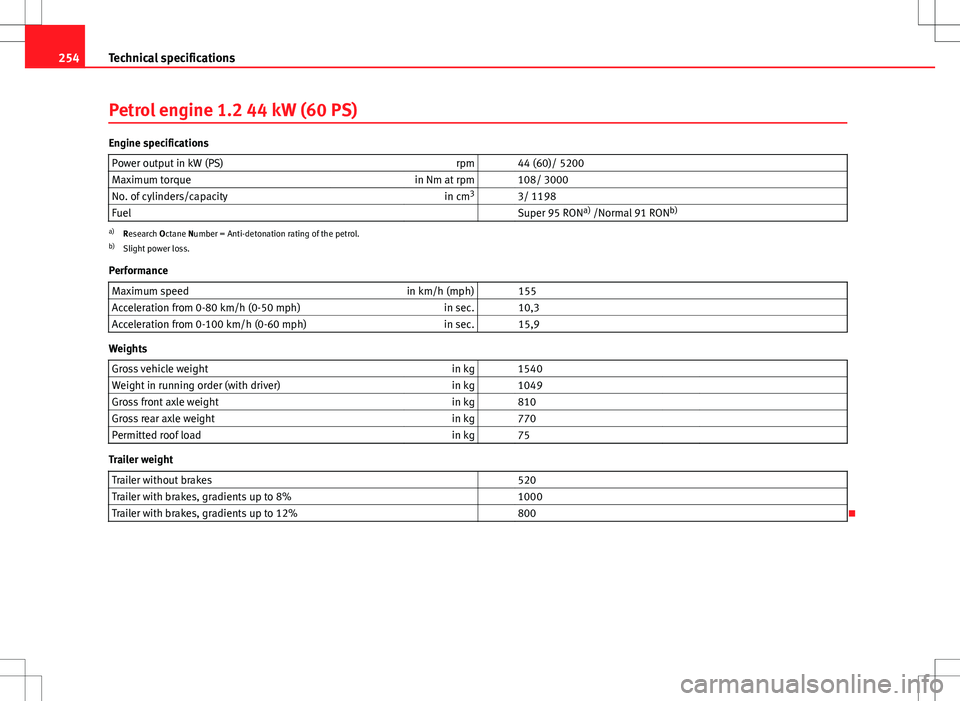
Petrol engine 1.2 44 kW (60 PS)
Engine specifications
Power output in kW (PS) rpm 44 (60)/ 5200
Maximum torque in Nm at rpm 108/ 3000
No. of cylinders/capacity in cm3
3/ 1198
Fuel Super 95 RON a)
/Normal 91 RON b)
a)
Research Octane Number = Anti-detonation rating of the petrol.
b) Slight power loss.
Performance Maximum speed in km/h (mph) 155
Acceleration from 0-80 km/h (0-50 mph) in sec. 10,3
Acceleration from 0-100 km/h (0-60 mph) in sec. 15,9
Weights
Gross vehicle weight in kg 1540
Weight in running order (with driver) in kg 1049
Gross front axle weight in kg 810
Gross rear axle weight in kg 770
Permitted roof load in kg 75
Trailer weight
Trailer without brakes 520
Trailer with brakes, gradients up to 8% 1000
Trailer with brakes, gradients up to 12% 800
Page 257 of 280
255
Technical specifications
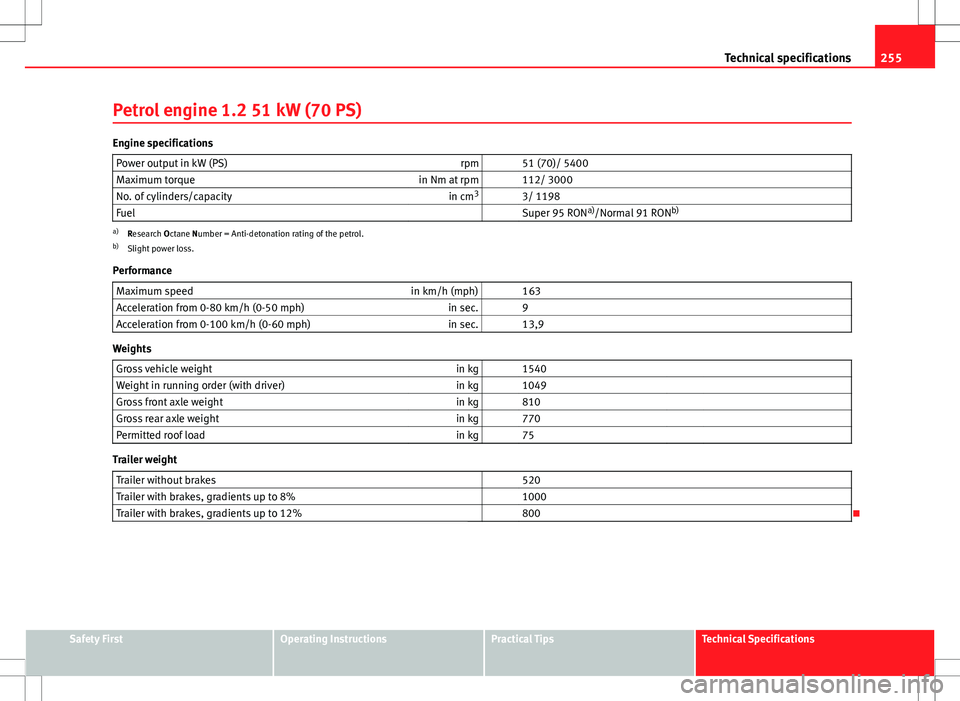
Petrol engine 1.2 51 kW (70 PS)
Engine specifications Power output in kW (PS) rpm 51 (70)/ 5400
Maximum torque in Nm at rpm 112/ 3000
No. of cylinders/capacity in cm3
3/ 1198
Fuel Super 95 RON a)
/Normal 91 RON b)
a)
Research Octane Number = Anti-detonation rating of the petrol.
b) Slight power loss.
Performance Maximum speed in km/h (mph) 163
Acceleration from 0-80 km/h (0-50 mph) in sec. 9
Acceleration from 0-100 km/h (0-60 mph) in sec. 13,9
Weights
Gross vehicle weight in kg 1540
Weight in running order (with driver) in kg 1049
Gross front axle weight in kg 810
Gross rear axle weight in kg 770
Permitted roof load in kg 75
Trailer weight
Trailer without brakes 520
Trailer with brakes, gradients up to 8% 1000
Trailer with brakes, gradients up to 12% 800
Safety FirstOperating InstructionsPractical TipsTechnical Specifications
Page 258 of 280
256Technical specifications
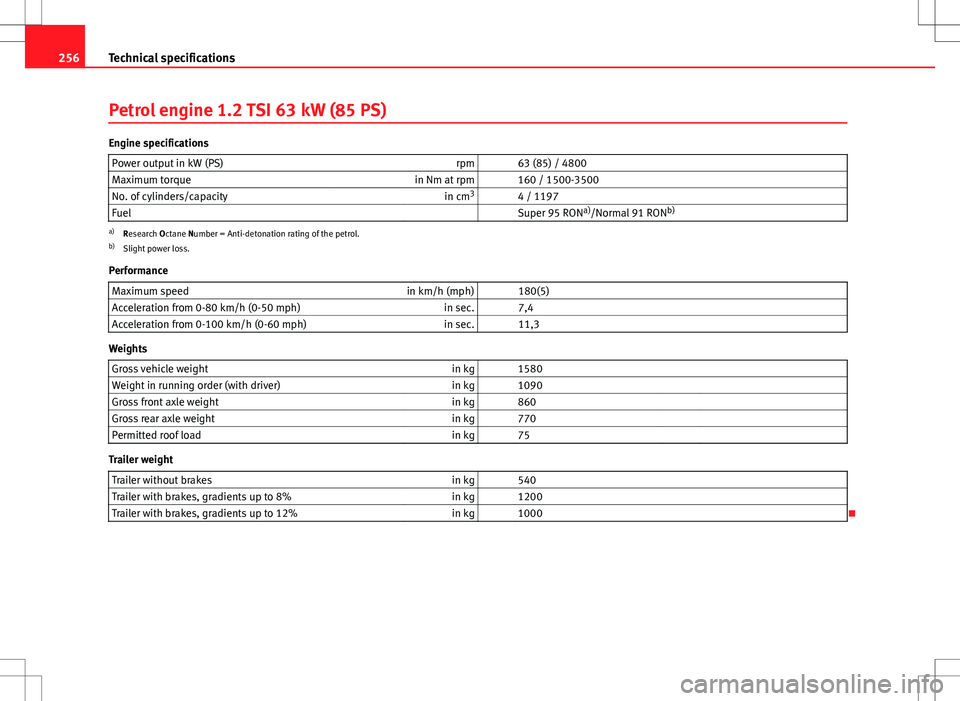
Petrol engine 1.2 TSI 63 kW (85 PS)
Engine specifications
Power output in kW (PS) rpm 63 (85) / 4800
Maximum torque in Nm at rpm 160 / 1500-3500
No. of cylinders/capacity in cm3
4 / 1197
Fuel Super 95 RON a)
/Normal 91 RON b)
a)
Research Octane Number = Anti-detonation rating of the petrol.
b) Slight power loss.
Performance Maximum speed in km/h (mph) 180(5)
Acceleration from 0-80 km/h (0-50 mph) in sec. 7,4
Acceleration from 0-100 km/h (0-60 mph) in sec. 11,3
Weights
Gross vehicle weight in kg 1580
Weight in running order (with driver) in kg 1090
Gross front axle weight in kg 860
Gross rear axle weight in kg 770
Permitted roof load in kg 75
Trailer weight
Trailer without brakes in kg 540
Trailer with brakes, gradients up to 8% in kg 1200
Trailer with brakes, gradients up to 12% in kg 1000
Page 259 of 280
257
Technical specifications
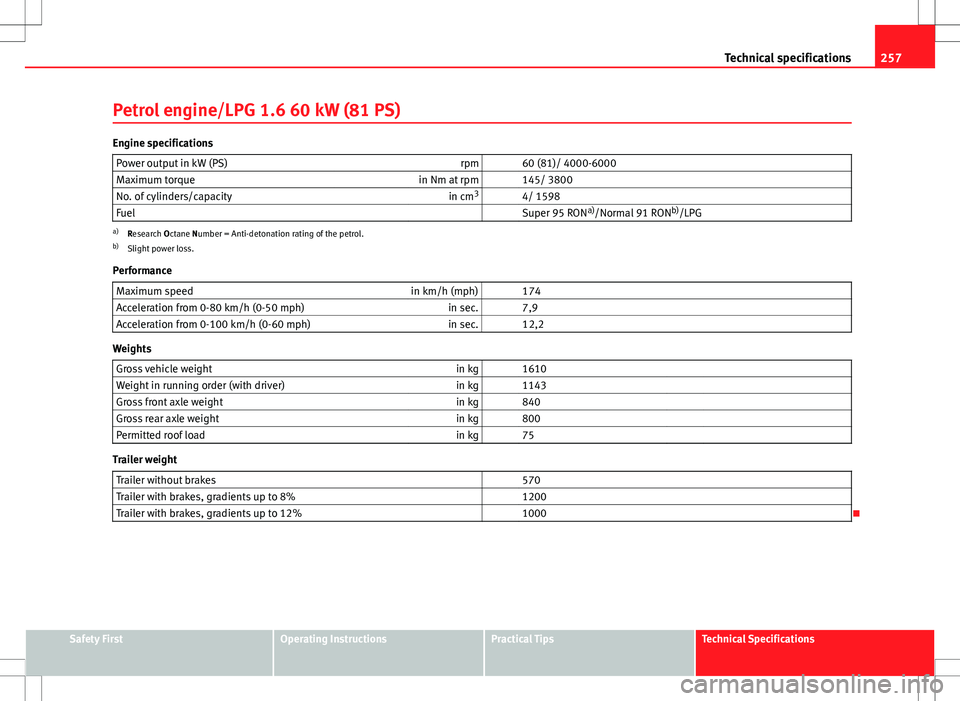
Petrol engine/LPG 1.6 60 kW (81 PS)
Engine specifications Power output in kW (PS) rpm 60 (81)/ 4000-6000
Maximum torque in Nm at rpm 145/ 3800
No. of cylinders/capacity in cm3
4/ 1598
Fuel Super 95 RON a)
/Normal 91 RON b)
/LPG
a) Research Octane Number = Anti-detonation rating of the petrol.
b) Slight power loss.
Performance Maximum speed in km/h (mph) 174
Acceleration from 0-80 km/h (0-50 mph) in sec. 7,9
Acceleration from 0-100 km/h (0-60 mph) in sec. 12,2
Weights
Gross vehicle weight in kg 1610
Weight in running order (with driver) in kg 1143
Gross front axle weight in kg 840
Gross rear axle weight in kg 800
Permitted roof load in kg 75
Trailer weight
Trailer without brakes 570
Trailer with brakes, gradients up to 8% 1200
Trailer with brakes, gradients up to 12% 1000
Safety FirstOperating InstructionsPractical TipsTechnical Specifications