2012 Seat Ibiza 5D service indicator
[x] Cancel search: service indicatorPage 76 of 280

74Cockpit
If the control lamp lights up again after driving on for a short distance, stop
the vehicle and switch the engine off . Contact a Technical Service or a spe-
cialised workshop.
Coolant level too low
If the warning light comes on, stop the vehicle, switch off the engine and
wait for it to cool down First check the coolant level. If the level of the cool-
ant is below the “MIN” mark, top up with coolant liquid ⇒
.
WARNING
● If your vehicle is immobilised for technical reasons, move it to a safe
distance from traffic. Turn the engine off, turn the hazard lights on and
place the warning triangle.
● Never open the bonnet if you can see or hear steam or coolant escap-
ing from the engine compartment. Risk of scalding. Wait until you can no
longer see or hear escaping steam or coolant.
● The engine compartment is a dangerous area! Before carrying out any
work in the engine compartment, switch off the engine and allow it to
cool down. Always note the corresponding warnings ⇒ page 195.
Alternator
This warning lamp signals a fault in the alternator.
The warning lamp lights up when the ignition is switched on. It should
go out when the engine has started running.
If the warning lamp lights up while driving, the alternator is no longer
charging the battery. You should immediately drive to the nearest special-
ised workshop. You should avoid using electrical equipment that is not absolutely necessa-
ry because this will drain the battery.
If the indicator flashes the voltage is insufficient for normal vehicle opera-
tion.
Turn signals
The control lamp flashes when the turn signals are in opera-
tion.
Depending on which turn signal is operating, either the left or right
turn signal lamp flashes. Both control lamps will flash at the same time
when the hazard warning lights are switched on.
If any of both turn signals fails, the warning lamp will start flashing twice
faster than normal.
For further information on the turn signals, please see ⇒ page 104.
“Safe” Electronic immobiliser*
This warning lamp flashes if an unauthorised key is used.
Inside the key there is a chip that deactivates the electronic immobiliser au-
tomatically when the key is inserted into the ignition. The electronic immo-
biliser will be activated again automatically as soon as you pull the key out
of the ignition lock.
The instrument panel displays the following message 1)
: SAFE. The vehicle
cannot be started in this case
1)
Depending on the version of the model.
Page 89 of 280

87
Opening and closing
WARNING
● An improper use of the key can cause serious injuries.
● Never leave children or disabled persons in the vehicle. In case of
emergency, they may not be able to leave the vehicle or manage on their
own.
● Never forget the keys inside the vehicle. Otherwise, this could result
in serious injuries, accidents or even the theft of your vehicle. Always
take the key with you when you leave the vehicle.
● An uncontrolled use of the key could start the engine or activate any
electric equipment (e.g. electric windows), causing risk of accident. The
vehicle can be locked when using the remote control key. This could com-
plicate the aid in case of emergency.
Note
● The radio frequency remote control key functions only when you are
within range ⇒ Fig. 47.
● If the vehicle cannot be unlocked or locked by using the radio frequency
remote control, the remote control key will have to be re-synchronised. For
this, go to your Technical Service.
Changing the battery
If the battery indicator does not flash when the buttons are pushed, the bat-
tery must be replaced.
CAUTION
The use of inappropriate batteries may damage the radio frequency remote
control. For this reason, always replace the dead battery with another of the
same size and power.
For the sake of the environment
Used batteries must be disposed of at an appropriate waste facility or
through an authorised service, given that their components can affect the
environment.
Synchronising the remote control key
If it is not possible to unlock or lock the door with the remote
control, it should be re-synchronised.
While the vehicle is open:
– Press the
button
2 ⇒
Fig. 46 on the remote control.
– Then close the vehicle using the key bit within one minute.
While the vehicle is closed:
– Press the
button
1 ⇒ Fig. 46 on the remote control.
– Then close the vehicle using the key bit within one minute.
It is possible that the vehicle could no longer be opened and closed with
the remote control if the button
is repeatedly pressed outside of the ef-
fective range of the radio frequency remote control. The remote control key
will have to be resynchronised.
Spare remote control keys are available in your Technical Service, where
they must be matched to the locking system.
Up to five remote control keys can be used.
Safety FirstOperating InstructionsPractical TipsTechnical Specifications
Page 215 of 280
213
Checking and refilling levels
Tyre useful life
The useful life of tyres is dependent on tyre pressure, driving
style and fitting.
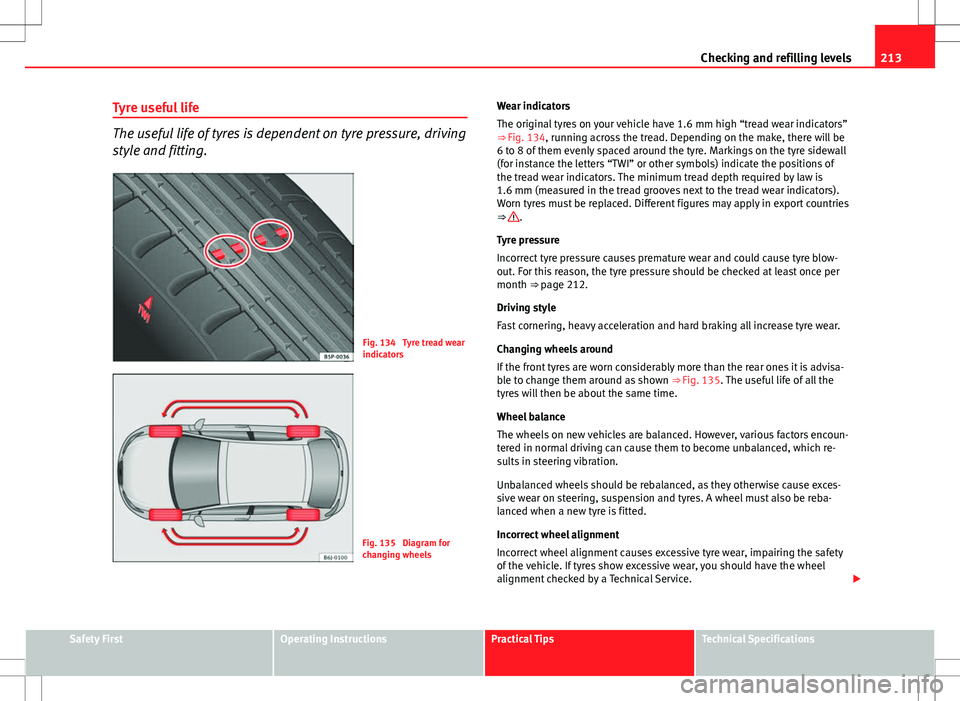
Fig. 134 Tyre tread wear
indicators
Fig. 135 Diagram for
changing wheels Wear indicators
The original tyres on your vehicle have 1.6 mm high “tread wear indicators”
⇒ Fig. 134, running across the tread. Depending on the make, there will be
6 to 8 of them evenly spaced around the tyre. Markings on the tyre sidewall
(for instance the letters “TWI” or other symbols) indicate the positions of
the tread wear indicators. The minimum tread depth required by law is
1.6 mm (measured in the tread grooves next to the tread wear indicators).
Worn tyres must be replaced. Different figures may apply in export countries
⇒
.
Tyre pressure
Incorrect tyre pressure causes premature wear and could cause tyre blow-
out. For this reason, the tyre pressure should be checked at least once per
month ⇒ page 212.
Driving style
Fast cornering, heavy acceleration and hard braking all increase tyre wear.
Changing wheels around
If the front tyres are worn considerably more than the rear ones it is advisa-
ble to change them around as shown ⇒ Fig. 135. The useful life of all the
tyres will then be about the same time.
Wheel balance
The wheels on new vehicles are balanced. However, various factors encoun-
tered in normal driving can cause them to become unbalanced, which re-
sults in steering vibration.
Unbalanced wheels should be rebalanced, as they otherwise cause exces-
sive wear on steering, suspension and tyres. A wheel must also be reba-
lanced when a new tyre is fitted.
Incorrect wheel alignment
Incorrect wheel alignment causes excessive tyre wear, impairing the safety
of the vehicle. If tyres show excessive wear, you should have the wheel
alignment checked by a Technical Service.
Safety FirstOperating InstructionsPractical TipsTechnical Specifications
Page 274 of 280

Exhaust gas purification system . . . . . . . . . . . 169
Exterior mirrors . . . . . . . . . . . . . . . . . . . . . . . . . 179
External aerial . . . . . . . . . . . . . . . . . . . . . . . . . . 186
F
Fabric trim cleaning . . . . . . . . . . . . . . . . . . . . . 183
Floor mats . . . . . . . . . . . . . . . . . . . . . . . . . . . . . . 16
Fog lights . . . . . . . . . . . . . . . . . . . . . . . . . . . . . . 98
Fog lights bulb . . . . . . . . . . . . . . . . . . . . . . . . . 238
Fog lights with cornering function . . . . . . . . . 101
Front airbags . . . . . . . . . . . . . . . . . . . . . . . . . . . 33 Description . . . . . . . . . . . . . . . . . . . . . . . . . . 33
Operation . . . . . . . . . . . . . . . . . . . . . . . . . . . 34
Safety notes . . . . . . . . . . . . . . . . . . . . . . . . . 36
Front ashtray . . . . . . . . . . . . . . . . . . . . . . . . . . . 123
Front drink holder . . . . . . . . . . . . . . . . . . . . . . . 122
Front interior light . . . . . . . . . . . . . . . . . . . . . . 105
Front passenger airbag deactivation . . . . . . . . 40
Front reading light . . . . . . . . . . . . . . . . . . . . . . 106
Front seat adjustment Lumbar support . . . . . . . . . . . . . . . . . . . . . 116
Fuel Diesel . . . . . . . . . . . . . . . . . . . . . . . . . . . . . 194
Petrol . . . . . . . . . . . . . . . . . . . . . . . . . . . . . . 194
Fuel consumption . . . . . . . . . . . . . . . . . . . 171, 250
Fuel level Indicator . . . . . . . . . . . . . . . . . . . . . . . . . . . . 57
Fuel reserve . . . . . . . . . . . . . . . . . . . . . . . . . . . . 72
Fuel tank see Fuel reserve . . . . . . . . . . . . . . . . . . . . . . 72 Fuel Tank
Opening the fuel tank flap . . . . . . . . . . . . . 189
Fuel: save . . . . . . . . . . . . . . . . . . . . . . . . . . . . . 171
Fuses . . . . . . . . . . . . . . . . . . . . . . . . . . . . . . . . . 226
G
Gear shift pattern . . . . . . . . . . . . . . . . . . . . . . . 147
General overview of the engine compartment 253
Glove compartment . . . . . . . . . . . . . . . . . . . . . 120
Glove compartment light . . . . . . . . . . . . . . . . . 106
Glow plug system . . . . . . . . . . . . . . . . . . . . . . . 142 control lamp . . . . . . . . . . . . . . . . . . . . . . . . . 68
H
Handbrake . . . . . . . . . . . . . . . . . . . . . . . . . . . . 155 Warning lamp . . . . . . . . . . . . . . . . . . . . . . . 155
Hazard warning lights . . . . . . . . . . . . . . . . . . . 103
HBA . . . . . . . . . . . . . . . . . . . . . . . . . . . . . . . . . . 163
Headlight flashers . . . . . . . . . . . . . . . . . . . . . . 104
Headlight range control . . . . . . . . . . . . . . . . . . 100
Headlights Driving abroad . . . . . . . . . . . . . . . . . . . . . . 173
Fog lights . . . . . . . . . . . . . . . . . . . . . . . . . . . 98
Headlight washer . . . . . . . . . . . . . . . . . . . . 110
Head restraints Adjusting . . . . . . . . . . . . . . . . . . . . . . 114, 115
Adjustment of the head restraint angle . . 115
Removing . . . . . . . . . . . . . . . . . . . . . . . . . . 115
Heated exterior mirrors . . . . . . . . . . . . . . . . . . 111
Heated front seats . . . . . . . . . . . . . . . . . . . . . . 117 Heated rear window
Heating element wires . . . . . . . . . . . . . . . . 180
Heating . . . . . . . . . . . . . . . . . . . . . . . . . . . . . . . 128
Heating system . . . . . . . . . . . . . . . . . . . . . . . . . 129
High pressure cleaners . . . . . . . . . . . . . . . . . . 178
Hill-start aid . . . . . . . . . . . . . . . . . . . . . . . . . . . 156
Horn . . . . . . . . . . . . . . . . . . . . . . . . . . . . . . . . . . 53
How to jump start description . . . . . . . . . . . . . 243
Hydraulic Brake Assist Automatic hazard warning lights activa-tion . . . . . . . . . . . . . . . . . . . . . . . . . . . . . . 163
I
Identification number . . . . . . . . . . . . . . . . . . . 250
Identification plate . . . . . . . . . . . . . . . . . . . . . . 250
Ignition key . . . . . . . . . . . . . . . . . . . . . . . . . . . . 139
Ignition lock . . . . . . . . . . . . . . . . . . . . . . . . . . . 139
Information in the multifunction display Memory displays . . . . . . . . . . . . . . . . . . . . . 59
Instrument and switch lighting . . . . . . . . . . . . 100
Instrument lighting . . . . . . . . . . . . . . . . . . . . . . 53
Instrument panel Service interval display . . . . . . . . . . . . . . . . 61
Instruments . . . . . . . . . . . . . . . . . . . . . . . . . . . . 55
Interior rear vision mirror . . . . . . . . . . . . . . . . . 110
Interval wipe, windscreen . . . . . . . . . . . . . . . . 107
ISOFIX system . . . . . . . . . . . . . . . . . . . . . . . . . . . 48
J
Jump-starting . . . . . . . . . . . . . . . . . . . . . . . . . . 242
272 Index