2012 RENAULT MEGANE RS lock
[x] Cancel search: lockPage 95 of 239

driving ................................................... (up to the end of the DU)
electronic parking brake ....................... (up to the end of the DU)
2.9
ENG_UD11746_2
Frein de parking assisté (X95 - B95 - D95 - Renault)
ENG_NU_837-6_BDK95_Renault_2
Electronic parking brake
Before leaving the vehicle,
check that the electronic
parking brake is fully ap -
plied. Indicator light 2 on
switch 3 and indicator light
}
on the instrument panel light up to
show that the parking brake is ap -
plied but go out when the doors are
locked.
Note:
To indicate that the electronic parking
brake is applied or released, a beep
sounds and the message “ Apply park-
ing brake ” appears on the instrument
panel:
– with the engine running: when the
driver’s door is opened;
– with the engine switched off (eg.
when the engine stalls): when a front
door is opened.
In this case, pull and release switch 3 to
apply the electronic parking brake.
Automatic releasing of the
electronic parking brake
The brake will be released as soon as
the vehicle moves, by accelerating with
a gear selected and the engine running.
Automatic operation
The electronic parking brake en -
sures vehicle immobilisation when the
engine is stopped and engine Start/
Stop button 1 is pressed.
In all other instances, e.g. engine stall-
ing, the electronic parking brake is not
applied automatically. Manual mode
must be used.
For certain country-specific model ver-
sions, the automatic brake application
function is not activated. Refer to the in-
formation on “Manual operation”.
ELECTRONIC PARkING bRAkE (1/3)
To confirm that the electronic parking
brake is applied, the message “Parking
brake on ” and indicator light
}
on the instrument panel and indicator
light 2 on switch 3 light up.
After the engine is switched off, indi -
cator light 2 goes out several minutes
after the electronic parking brake has
been applied and indicator light
}
goes out when the vehicle is locked.
1
2
3
Page 105 of 239

ABS ...................................................... (up to the end of the DU)
anti-lock braking system: ABS ..............(up to the end of the DU)
ESP: Electronic Stability Program ........ (up to the end of the DU)
ASR (traction control) ........................... (up to the end of the DU)
traction control: ASR .............................(up to the end of the DU)
Electronic Stability Program: ESP ........ (up to the end of the DU)
emergency brake assist ........................(up to the end of the DU)
emergency braking ............................... (up to the end of the DU)
traction control: ASR .............................................. (current page)
driving ................................................... (up to the end of the DU)
2.19
ENG_UD14885_2
Dispositifs de correction de conduite (X95 - B95 - D95 - Renault)
ENG_NU_837-6_BDK95_Renault_2
Driver correction devices/aids
DRIVER CORRECTION DEVICES/AIDS (1/4)
Depending on the vehicle, this is com-
posed of:
– t h e A bS ( a n t i - l o c k b r a k i n g
system);
– the electronic stability program
(E.S.P. ) with understeer control
and traction control (A.S.R.);
– emergency brake assist with, de -
pending on the vehicle, braking
anticipation.
In an emergency, apply firm and
continuous pressure to the brake
pedal. There is no need to pump
it repeatedly. The ABS will modu -
late the force applied in the braking
system.
These functions are an ad-
ditional aid in the event of
critical driving conditions,
enabling the vehicle behav -
iour to be adapted to suit the driving
conditions.
However, the functions do not take
the place of the driver. They do
not increase the vehicle’s limits
and should not encourage you
to drive more quickly. Therefore,
they can under no circumstances
replace the vigilance or responsibil -
ity of the driver when manoeuvring
the vehicle (the driver must always
be ready for sudden incidents which
may occur when driving).
Yo u r b r a k i n g s y s t e m s
are partially operational.
However, it is dangerous
to brake suddenly and
it is essential to stop immediately,
as soon as traffic conditions allow.
Contact an approved dealer.
Operating faults:
–
© and x lit up on the in -
strument panel along with the mes -
sages “Check ABS”, “Check braking
system” and “Check ESP”: the ABS,
E.S.P. and emergency brake assist
are deactivated. braking safety is
still guaranteed;
–
x, D, © and ®
lit on the instrument panel accom -
panied by the message “ Braking
system fault”: this indicates a fault
with the braking system.
In both cases, consult an approved
Dealer.
AbS (anti-lock braking
system)
Under heavy braking, the ABS prevents
the wheels from locking, allowing the
stopping distance to be managed and
keeping control of the vehicle.
Under these circumstances, the vehi -
cle can be steered to avoid an obstacle
whilst braking. In addition, this system
can increase stopping distances, par -
ticularly on roads with low surface grip
(wet ground etc.).
You will feel a pulsation through the
brake pedal each time the system is
activated. The ABS does not in any way
improve the vehicle’s physical perform-
ance relating to the road surface and
roadholding. It is still essential to follow
the rules of good driving practice (such
as driving at a safe distance from the
vehicle in front etc.).
Page 119 of 239
automatic gearbox (use) ....................... (up to the end of the DU)
automatic gearbox selector lever ..........(up to the end of the DU)
changing gear ....................................... (up to the end of the DU)
reverse gear selecting .......................................... (up to the end of the DU)
driving ................................................... (up to the end of the DU)
2.33
ENG_UD14762_4
Boîte automatique (X95 - B95 - D95 - Renault)
ENG_NU_837-6_BDK95_Renault_2
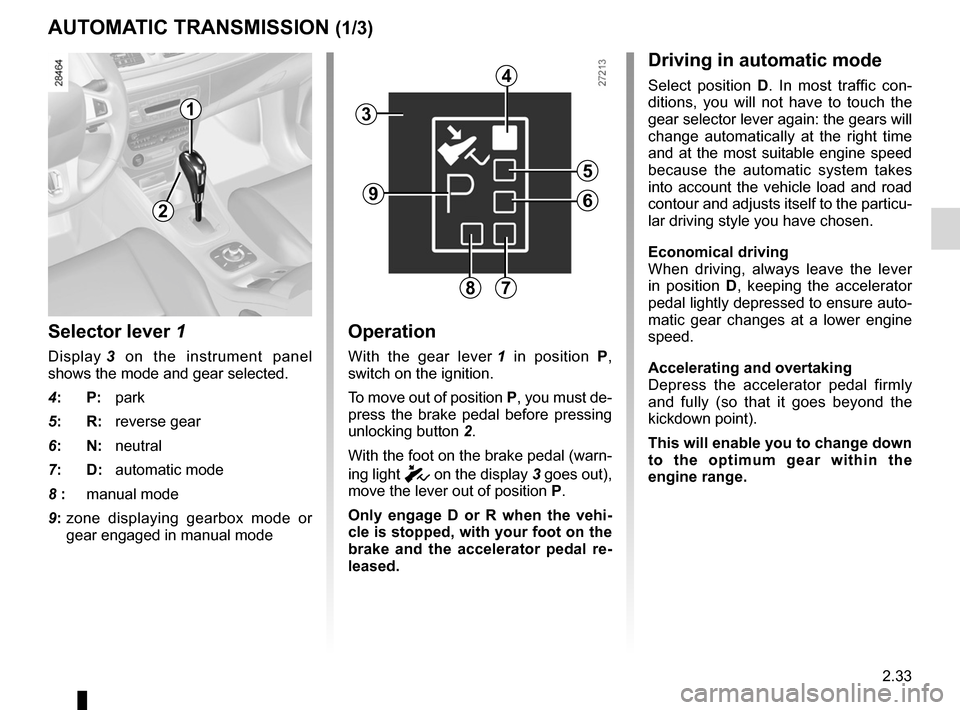
Selector lever 1
Display 3 on the instrument panel
shows the mode and gear selected.
4: P: park
5: R: reverse gear
6: N: neutral
7: D: automatic mode
8 : manual mode
9: zone displaying gearbox mode or
gear engaged in manual mode
Operation
With the gear lever 1 in position P,
switch on the ignition.
To move out of position P, you must de-
press the brake pedal before pressing
unlocking button 2.
With the foot on the brake pedal (warn-
ing light
c on the display 3 goes out),
move the lever out of position P.
Only engage D or R when the vehi -
cle is stopped, with your foot on the
brake and the accelerator pedal re -
leased.
Automatic gearbox
AUTOMATIC TRANSMISSION (1/3)
Driving in automatic mode
Select position D. In most traffic con -
ditions, you will not have to touch the
gear selector lever again: the gears will
change automatically at the right time
and at the most suitable engine speed
because the automatic system takes
into account the vehicle load and road
contour and adjusts itself to the particu-
lar driving style you have chosen.
Economical driving
When driving, always leave the lever
in position D, keeping the accelerator
pedal lightly depressed to ensure auto-
matic gear changes at a lower engine
speed.
Accelerating and overtaking
Depress the accelerator pedal firmly
and fully (so that it goes beyond the
kickdown point).
This will enable you to change down
to the optimum gear within the
engine range.
3
2
1
4
5
6
78
9
Page 120 of 239

2.34
ENG_UD14762_4
Boîte automatique (X95 - B95 - D95 - Renault)
ENG_NU_837-6_BDK95_Renault_2
Jaune NoirNoir texte
Parking the vehicle
When the vehicle is stopped, move the
lever to position P while keeping your
foot on the brake pedal: the gearbox is
in neutral and the drive wheels are me-
chanically locked by the driveshaft.
Apply the handbrake or, depending
on the vehicle, ensure that the elec-
tronic parking brake is applied.
Special circumstances
– If the road contours and bends
do not allow you to stay in auto -
matic mode (e.g.: in the mountains),
we recommend that you change to
manual mode.
This will prevent the automatic gear-
box from changing gears repeatedly
when climbing, and permit engine
braking on long descents.
– In cold weather, to prevent the
engine from stalling, wait a few mo-
ments before shifting the selector
lever from position P or N and en -
gaging D or R.
Driving in manual mode
With the selector lever in position D,
move the lever to the left. Shifting the
lever repeatedly allows you to change
gears manually:
– To move down through the gears,
push the lever backwards;
– To move up through the gears, push
the lever forwards.
The gear selected is displayed on the
instrument panel.
Special cases
In certain driving conditions (e.g.:
engine protection, operation of the
Electronic Stability Program) the auto -
mated system may change the gear au-
tomatically.
Likewise, to prevent incorrect manoeu -
vres, a gear change may be refused by
the automatic system: in this case the
gear display flashes for a few seconds
as a warning.
AUTOMATIC TRANSMISSION (2/3)
In very cold weather, the system
may prevent the gears from being
shifted in manual mode until the
gearbox reaches the right tempera-
ture.
An impact to the under -
side of the vehicle while
manoeuvring (e.g.: strik -
ing a post, raised kerb or
other street furniture) may result in
damage to the vehicle (e.g.: defor -
mation of an axle).
To avoid any risk of accident, have
your vehicle checked by an ap -
proved Dealer.
Page 121 of 239

JauneNoirNoir texte
2.35
ENG_UD14762_4
Boîte automatique (X95 - B95 - D95 - Renault)
ENG_NU_837-6_BDK95_Renault_2
When setting off, if the lever is locked
in position P even though you are de -
pressing the brake pedal and pressing
unlocking button 2, the lever can be re-
leased manually. To do this, press the
button by inserting an object into the
hole 10 and simultaneously press un -
locking button 2 located on the lever.
AUTOMATIC TRANSMISSION (3/3)
Operating faults
– When driving , if the message
“ Check auto gearbox ” appears on
the instrument panel, this indicates
there is a fault.
Contact your approved Dealer as
soon as possible.
– When driving , if the message “Auto
gearbox overheating” appears on the
instrument panel, stop the vehicle to
allow the gearbox to cool down.
Contact your approved Dealer as
soon as possible.
– If a vehicle with an automatic
gearbox breaks down, refer to the
information on “Towing” in Section 5.
10
2
Page 127 of 239
rear screen de-icing/demisting .............................. (current page)
windscreen de-icing/demisting .............................. (current page)
JauneNoirNoir texte
3.5
ENG_UD6312_1
Air conditionné (X95 - B95 - D95 - Renault)
ENG_NU_837-6_BDK95_Renault_3
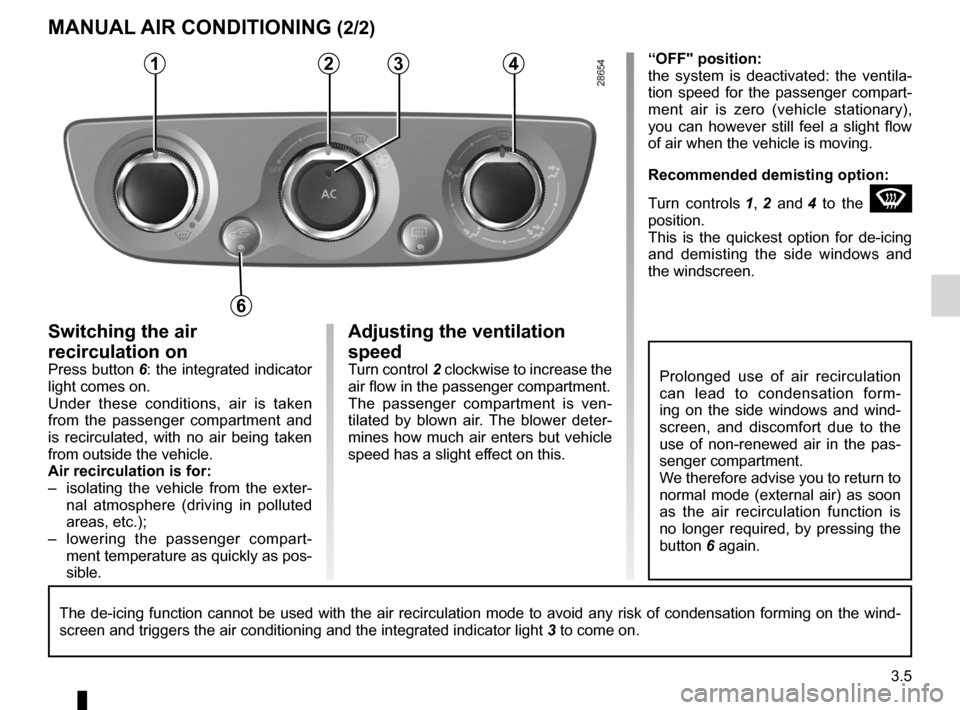
Adjusting the ventilation
speed
Turn control 2 clockwise to increase the
air flow in the passenger compartment.
The passenger compartment is ven -
tilated by blown air. The blower deter -
mines how much air enters but vehicle
speed has a slight effect on this.
Switching the air
recirculation on
Press button 6: the integrated indicator
light comes on.
Under these conditions, air is taken
from the passenger compartment and
is recirculated, with no air being taken
from outside the vehicle.
Air recirculation is for:
– isolating the vehicle from the exter -
nal atmosphere (driving in polluted
areas, etc.);
– lowering the passenger compart -
ment temperature as quickly as pos-
sible. “oFF" position:
the system is deactivated: the ventila
-
tion speed for the passenger compart-
ment air is zero (vehicle stationary),
you can however still feel a slight flow
of air when the vehicle is moving.
Recommended demisting option:
Turn controls 1 , 2 and 4 to the
W
position.
This is the quickest option for de-icing
and demisting the side windows and
the windscreen.
MANuAl AIR coNDITIoNINg (2/2)
Prolonged use of air recirculation
can lead to condensation form -
ing on the side windows and wind -
screen, and discomfort due to the
use of non-renewed air in the pas -
senger compartment.
We therefore advise you to return to
normal mode (external air) as soon
as the air recirculation function is
no longer required, by pressing the
button 6 again.
The de-icing function cannot be used with the air recirculation mode to avoid any risk of condensation forming on the wind -
screen and triggers the air conditioning and the integrated indicator li\
ght 3 to come on.
1234
6
Page 134 of 239

electric windows ................................... (up to the end of the DU)
child safety ............................................................. (current page)
children (safety) ..................................................... (current page)
sunroof .................................................. (up to the end of the DU)
3.12
ENG_UD18900_4
Lève-vitres électriques (X95 - B95 - D95 - Renault)
ENG_NU_837-6_BDK95_Renault_3
Jaune NoirNoir texte
These systems operate with the igni -
tion on or off, until one of the front doors
is opened (limited to about 3 minutes).
From the driver’s seat, use switch:
1 for the driver’s side;
2 for the front passenger side;
3 and 5 for the rear passenger win-
dows.
From the passenger seats, use
switch 6.
Note: if the window detects resistance
when closing (e.g.: fingers, branch of
a tree, etc.) it stops and then lowers
again by a few centimetres.
Electric windows/Electric sunroof
ElEcTRIc wINDowS/ElEcTRIc PANoRAMIc SuNRooF (1/3)
Electric windows
Press or pull the switch to raise or lower
a window to the desired height (the rear
windows do not open fully);
one-touch mode
This mode works in addition to the
operation of the electric windows de -
scribed previously. It either operates on
the front windows only, or on all the win-
dows.
Briefly press or pull the window switch
fully: the window is fully lowered or
raised. Pressing the switch again stops
the window moving.
1
2
34
5
6
Safety of rear occupants
The driver can disable op -
eration of the electric win -
dows and, depending on
the vehicle, the rear doors, by
pressing switch 4 . The indicator
light integrated in the switch lights
up to confirm that the locks have
been activated.
Driver’s responsibility
Never leave your vehicle with the
RENAULT card inside and never
leave a child (or a pet) unsuper -
vised, even for a short while. They
may pose a risk to themselves or to
others by starting the engine, acti -
vating equipment such as the elec-
tric windows or by locking the doors.
If any part of the body becomes
trapped, reverse the direction of the
window immediately by pressing the
relevant switch.
Risk of serious injury.
Avoid resting any objects against
a half-open window: there is a risk
that the electric window could be
damaged.
Page 135 of 239

JauneNoirNoir texte
3.13
ENG_UD18900_4
Lève-vitres électriques (X95 - B95 - D95 - Renault)
ENG_NU_837-6_BDK95_Renault_3
ElEcTRIc wINDowS/ElEcTRIc PANoRAMIc SuNRooF (2/3)
Sunroof
– open the sun blind
– To open slightly: turn button 9 to
position A;
– To open fully: turn button 9 to po -
sition B , C or D , depending on the
opening position required;
– To close: turn button 9 to position 0.
Sun blind
– to open: push handle 7 upwards
and guide the blind as it retracts;
– to close: pull handle 7 until it clicks
into the catch.
Special noteYour vehicle is equipped with an antip-
inch facility: when the sunroof encoun -
ters resistance whilst closing, (some -
body’s fingers, etc.) it stops and then
moves back several centimetres.
Driver’s responsibility
Never leave your vehicle
with the RENAULT card
inside and never leave a
child (or a pet) unsupervised, even
for a short while.
The reason for this is that the child
may endanger himself or others by
starting the engine, activating equip-
ment such as the window winders
for example, or locking the doors.
If a body part gets trapped, reverse
the direction of travel as soon as
possible by turning button 9 fully to
the right (position D).
Risk of serious injury.
70
AB
c
D
98