Page 372 of 381
This depends in particular upon the age of the
AdBlue ®
.
Ammonia vapours have a pungent odour and
are particularly irritating to:
R skin
R mucous membranes
R eyes
You may experience a burning sensation in
your eyes, nose and throat, as well as cough-
ing and watering of the eyes.
Do not inhale any ammonia vapours that may
be released. Fill the AdBlue ®
tank only in well-
ventilated areas.
Low outside temperatures AdBlue
®
freezes at a temperature of approx-
imately -11 †. The vehicle is equipped with
an AdBlue ®
preheating system at the factory.
Winter operation can therefore be guaran-
teed even at temperatures below -11 †.
Additives !
Only use AdBlue ®
in accordance with ISO
22241. Do not use additives with AdBlue ®
and do not dilute AdBlue ®
with water. This
may destroy the BlueTEC exhaust gas after-
treatment system.
Purity !
Impurities in AdBlue ®
(e.g. due to other
service products, cleaning agents or dust)
lead to:
R increased emission values
R damage to the catalytic converter
R engine damage
R malfunctions in the BlueTEC ®
exhaust
gas aftertreatment system
Assuring the purity of AdBlue ®
is particularly
important with respect to avoiding malfunc-
tions in the BlueTEC exhaust gas aftertreat-
ment system. If AdBlue
®
is pumped out of the AdBlue ®
tank,
e.g. during repair work, do not use this fluid
to refill the tank. The purity of the fluid can no
longer be guaranteed.
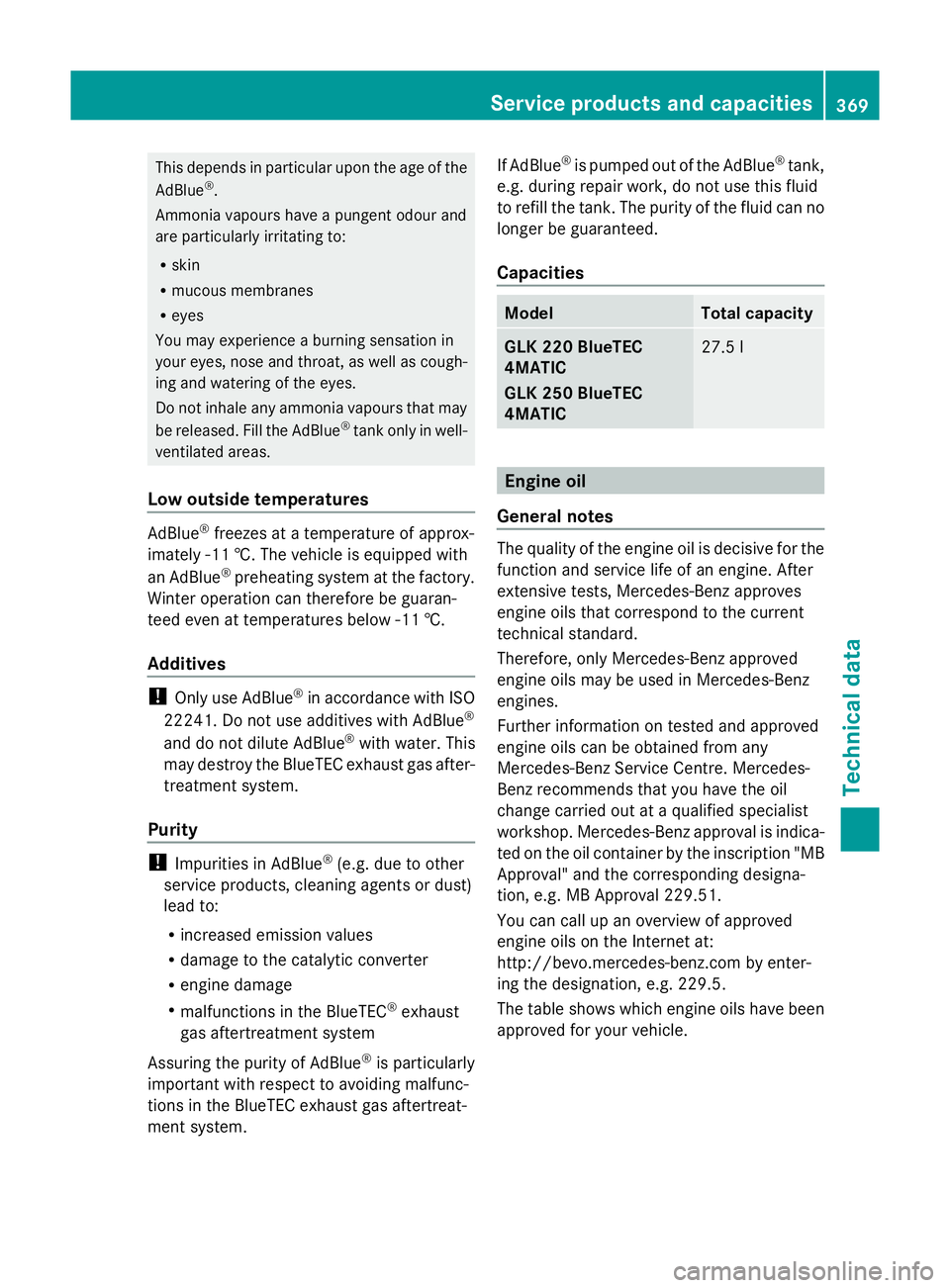
Capacities Model Total capacity
GLK 220 BlueTEC
4MATIC
GLK 250 BlueTEC
4MATIC
27.5 l
Engine oil
General notes The quality of the engine oil is decisive for the
function and service life of an engine. After
extensive tests, Mercedes-Benz approves
engine oils that correspond to the current
technical standard.
Therefore, only Mercedes-Benz approved
engine oils may be used in Mercedes-Benz
engines.
Further information on tested and approved
engine oils can be obtained from any
Mercedes-Benz Service Centre. Mercedes-
Benz recommends that you have the oil
change carried out at a qualified specialist
workshop. Mercedes-Benz approval is indica-
ted on the oil container by the inscription "MB
Approval" and the corresponding designa-
tion, e.g. MB Approval 229.51.
You can call up an overview of approved
engine oils on the Internet at:
http://bevo.mercedes-benz.com by enter-
ing the designation, e.g. 229.5.
The table shows which engine oils have been
approved for your vehicle.Service products and capacities
369Technical data Z
Page 373 of 381
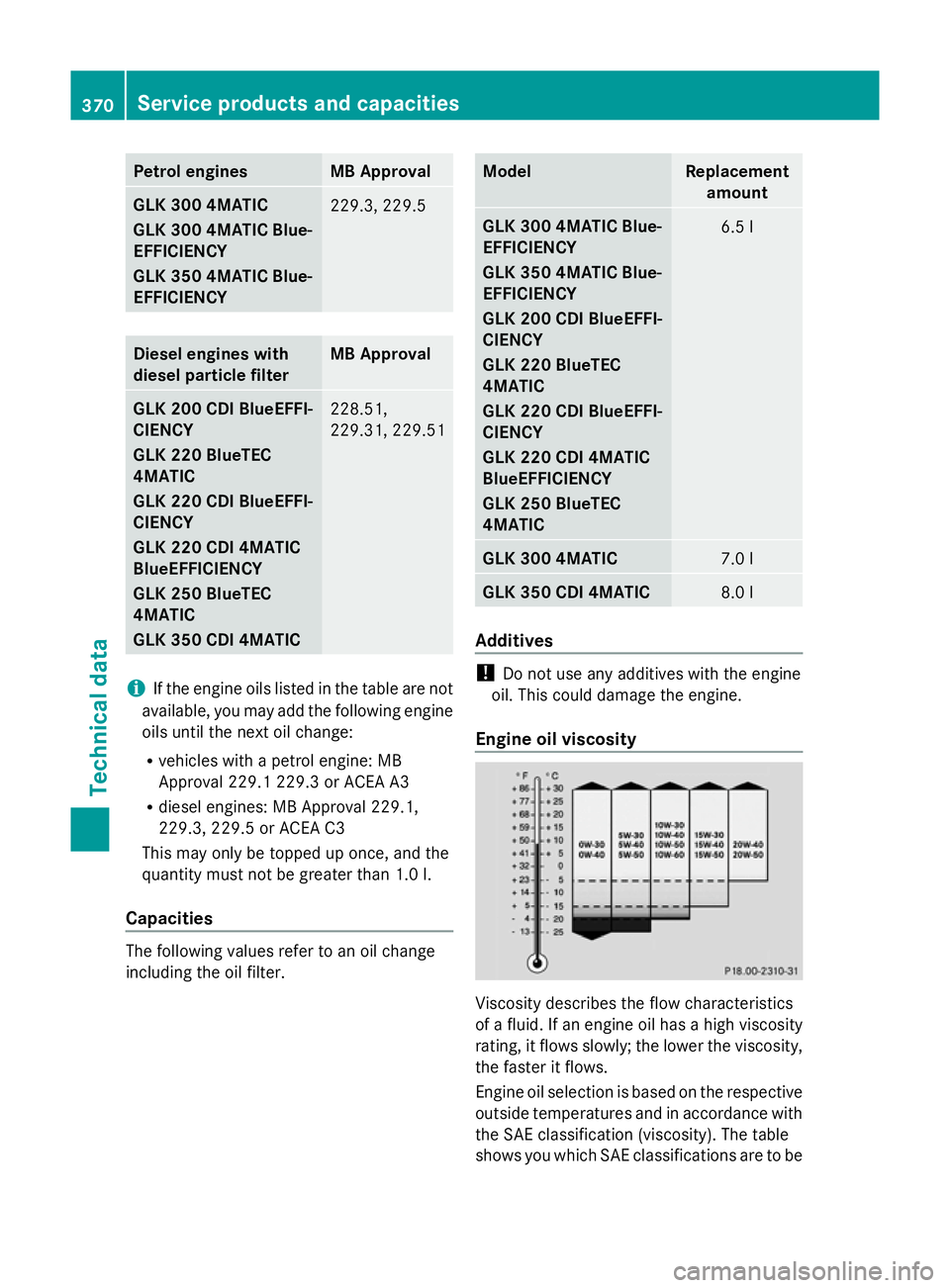
Petrol engines MB Approval
GLK 300 4MATIC
GLK 300 4MATIC Blue-
EFFICIENCY
GLK 350 4MATIC Blue-
EFFICIENCY
229.3, 229.5
Diesel engines with
diesel particle filter MB Approval
GLK 200 CDI BlueEFFI-
CIENCY
GLK 220 BlueTEC
4MATIC
GLK 220 CDI BlueEFFI-
CIENCY
GLK 220 CDI 4MATIC
BlueEFFICIENCY
GLK 250 BlueTEC
4MATIC
GLK 350 CDI 4MATIC 228.51,
229.31, 229.51
i
If the engine oils listed in the table are not
available, you may add the following engine
oils until the next oil change:
R vehicles with a petrol engine: MB
Approval 229.1 229.3 or ACEA A3
R diesel engines: MB Approval 229.1,
229.3, 229.5 or ACEA C3
This may only be topped up once, and the
quantity must not be greater than 1.0 l.
Ca pacities The following values refer to an oil change
including the oil filter. Model Replacement
amount GLK 300 4MATIC Blue-
EFFICIENCY
GLK 350 4MATIC Blue-
EFFICIENCY
GLK 200 CDI BlueEFFI-
CIENCY
GLK 220 BlueTEC
4MATIC
GLK 220 CDI BlueEFFI-
CIENCY
GLK 220 CDI 4MATIC
BlueEFFICIENCY
GLK 250 BlueTEC
4MATIC 6.5 l
GLK 300 4MATIC
7.0 l
GLK 350 CDI 4MATIC
8.0 l
Additives
!
Do not use any additives with the engine
oil. This could damage the engine.
Engine oil viscosity Viscosity describes the flow characteristics
of a fluid. If an engine oil has a high viscosity
rating, it flows slowly; the lower the viscosity,
the faster it flows.
Engine oil selection is based on the respective
outside temperatures and in accordance with
the SAE classification (viscosity). The table
shows you which SAE classifications are to be370
Service products and capacitiesTechnical data
Page 374 of 381

used. The low-temperature properties of
engine oils can be significantly impaired dur-
ing operation due to, for example, ageing or
soot and fuel accretion. It is therefore
strongly recommended to observe regular oil
changes using an approved engine oil with the
appropriate SAE classification. Brake fluid
G
WARNING
Over a period of time, the brake fluid absorbs
moisture from the air; This lowers its boiling
point.
If the boiling point of the brake fluid is too low,
vapour pockets may form in the brake system
when the brakes are applied hard (e.g. when
driving downhill). This impairs braking effi-
ciency.
You should have the brake fluid renewed at
regular intervals. The brake fluid change inter-
vals can be found in the Service Booklet.
Only use brake fluid approved by Mercedes-
Benz according to MB Approval 331.0.
Information about approved brake fluid can
be obtained at any qualified specialist work-
shop or on the Internet at
http://bevo.mercedes-benz.co m.
i Have the brake fluid renewed regularly at
a qualified specialist workshop. Coolant
Important safety notes G
WARNING
Antifreeze is highly flammable. Fire, naked
flames and smoking are prohibited when han-
dling antifreeze.
If antifreeze comes into contact with hot
engine parts, it may ignite and you could burn
yourself. Do not spill any antifreeze on hot
engine parts. !
Only add coolant that has been premixed
with the desired antifreeze protection. You
could otherwise damage the engine.
Further information on coolants can be
found in the Mercedes-Benz Specifications
for Service Products, MB Specifications for
Service Products 310.1, e.g. on the Inter-
net at http://bevo.mercedes-benz.com.
Or contact a qualified specialist workshop.
! Always use a suitable coolant mixture,
even in countries where high temperatures
prevail.
Otherwise, the engine cooling system is not
sufficiently protected from corrosion and
overheating.
! The engine cooling system is filled with
coolant, which must be renewed after
15 years or after 250,000 kilometres at the
latest.
The coolant is a mixture of water and anti-
freeze/corrosion inhibitor. It performs the
following tasks:
R anti-corrosion protection
R antifreeze protection
R raising the boiling point
If antifreeze/corrosion inhibitor is present in
the correct concentration, the boiling point of
the coolant during operation will be approx-
imately 130 †.
The antifreeze/corrosion inhibitor concentra-
tion in the engine cooling system should:
R be at least 50%. This will protect the engine
cooling system against freezing down to
approximately -37 †.
R not exceed 55% (antifreeze protection
down to -45 †). Heat will otherwise not be
dissipated as effectively.
If the vehicle has lost coolant, top it up with
equal amounts of water and antifreeze/cor-
rosion inhibitor. Mercedes-Benz recom-
mends an antifreeze/corrosion inhibitor con-
centrate in accordance with MB Specifica-
tions for Service Products 310.1. Service products and capacities
371Technical data Z
Page 378 of 381
24 GHz radar sensor system (country overview)
The 24 GHz radar sensor system requires separate approval for each country. When you are
driving in a country in which the radar sensor system is not approved, you must deactivate
the system using the on-board computer (Y page 242).
The current country overview can be obtained from a Mercedes-Benz Service Centre or on
the Internet at: http://www.mercedes-benz.de/betriebsanleitung.
Vehicles with a navigation system: the radar sensor system is deactivated automatically
near radio telescope facilities. A display message appears in the multifunction display to tell
you that the radar sensor system is being switched off (Y page 272).
The currently active systems are automatically deactivated:
R DISTRONIC PLUS (Y page 178)
R Blind Spot Assist (Y page 203)
R Active Blind Spot Assist (Y page 207)
R BAS PLUS (Y page 66)
R PRE-SAFE ®
Brake (Y page 69)
If deactivation does not occur automatically, you must deactivate the radar sensor system
using the on-board computer (Y page 242).
Vehicles without navigation and vehicles for Australia: you must deactivate the radar
sensor system using the on-board computer when you are near a radio telescope facility
(Y page 242). 24 GHz radar sensor system (country overview)
375Technical data Z