2012 JEEP LIBERTY Eco
[x] Cancel search: EcoPage 15 of 124

WARNING!
• In a collision, an unrestrained child, even a tiny baby, can become aprojectile inside the vehicle. The force required to hold even an
infant on your lap could become so great that you could not hold
the child, no matter how strong you are. The child and others could
be severely injured or killed. Any child riding in your vehicle should
be in a proper restraint for the child's size.
• Improper installation of a child restraint to the LATCH anchorages can lead to failure of an infant or child restraint. The child could be
severely injured or killed. Follow the manufacturer’s directions
exactly when installing an infant or child restraint.
• An incorrectly anchored tether strap could lead to increased head motion and possible injury to the child. Use only the anchor
positions directly behind the child seat to secure a child restraint
top tether strap.
• Rearward-facing child seats must never be used in the front seat of a vehicle with a front passenger air bag. An air bag deployment
could cause severe injury or death to infants in this position.
FRONT SEATS
Power Seats
• The power seat switch, located onthe outboard side of the seat near
the floor, controls forward/back,
up/down, and tilt adjustment.
Recliner • Lean forward slightly, lift the recliner lever located on the
outboard side of the seat, lean
back and release at the desired
position.
GETTING STARTED
13
Page 16 of 124

Memory Seat
• The memory seat feature allowsyou to save two different driver
seating positions, driver's outside
mirror, and radio station preset
settings. The memory button's are
located on the instrument panel to
the left of the steering column.
• Adjust all memory profile settings, press the S (SET) button then
press 1 or 2 within five seconds.
• To program a Key Fob to the memory position, place the ignition switch in the LOCK/OFF position and remove the Key Fob, press and release
the LOCK button on the Key Fob to be programmed within 5 seconds of
pressing button 1 or 2.
• Press 1 or 2 to recall the saved positions, or press UNLOCK on the programmed Key Fob.
• Refer to the Owner's Manual on the DVD for further details.
Manual Seat Adjustment
Forward/Rearward
• Lift up on the adjusting bar located at the front of the seat
near the floor and release at the
desired position.
Lumbar Support • Rotate the lumbar lever, located on the inboard side of the seat,
downward to increase and upward
to decrease the desired amount of
lumbar support.
GETTING STARTED
14
Page 17 of 124

Fold-Flat Front Passenger Seat
• The front passenger seat can befolded flat to allow for extended
cargo space. Pull up on the
recliner lever to fold down the
seatback.
CAUTION!
Do not place any article under a power seat or impede its ability to
move as it may cause damage to the seat controls. Seat travel may
become limited if movement is stopped by an obstruction in the seat's
path.
WARNING!
• Adjusting a seat while the vehicle is moving is dangerous. Thesudden movement of the seat could cause you to lose control. The
seat belt might not be properly adjusted, and you could be severely
injured or killed. Only adjust a seat while the vehicle is parked.
• Do not ride with the seatback reclined so that the seat belt is no longer resting against your chest. In a collision, you could slide
under the seat belt and be severely injured or killed. Use the recliner
only when the vehicle is parked.
REAR SEATS
60/40 Split Folding Rear Seat With Fold-Flat Feature
• Each rear seatback can be folded flat or reclined.
To Lower Rear Seatback • With the front seats fully upright and positioned forward, pull the release strap toward the front of the vehicle and fold the rear seatback
completely forward.
• Push down on the seatback to lock it in the folded position.
GETTING STARTED
15
Page 18 of 124

To Raise Rear Seatback• Pull the release strap toward the front of the vehicle.
• Raise the seatback and lock it into place.
Recliner Adjustment • Pull the release strap while sitting in the rear seat to recline the
seatback, release at the desired
position.
WARNING!
Be certain that the seatback is securely locked into position. If the
seatback is not securely locked into position, the seat will not provide
the proper stability for child seats and/or passengers. An improperly
latched seat could cause serious injury.
HEATED SEATS
Front Heated Seats
• The controls for front heated seats are located near the bottom center ofthe instrument panel (below the heater/air conditioning controls).
• Press the switch once to select High-level heating. Press the switch a second time to select Low-level heating. Press the switch a third time to
shut the heating elements Off.
• If the High-level setting is selected, the system will automatically switch to Low-level after approximately 30 minutes. The Low-level setting will
turn Off automatically after approximately 30 minutes.
WARNING!
• Persons who are unable to feel pain to the skin because ofadvanced age, chronic illness, diabetes, spinal cord injury,
medication, alcohol use, exhaustion or other physical conditions
must exercise care when using the seat heater. It may cause burns
even at low temperatures, especially if used for long periods of time.
• Do not place anything on the seat that insulates against heat, such as a blanket or cushion. This may cause the seat heater to overheat.
Sitting in a seat that has been overheated could cause serious burns
due to the increased surface temperature of the seat.
GETTING STARTED
16
Page 20 of 124

ENGINE BREAK-IN RECOMMENDATIONS
• A long break-in period is not required for the engine and drivetrain(transmission and axle) in your vehicle.
• Drive moderately during the first 300 miles (500 km). After the initial 60 miles (100 km), speeds up to 50 or 55 mph (80 or 90 km/h) are
desirable.
• While cruising, brief full-throttle acceleration within the limits of local traffic laws contributes to a good break-in. Wide-open throttle
acceleration in low gear can be detrimental and should be avoided.
• The engine oil installed in the engine at the factory is a high-quality energy conserving type lubricant. Oil changes should be consistent with
anticipated climate conditions under which vehicle operations will occur.
For the recommended viscosity and quality grades, refer to “Maintaining
Your Vehicle”.
NOTE: A new engine may consume some oil during its first few thousand
miles (kilometers) of operation. This should be considered a normal part of
the break-in and not interpreted as an indication of difficulty.
CAUTION!
Never use Non-Detergent Oil or Straight Mineral Oil in the engine or
damage may result.
TURN SIGNAL/LIGHTS LEVER
Headlights/Parking Lights
• Rotate the end of the lever to the first detent for parking lights,
the second detent for headlightsand the third detent for AUTO.
• When set to AUTO, the system automatically turns the headlights on or off based on ambient light levels.
OPERATING YOUR VEHICLE
18
Page 22 of 124

WIPER/WASHER LEVER
Front WipersIntermittent, Low And High Operation• Rotate the end of the lever to the first detent position for one of five intermittent settings, the second detent for low wiper operation and the
third detent for high wiper operation.
Washer Operation
• Pull the lever toward you and hold for as long as spray is desired.
Mist
• Pull down on the lever and release when a single wipe is desired.
NOTE: The mist feature does not activate the washer pump; therefore, no
washer fluid will be sprayed on the windshield. The wash function must be
activated in order to spray the windshield with washer fluid.
Rain Sensing Wipers
• This feature senses moisture on the vehicle's windshield and automatically activates the wipers for the driver when the switch is in the
intermittent position.
Rear WiperWiper Operation
• Rotate the center portion of the lever forward to the first detent for rear wiper operation.
Washer Operation
• Rotate the center portion of the lever past the first detent to activate the rear washer.
OPERATING YOUR VEHICLE
20
Page 23 of 124
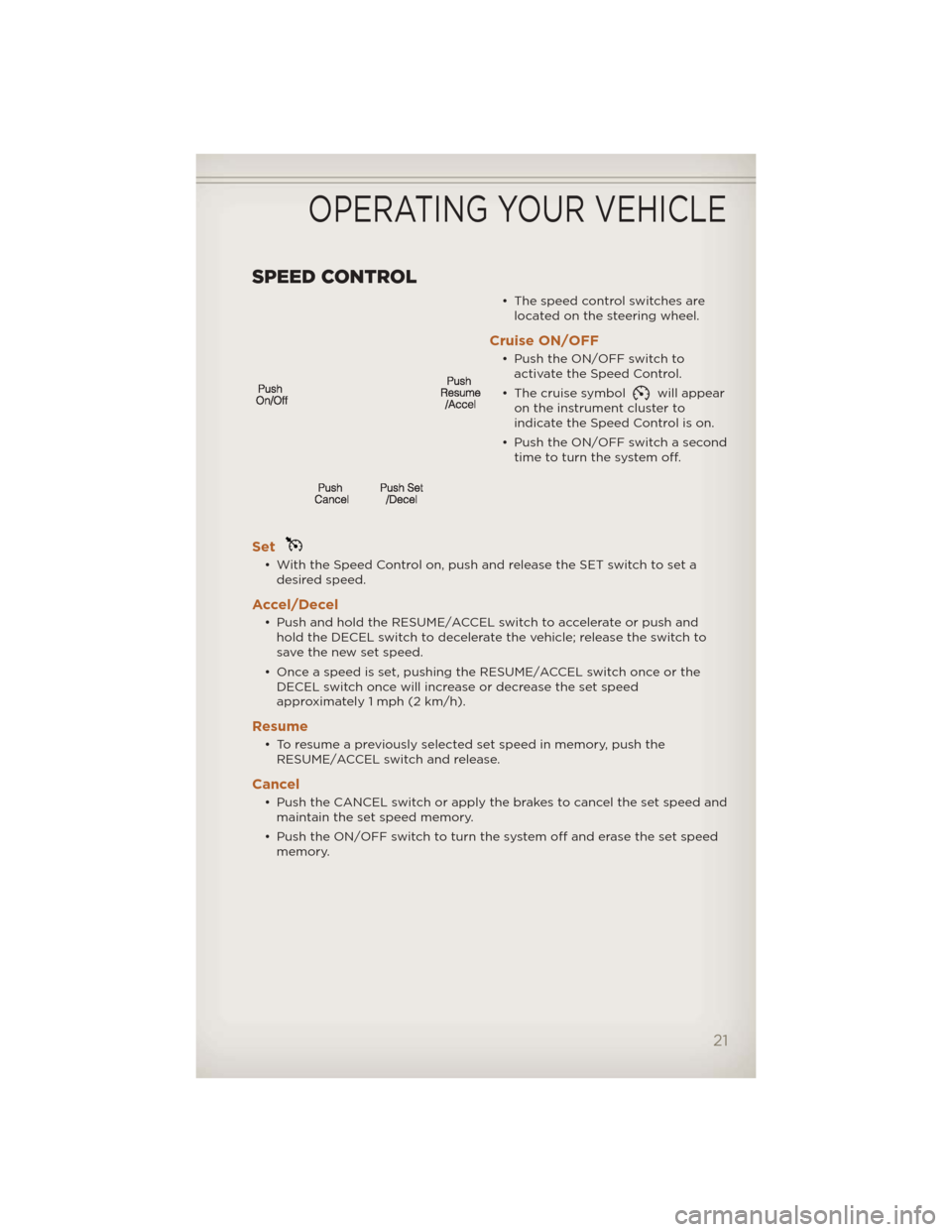
SPEED CONTROL
• The speed control switches arelocated on the steering wheel.
Cruise ON/OFF
• Push the ON/OFF switch toactivate the Speed Control.
• The cruise symbol
will appear
on the instrument cluster to
indicate the Speed Control is on.
• Push the ON/OFF switch a second time to turn the system off.
Set
• With the Speed Control on, push and release the SET switch to set adesired speed.
Accel/Decel
• Push and hold the RESUME/ACCEL switch to accelerate or push andhold the DECEL switch to decelerate the vehicle; release the switch to
save the new set speed.
• Once a speed is set, pushing the RESUME/ACCEL switch once or the DECEL switch once will increase or decrease the set speed
approximately 1 mph (2 km/h).
Resume
• To resume a previously selected set speed in memory, push theRESUME/ACCEL switch and release.
Cancel
• Push the CANCEL switch or apply the brakes to cancel the set speed andmaintain the set speed memory.
• Push the ON/OFF switch to turn the system off and erase the set speed memory.
OPERATING YOUR VEHICLE
21
Page 27 of 124

POWER SUNROOF
• The power sunroof switch is located on the overhead console.
Opening SunroofExpress• Press the switch rearward and release. The sunroof will fully open and stop automatically.
Closing SunroofExpress
• Press the switch forward and release. The sunroof will close automatically from any position.
Manual Open/Close
• Press and hold the switch rearward to open or forward to close thesunroof. Any release of the switch will stop the movement, and the
sunroof will remain in a partially open or closed position until the switch
is pressed again.
Venting Sunroof
• Press and release the "VENT" button, and the sunroof will open to thevent position. This is called “Express Vent” and will occur regardless of
sunroof position. During Express Vent operation, any movement of the
switch will stop the sunroof.
Pinch Protection Feature
• This feature will detect an obstruction in the opening of the sunroofduring Express Close operation. If an obstruction in the path of the
sunroof is detected, the sunroof will automatically return to the open
position.
NOTE: Pinch protection is disabled while the switch is pressed and held
during manual opening and closing of the sunroof.
WARNING!
• Never leave children in a vehicle with the key in the ignition switch. Occupants, particularly unattended children, can become entrapped
by the power sunroof while operating the power sunroof switch.
Such entrapment may result in serious injury or death.
• In a collision, there is a greater risk of being thrown from a vehicle with an open sunroof. You could also be severely injured or killed.
Always fasten your seat belt properly and make sure all passengers
are properly secured.
• Do not allow small children to operate the sunroof. Never allow your fingers, other body parts, or any object to project through the
sunroof opening. Injury may result.
OPERATING YOUR VEHICLE
25