Page 200 of 558
WARNING!
Failure to follow these warnings can result in injuries
that are serious or fatal to you, your passengers, and
others around you:
•In an accident, there is a greater risk of being
thrown from a vehicle with the Sky Slider™ open.
Always fasten your seat belt properly and make
sure all passengers are properly secured too.
•Before operating the Sky Slider™ make sure that
no moving parts of the Sky Slider™ can injure a
person or animal.
•Never place any extremities (hands, feet, etc.) near
the Sky Slider™ components or the roof area
while operating the Sky Slider™.(Continued)
WARNING! (Continued)
•If potential danger exists while opening or closing
the Sky Slider™ in Automatic Mode, press and
release the switch immediately to interrupt the
operation.
•If potential danger exists while opening or closing
the Sky Slider™ in Operator Mode, release the
switch immediately to interrupt the operation.
•Do not allow small children to operate the Sky
Slider™.
•Never leave children in a vehicle, with the key in
the ignition switch. Occupants, particularly unat-
tended children, can become entrapped by the Sky
Slider™ while operating the Sky Slider™ switch.
Such entrapment may result in serious injury or
death.
198 UNDERSTANDING THE FEATURES OF YOUR VEHICLE
Page 201 of 558
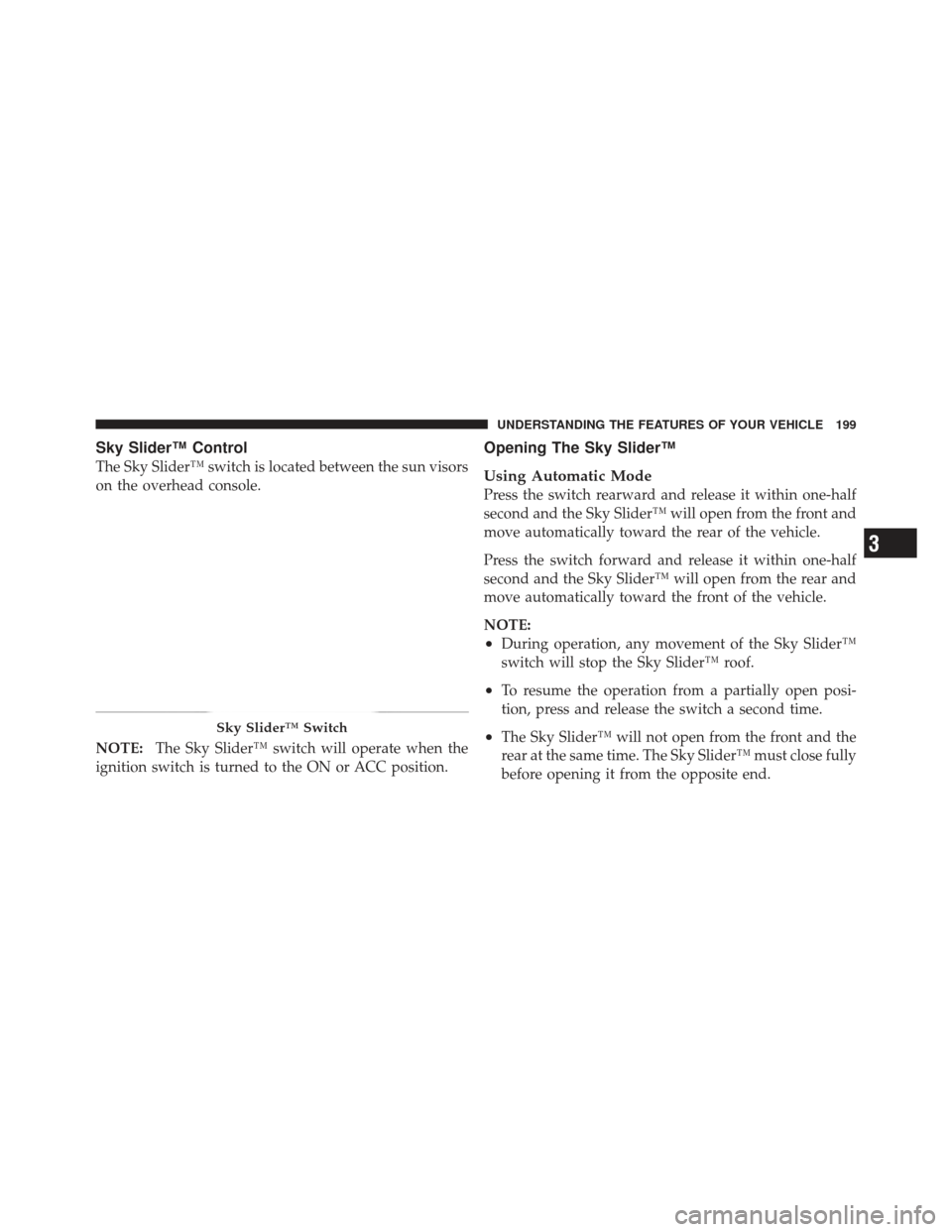
Sky Slider™ Control
The Sky Slider™ switch is located between the sun visors
on the overhead console.
NOTE:The Sky Slider™ switch will operate when the
ignition switch is turned to the ON or ACC position.
Opening The Sky Slider™
Using Automatic Mode
Press the switch rearward and release it within one-half
second and the Sky Slider™ will open from the front and
move automatically toward the rear of the vehicle.
Press the switch forward and release it within one-half
second and the Sky Slider™ will open from the rear and
move automatically toward the front of the vehicle.
NOTE:
•During operation, any movement of the Sky Slider™
switch will stop the Sky Slider™ roof.
•To resume the operation from a partially open posi-
tion, press and release the switch a second time.
•The Sky Slider™ will not open from the front and the
rear at the same time. The Sky Slider™ must close fully
before opening it from the opposite end.Sky Slider™ Switch
3
UNDERSTANDING THE FEATURES OF YOUR VEHICLE 199
Page 217 of 558
Rotate the switch upward past the first detent to
activate the rear washer. The washer pump will
continue to operate as long as the switch is held
(for a maximum of 10 seconds). Upon release, the wiper
will cycle two times before returning to the set position.
If the rear wiper is operating when the ignition is turned
OFF, the wiper will automatically return to the “park”
position. When the vehicle is restarted, the wiper will
resume function at whichever position the switch is set.
NOTE: The rear wiper and the rear washer will not
operate If the liftgate flipper glass is open.
Rear Window Defroster
The rear window defroster button is located on the
climate control (Mode) knob. Press this button to
turn on the rear window defroster and the heated outside
mirrors. An indicator in the button will illuminate when
the rear window defroster is on. The rear window defroster automatically turns off after approximately
10 minutes. For an additional five minutes of operation,
press the button a second time.
NOTE:
To prevent excessive battery drain, use the rear
window defroster only when the engine is operating.
CAUTION!
Failure to follow these cautions can cause damage to
the heating elements:
•Use care when washing the inside of the rear
window. Do not use abrasive window cleaners on
the interior surface of the window. Use a soft cloth
and a mild washing solution, wiping parallel to
the heating elements. Labels can be peeled off
after soaking with warm water.
(Continued)
3
UNDERSTANDING THE FEATURES OF YOUR VEHICLE 215
Page 221 of 558
UNDERSTANDING YOUR INSTRUMENT PANEL
CONTENTS
�Instrument Panel Features ............... 222
� Instrument Cluster .................... 223
� Instrument Cluster Descriptions ........... 224
� Electronic Vehicle Information Center (EVIC) —
If Equipped .......................... 239
▫ Electronic Vehicle Information Center (EVIC)
Displays ........................... 241
▫ Oil Change Required .................. 243
▫ EVIC Main Menu .................... 244 ▫
Compass Display / ECO
(Fuel Saver Mode) — If Equipped ........ 244
▫ Average Fuel Economy ................ 247
▫ Distance To Empty (DTE) .............. 248
▫ TirePSI ........................... 248
▫ Elapsed Time ....................... 249
▫ EVIC Units Selection (Units In Display) .... 249
▫ System Status ....................... 249
▫ Personal Settings
(Customer-Programmable Features) ....... 249
4
Page 226 of 558
INSTRUMENT CLUSTER DESCRIPTIONS
1. Fuel Gauge
The fuel gauge shows level of fuel in tank when ignition
switch is in the ON/RUN position.
2. Fuel Door ReminderThis symbol indicates the side of the vehicle
where the fuel cap is located.
3. Low Fuel Light This indicator lights when the fuel level drops to
approximately one-eighth tank.
4. Tire Pressure Monitoring Telltale Light Each tire, including the spare (if provided),
should be checked monthly when cold and
inflated to the inflation pressure recommended
by the vehicle manufacturer on the vehicle
placard or tire inflation pressure label. (If your vehicle has tires of a different size than the size indicated on the
vehicle placard or tire inflation pressure label, you should
determine the proper tire inflation pressure for those
tires.)
As an added safety feature, your vehicle has been
equipped with a Tire Pressure Monitoring System
(TPMS) that illuminates a low tire pressure telltale when
one or more of your tires is significantly under-inflated.
Accordingly, when the low tire pressure telltale illumi-
nates, you should stop and check your tires as soon as
possible, and inflate them to the proper pressure. Driving
on a significantly under-inflated tire causes the tire to
overheat and can lead to tire failure. Under-inflation also
reduces fuel efficiency and tire tread life, and may affect
the vehicle’s handling and stopping ability.
Please note that the TPMS is not a substitute for proper
tire maintenance, and it is the driver ’s responsibility to
224 UNDERSTANDING YOUR INSTRUMENT PANEL
Page 229 of 558
CAUTION!
Prolonged driving with the MIL on could cause
damage to the engine control system. It also could
affect fuel economy and drivability. If the MIL is
flashing, severe catalytic converter damage and
power loss will soon occur. Immediate service is
required.
WARNING!
A malfunctioning catalytic converter, as referenced
above, can reach higher temperatures than in normal
operating conditions. This can cause a fire if you
drive slowly or park over flammable substances such
as dry plants, wood, cardboard, etc. This could result
in death or serious injury to the driver, occupants or
others.7. High Beam Indicator
This indicator shows that the high beam head-
lights are on. Pull the multifunction control lever
on the left side of the steering column toward you to
switch to low beam.
8. Front Fog Light Indicator — If Equipped This indicator will illuminate when the front fog
lights are on.
9. Speedometer
Shows the vehicle speed in Miles Per Hour (MPH) or
kilometers per hour (km/h).
10. Turn Signal Indicators The arrow will flash with the exterior turn signal
when the turn signal lever is operated.
4
UNDERSTANDING YOUR INSTRUMENT PANEL 227
Page 230 of 558

If the vehicle electronics sense that the vehicle is driven
more than 1 mile (1.6 km) with either turn signal on, a
continuous chime will sound to alert you to turn the
signals off. If either indicator flashes at a rapid rate, check
for a defective outside light bulb.
11. Electronic Stability Control (ESC) Activation/
Malfunction Indicator Light — If EquippedThe “ESC Activation/Malfunction Indicator
Light” in the instrument cluster will come on
when the ignition switch is turned to the
ON/RUN position. It should go out with the
engine running. If the “ESC Activation/Malfunction In-
dicator Light” comes on continuously with the engine
running, a malfunction has been detected in the ESC
system. If this light remains on after several ignition
cycles, and the vehicle has been driven several miles
(kilometers) at speeds greater than 30 mph (48 km/h), see
your authorized dealer as soon as possible to have the
problem diagnosed and corrected. NOTE:
•The “ESC Off Indicator Light” and the “ESC
Activation/Malfunction Indicator Light” come on mo-
mentarily each time the ignition switch is turned to
ON/RUN.
•Each time the ignition is turned to ON/RUN, the ESC
system will be ON, even if it was turned off previously.
•The ESC system will make buzzing or clicking sounds
when it is active. This is normal; the sounds will stop
when ESC becomes inactive following the maneuver
that caused the ESC activation.
12. Charging System Light This light shows the status of the electrical charg-
ing system. The light should come on when the
ignition switch is first turned to ON/RUN and remain on
briefly as a bulb check. If the light stays on or comes on
while driving, turn off some of the vehicle’s non-essential
electrical devices or increase engine speed (if at idle). If
228 UNDERSTANDING YOUR INSTRUMENT PANEL
Page 231 of 558

the charging system light remains on, it means that the
vehicle is experiencing a problem with the charging
system. Obtain SERVICE IMMEDIATELY. See an autho-
rized dealer.
If jump starting is required, refer to “Jump Starting
Procedures” in “What To Do In Emergencies”.
13. Oil Pressure Warning LightThis light indicates low engine oil pressure. The
light should turn on momentarily when the engine
is started. If the light turns on while driving, stop the
vehicle and shut off the engine as soon as possible. A
chime will sound for four minutes when this light turns
on.
Do not operate the vehicle until the cause is corrected.
This light does not indicate how much oil is in the engine.
The engine oil level must be checked under the hood. 14. Anti-Lock Brake (ABS) Light
This light monitors the Anti-Lock Brake System
(ABS). The light will turn on when the ignition
switch is turned to the ON/RUN position and
may stay on for as long as four seconds.
If the ABS light remains on or turns on while driving, it
indicates that the Anti-Lock portion of the brake system
is not functioning and that service is required. However,
the conventional brake system will continue to operate
normally if the BRAKE warning light is not on.
If the ABS light is on, the brake system should be serviced
as soon as possible to restore the benefits of Anti-Lock
brakes. If the ABS light does not turn on when the
ignition switch is turned to the ON/RUN position, have
the light inspected by an authorized dealer.
15. Tachometer
This gauge measures engine revolutions-per-minute
(RPM x 1000). When the engine RPM are kept within the
4
UNDERSTANDING YOUR INSTRUMENT PANEL 229