Page 160 of 429
The automatic climate control
system in your vehicle maintains the
interior temperature you select. The
system also adjusts the f an speed
and airf low levels.The system automatically selects the
proper mix of conditioned and/or
heated air that will, as quickly as
possible, raise or lower the interior
temperature to your pref erence.
When you set either side
temperature to its lower limit
( ) or its upper limit ( ),
the system runs at f ull cooling or
heating only. It does not regulate the
interior temperature.
When you press a f an control button,
the fan is taken out of AUTO mode.
The driver
Page 161 of 429
�Û
�Ý
To turn the system completely off,
press the ON/OFF button.
Keep the system completely of f
f or short periods only.
To keep stale air and mustiness
f rom collecting, you should have
the f an running at all times. You can manually select various
f unctions of the climate control
system when it is in f ully automatic
mode. All other f eatures remain
automatically controlled. Making any
manual selection causes the word
AUTO in the display to go out.
Press the button to increase
the fan speed and airflow. Press the
button to decrease it.
This button turns the air
conditioningonandoff.Youwillsee
A/C ON or A/C OFF in the display.
When you turn the A/C of f , the
system cannot regulate the inside
temperature if you set the
temperature control below the
outside temperature.
In AUTO mode, the vehicle
Page 265 of 429
�µ�µ
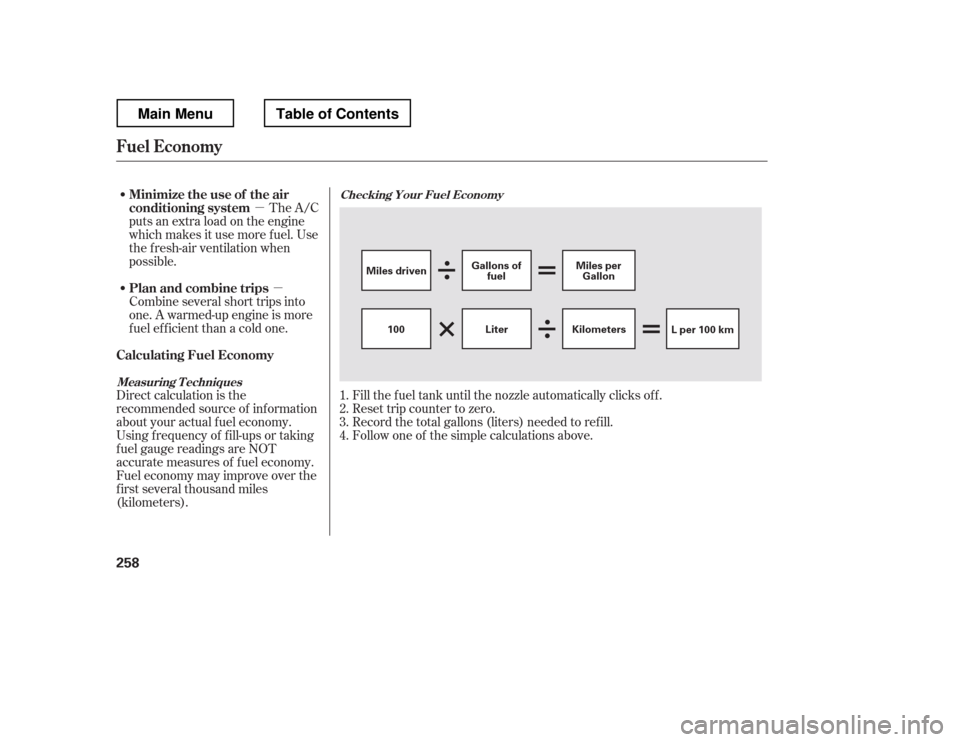
Fill the f uel tank until the nozzle automatically clicks of f .
Reset trip counter to zero.
Record the total gallons (liters) needed to ref ill.
Follow one of the simple calculations above.
The A/C
puts an extra load on the engine
which makes it use more f uel. Use
the f resh-air ventilation when
possible.
Combine several short trips into
one. A warmed-up engine is more
f uel ef f icient than a cold one.
Direct calculation is the
recommended source of inf ormation
about your actual f uel economy.
Using f requency of f ill-ups or taking
f uel gauge readings are NOT
accurate measures of f uel economy.
Fuel economy may improve over the
f irst several thousand miles
(kilometers). 1.2.3.4.
Checking Your Fuel Economy
Measuring T echniques
Fuel Economy
Minimize the use of the air
conditioning system
Plan and combine trips
Calculating Fuel Economy
258
Miles driven Gallons of
fuel Miles per
Gallon
100 KilometersL per 100 km
Liter
Main MenuTable of Contents
Page 299 of 429
Always steer moderately
when you are braking hard. Severe
or sharp steering wheel movement
can still cause your vehicle to veer
into oncoming traffic or off the road. such as trying to take a
corner too f ast or making a sudden
lane change. Always drive at a safe
speed f or the road and weather
conditions. It only helps with the
steering control during braking.
If the ABS indicator and the brake
system indicator come on together,
and the parking brake is f ully
released, the EBD system may also
be shut down.
Test your brakes as instructed on
page . If the brakes f eel normal,
drive slowly and have your vehicle
repaired by your dealer as soon as
possible. Avoid sudden hard braking
which could cause the rear wheels to
lock up and possibly lead to a loss of
control.
If this happens, you will also see the
‘‘CHECK ABS SYSTEM
Page 333 of 429
�Î �Î
�Ì �Ì
�µ�µ
�Î �Ì
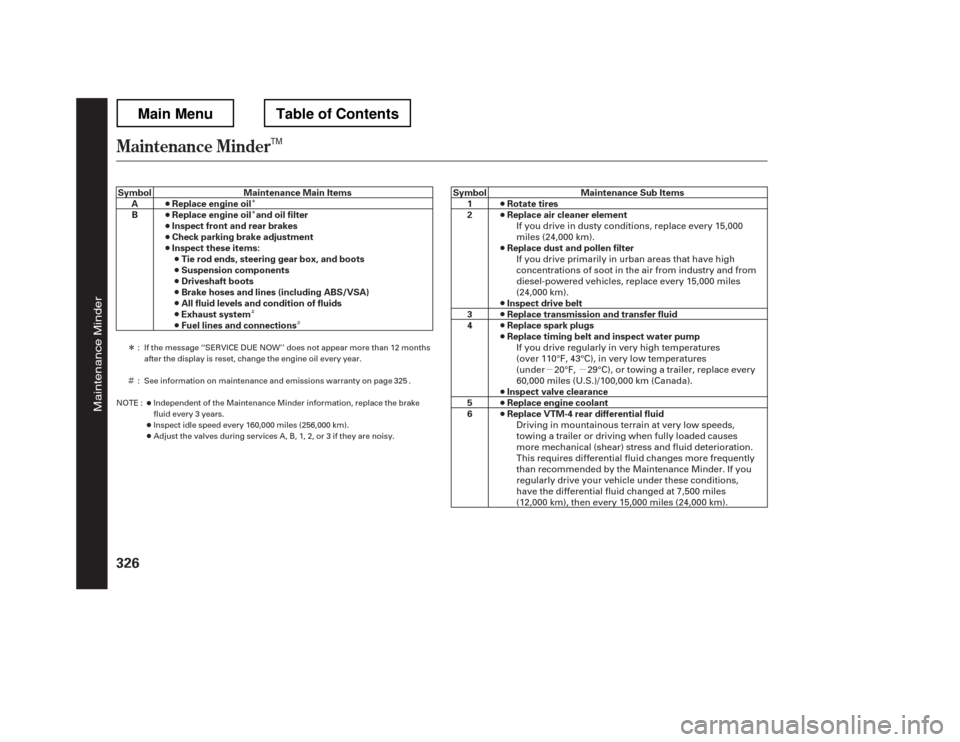
Maintenance Minder
326 Maintenance Main Items
Replace engine oil
Replace engine oil and oil filter
Inspect front and rear brakes
Check parking brake adjustment
Inspect these items: Tie rod ends, steering gear box, and boots
Suspension components
Driveshaft boots
Brake hoses and lines (including ABS/VSA)
All fluid levels and condition of fluids
Exhaust system
Fuel lines and connections Maintenance Sub Items
Rotate tires
Replace air cleaner element
Replace dust and pollen filter
Inspect drive belt
Replace transmission and transfer fluid
Replace spark plugs
Replace timing belt and inspect water pump
Inspect valve clearance
Replace engine coolant
Replace VTM-4 rear differential fluid
Symbol
Symbol
A
B 1 2 3 4 5 6
TM
Inspect idle speed every 160,000 miles (256,000 km).
Adjust the valves during services A, B, 1, 2, or 3 if they are noisy.
See information on maintenance and emissions warranty on page .
Independent of the Maintenance Minder information, replace the brake
fluid every 3 years.
If the message ‘‘SERVICE DUE NOW’’ does not appear more than 12 months
after the display is reset, change the engine oil every year.
NOTE : : :
325If you drive in dusty conditions, replace every 15,000
miles (24,000 km).
If you drive primarily in urban areas that have high
concentrations of soot in the air from industry and from
diesel-powered vehicles, replace every 15,000 miles
(24,000 km).
If you drive regularly in very high temperatures
(over 110
Page 357 of 429
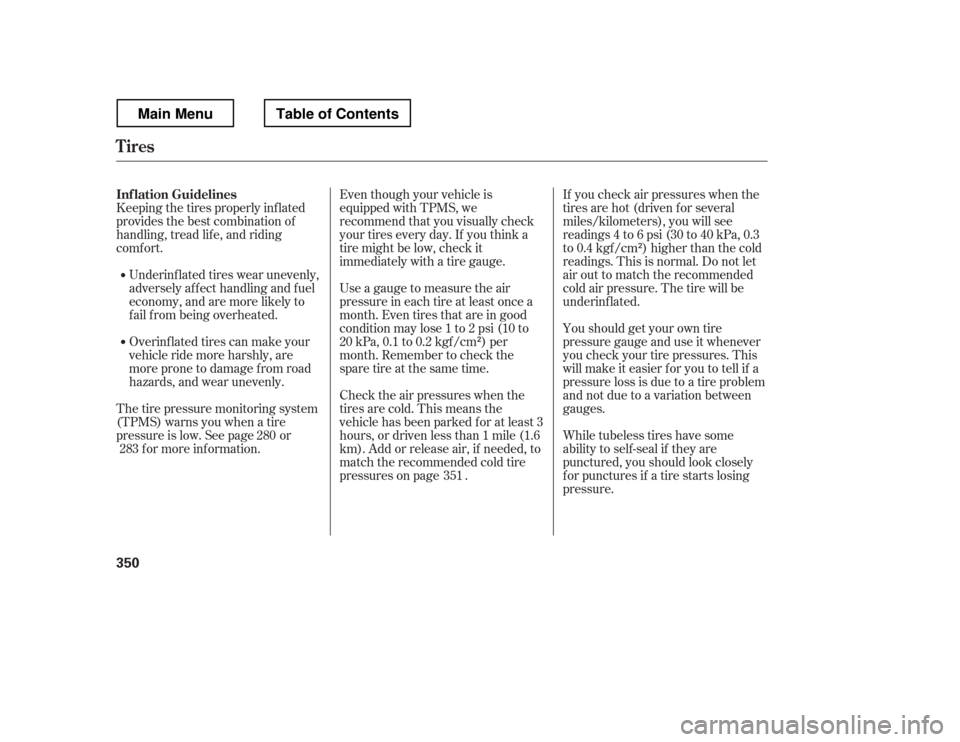
Keeping the tires properly inf lated
provides the best combination of
handling, tread lif e, and riding
comf ort.Underinf lated tires wear unevenly,
adversely affect handling and fuel
economy, and are more likely to
fail from being overheated.
Overinf lated tires can make your
vehicleridemoreharshly,are
more prone to damage f rom road
hazards, and wear unevenly. Even though your vehicle is
equipped with TPMS, we
recommend that you visually check
your tires every day. If you think a
tire might be low, check it
immediately with a tire gauge.
Use a gauge to measure the air
pressure in each tire at least once a
month. Even tires that are in good
condition may lose 1 to 2 psi (10 to
20 kPa, 0.1 to 0.2 kgf /cm ) per
month. Remember to check the
sparetireatthesametime.
Check the air pressures when the
tires are cold. This means the
vehicle has been parked f or at least 3
hours, or driven less than 1 mile (1.6
km). Add or release air, if needed, to
match the recommended cold tire
pressures on page . If you check air pressures when the
tires are hot (driven f or several
miles/kilometers), you will see
readings 4 to 6 psi (30 to 40 kPa, 0.3
to 0.4 kgf/cm ) higher than the cold
readings. This is normal. Do not let
air out to match the recommended
cold air pressure. The tire will be
underinf lated.
Youshouldgetyourowntire
pressure gauge and use it whenever
you check your tire pressures. This
will make it easier f or you to tell if a
pressure loss is due to a tire problem
and not due to a variation between
gauges.
While tubeless tires have some
ability to self -seal if they are
punctured, you should look closely
for punctures if a tire starts losing
pressure.
The tire pressure monitoring system
(TPMS) warns you when a tire
pressure is low. See page or
f or more inf ormation. 280
283
351
Inf lation Guidelines
Tires
350
Main MenuTable of Contents
Page 358 of 429
Never use a puncture-repairing agent
in a f lat tire. If used, you will have to
replace the tire pressure sensor.
Havetheflattirerepairedbyyour
dealer as soon as possible.
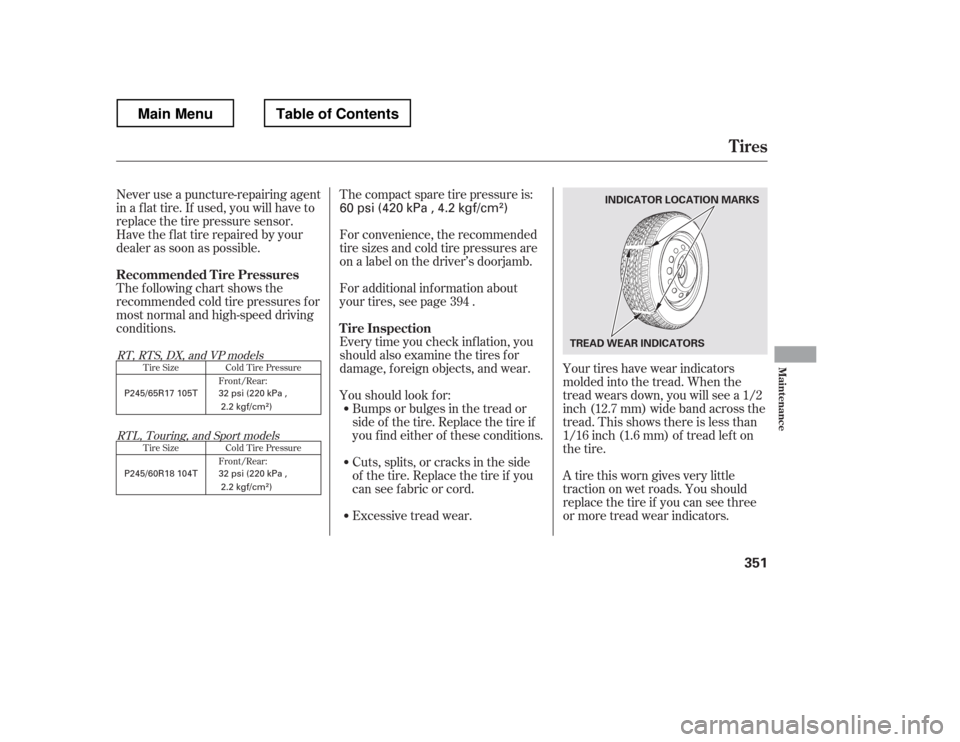
The following chart shows the
recommended cold tire pressures f or
most normal and high-speed driving
conditions.Your tires have wear indicators
molded into the tread. When the
tread wears down, you will see a 1/2
inch (12.7 mm) wide band across the
tread. This shows there is less than
1/16 inch (1.6 mm) of tread lef t on
the tire.
A tire this worn gives very little
traction on wet roads. You should
replace the tire if you can see three
or more tread wear indicators.
Thecompactsparetirepressureis:
Excessive tread wear.
Cuts, splits, or cracks in the side
of the tire. Replace the tire if you
can see f abric or cord.
Bumps or bulges in the tread or
side of the tire. Replace the tire if
youfindeitherof theseconditions.
Every time you check inf lation, you
should also examine the tires f or
damage, f oreign objects, and wear.
Youshouldlookfor:
For additional inf ormation about
your tires, see page .
For convenience, the recommended
tire sizes and cold tire pressures are
on a label on the driver
Page 397 of 429
�µ�µ
�Î �Î
�Î �Î �Î
�Î
�Î
�Î �Î �Î�Î �Î
�Î
�Î
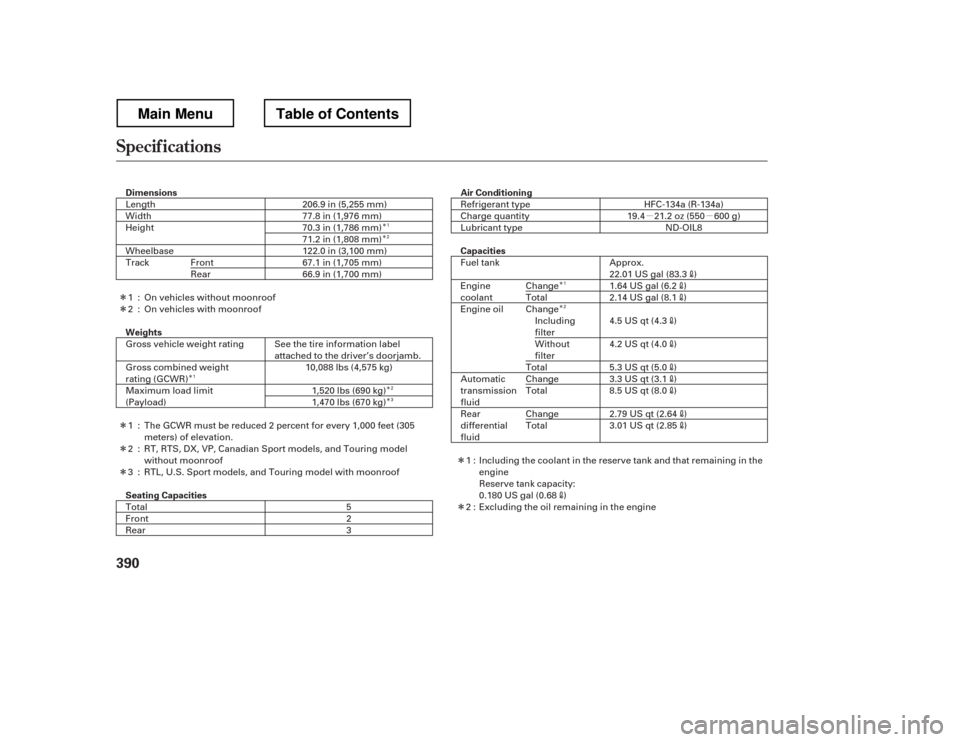
Specif ications
390 Air Conditioning
Dimensions
Capacities
Weights
Seating Capacities 206.9 in (5,255 mm)
77.8 in (1,976 mm)
70.3 in (1,786 mm)
Refrigerant type
Charge quantity
Lubricant type HFC-134a (R-134a)
19.4 21.2 oz (550 600 g) ND-OIL8
1,470 lbs (670 kg)
1,520 lbs (690 kg)
10,088 lbs (4,575 kg)
Length
Width
Height
Wheelbase
Track
66.9 in (1,700 mm)
67.1 in (1,705 mm)
122.0 in (3,100 mm)
The GCWR must be reduced 2 percent for every 1,000 feet (305
meters) of elevation. Fuel tank
Engine
coolant
Engine oil Automatic
transmission
fluidRear
differential
fluid
22.01 US gal (83.3
)
1.64 US gal (6.2)
2.14 US gal (8.1)
4.2 US qt (4.0
)
4.5 US qt (4.3
)
5.3 US qt (5.0
)
3.3 US qt (3.1)
8.5 US qt (8.0)
2.79 US qt (2.64
)
3.01 US qt (2.85)
Including the coolant in the reserve tank and that remaining in the
engine
Reserve tank capacity:
0.180 US gal (0.68
)
Excluding the oil remaining in the engine
71.2 in (1,808 mm)
Gross vehicle weight rating
Gross combined weight
rating (GCWR)
Maximum load limit
(Payload) See the tire information label
attached to the driver’s doorjamb.
3
2
5
Total
FrontRear Approx.
FrontRear
1: 2:
1: 2: 3:
Change Total
Change
Including
filter
Without
filter
Total
ChangeTotal
Change Total
1:
2:
On vehicles without moonroof
On vehicles with moonroof
RT, RTS, DX, VP, Canadian Sport models, and Touring model
without moonroof
RTL, U.S. Sport models, and Touring model with moonroof 1
231 2
1
2
Main MenuTable of Contents