Page 80 of 429
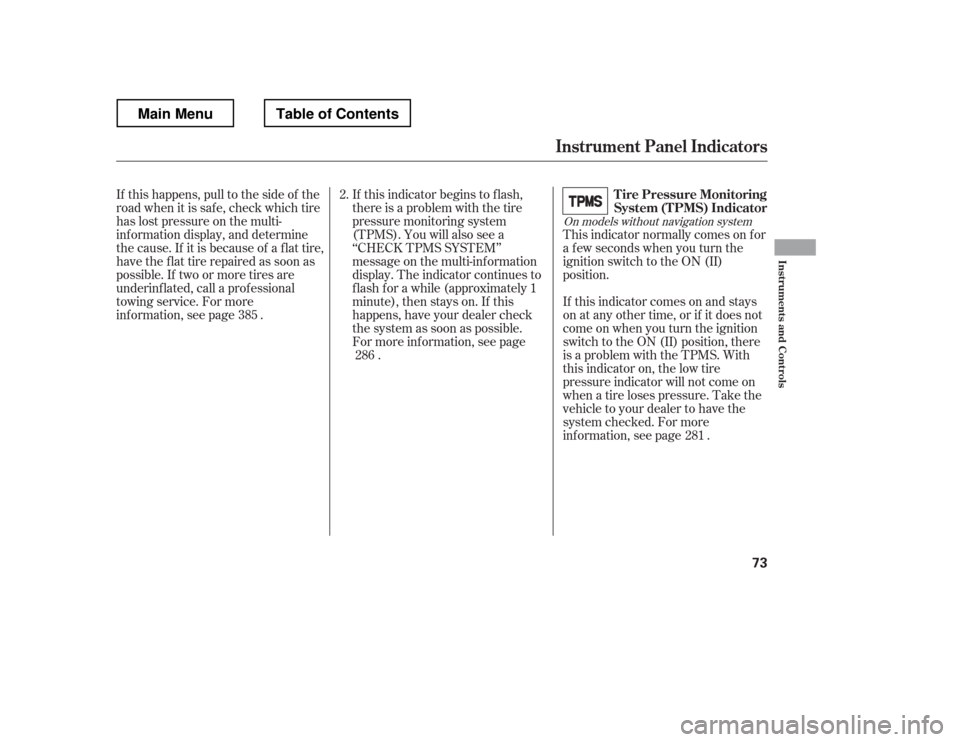
This indicator normally comes on f or
a f ew seconds when you turn the
ignition switch to the ON (II)
position.
If this happens, pull to the side of the
road when it is saf e, check which tire
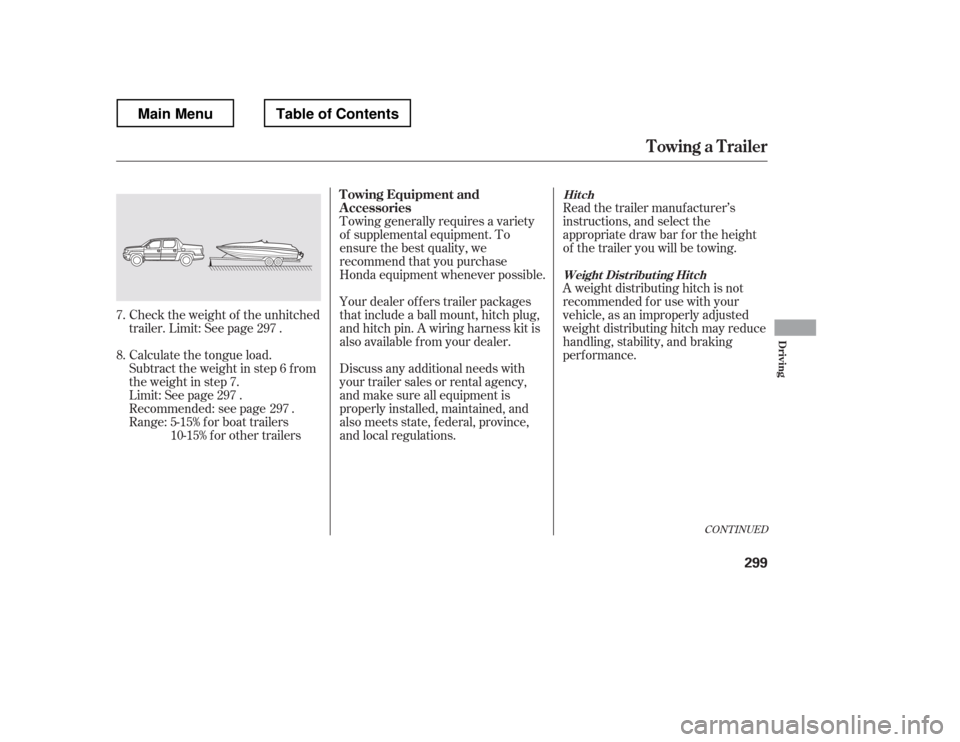
has lost pressure on the multi-
inf ormation display, and determine
the cause. If it is because of a flat tire,
have the flat tire repaired as soon as
possible. If two or more tires are
underinf lated, call a prof essional
towing service. For more
inf ormation, see page . If this indicator begins to f lash,
there is a problem with the tire
pressure monitoring system
(TPMS). You will also see a
‘‘CHECK TPMS SYSTEM
Page 276 of 429
This section gives you tips on
starting the engine under various
conditions, and how to operate the
automatic transmission. It also
includes important inf ormation on
parking your vehicle, the braking
system, the Variable Torque
Management
4-wheel drive
(VTM-4
) system, the vehicle
stability assist (VSA
), aka
Electronic Stability Control (ESC),
system, the tire pressure monitoring
system (TPMS), and f acts you need
if you are planning to tow a trailer or
drive of f -highway. ........................
Driving Guidelines . 270
........................
Preparing to Drive . 271
.......................
Starting the Engine . 272
..............
Automatic Transmission . 273
Variable Torque Management
...........
4WD (VTM-4) System . 278
Tire Pressure Monitoring System
......................................
(TPMS) . 280
...........................................
Parking . 288
.............................
Braking System . 290
...............
Anti-lock Brakes (ABS) . 291
Vehicle Stability Assist (VSA
),
aka Electronic Stability Control .......................
(ESC), System . 292
.................
Towing Weight Limits . 295
..........
Towing Weight Guidelines . 297
...........................
Towing a Trailer . 298
Of f -Highway Driving
..................................
Guidelines . 308
Driving
Driving
269
Main MenuINDEX
Page 302 of 429
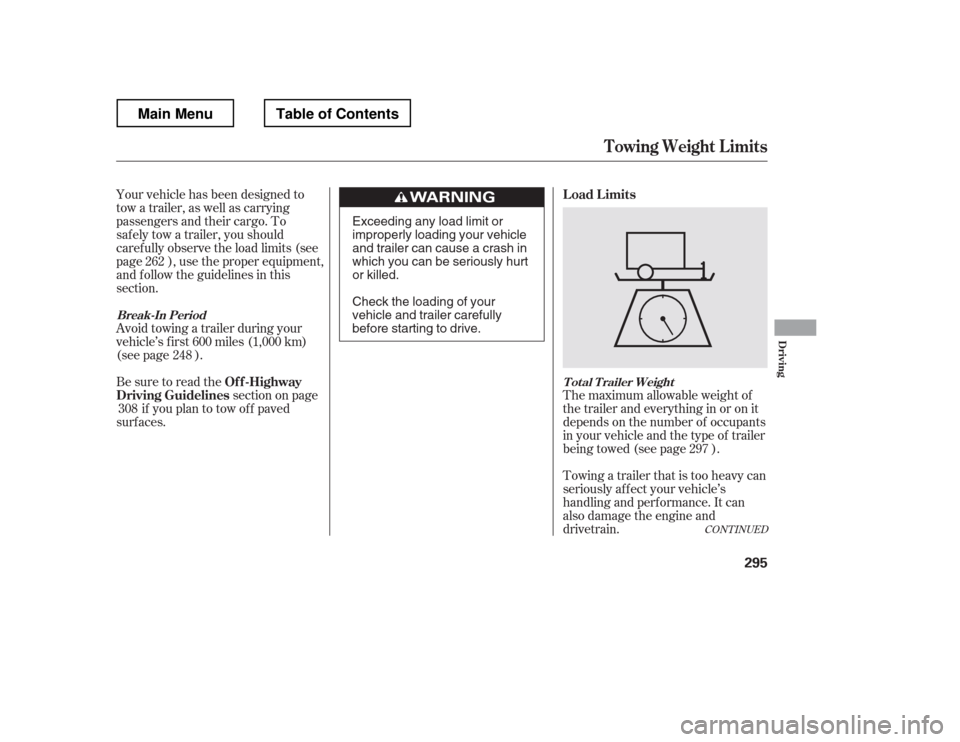
Your vehicle has been designed to
tow a trailer, as well as carrying
passengers and their cargo. To
saf ely tow a trailer, you should
caref ully observe the load limits (see
page ), use the proper equipment,
and f ollow the guidelines in this
section.The maximum allowable weight of
the trailer and everything in or on it
depends on the number of occupants
in your vehicle and the type of trailer
being towed (see page ).
Towing a trailer that is too heavy can
seriously af f ect your vehicle
Page 303 of 429
�µ�µ
�µ Thebestwaytoconfirmthatall
loads are within limits is to check
them at a public scale (see page
).
To help ensure a saf e drive to a scale,
or if you cannot get to a public scale,
we recommend that you estimate
your total trailer weight and tongue
load as described.
Add the weight of your trailer (as
quoted by the manuf acturer) with
everything in or on the trailer. Then
check the tables on page to
make sure you do not exceed the
limit f or your conditions.
The maximum
allowable weight of the vehicle, all
occupants, all accessories, all cargo,
and the tongue load is 6,050 lbs
(2,745 kg).
The maximum
allowable weight on the vehicle axles
is 3,105 lbs (1,410 kg) on the f ront
axle, and 3,245 lbs (1,475 kg) on the
rear axle.
The maximum
allowable weight of the f ully loaded
vehicle and trailer is 10,088 lbs
(4,575 kg) with the proper hitch.
The GCWR must be reduced 2
percent f or every 1,000 f eet (305
meters) of elevation.
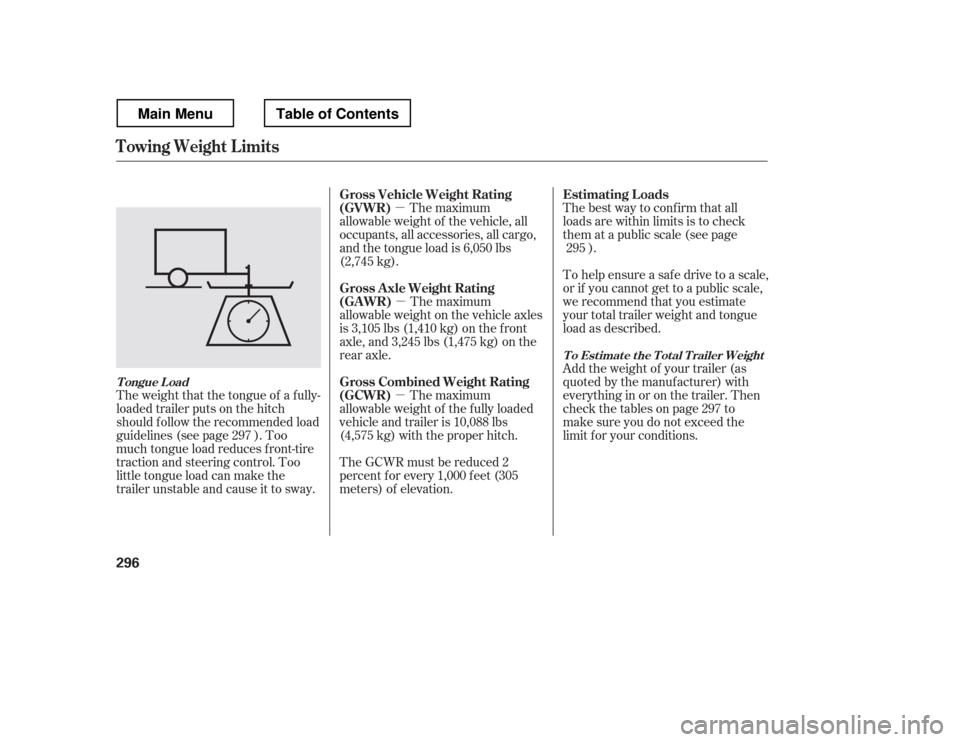
The weight that the tongue of a f ully-
loaded trailer puts on the hitch
should f ollow the recommended load
guidelines (see page ). Too
much tongue load reduces f ront-tire
traction and steering control. Too
little tongue load can make the
trailer unstable and cause it to sway.
297 295
297
Towing Weight Limits
Estimating Loads
Gross Vehicle Weight Rating
(GVWR)
Gross Axle Weight Rating
(GA WR)
Gross Combined Weight Rating
(GCWR)
To Estimate the Total Trailer Weight
Tongue Load
296
Main MenuTable of Contents
Page 304 of 429
�µ�µ
�Î�Î�Î
�Î
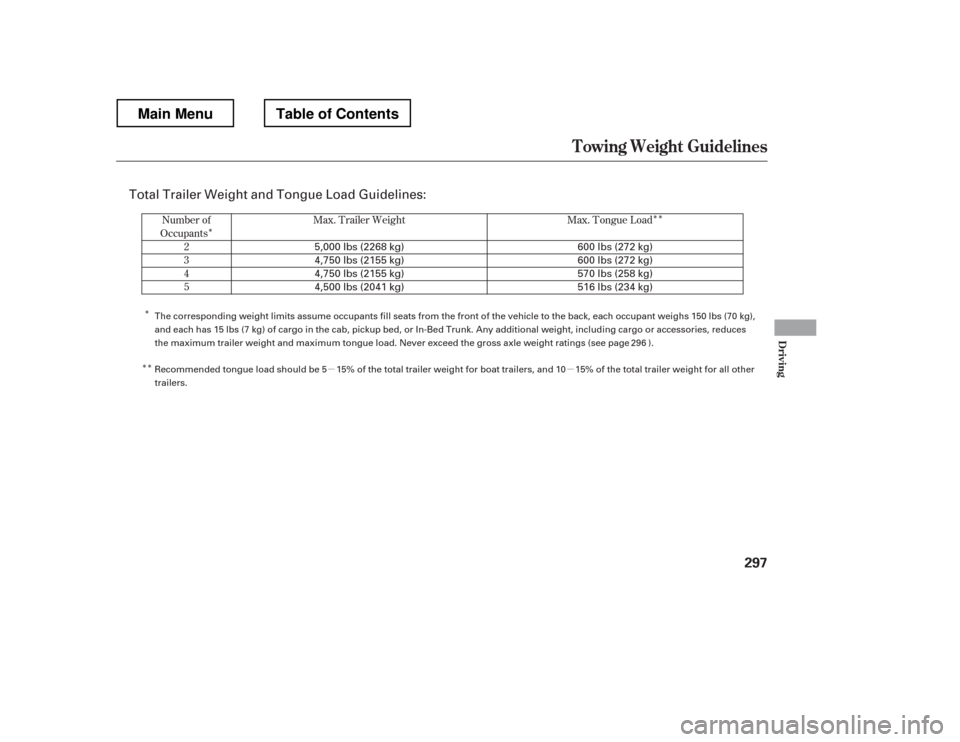
��ΠNumber of
Occupants 2 345 Max. T railer Weight Max. T ongue Load
Towing Weight Guidelines
Driving
297
Total Trailer Weight and Tongue Load Guidelines:
Recommended tongue load should be 5 15% of the total trailer weight for boat trailers, and 10 15% of the total trailer weight
for all other
trailers.
The corresponding weight limits assume occupants fill seats from the front of the vehicle to the back, eac
h occupant weighs 150 lbs (70 kg),
and each has 15 lbs (7 kg) of cargo in the cab, pickup bed, or In-Bed Trunk. Any additional weight, includi ng cargo or accessories, reduces
the maximum trailer weight and maximum tongue load. Never exceed the gross axle weight ratings (see page ). 296
5,000 lbs (2268 kg)
4,750 lbs (2155 kg)
4,750 lbs (2155 kg)
4,500 lbs (2041 kg)600 lbs (272 kg)
600 lbs (272 kg)
570 lbs (258 kg)
516 lbs (234 kg)
Main MenuTable of Contents
Page 305 of 429
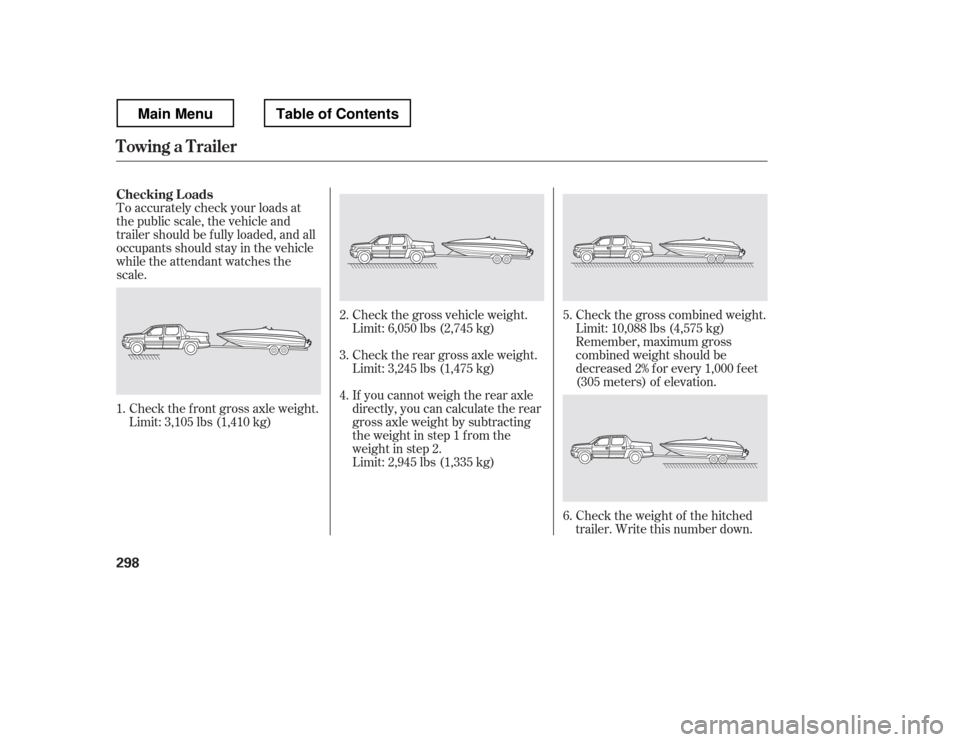
To accurately check your loads at
the public scale, the vehicle and
trailer should be f ully loaded, and all
occupants should stay in the vehicle
while the attendant watches the
scale.Check the f ront gross axle weight.
Limit: 3,105 lbs (1,410 kg) Check the gross vehicle weight.
Limit: 6,050 lbs (2,745 kg)
Check the weight of the hitched
trailer. Write this number down.
Check the gross combined weight.
Limit: 10,088 lbs (4,575 kg)
Remember, maximum gross
combined weight should be
decreased 2% f or every 1,000 f eet
(305 meters) of elevation.
If you cannot weigh the rear axle
directly, you can calculate the rear
gross axle weight by subtracting
the weight in step 1 from the
weight in step 2.
Limit: 2,945 lbs (1,335 kg)
Check the rear gross axle weight.
Limit: 3,245 lbs (1,475 kg)
1. 2. 3. 4.
5. 6.
Checking L oads
Towing a Trailer
298
Main MenuTable of Contents
Page 306 of 429
Check the weight of the unhitched
trailer. Limit: See page .Towing generally requires a variety
of supplemental equipment. To
ensure the best quality, we
recommend that you purchase
Honda equipment whenever possible.
Discuss any additional needs with
your trailer sales or rental agency,
and make sure all equipment is
properly installed, maintained, and
also meets state, f ederal, province,
and local regulations.
Your dealer of f ers trailer packages
that include a ball mount, hitch plug,
and hitch pin. A wiring harness kit is
also available from your dealer. Read the trailer manuf acturer
Page 308 of 429
Always use saf ety chains when you
tow a trailer. Make sure the chains
are secured to the trailer and hitch,
and that they cross under the tongue
and can catch the trailer if it
becomes unhitched. Leave enough
slack to allow the trailer to turn
corners easily, but do not let the
chains drag on the ground.When towing a trailer, we
recommend that you carry a f ull-size
spare wheel and tire for your vehicle
and trailer. See page f or proper
tire size, page f or how to store a
full size wheel and tire, and page
f or inf ormation on changing a
flat tire.
Remember to unhitch the trailer
bef ore changing a f lat. Ask your
trailer sales or rental agency where
and how to store the trailer