Page 530 of 681

For example, if you check and f ill
your tires in a warm area, then drive
in extremely cold weather, the tire
pressure will be lower than
measured and could be underinf lated
and cause the low tire pressure
indicator to come on. Or, if you
check and adjust your tire pressure
in cooler conditions, and drive into
extremely hot conditions, the tire
maybecomeoverinflated.However,
the low tire pressure indicator will
not come on if the tires are
overinf lated.
Refer to page for tire inflation
guidelines.
Although your tire pressure is
monitored, you must manually check
thetirepressuresmonthly.This indicator comes on and stays on
if there is a problem with the tire
pressure monitoring system.
If this happens, the system will shut
of f and no longer monitor tire
pressures. Have the system checked
by your dealer as soon as possible.
If the low tire pressure indicator or
TPMS indicator comes on, the VSA
system automatically turns on even if
the VSA system is turned of f by
pressing the VSA OFF switch (see
page ). If this happens, you
cannot turn the VSA system of f by
pressing the VSA OFF switch again.
Each tire, including the spare, should
be checked monthly when cold, and
set to the recommended inf lation
pressure as specif ied on the tire
information label and in the owner
Page 532 of 681
CONT INUED
If you think you can saf ely drive a
short distance to a service station,
proceed slowly to the station, then
inflate the tire to the recommended
pressure.
If the tire is f lat, or if the tire
pressure is too low to continue
driving, replace the tire with the
compact spare tire (see page ).
Driving on a signif icantly under-
inf lated tire causes the tire to
overheat and can lead to tire failure.
Under-inf lation also reduces f uel
efficiency and tire tread life, and may
af f ect the vehicle
Page 539 of 681
on loose or
uneven surf aces, such as gravel or
snow, than a vehicle without anti-
lock. It only helps with steering
control during braking.
such as trying to take a
corner too f ast or making a sudden
lane change. Always drive at a safe
speed f or the road and weather
conditions.
Always steer moderately
when you are braking hard. Severe
or sharp steering wheel movement
can still cause your vehicle to veer
into oncoming traffic or off the road.
If the ABS indicator and the brake
system indicator come on together,
and the parking brake is f ully
released, the EBD system may also
be shut down.
If this indicator comes on, the anti-
lock f unction of the braking system
has shut down. The brakes still work
like a conventional system, but
without anti-lock. You should have
your dealer inspect your vehicle as
soon as possible.
If the indicator comes on while
driving, test the brakes as instructed
on page .
You will also see a ‘‘CHECK ABS
SYSTEM
Page 542 of 681

Driving with varying tire or wheel
sizes may cause the VSA to
malf unction. When replacing tires,
makesuretheyareof thesamesize
and type as your original tires (see
page ).
If you install winter tires, make sure
they are the same size as those that
were originally supplied with your
vehicle. Exercise the same caution
during winter driving as you would if
your vehicle was not equipped with
VSA.Your vehicle is equipped with a hill
start assist f eature to help prevent
the vehicle f rom rolling on inclines
as you move your f oot f rom the
brake pedal to the accelerator.
This f eature starts operating a f ew
seconds af ter you are in any drive
gear position (when f aced uphill) or
in reverse (when f aced downhill).
This f eature requires that the
vehicle has come to a complete stop
bef ore it can work.
Hillstartassistmaynotholda
heavily loaded vehicle, such as when
your vehicle is connected to a trailer,
or prevent your vehicle f rom rolling
downhill on a very steep or slippery
slope.
605
VSA and Tire Sizes Hill Start Assist
Vehicle St abilit y A ssist (VSA), aka Electronic Stability Control (ESC), System
Driving
535
Main MenuTable of Contents
Page 543 of 681
The maximum allowable weight of
the trailer and everything in or on it
depends on the number of occupants
in your vehicle and the type of trailer
being towed (see page ).
Towing a trailer that is too heavy can
seriously af f ect your vehicle
Page 544 of 681

�Î
�Î �Î
�Î
The weight that the tongue of a f ully
loaded trailer puts on the hitch
shouldbe5to10percentof thetotal
trailer weight f or boat trailers, and 8
to 15 percent of total trailer weight
f or all other trailers. (See page f or limits f or your towing
situation). Too much tongue load
reduces front-tire traction and
steering control. Too little tongue
load can make the trailer unstable and cause it to sway.
The maximum allowable weight of
the vehicle, all occupants, all
accessories, all cargo, and the
tongue load is:
The maximum allowable weight of
the vehicle, all occupants, all
accessories, all cargo, and the
tongue load must not exceed:
on the f ront axle
on the f ront axle
on the rear axle
2:LXmodels
1 : Except LX models on the rear axle
540
4WD models: 2WD models: 4WD models:
2WD models:
2
1
Towing a Trailer
Tongue Load
Gross Vehicle Weight Rating
(GVWR): Gross Axle Weight Rating
(GA WR):
Driving
537
5,952 lbs (2,700 kg)
6,096 lbs (2,765 kg)
2,921 lbs (1,325 kg)
3,362 lbs (1,525 kg)
3,251 lbs (1,475 kg)
2,921 lbs (1,325 kg)
3,196 lbs (1,450 kg)
Main MenuTable of Contents
Page 545 of 681
Thebestwaytoconfirmthatall
loads are within limits is to check
them at a public scale. For public
scales in your area, check your local
phone book, or contact your trailer
dealer or rental agency for
assistance.
To help ensure a saf e drive to a scale,
or if you cannot get to a public scale,
we recommend that you estimate
your total trailer weight and tongue
load as described next.Add the weight of your trailer (as
quoted by the manuf acturer) with
everything in or on the trailer. Then
check the tables on page to
make sure you do not exceed the
limit f or your conditions.
The maximum allowable weight of
the f ully loaded vehicle and trailer
with the proper hitch is:
The GCWR must be reduced 2
percent f or every 1,000 f eet (305
meters) of elevation. 540
4WD models:
2WD models:
Estimating Loads
Gross Combined Weight Rating
(GCWR):To Estimate the Total Trailer Weight
Towing a Trailer
538
9,579 lbs (4,345 kg)
8,466 lbs (3,840 kg)
Main MenuTable of Contents
Page 547 of 681
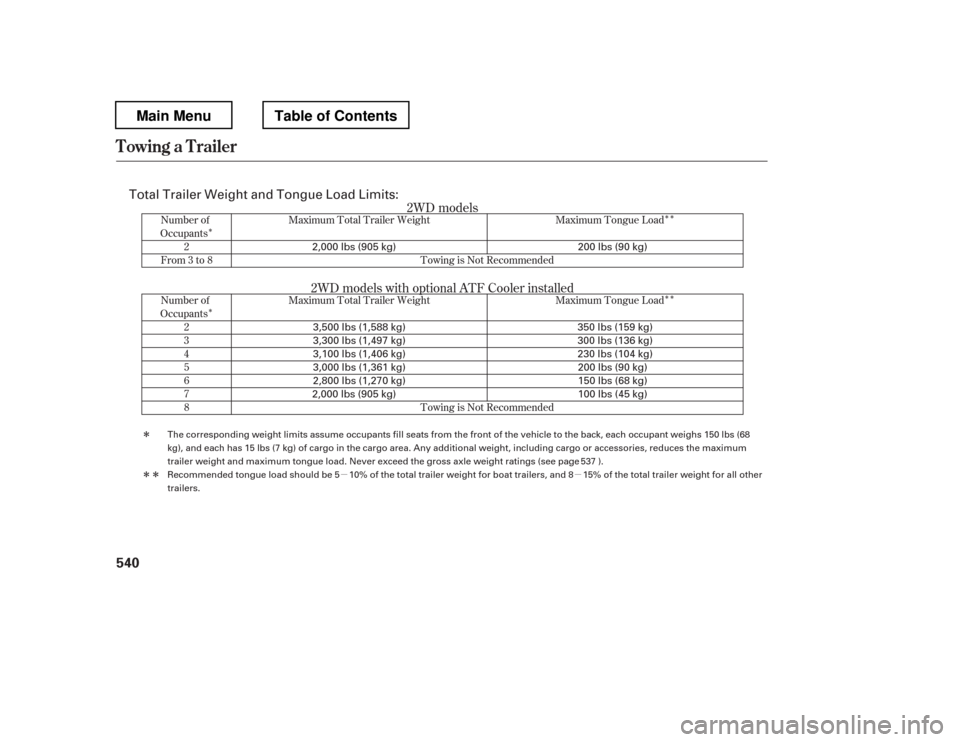
�Î
�Î
�Î�Î �Î�Î
�µ�µ
�Î �Î�Î
Number of
Occupants 2 3 4 5678
Number of
Occupants 2
From 3 to 8 T owing is Not Recommended
T owing is Not Recommended
Maximum T otal T railer Weight Maximum T ongue Load
Maximum T otal T railer Weight Maximum T ongue Load
2WD models
2WD models with optional ATF Cooler installed
Towing a Trailer
540
Total Trailer Weight and Tongue Load Limits:
The corresponding weight limits assume occupants fill seats from the front of the vehicle to the back, eac h occupant weighs 150 lbs (68
kg), and each has 15 lbs (7 kg) of cargo in the cargo area. Any additional weight, including cargo or accessories, reduces the maximum
trailer weight and maximum tongue load. Never exceed the gross axle weight ratings (see page ).
Recommended tongue load should be 5 10% of the total trailer weight for boat trailers, and 8 15% of the total trailer weight for all other
trailers. 537
2,000 lbs (905 kg)
200 lbs (90 kg)
3,500 lbs (1,588 kg)
3,300 lbs (1,497 kg)
3,100 lbs (1,406 kg)
3,000 lbs (1,361 kg)
2,800 lbs (1,270 kg)
2,000 lbs (905 kg) 350 lbs (159 kg)
300 lbs (136 kg)
230 lbs (104 kg)
200 lbs (90 kg)
150 lbs (68 kg)
100 lbs (45 kg)
Main MenuTable of Contents


