Page 456 of 681
CONT INUED
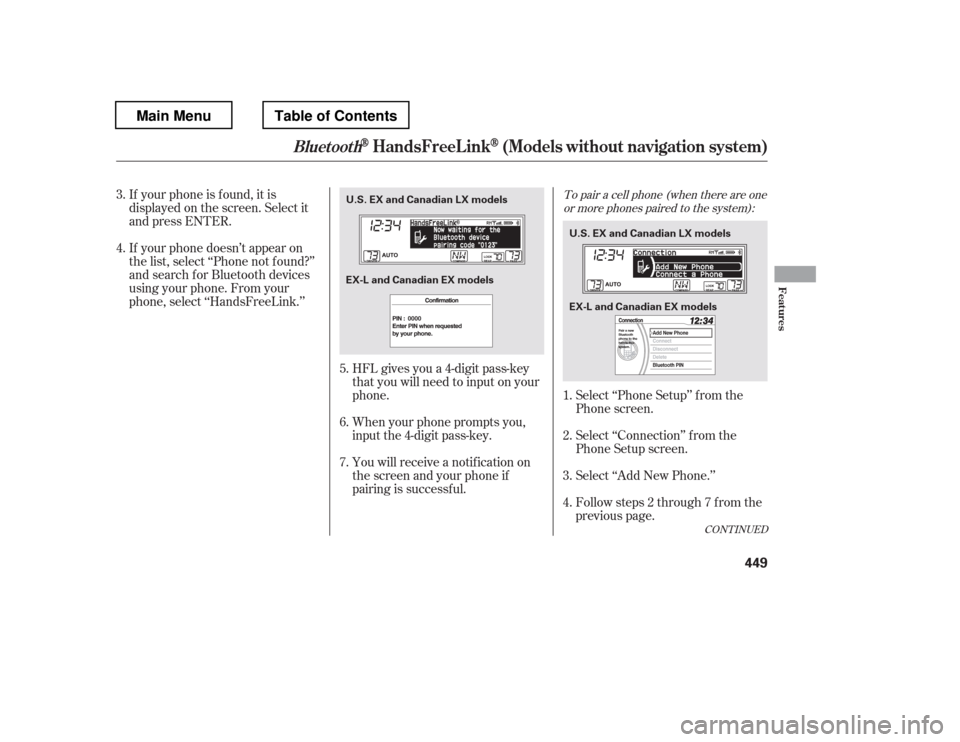
Follow steps 2 through 7 f rom the
previous page.
Select ‘‘Add New Phone.
Page 467 of 681
�µ
�µ �µ
�Î �Î
The f ollowing options are available
during a call:
When you receive a call, a
notif ication appears on the screen
(see page ).
To answer the call, press the
PICK-UPbuttononthesteering
wheel.
To end or decline the call, press the
HANG-UP button.
Allows you to transf er a
call f rom HFL to your phone, or
f rom your phone to HFL.
Allows you to mute your
voice. Allows you to send
numbers or names during a call. This
is usef ul when you call a menu-
driven phone system.
Availableonsomephones.
Touch Tones on U.S. EX and
Canadian LX models.
:
443 During a Call
Receiving a CallTransfer
Mut e Dial T ones
BluetoothHandsFreeL ink(Models without navigation syst em)
460
Example
U.S. EX and Canadian LX models
EX-L and Canadian EX models
Main MenuTable of Contents
Page 502 of 681

Your vehicle is designed to operate
on unleaded gasoline with a pump
octane number of 87 or higher. Use
of a lower octane gasoline can cause
a persistent, heavy, metallic rapping
noise that can lead to engine damage.
Premium f uel is recommended when
towing in certain conditions (see
page ).
Some gasoline today is blended with
oxygenates such as ethanol. Your
vehicle is designed to operate on
oxygenated gasoline containing up to
10% ethanol by volume. Do not use
gasoline containing methanol. If you
notice any undesirable operating
symptoms, try another service
station or switch to another brand of
gasoline.In addition, in order to maintain good
perf ormance, f uel economy, and
emissions control, we strongly
recommend the use of gasoline that
does NOT contain harmf ul
manganese-based f uel additives such
as MMT, if such gasoline is available.
Use of gasoline with these additives
may adversely af f ect perf ormance,
and cause the Malfunction Indicator
Lamp on your instrument panel to
come on. If this happens, contact
your dealer f or service.
549
CONT INUED
Fuel Recommendation
Fuel Recommendation
Bef ore Driving
495
If a non-FFV is inadvertently
ref ueled once with E85 f uel, have
the f uel tank drained at a dealer.
If this occurs over a prolonged
period, damage may occur.
Do not use E85 f uel in a non-Flex Fuel
Vehicle (FFV).
Non-FFV models are not designed to
run on E85 f uel. Using E85 f uel can
damage the f uel system components.
T o help prevent harmf ul f uel system
and engine deposits, use high quality
f uel containing detergent and additives.
Main MenuTable of Contents
Page 507 of 681
Wait a f ew minutes af ter turning the
engine of f bef ore you check the oil.Remove the dipstick (orange loop). Remove the dipstick again, and
check the level. It should be
between the upper and lower
marks.
If it is near or below the lower mark,
see on page . Look at the coolant level in the
radiator reserve tank. Make sure it is
between the MAX and MIN lines. If
it is below the MIN line, see
on page f or
inf ormation on adding the proper
coolant.
Refer to
on page f or inf ormation
about checking other items on your
vehicle.
Wipe of f the dipstick with a clean
cloth or paper towel.
Insert the dipstick all the way back
into its hole.
1. 3.
2. 4.
576 579
571
Oil Check
A dding Engine OilEngine Coolant Check
A dding
Engine Coolant
Owner
Page 511 of 681
Bef ore installing any accessory:Make sure the accessory does not
obscure any lights, or interf ere
with proper vehicle operation or
perf ormance.
Be sure electronic accessories do
not overload electrical circuits
(see page ) or interf ere with
proper operation of your vehicle.
Do not install accessories on the
side pillars or across the rear
windows. Accessories installed in
theseareasmayinterferewith
proper operation of the side
curtain airbags.
When properly installed, cellular
phones, alarms, two-way radios, and
low-powered audio systems should
not interf ere with your vehicle
Page 519 of 681

Because your vehicle rides higher
of f the ground, it has a high center
of gravity that can cause it to roll
over if you make abrupt turns. Utility
vehicles have a signif icantly higher
roll over rate than other types of
vehicles.
To prevent rollovers or loss of
control:Take corners at slower speeds
than you would with a passenger
vehicle.
Avoid sharp turns and abrupt
maneuvers whenever possible. Do not modif y your vehicle in any
way that would raise the center of
gravity.
Do not carry heavy cargo on the
roof .
Your vehicle has higher ground
clearance that allows you to travel
over bumps, obstacles, and rough
terrain. It also provides good
visibility so you can anticipate
problems earlier. Youshoulddothefollowingchecks
and adjustments bef ore you drive
your vehicle.
Make sure all windows, mirrors,
and outside lights are clean and
unobstructed. Remove f rost, snow,
or ice.
Check that the hood is f ully closed.
Visually check the tires. If a tire
looks low, use a gauge to check its
pressure.
Check that any items you may be
carrying are stored properly or
f astened down securely.
Check the seat adjustment (see
page ).
Your vehicle is equipped with a f our-
wheel drive (4WD) system. When
the system senses a loss of front-
wheel traction, it automatically
transf ers some power to the rear
wheels. This gives you better
traction and mobility.
You still need to exercise the same
care when accelerating, steering, and
brakingthatyouwouldinatwo-
wheel drive vehicle. 1. 2. 3. 4.5.
154
See page f or of f -highway driving
guidelines.
4WD models only
552
Driving Guidelines, Preparing to Drive
Driving Guidelines Preparing to Drive
512
Main MenuTable of Contents
Page 520 of 681

CONT INUED
Check the adjustment of the
inside and outside mirrors (see
page ).
Check the steering wheel
adjustment (see page ).Without touching the accelerator
pedal, turn the ignition switch to
the START (III) position, then
release the ignition switch. You do
not need to hold the ignition
switch in the START (III) position
to start the engine. Depending on
the outside temperature, thestarter motor runs f or about 6 to 9
seconds until the engine starts.
If you hold the ignition switch in
the START (III) position f or more
than 7 seconds, the starter motor,
depending on the outside
temperature, runs f or about 10 to
25 seconds until the engine starts.
If the engine does not start, wait at
least 10 seconds bef ore trying
again.
Make sure the shif t lever is in
Park. Press on the brake pedal.
In cold weather, turn of f all
electrical accessories to reduce
the drain on the battery.
Apply the parking brake.
Fasten your seat belt. Check that
your passengers have f astened
their seat belts (see page ). Your vehicle
Page 523 of 681

�µ
�µ
�µ Use neutral if you
need to restart a stalled engine, or if
it is necessary to stop brief ly with
the engine idling. Shif t to the Park
position if you need to leave your
vehicle for any reason. Press on the
brake pedal when you are moving
the shift lever from neutral to
another gear.
If you have done all of the above and
still cannot move the lever out of
Park, see on
page .
To avoid transmission damage, come
to a complete stop bef ore shif ting
into Park. The shif t lever must be in
Park bef ore you can remove the key
from the ignition switch.
Press the brake
pedal and the release button on the
frontoftheshiftlevertoshiftfrom
Park to reverse. To shif t f rom
reverse to neutral, come to a
completestop,andthenshift.Press
the release button bef ore shif ting
into reverse f rom neutral.
This position mechani-
cally locks the transmission. Use
Park whenever you are turning of f or
starting the engine. To shif t out of
Park, you must press on the brake
pedal and the release button on the
shif t lever. Make sure your f oot is of f
the accelerator pedal. 518Do this:
Press the brake pedal and the
shift lever release button.
Press the shift lever release
button.
Move the shift lever.
Press the D button.
To shift from:
PtoR
RtoP
NtoR
Dto2 2to1
1to2
2toD
DtoN
NtoD
RtoN
DtoD
DtoD
3
3
3
Automatic Transmission
Neutral (N)
Shif t L ock Release
Reverse (R)
Park (P)
516
Main MenuTable of Contents