2012 FORD FOCUS ELECTRIC sensor
[x] Cancel search: sensorPage 183 of 380
Driver’s and/or passenger seat position sensor
The driver’s seat position sensor allows your Personal Safety System to
tailor the deployment level of the driver dual-stage airbag based on seat
position. The system is designed to help protect smaller drivers sitting
close to the driver airbag by providing a lower airbag output level.
Front passenger sensing system
For airbags to do their job they must inflate with great force, and this force
can pose a potentially deadly risk to occupants that are very close to the
airbag when it begins to inflate. For some occupants, like infants in
rear-facing child seats, this occurs because they are initially sitting very
close to the airbag. For other occupants, this occurs when the occupant is
not properly restrained by safety belts or child safety seats and they move
forward during pre-crash braking. The most effective way to reduce the
risk of unnecessary injuries is to make sure all occupants are properly
restrained. Accident statistics suggest that children are much safer when
properly restrained in the rear seating positions than in the front.
WARNING:Air bags can kill or injure a child in a child seat.
NEVER place a rear-facing child seat in front of an active air
bag. If you must use a forward-facing child seat in the front seat, move
the seat all the way back.
WARNING: Always transport children 12 years old and under in
a rear seating position and always properly use appropriate child
restraints.
The front passenger sensing system can automatically turn off the
passenger front airbag. The system is designed to help protect small
(child size) occupants from airbag deployments when they are
improperly seated or restrained in the front passenger seat contrary to
proper child-seating or restraint usage recommendations. Even with this
technology, parents are STRONGLYencouraged to always properly
restrain children in the rear seat. The sensor also turns off the airbag
when the passenger seat is empty to prevent unnecessary replacement of
the airbag(s) after a collision.
When the front passenger seat is occupied and the sensing system has
turned off the passenger’s frontal airbag, the “pass airbag off” indicator
will light and stay lit to remind you that the front passenger frontal
airbag is off. See Front passenger sensing system in theAirbag
supplemental restraints (SRS) section of this chapter.
Seating and Safety Restraints 183
2012 Focus Electric Vehicle(fob)
Owners Guide gf, 1st Printing
USA (fus)
Page 184 of 380
Front safety belt usage sensors
The front safety belt usage sensors detect whether or not the driver and
front outboard passenger safety belts are fastened. This information
allows your Personal Safety System to tailor the airbag deployment and
safety belt pretensioner activation depending upon safety belt usage.
Front outboard safety belt pretensioners
The safety belt pretensioners at the front outboard seating positions are
designed to tighten the safety belts firmly against the occupant’s body
during frontal collisions, and in side collisions when the side air curtain
system activates. This helps increase the effectiveness of the safety belts.
In frontal collisions, the safety belt pretensioners can be activated alone
or, if the collision is of sufficient severity, together with the front airbags.
Front outboard safety belt energy management retractors
The front safety belt energy management retractors allow webbing to be
pulled out of the retractor in a gradual and controlled manner in
response to the occupant’s forward momentum. This helps reduce the
risk of force-related injuries to the occupant’s chest by limiting the load
on the occupant.
Determining if the Personal Safety System is operational
The Personal Safety System uses a warning light in the instrument
cluster, a warning message, or a backup tone to indicate the condition of
the system. Refer to theWarning lights and indicators section in the
Instrument Cluster chapter. Routine maintenance of the Personal Safety
System is not required.
The Restraints Control Module (RCM) monitors its own internal circuits
and the circuits for the airbag supplemental restraints, crash sensor(s),
safety belt pretensioners, front safety belt buckle sensors, front
passenger sensing system, and the driver seat position sensor. In
addition, the RCM also monitors the restraints warning light in the
instrument cluster. A difficulty with the system is indicated by one or
more of the following.
• The warning light will either flash or stay lit.
• The warning light will not illuminate immediately after ignition is
turned on.
• A warning message will appear until the problem and warning light are
repaired.
If any of these things happen, even intermittently, have the Personal Safety
System serviced at an authorized dealer immediately. Unless serviced, the
system may not function properly in the event of a collision.
184 Seating and Safety Restraints
2012 Focus Electric Vehicle (fob)
Owners Guide gf, 1st Printing
USA (fus)
Page 196 of 380
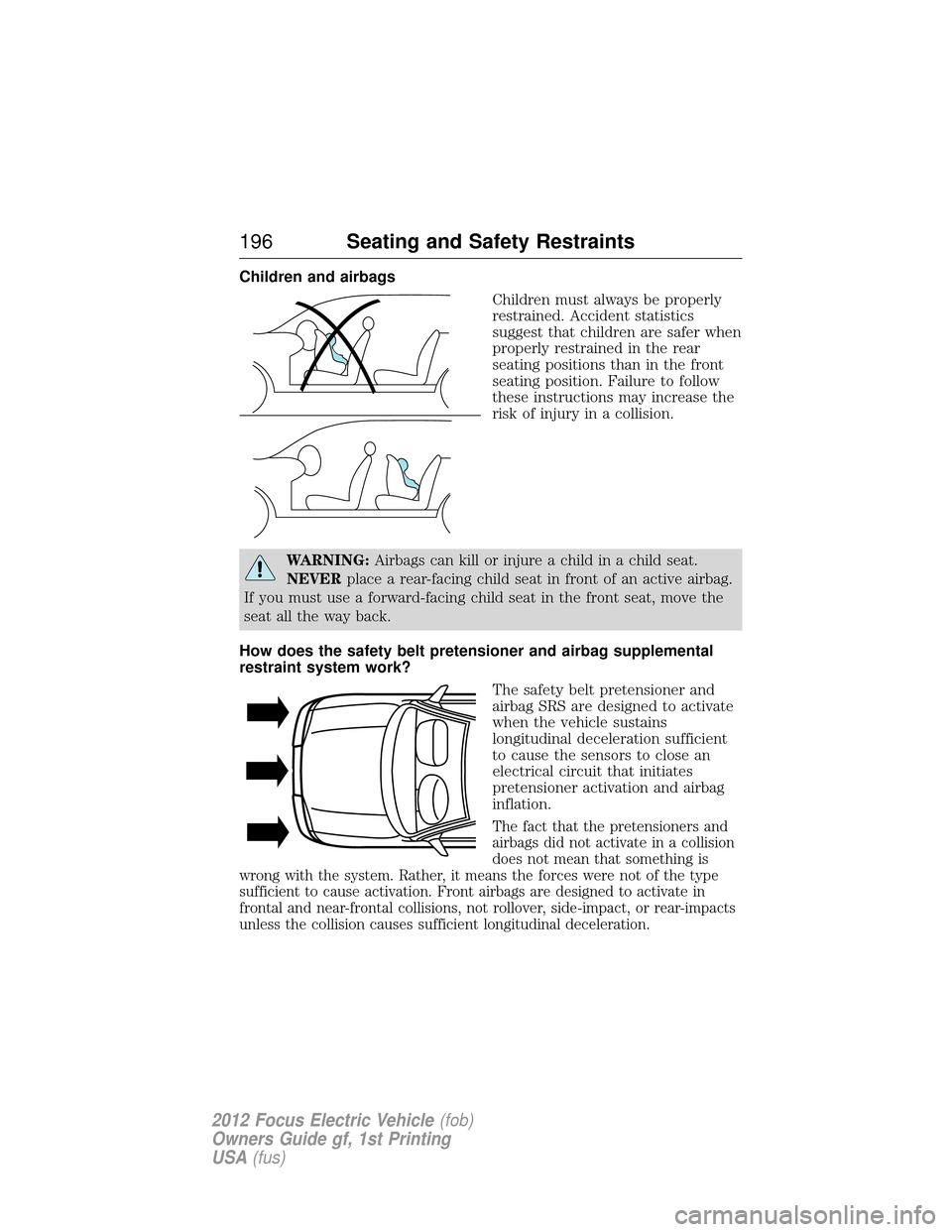
Children and airbagsChildren must always be properly
restrained. Accident statistics
suggest that children are safer when
properly restrained in the rear
seating positions than in the front
seating position. Failure to follow
these instructions may increase the
risk of injury in a collision.
WARNING:Airbags can kill or injure a child in a child seat.
NEVER place a rear-facing child seat in front of an active airbag.
If you must use a forward-facing child seat in the front seat, move the
seat all the way back.
How does the safety belt pretensioner and airbag supplemental
restraint system work? The safety belt pretensioner and
airbag SRS are designed to activate
when the vehicle sustains
longitudinal deceleration sufficient
to cause the sensors to close an
electrical circuit that initiates
pretensioner activation and airbag
inflation.
The fact that the pretensioners and
airbags did not activate in a collision
does not mean that something is
wrong with the system. Rather, it means the forces were not of the type
sufficient to cause activation. Front airbags are designed to activate in
frontal and near-frontal collisions, not rollover, side-impact, or rear-impacts
unless the collision causes sufficient longitudinal deceleration.
196 Seating and Safety Restraints
2012 Focus Electric Vehicle (fob)
Owners Guide gf, 1st Printing
USA (fus)
Page 197 of 380
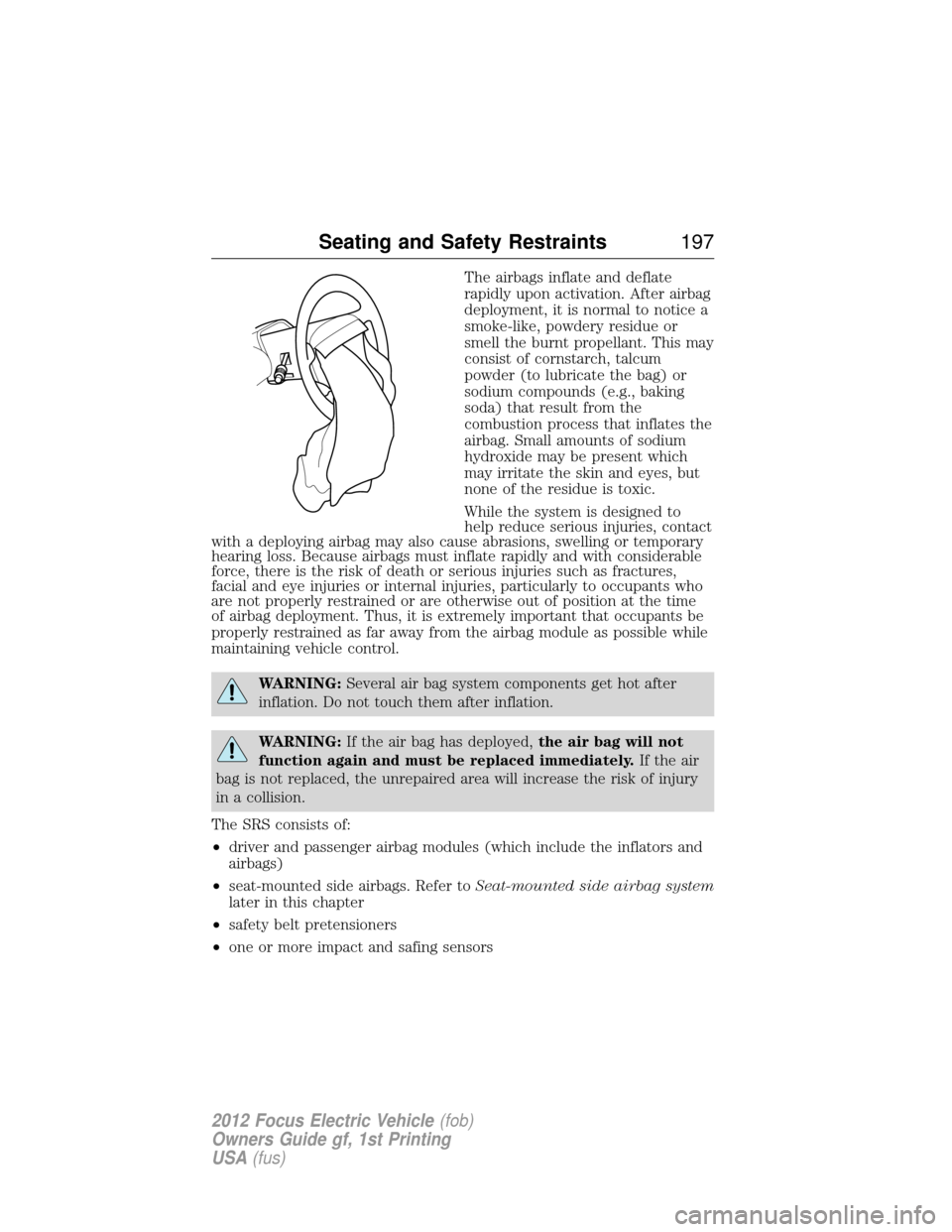
The airbags inflate and deflate
rapidly upon activation. After airbag
deployment, it is normal to notice a
smoke-like, powdery residue or
smell the burnt propellant. This may
consist of cornstarch, talcum
powder (to lubricate the bag) or
sodium compounds (e.g., baking
soda) that result from the
combustion process that inflates the
airbag. Small amounts of sodium
hydroxide may be present which
may irritate the skin and eyes, but
none of the residue is toxic.
While the system is designed to
help reduce serious injuries, contact
with a deploying airbag may also cause abrasions, swelling or temporary
hearing loss. Because airbags must inflate rapidly and with considerable
force, there is the risk of death or serious injuries such as fractures,
facial and eye injuries or internal injuries, particularly to occupants who
are not properly restrained or are otherwise out of position at the time
of airbag deployment. Thus, it is extremely important that occupants be
properly restrained as far away from the airbag module as possible while
maintaining vehicle control.
WARNING: Several air bag system components get hot after
inflation. Do not touch them after inflation.
WARNING: If the air bag has deployed, the air bag will not
function again and must be replaced immediately. If the air
bag is not replaced, the unrepaired area will increase the risk of injury
in a collision.
The SRS consists of:
• driver and passenger airbag modules (which include the inflators and
airbags)
• seat-mounted side airbags. Refer to Seat-mounted side airbag system
later in this chapter
• safety belt pretensioners
• one or more impact and safing sensors
Seating and Safety Restraints 197
2012 Focus Electric Vehicle(fob)
Owners Guide gf, 1st Printing
USA (fus)
Page 198 of 380
•a readiness light and tone
• and the electrical wiring which connects the components
• Side curtain airbag system. Refer to Side curtain airbag systemlater
in this chapter.
• Front passenger sensing system. Refer to Front passenger sensing
system later in this chapter.
• “Passenger airbag off” or “pass airbag off” indicator lamp. Refer to
Front passenger sensing system later in this chapter.
The diagnostic module monitors its own internal circuits and the
supplemental airbag electrical system wiring (including the impact
sensors), the system wiring, the airbag system readiness light, the airbag
backup power, the airbag ignitors and safety belt pretensioners.
FRONT PASSENGER SENSING SYSTEM
WARNING: Even with Advanced Restraints Systems, children 12
and under should be properly restrained in a rear seating position.
WARNING: Sitting improperly out of position or with the seat
back reclined too far can take off weight from the seat cushion
and affect the decision of the front passenger sensing system, resulting
in serious injury or death in a crash.
Always sit upright against your seatback, with your feet on the floor.
WARNING: To reduce the risk of possible serious injury:
Do not stow objects in seat back map pocket (if equipped) or
hang objects off seat back if a child is in the front passenger seat.
Do not place objects underneath the front passenger seat or between
the seat and the center console (if equipped).
Check the “passenger airbag off” or “pass airbag off” indicator lamp for
proper airbag Status.
Failure to follow these instructions may interfere with the passenger
seat sensing system.
WARNING: Any alteration/modification to the front passenger
seat may affect the performance of the front passenger sensing
system.
198 Seating and Safety Restraints
2012 Focus Electric Vehicle (fob)
Owners Guide gf, 1st Printing
USA (fus)
Page 199 of 380
This system works with sensors that are part of the front passenger’s
seat and safety belt to detect the presence of a properly seated occupant
and determine if the front passenger’s frontal airbag should be enabled
(may inflate) or not.The front passenger sensing system
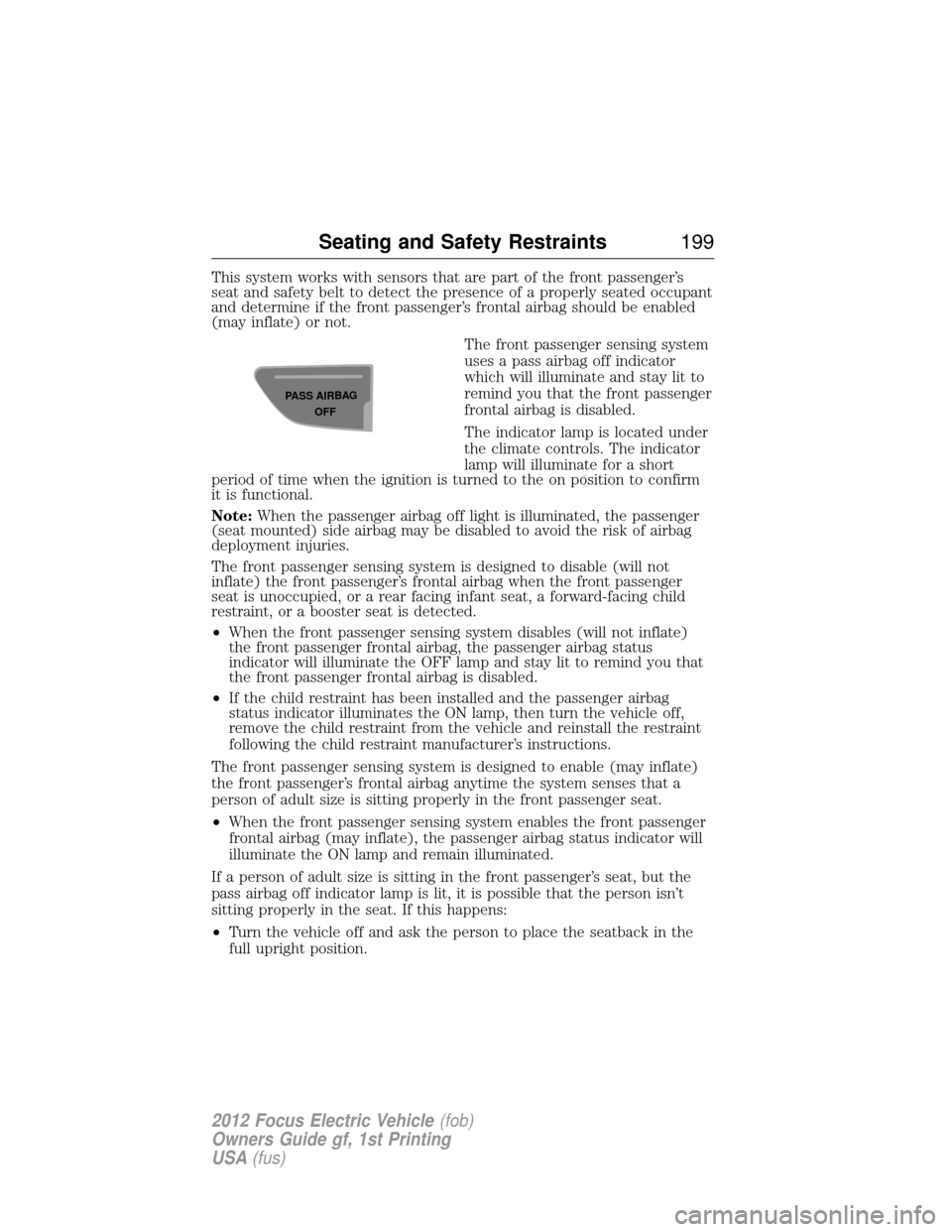
uses a pass airbag off indicator
which will illuminate and stay lit to
remind you that the front passenger
frontal airbag is disabled.
The indicator lamp is located under
the climate controls. The indicator
lamp will illuminate for a short
period of time when the ignition is turned to the on position to confirm
it is functional.
Note: When the passenger airbag off light is illuminated, the passenger
(seat mounted) side airbag may be disabled to avoid the risk of airbag
deployment injuries.
The front passenger sensing system is designed to disable (will not
inflate) the front passenger’s frontal airbag when the front passenger
seat is unoccupied, or a rear facing infant seat, a forward-facing child
restraint, or a booster seat is detected.
• When the front passenger sensing system disables (will not inflate)
the front passenger frontal airbag, the passenger airbag status
indicator will illuminate the OFF lamp and stay lit to remind you that
the front passenger frontal airbag is disabled.
• If the child restraint has been installed and the passenger airbag
status indicator illuminates the ON lamp, then turn the vehicle off,
remove the child restraint from the vehicle and reinstall the restraint
following the child restraint manufacturer’s instructions.
The front passenger sensing system is designed to enable (may inflate)
the front passenger’s frontal airbag anytime the system senses that a
person of adult size is sitting properly in the front passenger seat.
• When the front passenger sensing system enables the front passenger
frontal airbag (may inflate), the passenger airbag status indicator will
illuminate the ON lamp and remain illuminated.
If a person of adult size is sitting in the front passenger’s seat, but the
pass airbag off indicator lamp is lit, it is possible that the person isn’t
sitting properly in the seat. If this happens:
• Turn the vehicle off and ask the person to place the seatback in the
full upright position.
PASS AIRBAG
OFF
Seating and Safety Restraints 199
2012 Focus Electric Vehicle(fob)
Owners Guide gf, 1st Printing
USA (fus)
Page 201 of 380
To know if the front passenger sensing system is operating
properly, refer toCrash sensors and Airbag Indicator later in
this chapter.
If the airbag readiness lamp is lit, do the following:
The driver and/or adult passengers should check for any objects that
may be lodged underneath the front passenger seat or cargo interfering
with the seat.
If objects are lodged and/or cargo is interfering with the seat; please take
the following steps to remove the obstruction:
• Pull the vehicle over.
• Turn the vehicle off.
• Driver and/or adult passengers should check for any objects lodged
underneath the front passenger seat or cargo interfering with the seat.
• Remove the obstruction(s) (if found).
• Restart the vehicle.
• Wait at least two minutes and verify that the airbag readiness lamp is
no longer illuminated
• If the airbag readiness lamp remains illuminated, this may or may/not
be a problem due to the front passenger sensing system.
DO NOT attempt to repair or service the system; take your vehicle
immediately to an authorized dealer.
If it is necessary to modify an advanced front airbag system to
accommodate a person with disabilities, contact the Ford Customer
Relationship Center at the phone number shown in the Customer
Assistance section of this Owner’s Manual.
Determining if the system is operational
The system uses a warning indicator light in the instrument cluster or a
backup tone to indicate the condition of the system. Routine
maintenance of the airbag is not required.
A difficulty with the system is indicated by one or more of the following: •The readiness light (same light for front and side airbag
system) will either flash or stay lit.
• The readiness light will not illuminate immediately after ignition is
turned on.
• An information message will appear in the message center.
Seating and Safety Restraints 201
2012 Focus Electric Vehicle(fob)
Owners Guide gf, 1st Printing
USA (fus)
Page 203 of 380
How does the side airbag system work?
The design and development of the side airbag system included
recommended testing procedures that were developed by a group of
automotive safety experts known as the Side Airbag Technical Working
Group. These recommended testing procedures help reduce the risk of
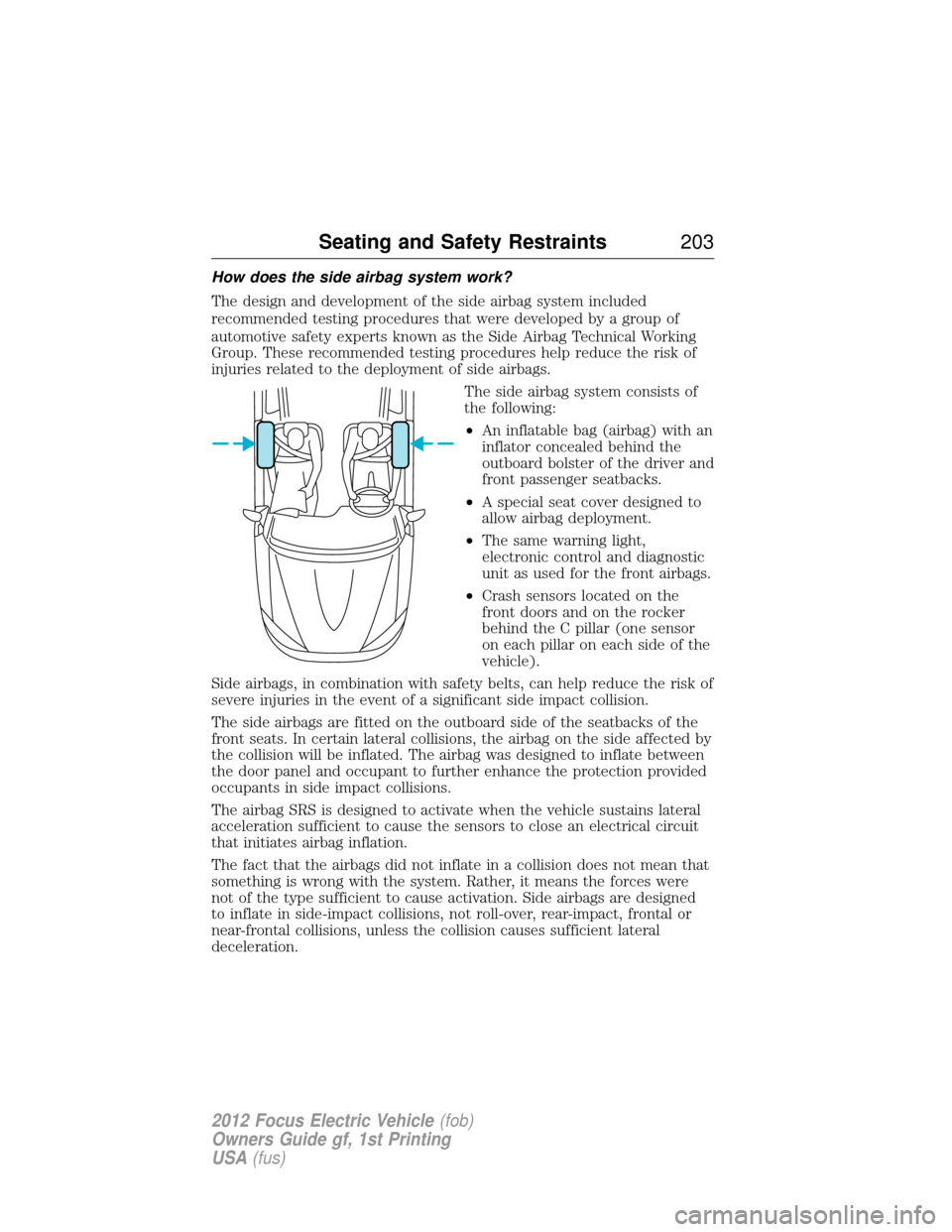
injuries related to the deployment of side airbags.The side airbag system consists of
the following:
•An inflatable bag (airbag) with an
inflator concealed behind the
outboard bolster of the driver and
front passenger seatbacks.
• A special seat cover designed to
allow airbag deployment.
• The same warning light,
electronic control and diagnostic
unit as used for the front airbags.
• Crash sensors located on the
front doors and on the rocker
behind the C pillar (one sensor
on each pillar on each side of the
vehicle).
Side airbags, in combination with safety belts, can help reduce the risk of
severe injuries in the event of a significant side impact collision.
The side airbags are fitted on the outboard side of the seatbacks of the
front seats. In certain lateral collisions, the airbag on the side affected by
the collision will be inflated. The airbag was designed to inflate between
the door panel and occupant to further enhance the protection provided
occupants in side impact collisions.
The airbag SRS is designed to activate when the vehicle sustains lateral
acceleration sufficient to cause the sensors to close an electrical circuit
that initiates airbag inflation.
The fact that the airbags did not inflate in a collision does not mean that
something is wrong with the system. Rather, it means the forces were
not of the type sufficient to cause activation. Side airbags are designed
to inflate in side-impact collisions, not roll-over, rear-impact, frontal or
near-frontal collisions, unless the collision causes sufficient lateral
deceleration.
Seating and Safety Restraints 203
2012 Focus Electric Vehicle(fob)
Owners Guide gf, 1st Printing
USA (fus)