Page 189 of 306

Tightening steering column joint bolts
As a good maintenance practice, it is recommended that steering column
joint bolts be checked for tightness every 60,000 miles (96,000 km) or
annually, whichever occurs first. DO NOT OVERTIGHTEN.
Power steering hydraulic system
Whenever the power steering’s hydraulic system has been drained and
refilled for any reason, air must be bled from the system before returning
the vehicle to service. Failure to properly bleed the hydraulic system can
result in degradation of power system performance.
Consult your dealer who is aware of the proper procedures for filling and
bleeding the system.
OPENING THE HOOD
The hood and fenders are held in position by a latch located on each
fender.
WARNING:The parking brake must be fully set before opening
the hood or possible personal injury may occur.
WARNING:To reduce the risk of the possibility of personal
injury, never stand beneath the hood when it is being raised or
lowered.
WARNING:If you must leave the engine running while checking
under the hood, do not allow any loose clothing, jewelry, hair or
other items to get near moving engine components or possible personal
injury may occur.
To open the hood:
1. Set the parking brake, shift into N (Neutral) (automatic transmission)
or 1 (First) (manual transmission) and turn the engine off.
Maintenance and Specifications
189
2012 F-650/750(f67)
Supplement, 2nd Printing
USA(fus)
Page 190 of 306
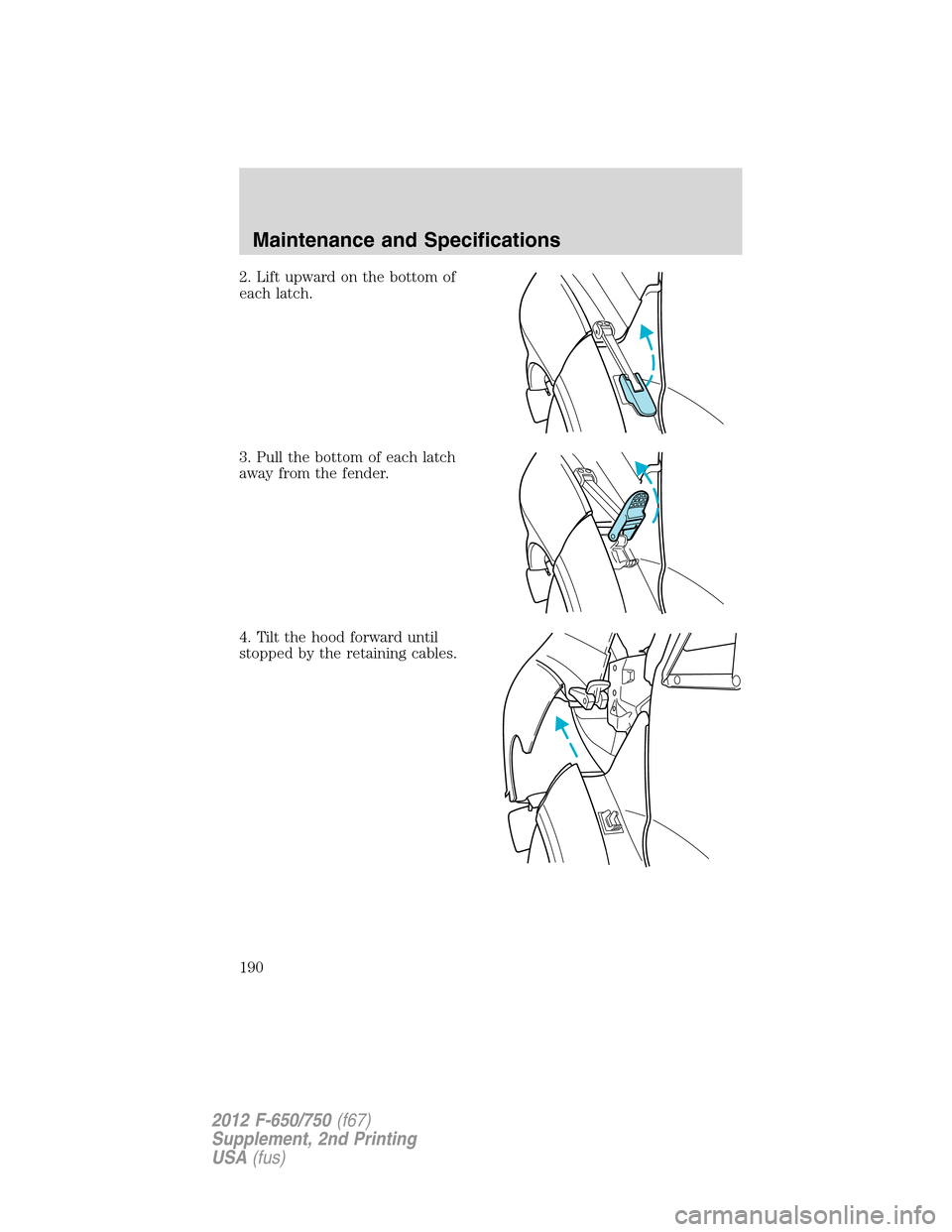
2. Lift upward on the bottom of
each latch.
3. Pull the bottom of each latch
away from the fender.
4. Tilt the hood forward until
stopped by the retaining cables.
Maintenance and Specifications
190
2012 F-650/750(f67)
Supplement, 2nd Printing
USA(fus)
Page 191 of 306
To lower the hood:
1. Push the hood rearward at the top center of the hood above the grille
until closed.
2. Engage the latch on each fender.
3. Push down on the bottom of each latch until locked.
WINDSHIELD WASHER FLUID
Add fluid to fill the reservoir if the level is low. In very cold weather, do
not fill the reservoir completely.
Only use a washer fluid that meets Ford specifications. Do not use any
special washer fluid such as windshield water repellent type fluid or bug
wash. They may cause squeaking, chatter noise, streaking and smearing.
Refer toMaintenance product specifications and capacitiesin this
chapter.
State or local regulations on volatile organic compounds may restrict the
use of methanol, a common windshield washer antifreeze additive.
Washer fluids containing non-methanol antifreeze agents should be used
only if they provide cold weather protection without damaging the
vehicle’s paint finish, wiper blades or washer system.
WARNING:If you operate your vehicle in temperatures below
40°F (5°C), use washer fluid with antifreeze protection. Failure
to use washer fluid with antifreeze protection in cold weather could
result in impaired windshield vision and increase the risk of injury or
accident.
Maintenance and Specifications
191
2012 F-650/750(f67)
Supplement, 2nd Printing
USA(fus)
Page 192 of 306

CHANGING THE WIPER BLADES
1. Pull the wiper arm away from the
vehicle. Pry open the lock cover
with your thumb (1) to release the
blade and pull the wiper blade down
toward the windshield to remove it
from the arm (2).
2. Insert the wiper arm hook into
the wiper arm (3).
3. While holding the wiper arm,
push the wiper blade up and away from the windshield.
4. Close the lock cover.
Replace wiper blades at least once per year for optimum performance.
Poor wiper quality can be improved by cleaning the wiper blades and the
windshield. Refer toWindows and wiper bladesin theCleaning
chapter.
To prolong the life of the wiper blades, it is highly recommended to
scrape off the ice on the windshield before turning on the wipers. The
layer of ice has many sharp edges and can damage the micro edge of the
wiper rubber element.
ENGINE OIL (DIESEL ENGINE ONLY)
Refer to your engine operator’s manual for information on checking and
adding engine oil as well as engine oil specifications, capacities and
required maintenance.
Maintenance and Specifications
192
2012 F-650/750(f67)
Supplement, 2nd Printing
USA(fus)
Page 193 of 306

ENGINE OIL (GASOLINE ENGINE ONLY)
Checking the engine oil
Refer to thescheduled maintenance informationfor the appropriate
intervals for checking the engine oil.
1. Make sure the vehicle is on level ground.
2. Turn the engine off and wait 15 minutes for the oil to drain into the
oil pan.
3. Set the parking brake and ensure the gearshift is securely latched in
P (Park).
4. Open the hood. Protect yourself from engine heat.
5. Locate and carefully remove the engine oil dipstick.
6. Wipe the dipstick clean. Insert the dipstick fully, then remove it
again.
•If the oil level isbetween the two holes,the oil level is acceptable.
DO NOT ADD OIL.
•If the oil level is at or below the lower hole, add enough oil to raise
the level to within the two holes. Refer toAdding engine oilin the
following section.
•Oil levels above the upper hole may cause engine damage. Some oil
must be removed from the engine by a service technician.
When the oil level is in its proper operating range, put the dipstick back
in and ensure it is fully seated.
Adding engine oil
Check the engine oil. For instructions, refer toChecking the engine oil.
1. If the engine oil level is not within the normal range, add only
certified engine oil of the recommended viscosity. Remove the engine
oil filler cap and use a funnel to pour the engine oil into the opening.
2. Recheck the engine oil level. Make sure the oil level is not above the
normal operating range on the engine oil level dipstick.
3. Install the dipstick and ensure it is fully seated.
4. Fully install the engine oil filler cap by turning the filler cap
clockwise until three clicks are heard or until the cap is fully seated.
To avoid possible oil loss, DO NOT operate the vehicle with the
engine oil dipstick and/or the engine oil filler cap removed.
Maintenance and Specifications
193
2012 F-650/750(f67)
Supplement, 2nd Printing
USA(fus)
Page 194 of 306
Engine oil and filter recommendations
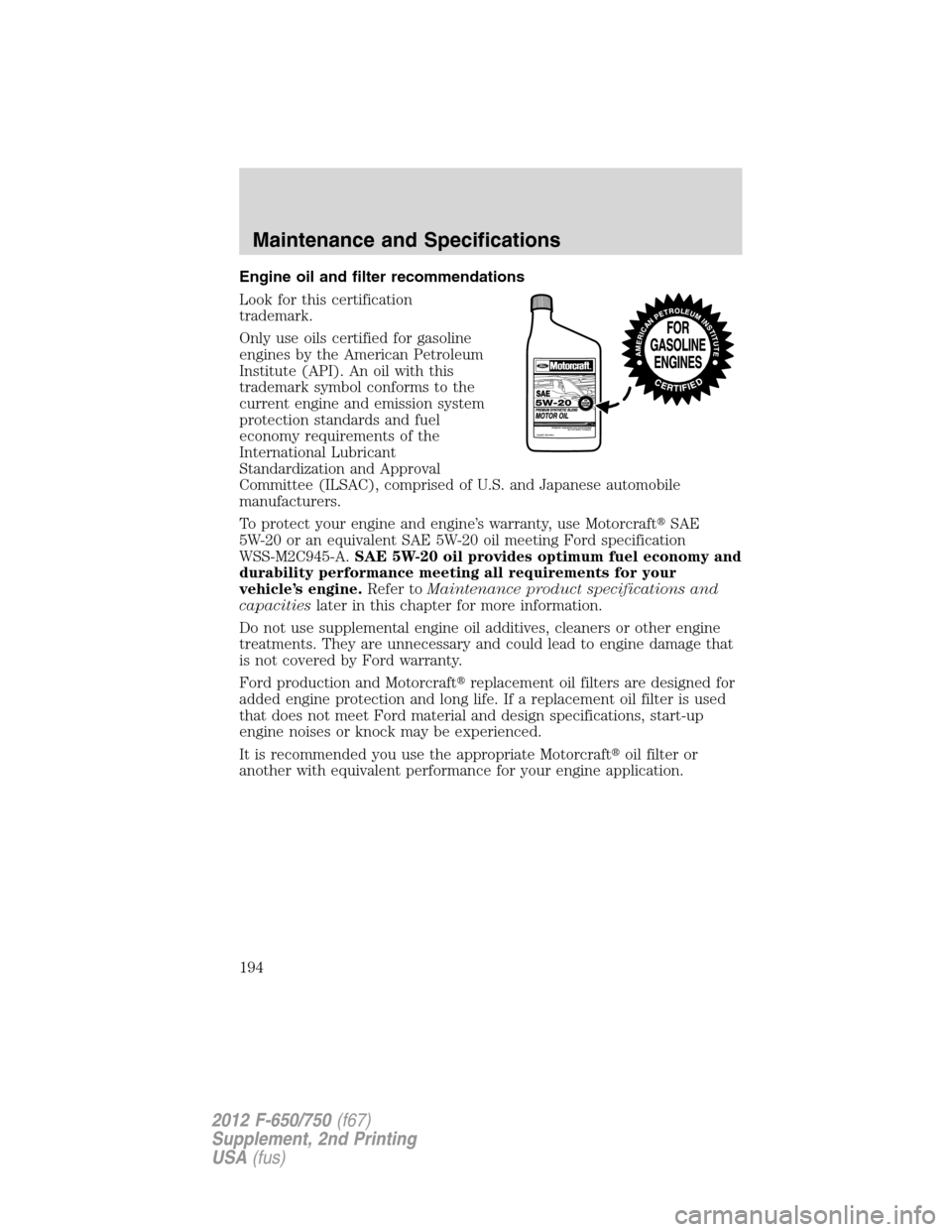
Look for this certification
trademark.
Only use oils certified for gasoline
engines by the American Petroleum
Institute (API). An oil with this
trademark symbol conforms to the
current engine and emission system
protection standards and fuel
economy requirements of the
International Lubricant
Standardization and Approval
Committee (ILSAC), comprised of U.S. and Japanese automobile
manufacturers.
To protect your engine and engine’s warranty, use Motorcraft�SAE
5W-20 or an equivalent SAE 5W-20 oil meeting Ford specification
WSS-M2C945-A.SAE 5W-20 oil provides optimum fuel economy and
durability performance meeting all requirements for your
vehicle’s engine.Refer toMaintenance product specifications and
capacitieslater in this chapter for more information.
Do not use supplemental engine oil additives, cleaners or other engine
treatments. They are unnecessary and could lead to engine damage that
is not covered by Ford warranty.
Ford production and Motorcraft�replacement oil filters are designed for
added engine protection and long life. If a replacement oil filter is used
that does not meet Ford material and design specifications, start-up
engine noises or knock may be experienced.
It is recommended you use the appropriate Motorcraft�oil filter or
another with equivalent performance for your engine application.
Maintenance and Specifications
194
2012 F-650/750(f67)
Supplement, 2nd Printing
USA(fus)
Page 195 of 306
BATTERY
Your vehicle is equipped with two or three maintenance-free batteries
mounted in a covered tray located on the left frame rail. The covered
battery tray, depending upon application, may also have one or two steps
attached.
WARNING:This vehicle is equipped with more than one
battery, removal of cable from only one battery does not
disconnect the vehicle electrical system. Be sure to disconnect cables
from all batteries when disconnecting power. Failure to do so may
cause serious personal injury or property damage.
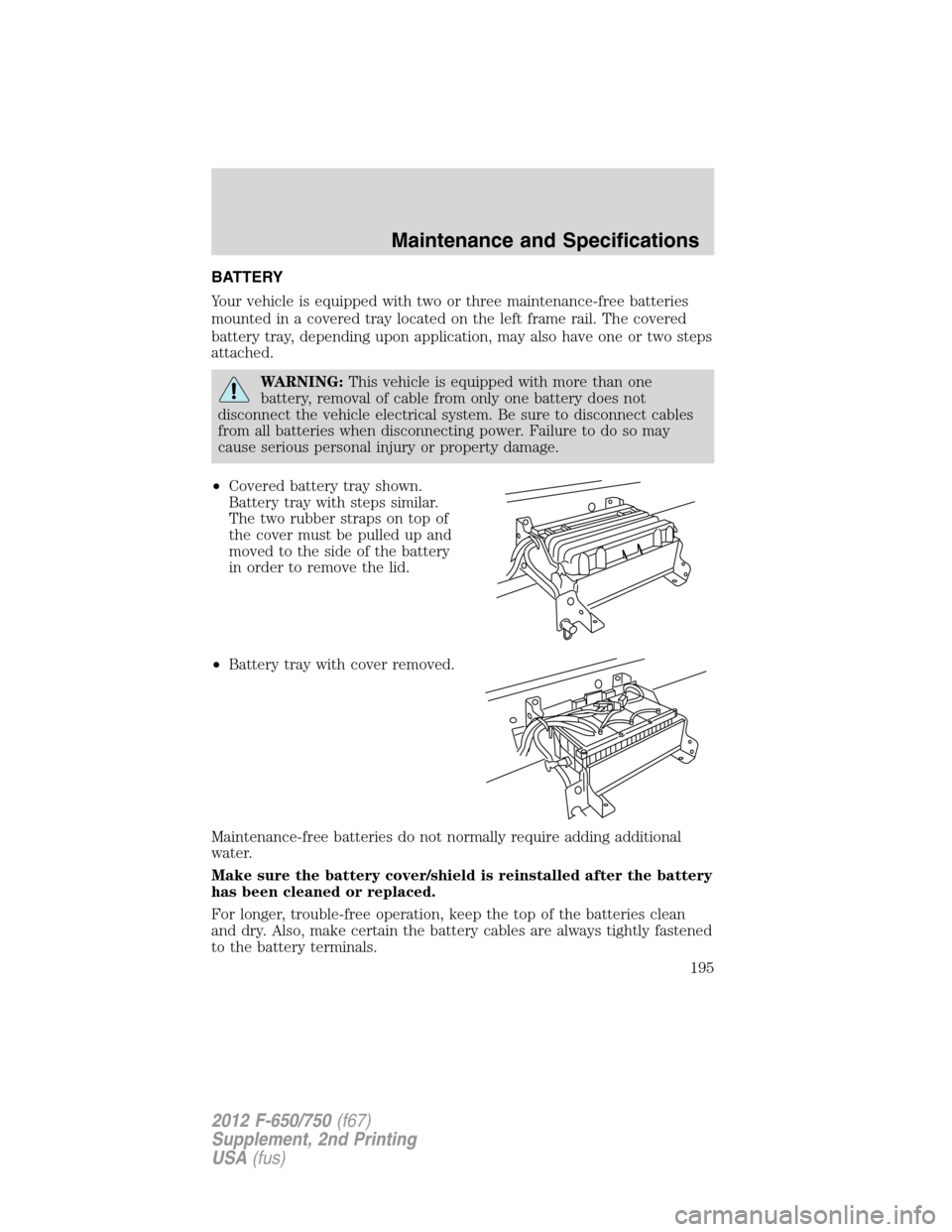
•Covered battery tray shown.
Battery tray with steps similar.
The two rubber straps on top of
the cover must be pulled up and
moved to the side of the battery
in order to remove the lid.
•Battery tray with cover removed.
Maintenance-free batteries do not normally require adding additional
water.
Make sure the battery cover/shield is reinstalled after the battery
has been cleaned or replaced.
For longer, trouble-free operation, keep the top of the batteries clean
and dry. Also, make certain the battery cables are always tightly fastened
to the battery terminals.
Maintenance and Specifications
195
2012 F-650/750(f67)
Supplement, 2nd Printing
USA(fus)
Page 196 of 306

If you see any corrosion on the battery or terminals, remove the cables
from the terminals and clean with a wire brush. You can neutralize the
acid with a solution of baking soda and water.
It is recommended that the negative battery cable terminal be
disconnected from the battery if you plan to store your vehicle for an
extended period of time; this minimizes the discharge of your battery
during storage.
If the engine cranks but does not start, remove the battery box cover
and check the 40A inline fuse located on the battery cable above the
battery.
WARNING:Batteries normally produce explosive gases which
can cause personal injury. Therefore, do not allow flames, sparks
or lighted substances to come near the battery. When working near the
battery, always shield your face and protect your eyes. Always provide
proper ventilation.
WARNING:When lifting a plastic-cased battery, excessive
pressure on the end walls could cause acid to flow through the
vent caps, resulting in personal injury and/or damage to the vehicle or
battery. Lift the battery with a battery carrier or with your hands on
opposite corners.
WARNING:Keep batteries out of reach of children. Batteries
contain sulfuric acid. Avoid contact with skin, eyes or clothing.
Shield your eyes when working near the battery to protect against
possible splashing of acid solution. In case of acid contact with skin or
eyes, flush immediately with water for a minimum of 15 minutes and
get prompt medical attention. If acid is swallowed, call a physician
immediately.
WARNING:Battery posts, terminals and related accessories
contain lead and lead compounds.Wash hands after handling.
Maintenance and Specifications
196
2012 F-650/750(f67)
Supplement, 2nd Printing
USA(fus)