Page 65 of 306

STEERING WHEEL CONTROLS (IF EQUIPPED)
SYNC�system hands free
control feature (if equipped)
Press
briefly to use the voice
command feature. You will hear a
tone and LISTENING will appear in
the radio display. Press and
hold
to exit voice command.
Press
to activate phone mode or answer a phone call. Press and
hold
to end a call or exit phone mode.
For further information on the SYNC�system, refer to theSYNC�
supplement.
UPFITTER CONTROLS (IF EQUIPPED)
Your vehicle may be equipped with
the Upfitter option package which
provides four switches, mounted in
the center of the instrument panel,
labeled AUX 1, AUX 2, AUX 3 and
AUX 4. These switches only operate
while the ignition is in the on
position, whether the engine is
running or not. It is, however, recommended that the engine remain
running to maintain battery charge when using the Upfitter switches for
extended duration or higher current draws. (This is even more important
for vehicles with diesel engines since the glow plugs are also draining
battery power when the ignition key is in the on position.) Each switch
provides 10 amps of power.
If your vehicle is equipped with this option, there is also be a relay box
located on the driver side end of the instrument panel. See your
authorized dealer for service.
Switch access location is in a connector located in the engine
compartment More detailed information can be found at
https://www.fleet.ford.com/truck/bbas/.
Driver Controls
65
2012 F-650/750(f67)
Supplement, 2nd Printing
USA(fus)
Page 133 of 306

several transmission upshifts and downshifts; during this learning
process, slightly firmer shifts may occur. After this learning process,
normal shift feel and shift scheduling will resume.
P (Park)
This position locks the transmission and prevents the rear wheels from
turning.
To put your vehicle in gear:
1. Start the engine
2. Press the brake pedal
3. Move the gearshift lever into the desired gear
To put your vehicle in P (Park):
1. Come to a complete stop
2. Move the gearshift lever and securely latch it in P (Park)
WARNING:Always set the parking brake fully and make sure
the gearshift is latched in P (Park). Turn the ignition to the off
position and remove the key whenever you leave your vehicle.
R (Reverse)
With the gearshift lever in R (Reverse), the vehicle will move backward.
Always come to a complete stop before shifting into and out of R
(Reverse).
N (Neutral)
With the gearshift lever in N (Neutral), the vehicle can be started and is
free to roll. Hold the brake pedal down while in this position.
D (Drive)
This is the normal driving position for the best fuel economy. This
position allows automatic upshifts and downshifts through gears one
through six.
4 (Fourth)
This position allows automatic upshifts and downshifts in gears one
through four.
2 (Second)
Use 2 (Second) to start-up on slippery roads or to provide additional
engine braking on downgrades.
Driving
133
2012 F-650/750(f67)
Supplement, 2nd Printing
USA(fus)
Page 240 of 306
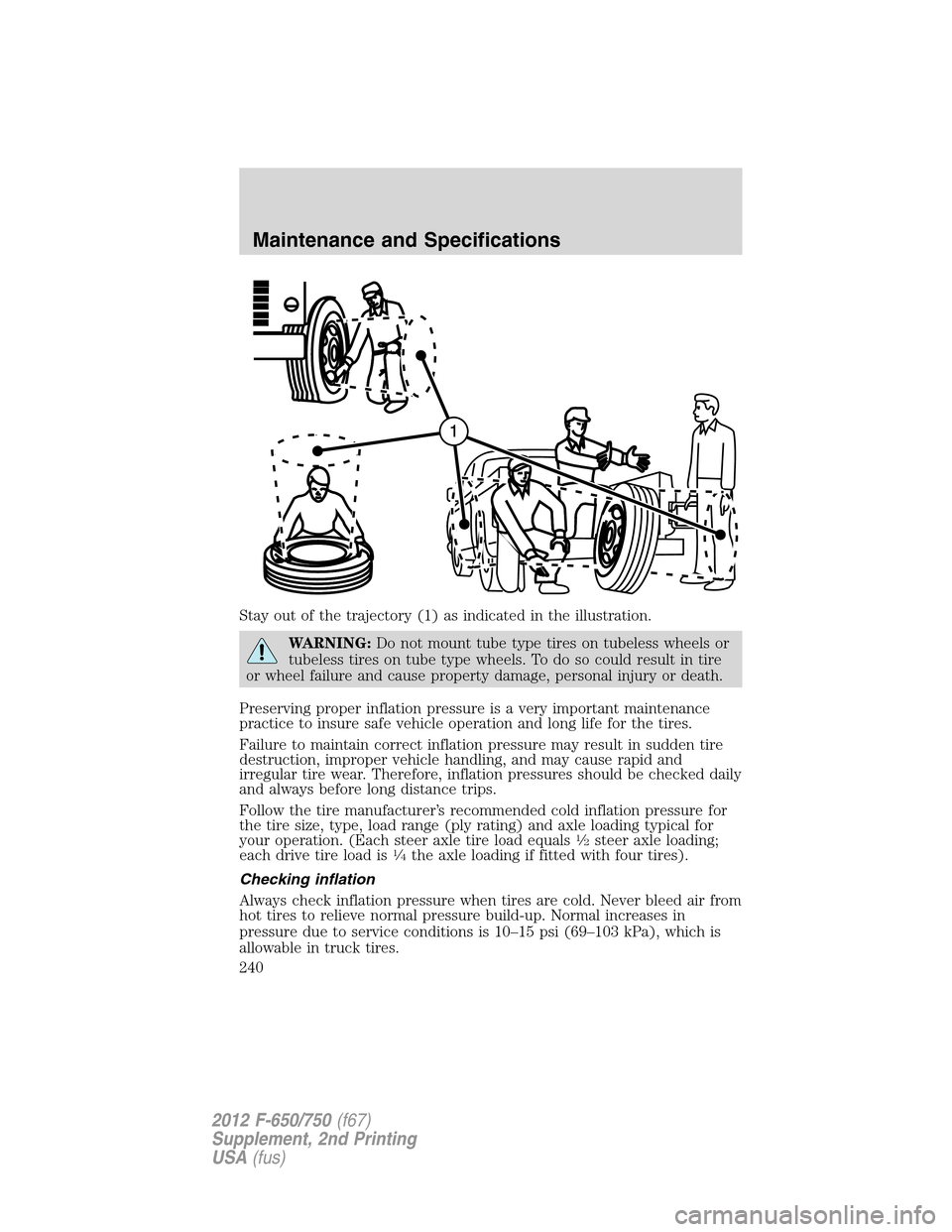
Stay out of the trajectory (1) as indicated in the illustration.
WARNING:Do not mount tube type tires on tubeless wheels or
tubeless tires on tube type wheels. To do so could result in tire
or wheel failure and cause property damage, personal injury or death.
Preserving proper inflation pressure is a very important maintenance
practice to insure safe vehicle operation and long life for the tires.
Failure to maintain correct inflation pressure may result in sudden tire
destruction, improper vehicle handling, and may cause rapid and
irregular tire wear. Therefore, inflation pressures should be checked daily
and always before long distance trips.
Follow the tire manufacturer’s recommended cold inflation pressure for
the tire size, type, load range (ply rating) and axle loading typical for
your operation. (Each steer axle tire load equals
12steer axle loading;
each drive tire load is14the axle loading if fitted with four tires).
Checking inflation
Always check inflation pressure when tires are cold. Never bleed air from
hot tires to relieve normal pressure build-up. Normal increases in
pressure due to service conditions is 10–15 psi (69–103 kPa), which is
allowable in truck tires.
Maintenance and Specifications
240
2012 F-650/750(f67)
Supplement, 2nd Printing
USA(fus)