2012 FORD F650 maintenance
[x] Cancel search: maintenancePage 33 of 306
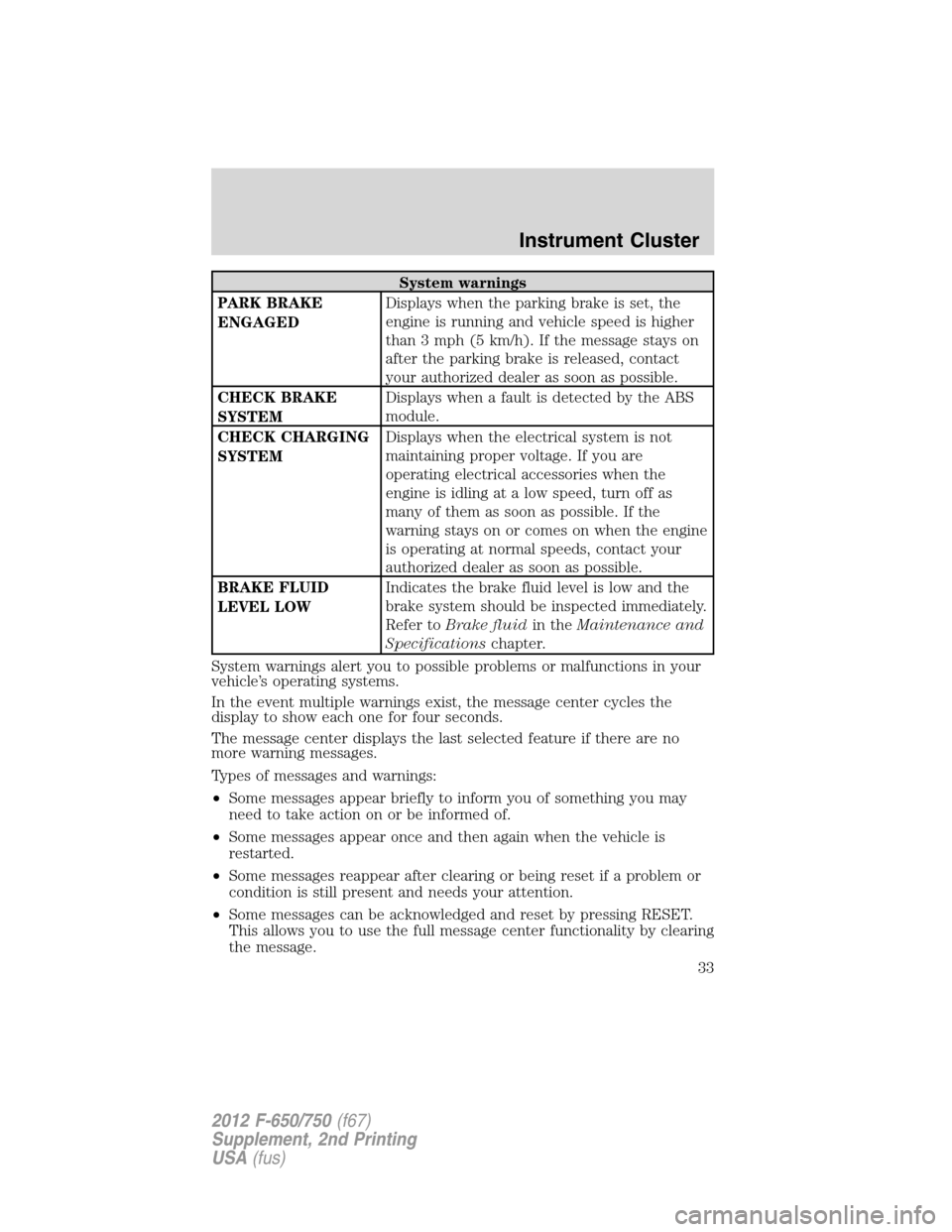
System warnings
PARK BRAKE
ENGAGEDDisplays when the parking brake is set, the
engine is running and vehicle speed is higher
than 3 mph (5 km/h). If the message stays on
after the parking brake is released, contact
your authorized dealer as soon as possible.
CHECK BRAKE
SYSTEMDisplays when a fault is detected by the ABS
module.
CHECK CHARGING
SYSTEMDisplays when the electrical system is not
maintaining proper voltage. If you are
operating electrical accessories when the
engine is idling at a low speed, turn off as
many of them as soon as possible. If the
warning stays on or comes on when the engine
is operating at normal speeds, contact your
authorized dealer as soon as possible.
BRAKE FLUID
LEVEL LOWIndicates the brake fluid level is low and the
brake system should be inspected immediately.
Refer toBrake fluidin theMaintenance and
Specificationschapter.
System warnings alert you to possible problems or malfunctions in your
vehicle’s operating systems.
In the event multiple warnings exist, the message center cycles the
display to show each one for four seconds.
The message center displays the last selected feature if there are no
more warning messages.
Types of messages and warnings:
•Some messages appear briefly to inform you of something you may
need to take action on or be informed of.
•Some messages appear once and then again when the vehicle is
restarted.
•Some messages reappear after clearing or being reset if a problem or
condition is still present and needs your attention.
•Some messages can be acknowledged and reset by pressing RESET.
This allows you to use the full message center functionality by clearing
the message.
Instrument Cluster
33
2012 F-650/750(f67)
Supplement, 2nd Printing
USA(fus)
Page 102 of 306
Follow all instructions provided by the manufacturer of the booster seat.
WARNING:Never place, or allow a child to place, the shoulder
belt under a child’s arm or behind the back because it reduces
the protection for the upper part of the body and may increase the risk
of injury or death in a collision.
Safety belt maintenance
Inspect the vehicle safety belts and child safety seat systems periodically
to make sure they work properly and are not damaged. Inspect the
vehicle and child seat safety belts to make sure there are no nicks, tears
or cuts. Replace if necessary. All vehicle safety belt assemblies, including
retractors, buckles, front safety belt buckle assemblies, buckle support
assemblies (slide bar-if equipped), shoulder belt height adjusters (if
equipped), shoulder belt guide on seatback (if equipped), child safety
seat LATCH and tether anchors, and attaching hardware, should be
inspected after a collision. Refer to the child restraint manufacturer’s
instructions for additional inspection and maintenance information
specific to the child restraint. Ford Motor Company recommends that all
safety belt assemblies in use in vehicles involved in a collision be
replaced. However, if the collision was minor and an authorized dealer
finds that the belts do not show damage and continue to operate
properly, they do not need to be replaced. Safety belt assemblies not in
use during a collision should also be inspected and replaced if either
damage or improper operation is noted.
For proper care of soiled safety belts, refer toInteriorin theCleaning
chapter.
WARNING:Ford Motor Company recommends that all safety
belt assemblies used in vehicles involved in a collision be
inspected for proper function and replaced, if necessary. Safety belt
assemblies not in use during a collision should also be inspected and
replaced if either damage or improper operation is noted.
WARNING:Failure to inspect and if necessary replace the
safety belt assembly under the above conditions could result in
severe personal injuries in the event of a collision.
Seating and Safety Restraints
102
2012 F-650/750(f67)
Supplement, 2nd Printing
USA(fus)
Page 107 of 306

Hot weather operation
•Use a permanent-type engine coolant to protect the engine against
damage from overheating.
•Fill the fuel tank at the end of daily operation to prevent condensation
in the fuel system.
•Keep external surfaces of the engine, radiator, charge air cooler, A/C
condenser and accessories clean to avoid dirt build-up.
•Above normal coolant temperatures could be experienced while
driving in a transmission gear ratio which lugs the engine. To correct
this problem, engine speed should be increased by downshifting into
the next lower gear.
Restarting after running out of fuel
The fuel system may need to be purged of air, refer toRunning out of
fuelin theMaintenance and Specificationschapter.
Engine shutdown (diesel engine only)
Allow the engine to idle for three to five minutes before shutting it
down. The larger the engine, the greater the need for this idling period.
However, do not let the engine idle for more than 10 minutes.
GENERAL OPERATING INSTRUCTIONS
•Start the vehicle in motion by using the highest gear speed in the
transmission that lets the engine easily start the load without slipping
the clutch.
•Accelerate smoothly and evenly; rapid acceleration increases fuel
consumption without increasing engine performance.
•
When approaching a hill, press the accelerator smoothly to start the
incline at full power, then shift down as needed to maintain vehicle speed.
•When going down a hill, or long steep grades, prevent overspeeding of
the engine; normally, choose the same gear to descend the hill that
you use to ascend the hill. The engine governor has no control over
engine speed when it is being pushed by a loaded vehicle.
•Operate in a gear that permits an engine speed not in excess of the
maximum governed speed or high-idle RPM (no load).
•
Always shift to a lower gear at high altitudes to prevent engine smoking.
•Diesel engines:Allow the engine to idle for three to five minutes
before shutting it down; the larger the engine, the greater the need for
this idling period. However, do not let the engine idle for more than
10 minutes.
Driving
107
2012 F-650/750(f67)
Supplement, 2nd Printing
USA(fus)
Page 109 of 306

may be limited and your vehicle may stall. Water may also enter your
engine’s air intake and severely damage your engine, drive axles or the
transmission (through the breather ports).
Once through the water, always dry the brakes by moving your vehicle
slowly while applying light pressure on the brake pedal. Wet brakes do
not stop the vehicle as quickly as dry brakes.
ENGINE AUTOMATIC SHUTDOWN WARNING LIGHT OR CHIME
(IF EQUIPPED)
This feature illuminates a light in the instrument cluster and/or sounds a
chime indicating that the engine is being shut down in the event of high
coolant temperature, low engine oil pressure, high diesel particulate filter
soot loading or low engine coolant level. In the event any of these
conditions exist, the engine automatically shuts down.
If the engine shuts down, it can be restarted and operated for
30 seconds at a time or until the problem is corrected. Do not attempt to
use this restarting feature to drive the vehicle very far as serious engine
damage could result.
WARNING:In the event of engine shutdown, make sure the
vehicle is safely off the road and the problem is remedied prior
to returning to the road. Failure to remove the vehicle from the road
could result in an accident, causing serious injury or death.
GENERAL BRAKE INFORMATION
All standard equipment brakes are designed to be self-adjusting.
Automatic adjustment, when required, occurs whenever the brakes are
applied and released during forward or reverse operation. Refer to the
Scheduled Maintenance Guidechapter for scheduled maintenance.
Occasional brake noise is normal and often does not indicate a performance
concern with the vehicle’s brake system. In normal operation, automotive
brake systems may emit occasional or intermittent squeal or groan noises
when the brakes are applied. Such noises are usually heard during the first
few brake applications in the morning; however, they may be heard at any
time while braking and can be aggravated by environmental conditions
such as cold, heat, moisture, road dust, salt or mud. If a “metal-to-metal,”
“continuous grinding” or “continuous squeal” sound is present while
braking, the brake linings may be worn-out and should be inspected by a
qualified service technician.
Know the required stopping distances for all driving conditions that may
be encountered. For longer brake lining life, take full advantage of engine
braking power when coming to a stop.
Driving
109
2012 F-650/750(f67)
Supplement, 2nd Printing
USA(fus)
Page 117 of 306
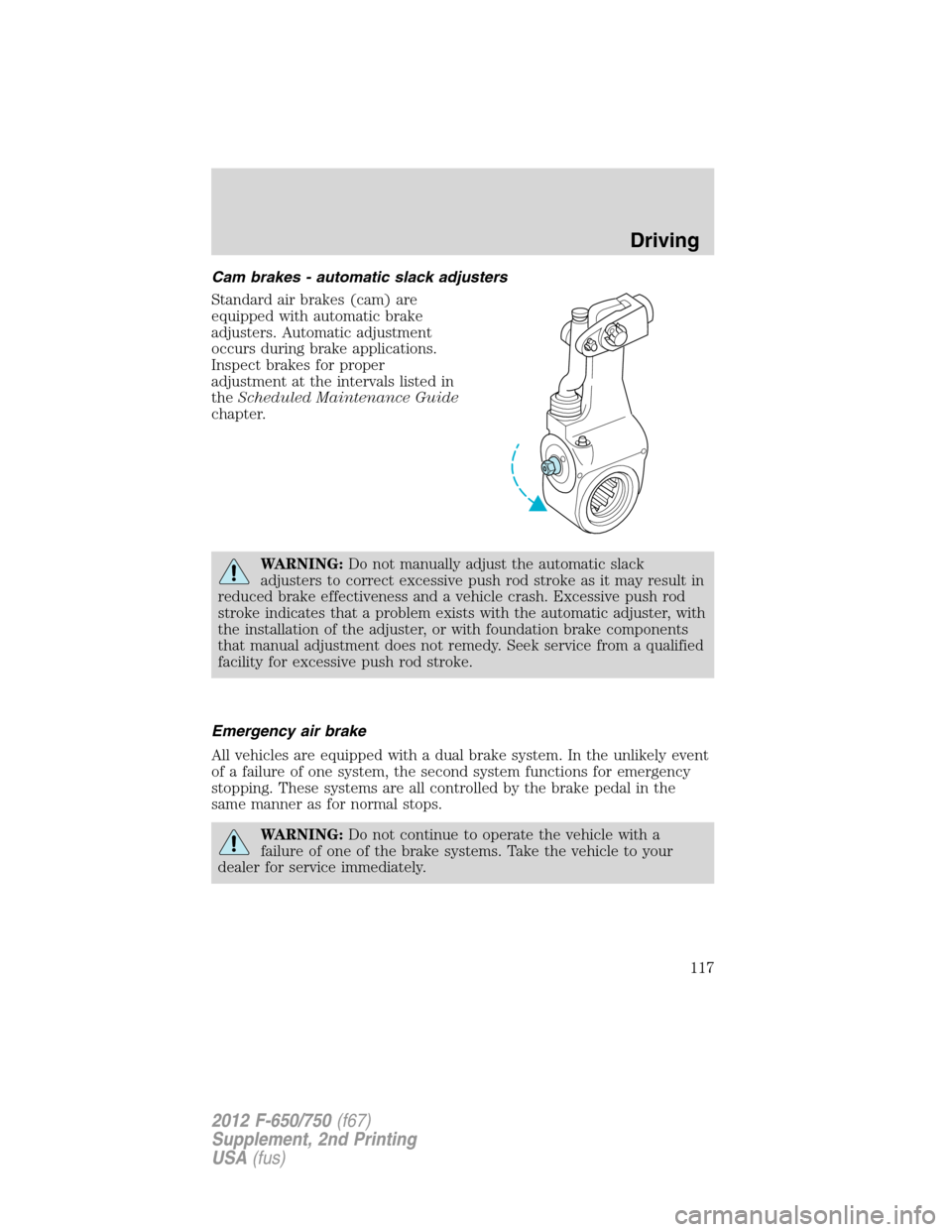
Cam brakes - automatic slack adjusters
Standard air brakes (cam) are
equipped with automatic brake
adjusters. Automatic adjustment
occurs during brake applications.
Inspect brakes for proper
adjustment at the intervals listed in
theScheduled Maintenance Guide
chapter.
WARNING:Do not manually adjust the automatic slack
adjusters to correct excessive push rod stroke as it may result in
reduced brake effectiveness and a vehicle crash. Excessive push rod
stroke indicates that a problem exists with the automatic adjuster, with
the installation of the adjuster, or with foundation brake components
that manual adjustment does not remedy. Seek service from a qualified
facility for excessive push rod stroke.
Emergency air brake
All vehicles are equipped with a dual brake system. In the unlikely event
of a failure of one system, the second system functions for emergency
stopping. These systems are all controlled by the brake pedal in the
same manner as for normal stops.
WARNING:Do not continue to operate the vehicle with a
failure of one of the brake systems. Take the vehicle to your
dealer for service immediately.
Driving
117
2012 F-650/750(f67)
Supplement, 2nd Printing
USA(fus)
Page 136 of 306
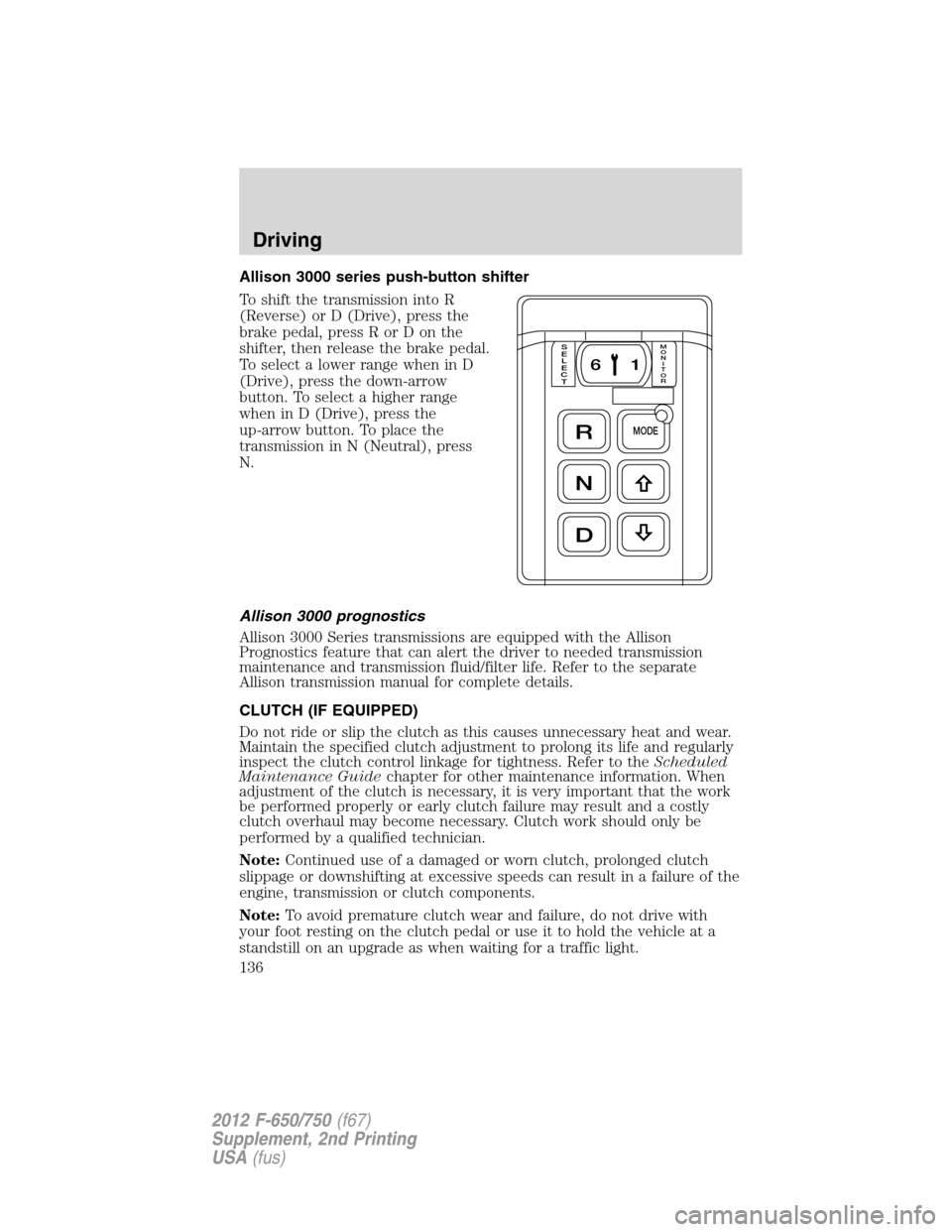
Allison 3000 series push-button shifter
To shift the transmission into R
(Reverse) or D (Drive), press the
brake pedal, press R or D on the
shifter, then release the brake pedal.
To select a lower range when in D
(Drive), press the down-arrow
button. To select a higher range
when in D (Drive), press the
up-arrow button. To place the
transmission in N (Neutral), press
N.
Allison 3000 prognostics
Allison 3000 Series transmissions are equipped with the Allison
Prognostics feature that can alert the driver to needed transmission
maintenance and transmission fluid/filter life. Refer to the separate
Allison transmission manual for complete details.
CLUTCH (IF EQUIPPED)
Do not ride or slip the clutch as this causes unnecessary heat and wear.
Maintain the specified clutch adjustment to prolong its life and regularly
inspect the clutch control linkage for tightness. Refer to theScheduled
Maintenance Guidechapter for other maintenance information. When
adjustment of the clutch is necessary, it is very important that the work
be performed properly or early clutch failure may result and a costly
clutch overhaul may become necessary. Clutch work should only be
performed by a qualified technician.
Note:Continued use of a damaged or worn clutch, prolonged clutch
slippage or downshifting at excessive speeds can result in a failure of the
engine, transmission or clutch components.
Note:To avoid premature clutch wear and failure, do not drive with
your foot resting on the clutch pedal or use it to hold the vehicle at a
standstill on an upgrade as when waiting for a traffic light.
S
E
L
E
C
TM
O
N
I
T
O
R
6
MODER
N
D
1
Driving
136
2012 F-650/750(f67)
Supplement, 2nd Printing
USA(fus)
Page 149 of 306

•Turn off the speed control. The speed control may shut off
automatically when you are towing on long, steep grades.
•Use a lower gear to eliminate excessive shifting and assist in
transmission cooling.
•Allow more distance for stopping with a trailer attached; anticipate
stops and brake gradually.
Servicing after towing
If you tow a trailer for long distances, your vehicle requires more
frequent service intervals. Refer to theScheduled Maintenance Guide
chapter for more information.
Trailer towing tips
•Practice turning, stopping and backing up before starting on a trip to
get the feel of the vehicle trailer combination. When turning, make
wider turns so the trailer wheels clears curbs and other obstacles.
•Allow more distance for stopping with a trailer attached.
•If you are driving down a long or steep hill, shift to a lower gear. Do
not apply the brakes continuously, as they may overheat and become
less effective.
•
The trailer tongue weight should be 10–15% of the loaded trailer weight.
•If you are towing a trailer frequently in hot weather, hilly conditions,
at GCW, or any combination of these factors, consider refilling your
rear axle with synthetic gear lube if not already so equipped. Refer to
Lubricant specificationsin theMaintenance and Specifications
chapter for the lubricant specification. Remember that regardless of
the rear axle lube used, do not tow a trailer for the first 500 miles
(800 km) of a new vehicle, and that the first 500 miles (800 km) of
towing be done at no faster than 70 mph (112 km/h) with no full
throttle starts.
•After you have traveled 50 miles (80 km), thoroughly check your
hitch, electrical connections and trailer wheel lug nuts.
•
To aid in engine/transmission cooling and A/C efficiency during hot
weather while stopped in traffic, place the gearshift lever in P (Park) (if
available on your automatic transmission) or N (Neutral) (manual
transmissions and automatic transmissions withoutaP[Park] position).
•Vehicles with trailers should not be parked on a grade. If you must
park on a grade, place wheel chocks under the trailer’s wheels.
Driving
149
2012 F-650/750(f67)
Supplement, 2nd Printing
USA(fus)
Page 171 of 306
In Canada:
Mailing address
Customer Relationship Centre
Ford Motor Company of Canada, Limited
P.O. Box 2000
Oakville, Ontario L6J 5E4
800-565-3673
www.ford.ca
Additional information and resources are available online at
www.fleet.ford.com:
•U.S. dealer locator by Dealer Name, City/State, or Zip Code
•Owner Guides
•Maintenance Schedules
•Recalls
•Ford Extended Service Plans
•Ford Genuine Accessories
IN CALIFORNIA (U.S. ONLY)
California Civil Code Section 1793.2(d) requires that, if a manufacturer
or its representative is unable to repair a motor vehicle to conform to the
vehicle’s applicable express warranty after a reasonable number of
attempts, the manufacturer shall be required to either replace the
vehicle with one substantially identical or repurchase the vehicle and
reimburse the buyer in an amount equal to the actual price paid or
payable by the consumer (less a reasonable allowance for consumer
use). The consumer has the right to choose whether to receive a refund
or replacement vehicle.
California Civil Code Section 1793.22(b) presumes that the manufacturer
has had a reasonable number of attempts to conform the vehicle to its
applicable express warranties if, within the first 18 months of ownership
of a new vehicle or the first 18,000 miles (29,000 km), whichever occurs
first:
1. Two or more repair attempts are made on the same nonconformity
likely to cause death or serious bodily injury OR
2. Four or more repair attempts are made on the same nonconformity (a
defect or condition that substantially impairs the use, value or safety of
the vehicle) OR
3. The vehicle is out of service for repair of nonconformities for a total of
more than 30 calendar days (not necessarily all at one time)
Customer Assistance
171
2012 F-650/750(f67)
Supplement, 2nd Printing
USA(fus)