2012 FORD EXPEDITION oil level
[x] Cancel search: oil levelPage 328 of 400
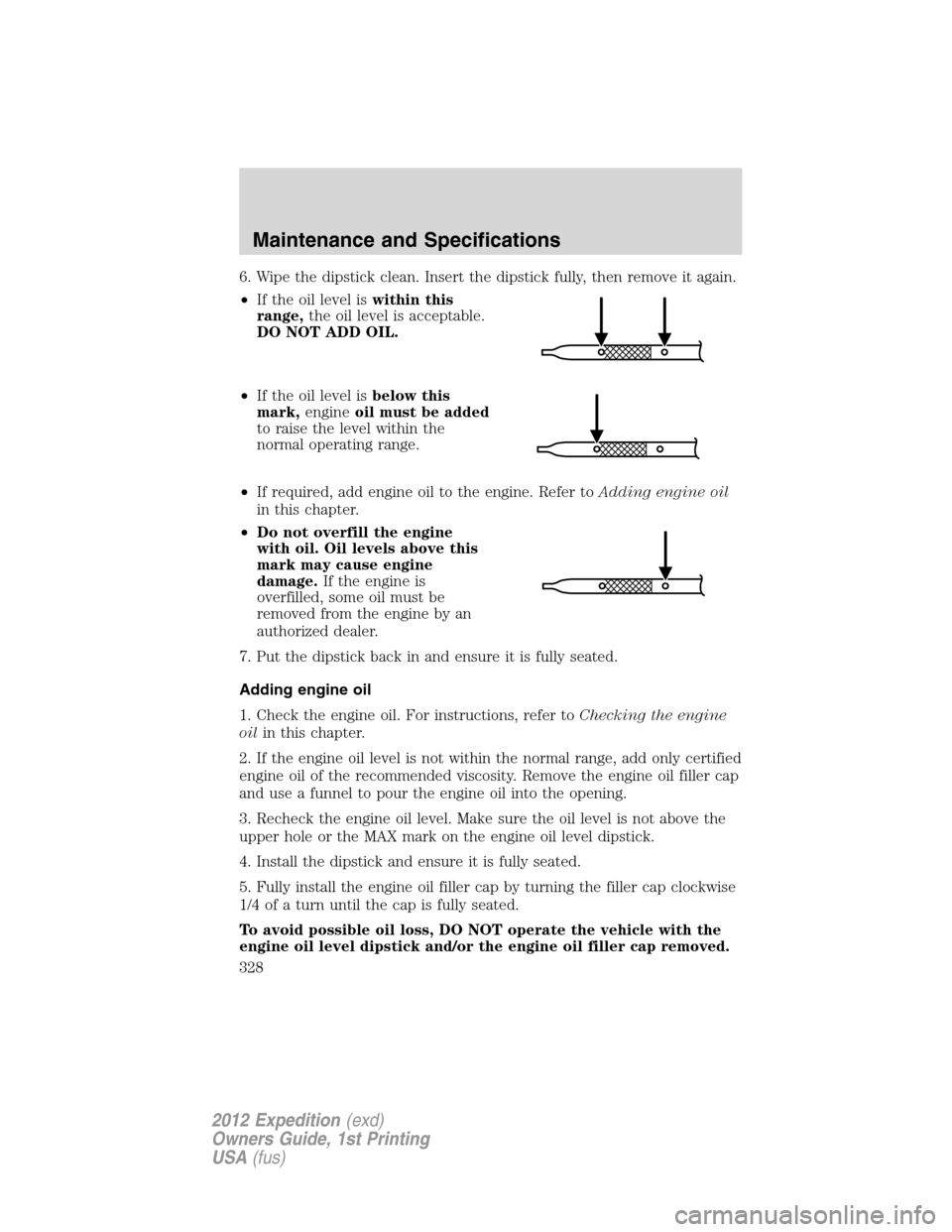
6. Wipe the dipstick clean. Insert the dipstick fully, then remove it again.
•If the oil level iswithin this
range,the oil level is acceptable.
DO NOT ADD OIL.
•If the oil level isbelow this
mark,engineoil must be added
to raise the level within the
normal operating range.
•If required, add engine oil to the engine. Refer toAdding engine oil
in this chapter.
•Do not overfill the engine
with oil. Oil levels above this
mark may cause engine
damage.If the engine is
overfilled, some oil must be
removed from the engine by an
authorized dealer.
7. Put the dipstick back in and ensure it is fully seated.
Adding engine oil
1. Check the engine oil. For instructions, refer toChecking the engine
oilin this chapter.
2. If the engine oil level is not within the normal range, add only certified
engine oil of the recommended viscosity. Remove the engine oil filler cap
and use a funnel to pour the engine oil into the opening.
3. Recheck the engine oil level. Make sure the oil level is not above the
upper hole or the MAX mark on the engine oil level dipstick.
4. Install the dipstick and ensure it is fully seated.
5. Fully install the engine oil filler cap by turning the filler cap clockwise
1/4 of a turn until the cap is fully seated.
To avoid possible oil loss, DO NOT operate the vehicle with the
engine oil level dipstick and/or the engine oil filler cap removed.
Maintenance and Specifications
328
2012 Expedition(exd)
Owners Guide, 1st Printing
USA(fus)
Page 332 of 400
•If you do not allow the engine to relearn its idle trim, the idle
quality of your vehicle may be adversely affected until the idle
trim is eventually relearned.
If the battery has been disconnected or a new battery has been installed,
the clock and the preset radio stations must be reset once the battery is
reconnected.
•Always dispose of automotive
batteries in a responsible manner.
Follow your local authorized
standards for disposal. Call your
local authorized recycling center
to find out more about recycling
automotive batteries.
ENGINE COOLANT
Checking engine coolant
The concentration and level of engine coolant should be checked at the
intervals listed inscheduled maintenance information.The coolant
concentration should be maintained at 50/50 coolant and distilled water.
For best results, coolant concentration should be tested with a
refractometer such as Rotunda tool 300-ROB75240E available from your
dealer. Ford does not recommend the use of hydrometers or coolant test
strips for measuring coolant concentration. The level of coolant should
be maintained at the FULL COLD level or within the COLD FILL RANGE
in the coolant reservoir. If the level falls below, add coolant per the
instructions in theAdding engine coolantsection.
Your vehicle was factory-filled with a 50/50 engine coolant and water
concentration. If the concentration of coolant falls below 40% or above
60%, the engine parts could become damaged or not work properly.A
50/50 mixture of coolant and water provides the following:
•Improved freeze protection.
•Improved boiling protection.
•Protection against rust and other forms of corrosion.
•Proper function of calibrated gauges.
L
E
A
D
RETURN
RECYCLE
Maintenance and Specifications
332
2012 Expedition(exd)
Owners Guide, 1st Printing
USA(fus)
Page 342 of 400
Choosing the right fuel
Use only UNLEADED FUEL and FUEL ETHANOL (Ed75–Ed85).
The use of leaded fuel is prohibited by law and could damage your
vehicle.
Your vehicle was not designed to use fuel or fuel additives with metallic
compounds, including manganese-based additives.
Note:Use of any fuel other than those recommended may cause
powertrain damage, a loss of vehicle performance, and repairs may not
be covered under warranty.
Octane recommendations
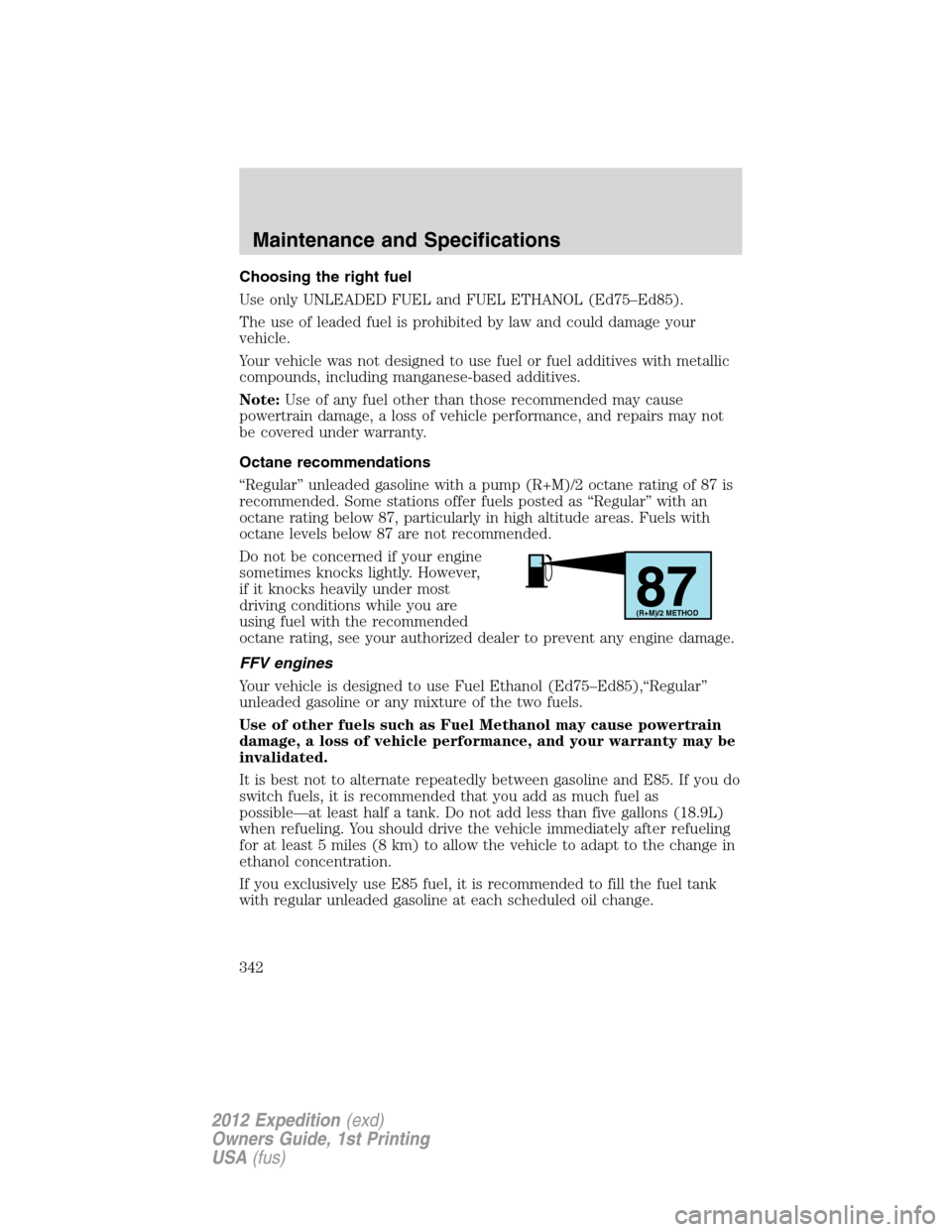
“Regular” unleaded gasoline with a pump (R+M)/2 octane rating of 87 is
recommended. Some stations offer fuels posted as “Regular” with an
octane rating below 87, particularly in high altitude areas. Fuels with
octane levels below 87 are not recommended.
Do not be concerned if your engine
sometimes knocks lightly. However,
if it knocks heavily under most
driving conditions while you are
using fuel with the recommended
octane rating, see your authorized dealer to prevent any engine damage.
FFV engines
Your vehicle is designed to use Fuel Ethanol (Ed75–Ed85),“Regular”
unleaded gasoline or any mixture of the two fuels.
Use of other fuels such as Fuel Methanol may cause powertrain
damage, a loss of vehicle performance, and your warranty may be
invalidated.
It is best not to alternate repeatedly between gasoline and E85. If you do
switch fuels, it is recommended that you add as much fuel as
possible—at least half a tank. Do not add less than five gallons (18.9L)
when refueling. You should drive the vehicle immediately after refueling
for at least 5 miles (8 km) to allow the vehicle to adapt to the change in
ethanol concentration.
If you exclusively use E85 fuel, it is recommended to fill the fuel tank
with regular unleaded gasoline at each scheduled oil change.
87(R+M)/2 METHOD
Maintenance and Specifications
342
2012 Expedition(exd)
Owners Guide, 1st Printing
USA(fus)
Page 375 of 400
one-stop service from routine maintenance like oil changes and tire
rotations to repairs like brake service, check out the value your dealers
can offer.
Owner checks and services
Certain basic maintenance checks and inspections should be performed
by the owner or a service technician at the intervals indicated. Service
information and supporting specifications are provided in this owner’s
guide.
Any adverse condition should be brought to the attention of your dealer
or qualified service technician as soon as possible for the proper service
advice. The owner maintenance service checks are generally not covered
by warranties so you may be charged for labor, parts or fluids used.
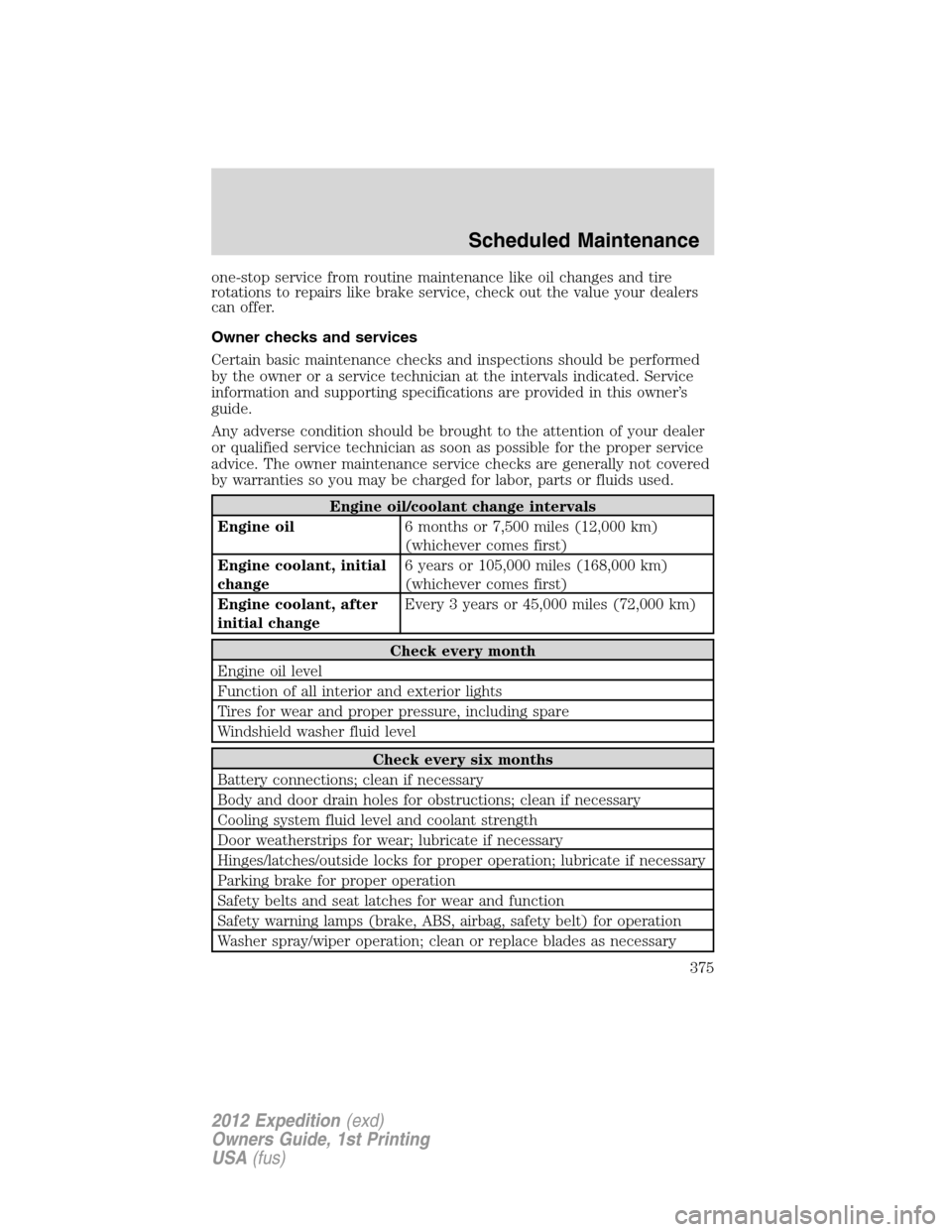
Engine oil/coolant change intervals
Engine oil6 months or 7,500 miles (12,000 km)
(whichever comes first)
Engine coolant, initial
change6 years or 105,000 miles (168,000 km)
(whichever comes first)
Engine coolant, after
initial changeEvery 3 years or 45,000 miles (72,000 km)
Check every month
Engine oil level
Function of all interior and exterior lights
Tires for wear and proper pressure, including spare
Windshield washer fluid level
Check every six months
Battery connections; clean if necessary
Body and door drain holes for obstructions; clean if necessary
Cooling system fluid level and coolant strength
Door weatherstrips for wear; lubricate if necessary
Hinges/latches/outside locks for proper operation; lubricate if necessary
Parking brake for proper operation
Safety belts and seat latches for wear and function
Safety warning lamps (brake, ABS, airbag, safety belt) for operation
Washer spray/wiper operation; clean or replace blades as necessary
Scheduled Maintenance
375
2012 Expedition(exd)
Owners Guide, 1st Printing
USA(fus)
Page 376 of 400
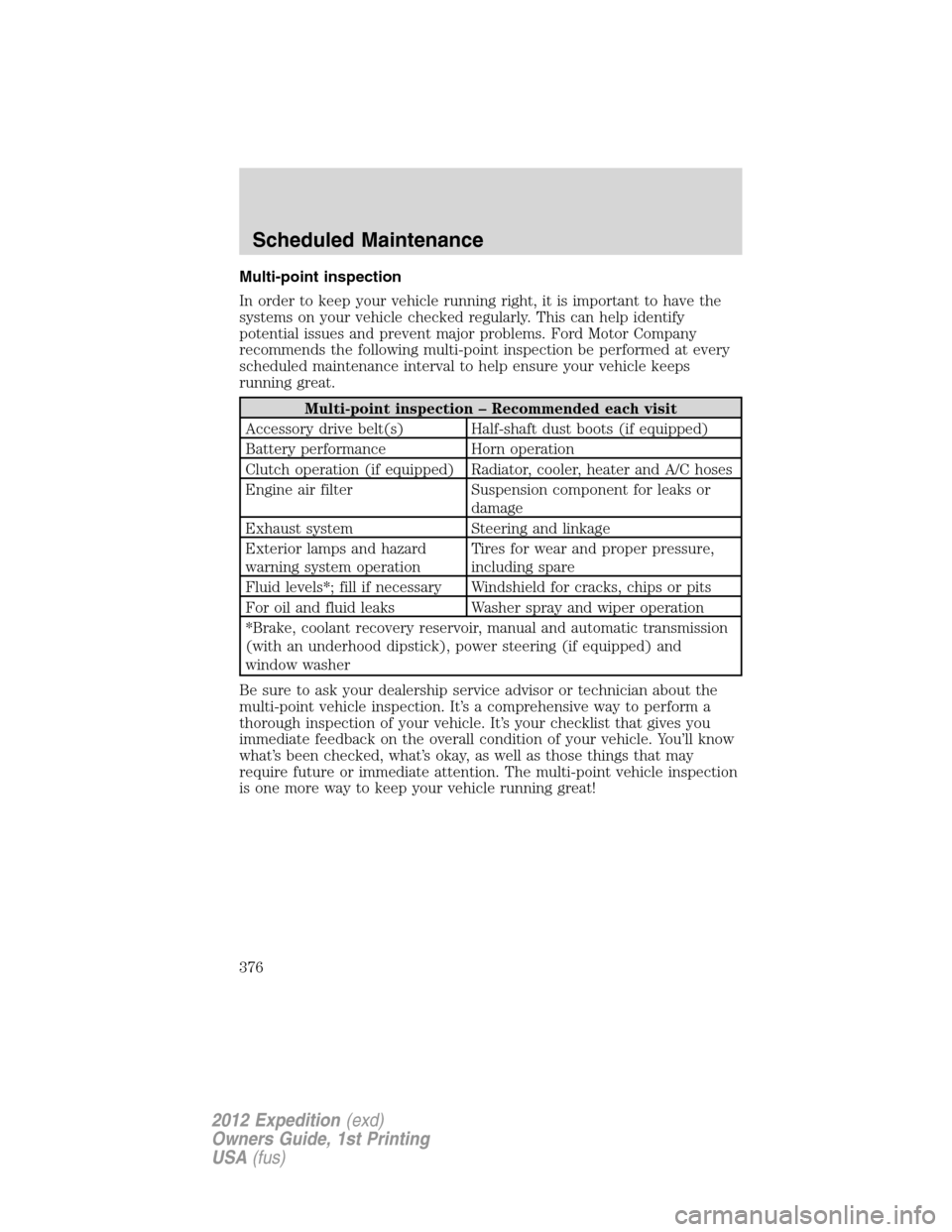
Multi-point inspection
In order to keep your vehicle running right, it is important to have the
systems on your vehicle checked regularly. This can help identify
potential issues and prevent major problems. Ford Motor Company
recommends the following multi-point inspection be performed at every
scheduled maintenance interval to help ensure your vehicle keeps
running great.
Multi-point inspection – Recommended each visit
Accessory drive belt(s) Half-shaft dust boots (if equipped)
Battery performance Horn operation
Clutch operation (if equipped) Radiator, cooler, heater and A/C hoses
Engine air filter Suspension component for leaks or
damage
Exhaust system Steering and linkage
Exterior lamps and hazard
warning system operationTires for wear and proper pressure,
including spare
Fluid levels*; fill if necessary Windshield for cracks, chips or pits
For oil and fluid leaks Washer spray and wiper operation
*Brake, coolant recovery reservoir, manual and automatic transmission
(with an underhood dipstick), power steering (if equipped) and
window washer
Be sure to ask your dealership service advisor or technician about the
multi-point vehicle inspection. It’s a comprehensive way to perform a
thorough inspection of your vehicle. It’s your checklist that gives you
immediate feedback on the overall condition of your vehicle. You’ll know
what’s been checked, what’s okay, as well as those things that may
require future or immediate attention. The multi-point vehicle inspection
is one more way to keep your vehicle running great!
Scheduled Maintenance
376
2012 Expedition(exd)
Owners Guide, 1st Printing
USA(fus)
Page 379 of 400
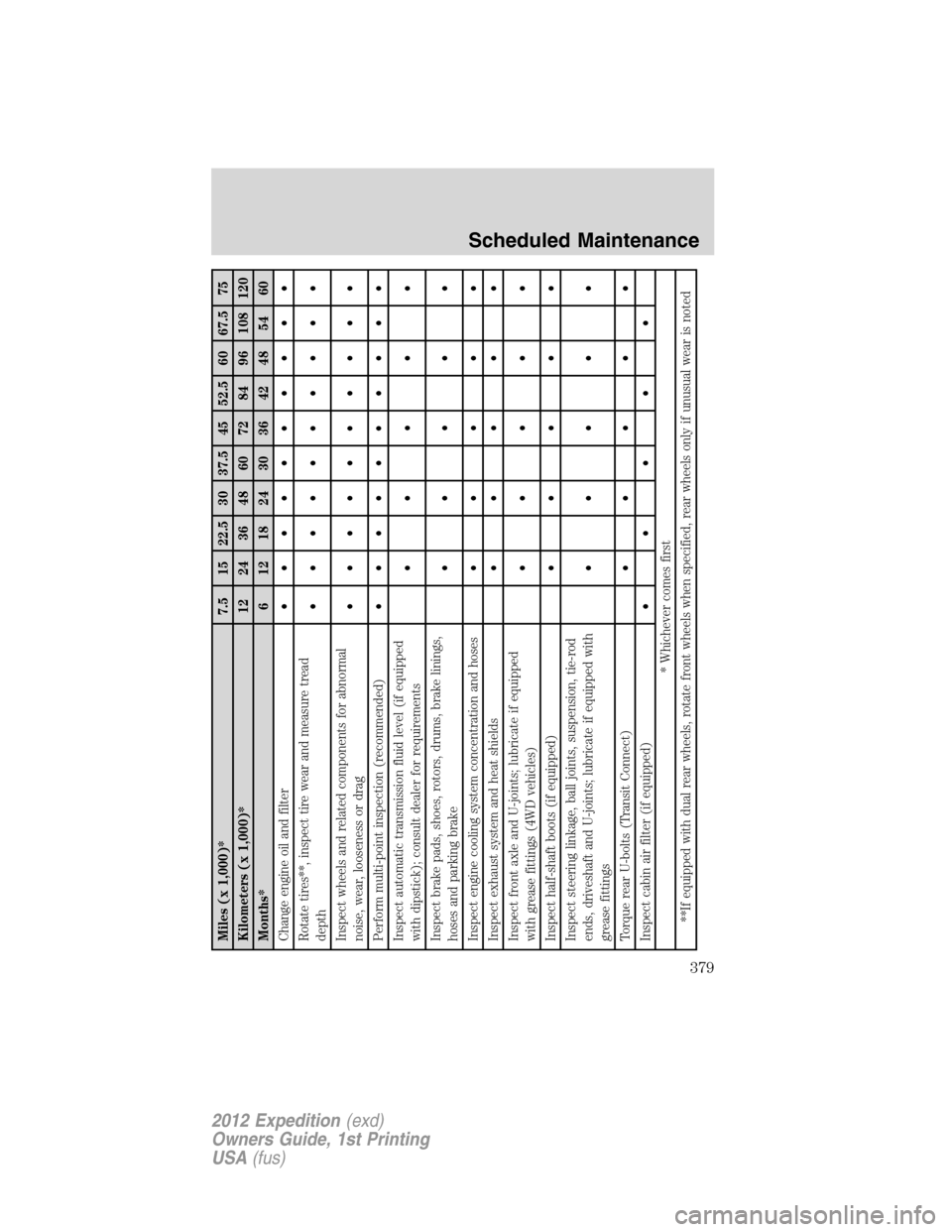
Miles (x 1,000)* 7.5 15 22.5 30 37.5 45 52.5 60 67.5 75
Kilometers (x 1,000)* 12 24 36 48 60 72 84 96 108 120
Months* 6 12 18 24 30 36 42 48 54 60
Change engine oil and filter• •••••••••
Rotate tires**, inspect tire wear and measure tread
depth• •••••••••
Inspect wheels and related components for abnormal
noise, wear, looseness or drag• •••••••••
Perform multi-point inspection (recommended)• •••••••••
Inspect automatic transmission fluid level (if equipped
with dipstick); consult dealer for requirements•••••
Inspect brake pads, shoes, rotors, drums, brake linings,
hoses and parking brake•••••
Inspect engine cooling system concentration and hoses•••••
Inspect exhaust system and heat shields•••••
Inspect front axle and U-joints; lubricate if equipped
with grease fittings (4WD vehicles)•••••
Inspect half-shaft boots (if equipped)•••••
Inspect steering linkage, ball joints, suspension, tie-rod
ends, driveshaft and U-joints; lubricate if equipped with
grease fittings•••••
Torque rear U-bolts (Transit Connect)•••••
Inspect cabin air filter (if equipped)•••••
* Whichever comes first
**If equipped with dual rear wheels, rotate front wheels when specified, rear wheels only if unusual wear is noted
Scheduled Maintenance
379
2012 Expedition(exd)
Owners Guide, 1st Printing
USA(fus)
Page 380 of 400
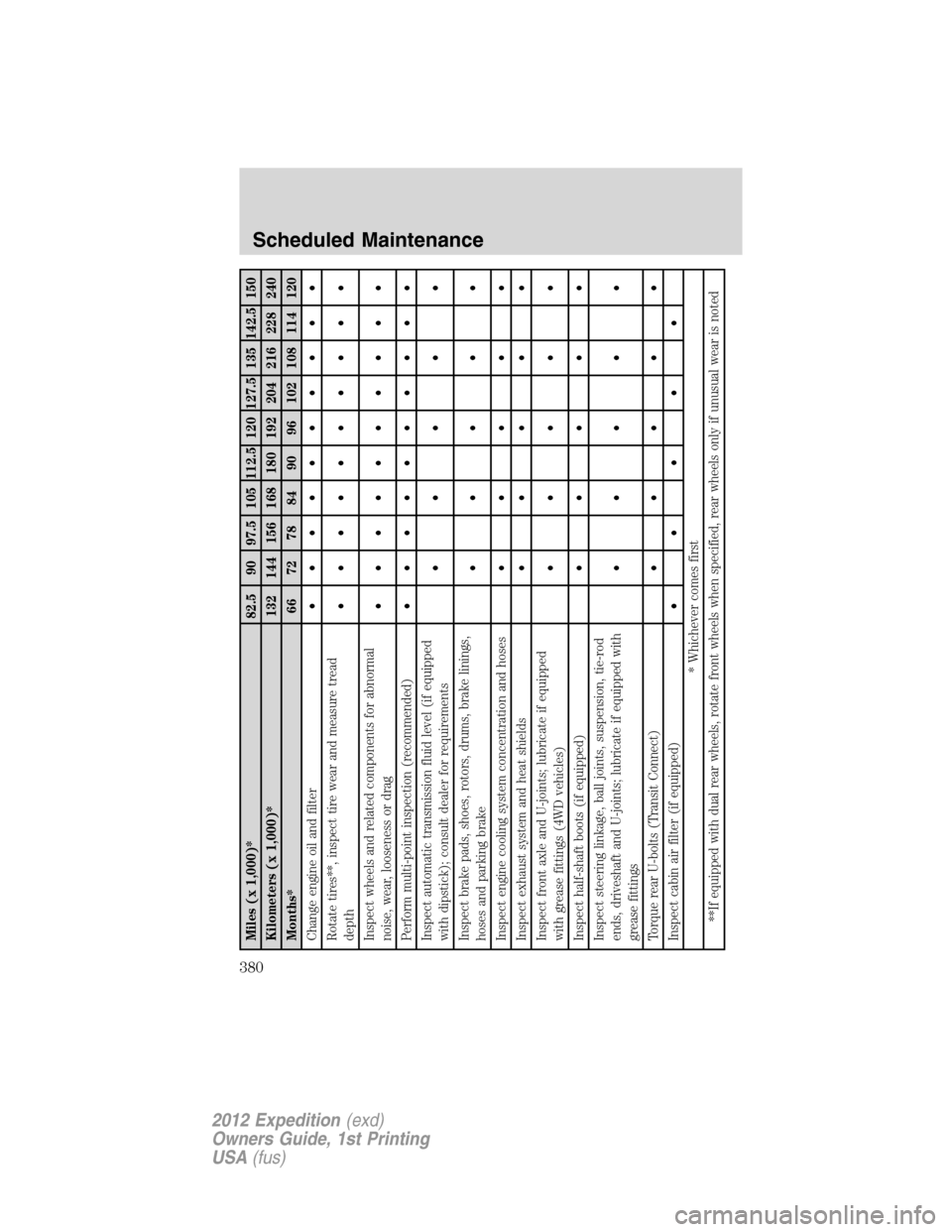
Miles (x 1,000)* 82.5 90 97.5 105 112.5 120 127.5 135 142.5 150
Kilometers (x 1,000)* 132 144 156 168 180 192 204 216 228 240
Months* 66 72 78 84 90 96 102 108 114 120
Change engine oil and filter• •••••••••
Rotate tires**, inspect tire wear and measure tread
depth• •••••••••
Inspect wheels and related components for abnormal
noise, wear, looseness or drag• •••••••••
Perform multi-point inspection (recommended)• •••••••••
Inspect automatic transmission fluid level (if equipped
with dipstick); consult dealer for requirements•••••
Inspect brake pads, shoes, rotors, drums, brake linings,
hoses and parking brake•••••
Inspect engine cooling system concentration and hoses•••••
Inspect exhaust system and heat shields•••••
Inspect front axle and U-joints; lubricate if equipped
with grease fittings (4WD vehicles)•••••
Inspect half-shaft boots (if equipped)•••••
Inspect steering linkage, ball joints, suspension, tie-rod
ends, driveshaft and U-joints; lubricate if equipped with
grease fittings•••••
Torque rear U-bolts (Transit Connect)•••••
Inspect cabin air filter (if equipped)•••••
* Whichever comes first
**If equipped with dual rear wheels, rotate front wheels when specified, rear wheels only if unusual wear is noted
Scheduled Maintenance
380
2012 Expedition(exd)
Owners Guide, 1st Printing
USA(fus)