Page 355 of 594
Climate Control Functions
A/C (Air Conditioning)
The Air Conditioning (A/C) button allows the operator
to manually activate or deactivate the air conditioning
system. When the air conditioning system is turned on,
cool dehumidified air will flow through the outlets into
the cabin. For improved fuel economy, press the A/C
button to turn off the air conditioning and manually
adjust the blower and airflow mode settings.
NOTE:
•For Manual Climate Controls, if the system is in Mix,
Floor or Defrost Mode, the A/C can be turned off, but
the A/C system shall remain active to prevent fogging
of the windows.
•If fog or mist appears on the windshield or side glass,
select Defrost mode and increase blower speed.
•If your air conditioning performance seems lower than
expected, check the front of the A/C condenser (lo-
cated in front of the radiator), for an accumulation of
dirt or insects. Clean with a gentle water spray from
behind the radiator and through the condenser. Fabric
front fascia protectors may reduce airflow to the
condenser, reducing air conditioning performance.
Recirculation Control
When outside air contains smoke, odors, or
high humidity, or if rapid cooling is desired,
you may wish to recirculate interior air by
pressing the Recirculation control button. The
recirculation indicator will illuminate when this button is
selected. Push the button a second time to turn off the
Recirculation mode and allow outside air into the vehicle.
NOTE: In cold weather, use of Recirculation mode may
lead to excessive window fogging. On systems with
Manual Climate Controls, the Recirculation mode is not
4
UNDERSTANDING YOUR INSTRUMENT PANEL 353
Page 364 of 594
▫General Information .................. 435
� Fuel Requirements ..................... 436
▫ 3.6L Engine – If Equipped .............. 436
▫ 5.7L Engine – If Equipped .............. 436
▫ Reformulated Gasoline ................ 437
▫ Gasoline/Oxygenate Blends ............. 437
▫ E-85 Usage In Non-Flex Fuel Vehicles ...... 438
▫ MMT In Gasoline .................... 438
▫ Materials Added To Fuel ............... 439
▫ Fuel System Cautions ................. 439
▫ Carbon Monoxide Warnings ............ 440�
Flexible Fuel (3.6L Engine Only) —
If Equipped .......................... 440
▫ E-85 General Information ............... 440
▫ Ethanol Fuel (E-85) ................... 441
▫ Fuel Requirements ................... 441
▫ Selection Of Engine Oil For Flexible Fuel
Vehicles (E-85) And Gasoline Vehicles ...... 442
▫ Starting ........................... 443
▫ Cruising Range ...................... 443
▫ Replacement Parts ................... 443
▫ Maintenance ........................ 443
� Adding Fuel ......................... 444
▫ Emergency Fuel Filler Door Release ....... 446
362 STARTING AND OPERATING
Page 369 of 594
•Press the ENGINE START/STOP button a third time
to return the ignition switch to the OFF position (EVIC
displays “OFF”).
Extreme Cold Weather (Below –20°F Or�29°C)
To ensure reliable starting at these temperatures, use of
an externally powered electric engine block heater (avail-
able from your authorized dealer) is recommended.
If Engine Fails To Start
WARNING!
•Never pour fuel or other flammable liquids into
the throttle body air inlet opening in an attempt to
start the vehicle. This could result in a flash fire
causing serious personal injury.
(Continued)
WARNING! (Continued)
•Do not attempt to push or tow your vehicle to get
it started. Vehicles equipped with an automatic
transmission cannot be started this way. Unburned
fuel could enter the catalytic converter and once
the engine has started, ignite and damage the
converter and vehicle. If the vehicle has a dis-
charged battery, booster cables may be used to
obtain a start from a booster battery or the battery
in another vehicle. This type of start can be dan-
gerous if done improperly. Refer to “Jump Start-
ing” in “What To Do In Emergencies” for further
information.
5
STARTING AND OPERATING 367
Page 370 of 594
Clearing A Flooded Engine
(Using ENGINE START/STOP Button)
If the engine fails to start after you have followed the
“Normal Starting” or “Extreme Cold Weather�proce-
dures, it may be flooded. To clear any excess fuel, press
and hold the brake pedal, push the accelerator pedal all
the way to the floor and hold it, then press and release the
ENGINE START/STOP button once. The starter motor
will engage automatically, run for 10 seconds, and then
disengage. Once this occurs, release the accelerator pedal
and the brake pedal, wait 10 to 15 seconds, then repeat
the “Normal Starting” procedure.
After Starting
The idle speed is controlled automatically and it will
decrease as the engine warms up.
ENGINE BLOCK HEATER — IF EQUIPPED
The engine block heater warms the engine, and permits
quicker starts in cold weather. Connect the cord to a
standard 110-115 Volt AC electrical outlet with a
grounded, three-wire extension cord.
The engine block heater cord is routed under the hood on
the driver side of the vehicle. It has a removable cap that
is located on the driver side of the Integrated Power
Module.
The engine block heater must be plugged in at least one
hour to have an adequate warming effect on the engine.
WARNING!
Remember to disconnect the engine block heater
cord before driving. Damage to the 110-115 Volt
electrical cord could cause electrocution.
368 STARTING AND OPERATING
Page 372 of 594
WARNING! (Continued)
•Unintended movement of a vehicle could injure
those in or near the vehicle. As with all vehicles,
you should never exit a vehicle while the engine is
running. Before exiting a vehicle, always apply the
parking brake, shift the transmission into PARK,
and turn the engine OFF. When the ignition is in
the OFF position, the shift lever is locked in
PARK, securing the vehicle against unwanted
movement. Furthermore, you should never leave
unattended children inside a vehicle.
Key Ignition Park Interlock
This vehicle is equipped with a Key Ignition Park Interlock
which requires the shift lever to be placed in PARK before
the engine can be turned off. This helps the driver avoid
inadvertently leaving the vehicle without placing the trans-
mission in PARK. This system also locks the shift lever in
PARK whenever the ignition switch is in the OFF position.
Brake/Transmission Shift Interlock System
This vehicle is equipped with a Brake Transmission Shift
Interlock (BTSI) that holds the shift lever in the PARK
position unless the brakes are applied. To move the shift
lever out of the PARK position, the ignition switch must
be turned to the ON/RUN or START position (engine
running or not) and the brake pedal must be pressed.
Eight-Speed Automatic Transmission – 3.6L
Engine
Your new vehicle is equipped with a state of the art, fuel
efficient eight-speed transmission. The electronic shift
lever in this vehicle does not slide like a conventional
shifter. Instead, the shift lever is spring loaded and moves
forward and rearward, always returning to the center
position after each gear is selected.
The transmission gear (PRND) is displayed both on the
shift lever and in the Electronic Vehicle Information
Center (EVIC).
370 STARTING AND OPERATING
Page 381 of 594
WARNING!
Do not coast in NEUTRAL and never turn off the
ignition to coast down a hill. These are unsafe
practices that limit your response to changing traffic
or road conditions. You might lose control of the
vehicle and have a collision.
CAUTION!
Towing the vehicle, coasting, or driving for any other
reason with the transmission in NEUTRAL can result
in severe transmission damage. Refer to “Recre-
ational Towing” in “Starting And Operating” and
“Towing A Disabled Vehicle” in “What To Do In
Emergencies” for further information.
DRIVE
This range should be used for most city and highway
driving. It provides the smoothest upshifts and down-
shifts, and the best fuel economy. The transmission
automatically upshifts through underdrive first, second,
and third gears, direct fourth gear and overdrive fifth
gear. The DRIVE position provides optimum driving
characteristics under all normal operating conditions.
When frequent transmission shifting occurs (such as
when operating the vehicle under heavy loading condi-
tions, in hilly terrain, traveling into strong head winds, or
while towing heavy trailers), use the “AutoStick�” mode
(refer to “AutoStick�” in this section) to select a lower
gear. Under these conditions, using a lower gear will
improve performance and extend transmission life by
reducing excessive shifting and heat buildup.
5
STARTING AND OPERATING 379
Page 387 of 594
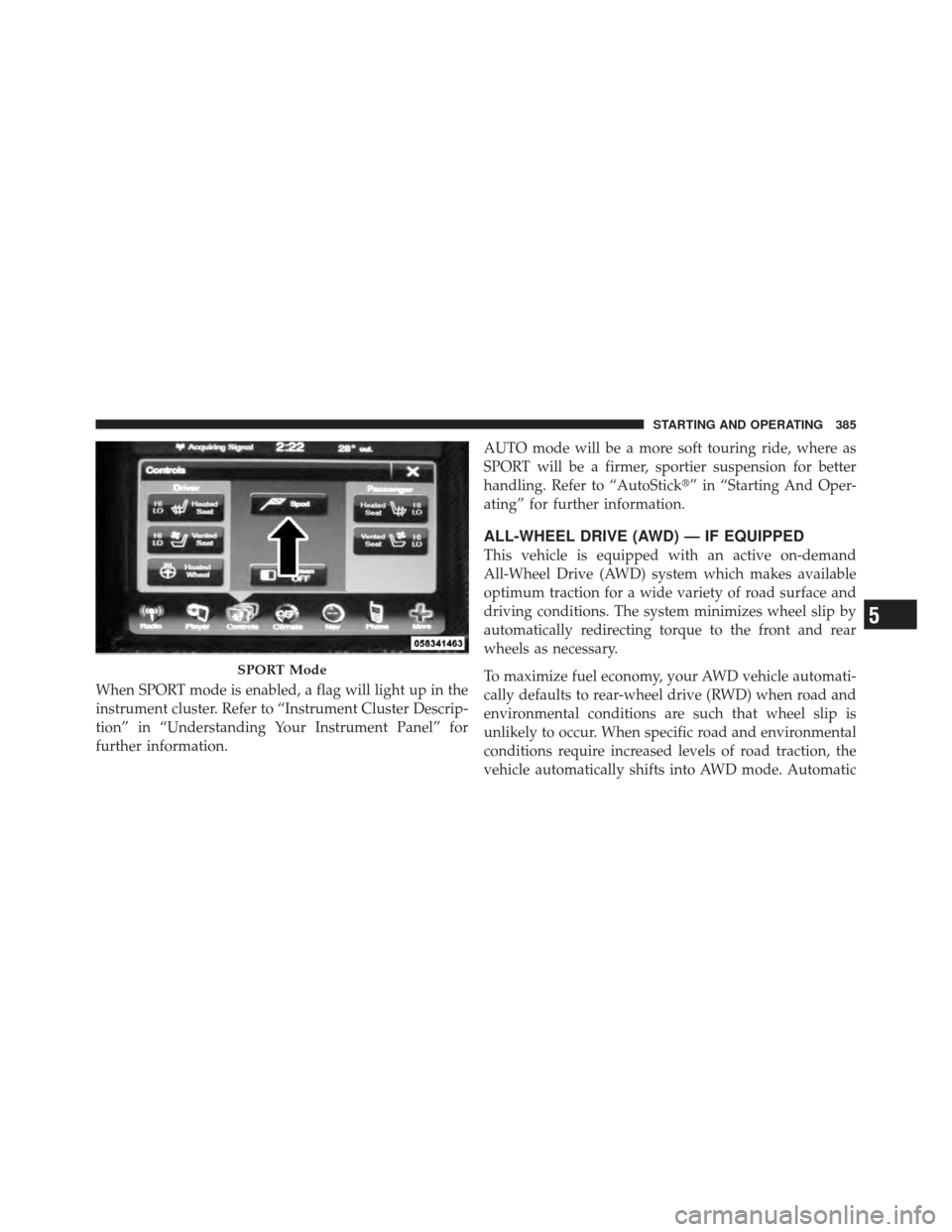
When SPORT mode is enabled, a flag will light up in the
instrument cluster. Refer to “Instrument Cluster Descrip-
tion” in “Understanding Your Instrument Panel” for
further information.AUTO mode will be a more soft touring ride, where as
SPORT will be a firmer, sportier suspension for better
handling. Refer to “AutoStick�” in “Starting And Oper-
ating” for further information.
ALL-WHEEL DRIVE (AWD) — IF EQUIPPED
This vehicle is equipped with an active on-demand
All-Wheel Drive (AWD) system which makes available
optimum traction for a wide variety of road surface and
driving conditions. The system minimizes wheel slip by
automatically redirecting torque to the front and rear
wheels as necessary.
To maximize fuel economy, your AWD vehicle automati-
cally defaults to rear-wheel drive (RWD) when road and
environmental conditions are such that wheel slip is
unlikely to occur. When specific road and environmental
conditions require increased levels of road traction, the
vehicle automatically shifts into AWD mode. Automatic
SPORT Mode
5
STARTING AND OPERATING 385
Page 393 of 594
NOTE:
•Even if power steering assistance is no longer opera-
tional, it is still possible to steer the vehicle. Under
these conditions there will be a substantial increase in
steering effort, especially at very low vehicle speeds
and during parking maneuvers.
•If the condition persists, see your authorized dealer for
service.
MULTI-DISPLACEMENT SYSTEM (MDS)
(IF EQUIPPED) — 5.7L ENGINE ONLY
This feature offers improved fuel economy by shutting
off four of the engine’s eight cylinders during light load
and cruise conditions. The system is automatic with no
driver inputs or additional driving skills required.
NOTE:The MDS system may take some time to return
to full functionality after a battery disconnect.
PARKING BRAKE
Before leaving the vehicle, make sure that the parking
brake is fully applied and place the shift lever in the
PARK position.
5
STARTING AND OPERATING 391