2012 Citroen DS4 eco
[x] Cancel search: ecoPage 180 of 396

Braking assistance systems
Group of supplementary systems which helpyou to obtain optimum braking in complete safety in emergency situations:
- anti-lock braking system (ABS),
- electronic brake force distribution
(EBFD),
- emergency braking assistance (EBA).
Anti-lock braking system
and electronic brake force
distribution
Linked systems which improve the stability and
manoeuvrability of your vehicle when braking,
in par ticular on poor or slippery surfaces.
Activation
The anti-lock braking system comes into
operation automatically when there is a risk of
wheel lock.
Normal operation of the ABS may make itself
felt by slight vibration of the brake pedal.
When braking in an emergency, pressvery firmly without releasing thepressure.
Operating fault
If this warning lamp comes on,
together with the STOPand ABSwarning lamps, accompanied by an
audible signal and a message in the screen, it
indicates a malfunction of the electronic brake force distribution which could result in loss of control of the vehicle when braking.You must stop as soon as it is safe to do so.
When replacing wheels (tyres andrims), ensure that they conform to themanufacturer's recommendations.
If this warnin
g lamp comes on,
accompanied by an audible signaland a message in the screen, it
indicates a malfunction of the anti-lock brakingsystem which could result in loss of control of
the vehicle when braking.
In either case, contact a CITROËN dealer or a
qualified workshop.
Page 181 of 396

179Safety
Emergency braking assistance
System which, in an emergency, enables you
to obtain the optimum braking pressure more
quickly, thus reducing the stopping distance.
Activation
It is triggered by the speed at which the brake pedal is pressed.
The effect of this is a reduction in theresistance of the pedal and an increase in
braking efficiency.
When braking in an emergency, press firmly without releasing the pressure.
Trajectory control systems (ESP)
Anti-slip regulation (ASR)
and electronic stability
control (ESC)
The anti-slip regulation (also known as traction control) optimises traction to prevent skidding
of the wheels, by acting on the brakes of the
driving wheels and on the engine.The electronic stability control acts on the brake
of one or more wheels and on the engine to keep the vehicle on the trajectory required by the
driver, within the limits of the laws of physics.
Activation
These systems are activated automaticallyeach time the vehicle is started.
They come into operation in the event of a gripor trajectory problem.
This is indicated b
y flashing of this
warning lamp in the instrument panel.
Intelligent traction control
s
ystem ("Snow motion")
Your vehicle has a system to help driving on snow: intelligent traction control.
This system detects situations of difficult surface adhesion that could make it difficult to
move off or make progress on deep fresh snowor compacted snow.
In these situations, the intelligent tractioncontrol limits the amount of wheel slip to
provide the best traction and trajectory control
for your vehicle.
The use of snow tyres is strongly recommended on surfaces offering low levels of adhesion.
Page 182 of 396

Deactivation
In exceptional conditions (starting a vehicle
which is bogged down, stuck in snow, on softground...), if you are unable to make progress,it may be advisable to temporarily deactivate
these systems, so that the wheels can spinfreely and allow the vehicle to move.
) Press the "ESP OFF"
button,located near the steering wheel.
Reactivation
These systems are reactivated automatically each time the ignition is switched back on or from 30 mph (50 km/h).)
Press the "ESP OFF"
button again to
reactivate them manually.
Operating fault
The trajectory control systems offer increased safety in normal driving, butthis should not encourage the driver to take extra risks or drive at high speed.
The correct functioning of these systems is assured provided thatmanufacturer's recommendations areobserved on:
- wheels (tyres and rims),
- braking components,
- electronic components,
- assembly and repair procedures.
After an impact, have these systems checked by a CITROËN dealer or a qualified workshop.
I
f this warning lamp comes on,
accompanied by an audible signal
and a message in the screen, this
indicates a fault with these systems.
Have it checked by a CITROËN dealer or aqualified workshop.
It is recommended that the systems bereactivated as soon as possible.
If this warnin
g lamp comes on in the instrumentpanel and the indicator lamp in the buttoncomes on, this indicates that these systems aredeactivated.
Page 183 of 396

Safety
Seat belts
Front seat belts
The front seat belts are fitted with apretensioning and force limiting system.
This system improves safety in the frontseats in the event of a front or side impact.
Dependin
g on the severity of the impact, thepretensioning system instantly tightens the seat
belts against the body of the occupants.
The pretensioning seat belts are active when
the ignition is on.
The force limiter reduces the pressure of the seat belt on the chest of the occupant, so improving their protection.
Fastening
)Pull the strap, then inser t the tongue in the buckle.)Check that the seat belt is fastenedcorrectly by pulling the strap.
Unfastening
)Press the red button on the buckle.)Guide the seat belt as it reels in.
Seat belt not fastened/unfastened warning lamp in the instrument panel
When the ignition is switched on,
this warning lamp comes on in the
instrument
panel if the driver and/or
the front passenger has not fastened their seat belt.
From approximately 12 mph (20 km/h)this warning lamp flashes for two minutes
accompanied by an audible signal of increasingvolume. Once these two minutes have elapsed,
this warning lamp remains on until the driver
and/or the front passenger fastens their seat belt.
Height adjustment
) To lower the attachment point, squeeze thecontrol Aand slide it downwards. )
To raise the attachment point, slide the control Aupwards.
Page 185 of 396

Safety
Seat belt unfastened warninglamp in the instrument panel
This warning lamp comes on in the
instrument panel when one or more rear passengers unfasten their seat belt.
Seat belt unfastened warninglamps display
3. Right hand rear seat belt warning lamp.4.
Centre rear seat belt warning lamp.
5. Left hand rear seat belt warning lamp.
When the ignition is switched on, with the
engine running or when the vehicle is moving at less than 12 mph (20 km/h), the corresponding warning lamps 3, 4 and 5
come on in red for approximately 30 seconds, if the seat belt is not
fastened.
When the vehicle is moving at more than 12 mph (20 km/h), the corresponding warning lamps 3,4and 5come on in red, accompanied by anaudible signal and a message in the screen, if a rear passenger has unfastened their seat belt. From approximatel
y 12 mph (20 km/h),
this warning lamp flashes for two minutes
accompanied by an audible signal of increasingvolume. Once these two minutes have elapsed,
this warning lamp remains on until the one or more rear passengers fasten their seat belt.
Page 186 of 396

The driver must ensure that passengers usethe seat belts correctly and that they are allrestrained securely before setting off.
Wherever you are seated in the vehicle, always fasten your seat belt, even for short journeys. Do not interchange the seat belt buckles as they will not fulfil their role fully.
The seat belts are fitted with an inertia reel permitting automatic adjustment of the lengthof the strap to your size. The seat belt isstowed automatically when not in use.
Before and after use, ensure that the seatbelt is reeled in correctly.
The lower part of the strap must be positioned as low as possible on the pelvis.
The upper par t must be positioned in the hollow of the shoulder.
The inertia reels are fitted with an automatic locking device which comes into operation inthe event of a collision, emergency braking or if the vehicle rolls over. You can release the device by pulling firmly on the strap and releasing it so that it reels in slightly.
In order to be effective, a seat belt must:
- be tightened as close to the body as possible,
- be pulled in front of you with a smooth movement, checking that it does nottwist,
- be used to restrain only one person,
- not bear any trace of cuts or fraying,
- not be converted or modified to avoidaffecting its per formance.
In accordance with current safety regulations, for all repairs on your vehicle, go to aqualified workshop with the skills and equipment needed, which a CITROËN dealer is able to provide. Have your seat belts checked regularly by a CITROËN dealer or a qualified workshop, particularly if the straps show signs of damage.
Clean the seat belt straps with soapy water or a textile cleaning product, sold by CITROËN dealers.
After folding or moving a seat or rear benchseat, ensure that the seat belt is positioned and reeled in correctly.
Recommendations for children
Use a suitable child seat if the passenger is less than 12 years old or shor ter than one and a half metres.
Never use the same seat belt to secure more than one person.
Never allow a child to travel on your lap.
In the event of an impact
Depending on the nature andseriousness of the impact , the pretensioning device may be deployed before and independently of the airbags.Deployment of the pretensioners is accompanied by a slight discharge of harmless smoke and a noise, due to theactivation of the pyrotechnic cartridge incorporated in the system.
In all cases, the airbag warning lampcomes on.
Following an impact, have the seat beltssystem checked, and if necessary replaced, by a CITROËN dealer or a qualified workshop.
Page 187 of 396
185
Safety
Airbags
System designed to maximise the safety of the
occupants (with the exception of the rear centrepassenger) in the event of violent collisions.
It supplements the action of the force-limiting
seat belts (with the exception of the rear centrepassenger).
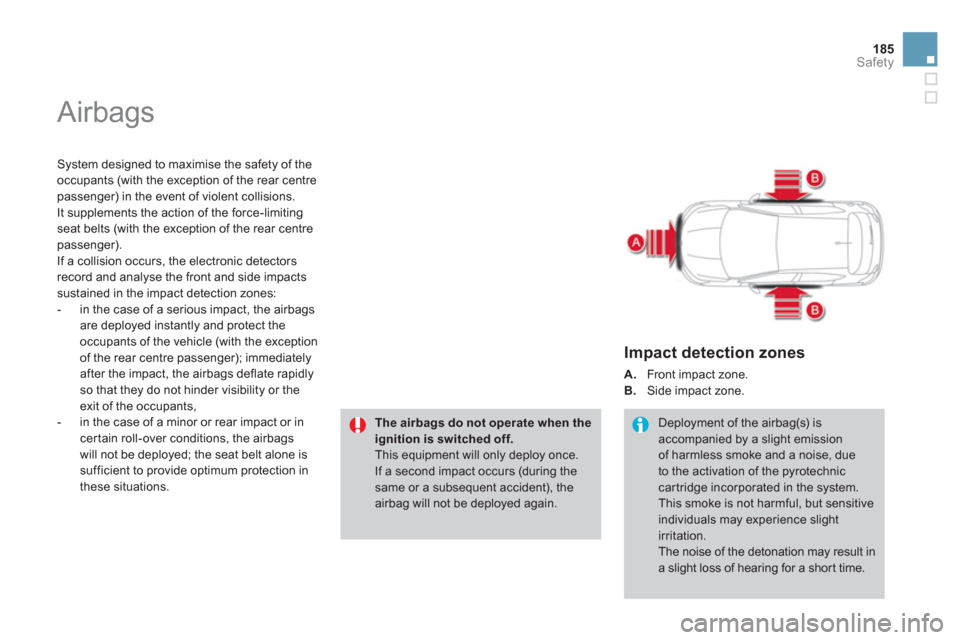
If a collision occurs, the electronic detectors
record and analyse the front and side impacts sustained in the impact detection zones:
- in the case of a serious impact, the airbagsare deployed instantly and protect the
occupants of the vehicle (with the exception
of the rear centre passenger); immediatelyafter the impact, the airbags deflate rapidlyso that they do not hinder visibility or theexit of the occupants,
- in the case of a minor or rear impact or incer tain roll-over conditions, the airbags
will not be deployed; the seat belt alone is sufficient to provide optimum protection in
these situations.
The airbags do not operate when theignition is switched off.This equipment will only deploy once. If a second impact occurs (during the same or a subsequent accident), theairbag will not be deployed again.
Impact detection zones
A.Front impact zone.
B. Side impact zone.
Deployment of the airbag(s) isaccompanied by a slight emissionof harmless smoke and a noise, dueto the activation of the pyrotechnic cartridge incorporated in the system.
This smoke is not harmful, but sensitive individuals may experience slightirritation.
The noise of the detonation may result ina slight loss of hearing for a shor t time.
Page 192 of 396

For the airbags to be fully effective, observe the following safety rules:
Front airbags
Do not drive holding the steering wheel by its spokes or resting your hands on the centre par t of the wheel.
Passengers must not place their feet on thedashboard.
If possible, do not smoke as deployment of the airbags can cause burns or the risk of injury from a cigarette or pipe.
Never remove or pierce the steering wheel or hit it violently.
Lateral airbags
Use only approved covers on the seats,compatible with the deployment the lateral airbags. For information on the range of seat covers suitable for your vehicle, you cancontact a CITROËN dealer (see "Practicalinformation - § Accessories").
Do not fix or attach anything to the seat backs (clothing...). This could cause injury to the chest or arms if the lateral airbag isdeployed.
Do not sit with the upper par t of the body any nearer to the door than necessary.
Curtain airbags
Do not fix or attach anything to the roof. This could cause injury to the head if thecurtain airbag is deployed.
If fitted on your vehicle, do not remove the grab handles installed on the roof, they play a par t in securing the cur tain airbags.
Sit in a normal upright position.
Wear a correctly adjusted seat belt.
Do not leave anything between the occupantsand the airbags (a child, pet, object...). This could hamper the operation of the airbags or injure the occupants. After an accident or if the vehicle has beenstolen or broken into, have the airbagsystems checked. All work on the airbag system must be carriedout by a CITROËN dealer or a qualified workshop.
Even if all of the precautions mentioned are obser ved, a risk of injury or of minor burns to the head, chest or arms when an airbag is deployed cannot be ruled out. The
bag inflates almost instantly (within a few milliseconds) then deflates within the sametime discharging the hot gas via openings provided for this purpose.