Page 261 of 394
Black plate (23,1)Chevrolet Colorado Owner Manual - 2012
Vehicle Care 10-23
If Steam is Coming from the
Engine Compartment
{WARNING
Steam from an overheated engine
can burn you badly, even if you
just open the hood. Stay away
from the engine if you see or hear
steam coming from it. Just turn it
off and get everyone away from
the vehicle until it cools down.
Wait until there is no sign of
steam or coolant before you open
the hood.
If you keep driving when the
engine is overheated, the liquids
in it can catch fire. You or others
could be badly burned. Stop the
engine if it overheats, and get out
of the vehicle until the engine
is cool.
If No Steam is Coming from
the Engine Compartment
If an engine overheat warning is
displayed but no steam can be seen
or heard, the problem may not be
too serious. Sometimes the engine
can get a little too hot when the
vehicle:
.Climbs a long hill on a hot day.
.Stops after high-speed driving.
.Idles for long periods in traffic.
.Tows a trailer. See“Driving on
Grades” underTrailer Towing on
page 9‑57.
If the overheat warning is displayed
with no sign of steam:
1. Turn the air conditioning off.
2. Turn the heater on to the highest temperature and to the highest
fan speed. Open the windows as
necessary. 3. In heavy traffic, let the engine
idle in N (Neutral) while stopped.
If it is safe to do so, pull off
the road, shift to P (Park)
or N (Neutral) and let the
engine idle.
If the temperature overheat gauge
is no longer in the overheat zone
or an overheat warning no longer
displays, the vehicle can be driven.
Continue to drive the vehicle slowly
for about 10 minutes. Keep a safe
vehicle distance from the vehicle in
front. If the warning does not come
back on, continue to drive normally.
If the warning continues, pull
over, stop, and park the vehicle
right away.
If there is no sign of steam, idle
the engine for three minutes while
parked. If the warning is still
displayed, turn off the engine until it
cools down.
Page 262 of 394

Black plate (24,1)Chevrolet Colorado Owner Manual - 2012
10-24 Vehicle Care
Engine Fan
This vehicle has a clutched engine
cooling fan. When the clutch is
engaged, the fan spins faster to
provide more air to cool the engine.
In most everyday driving conditions,
the clutch is not engaged. This
improves fuel economy and reduces
fan noise. Under heavy vehicle
loading, trailer towing and/or high
outside temperatures, the fan speed
increases when the clutch engages.
So you may hear an increase in fan
noise. This is normal and should not
be mistaken as the transmission
slipping or making extra shifts.
It is merely the cooling system
functioning properly. The fan will
slow down when additional cooling
is not required and the clutch
disengages.
This fan noise may also be heard
when the engine is started. It will go
away as the fan clutch disengages.
Power Steering Fluid
The power steering fluid reservoir is
located near the front of the engine
compartment, behind the radiator.
SeeEngine Compartment Overview
on page 10‑6 for reservoir location.
When to Check Power Steering
Fluid
It is not necessary to regularly
check power steering fluid unless
there is a leak suspected in the
system or an unusual noise is
heard. A fluid loss in this system
could indicate a problem. Have the
system inspected and repaired.
How to Check Power Steering
Fluid
1. Turn the key off and let the
engine compartment cool down.
2. Wipe the cap and the top of the reservoir clean.
3. Unscrew the cap and wipe the dipstick with a clean rag.
4. Replace the cap and completely tighten it.
5. Then remove the cap again and look at the fluid level on the
dipstick.
The level should be between the
ADD and FULL marks. If necessary,
add only enough fluid to bring the
level up to the proper range.
Page 278 of 394
Black plate (40,1)Chevrolet Colorado Owner Manual - 2012
10-40 Vehicle Care
To remove the cover, push in on the
tab on the end of the cover and lift.
To reinstall the cover, line up the tab
and push down on the cover until
the tab clicks into place.
Notice:Spilling liquid on any
electrical component on the
vehicle may damage it. Always
keep the covers on any electrical
component.
The trailer brake relay is located on
the bottom side of the battery
harness.
Fuses Usage
O2 SNSR Oxygen Sensors,
Air Injection
Reactor (AIR)
Relay
A/C Air Conditioning
Control Head,
Power Seats
A/C
CMPRSR Air Conditioning
Compressor
Page 280 of 394
Black plate (42,1)Chevrolet Colorado Owner Manual - 2012
10-42 Vehicle Care
FusesUsage
PWR/WNDW Power Windows
(If Equipped)
RDO Radio
REAR
PRK LAMP Rear Parking
Lamp 1, Passenger
Side Taillamp,
License Plate
Lamps
REAR PRK
LAMP2 Driver Side
Rear Taillamp,
Passenger Side
Airbag Indicator
Lighting,
Instrument Panel
Dimming Power
(2WD/4WD switch
lighting) Fuses
Usage
RT HDLP Passenger Side
Headlamp
RVC Regulated Voltage
Control
S/ROOF Not Used
STOP Stop Lamps
STRTR Starter Solenoid
Relay
TBC Truck Body
Controller
TCM Transmission
Control Module
TCCM Transfer Case
Control Module Fuses
Usage
TRAILER
BRAKE Trailer Brake
TRANS Transmission
Solenoid
TRN/
HAZRD FRT Turn/Hazard/
Courtesy/Cargo
Lamps/Mirrors
TRN/
HAZRD
REAR Rear Turn/Hazard
Lights
VSES/STOP Vehicle Stability
Enhancement
System/Stop
WPR Wiper
WSW Wiper/Washer
Switch
Page 283 of 394
Black plate (45,1)Chevrolet Colorado Owner Manual - 2012
Vehicle Care 10-45
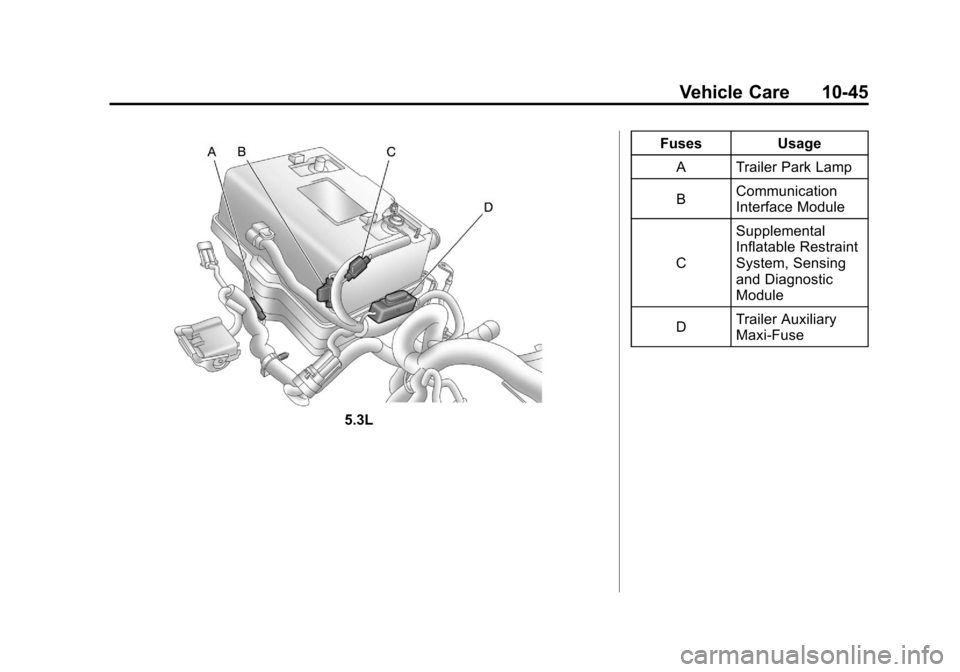
5.3LFuses Usage
A Trailer Park Lamp
B Communication
Interface Module
C Supplemental
Inflatable Restraint
System, Sensing
and Diagnostic
Module
D Trailer Auxiliary
Maxi-Fuse
Page 327 of 394

Black plate (89,1)Chevrolet Colorado Owner Manual - 2012
Vehicle Care 10-89
Towing
Towing the Vehicle
Notice:To avoid damage, the
disabled vehicle should be
towed with all four wheels off
the ground. Care must be taken
with vehicles that have low
ground clearance and/or special
equipment. Always flatbed on a
car carrier.
Consult your dealer or a
professional towing service if the
disabled vehicle must be towed.
See Roadside Assistance Program
(U.S. and Canada) on page 13‑7
or Roadside Assistance Program
(Mexico) on page 13‑9.
To tow the vehicle behind another
vehicle for recreational purposes,
such as behind a motor home, see
“Recreational Vehicle Towing” in this
section.
Recreational Vehicle
Towing
Recreational vehicle towing means
towing the vehicle behind another
vehicle –such as behind a motor
home. The two most common types
of recreational vehicle towing are
known as dinghy towing and dolly
towing. Dinghy towing is towing the
vehicle with all four wheels on the
ground. Dolly towing is towing the
vehicle with two wheels on the
ground and two wheels up on a
device known as a dolly.
Here are some important things to
consider before recreational vehicle
towing:
.What is the towing capacity
of the towing vehicle? Be
sure to read the tow
vehicle manufacturer's
recommendations.
.What is the distance that will be
travelled? Some vehicles have
restrictions on how far and how
long they can tow.
.Is the proper towing equipment
going to be used? See your
dealer or trailering professional
for additional advice and
equipment recommendations.
.Is the vehicle ready to be
towed? Just as preparing the
vehicle for a long trip, make sure
the vehicle is prepared to be
towed.
Page 340 of 394
Black plate (2,1)Chevrolet Colorado Owner Manual - 2012
11-2 Service and Maintenance
Because of the way people use
vehicles, maintenance needs
vary. There may need to be
more frequent checks and
services. The Additional
Required Services‐Normal
are for vehicles that:
.Carry passengers and cargo
within recommended limits on
the Tire and Loading Information
label. See Vehicle Load Limits
on page 9‑16.
.Are driven on reasonable road
surfaces within legal driving
limits.
.Use the recommended fuel.
See Recommended Fuel on
page 9‑49.
Refer to the information in the
Maintenance Schedule Additional
Required Services ‐Normal chart. The Additional Required
Services
‐Severe are for
vehicles that are:
.Mainly driven in hilly or
mountainous terrain.
.Frequently towing a trailer.
.Used for high speed or
competitive driving.
.Used for taxi, police, or delivery
service.
Refer to the information in the
Maintenance Schedule Additional
Required Services ‐Severe chart.
{WARNING
Performing maintenance work
can be dangerous and can
cause serious injury. Perform
maintenance work only if the
required information, proper tools,
and equipment are available.
If they are not, see your dealer to
have a trained technician do the
work. See Doing Your Own
Service Work on page 10‑4.
Page 372 of 394

Black plate (12,1)Chevrolet Colorado Owner Manual - 2012
13-12 Customer Information
.Food service, beverages,
telephone calls, or other extra
costs. Accommodation costs
apply only to Mexico per the
terms and conditions of the
Roadside Assistance program.
.Any damage to the vehicle
without intent, derived from the
services provided.
.Cost of towing a trailer when
choosing a Chevrolet dealer
that is nearest to the temporary
storage facility for the disabled
vehicle.
.Cost of all maneuvers required
to access the vehicle when it is
not available to be towed.
.Cost of fuel provided.
Routine vehicle repair costs are
not covered by the Roadside
Assistance program. For more
information, see your new vehicle
warranty. Contacting Roadside Assistance
Roadside Assistance services are
of no cost to you and available
24 hours a day, 365 days a year.
Costs are only incurred in situations
that exceed the limits of the
program, some of which are listed
previously in this section.
To contact Roadside Assistance by
phone, use the following numbers:
Mexico
01-800-466-0800
United States
1-866-466-8901
Canada
1-800-268-6800
E-mail
[email protected]
Chevrolet reserves the right to make
any changes or discontinue the
Roadside Assistance program at
any time without notification.
Scheduling Service
Appointments (U.S. and
Canada)
When the vehicle requires warranty
service, contact your dealer and
request an appointment. By
scheduling a service appointment
and advising the service consultant
of your transportation needs, your
dealer can help minimize your
inconvenience.
If the vehicle cannot be scheduled
into the service department
immediately, keep driving it until
it can be scheduled for service,
unless, of course, the problem is
safety related. If it is, please call
your dealership, let them know this,
and ask for instructions.
If your dealer requests you to bring
the vehicle for service, you are
urged to do so as early in the work
day as possible to allow for same
day-repair.