2011 TOYOTA VERSO S remote control
[x] Cancel search: remote controlPage 208 of 664
2084-2. Opening, closing and locking the doors
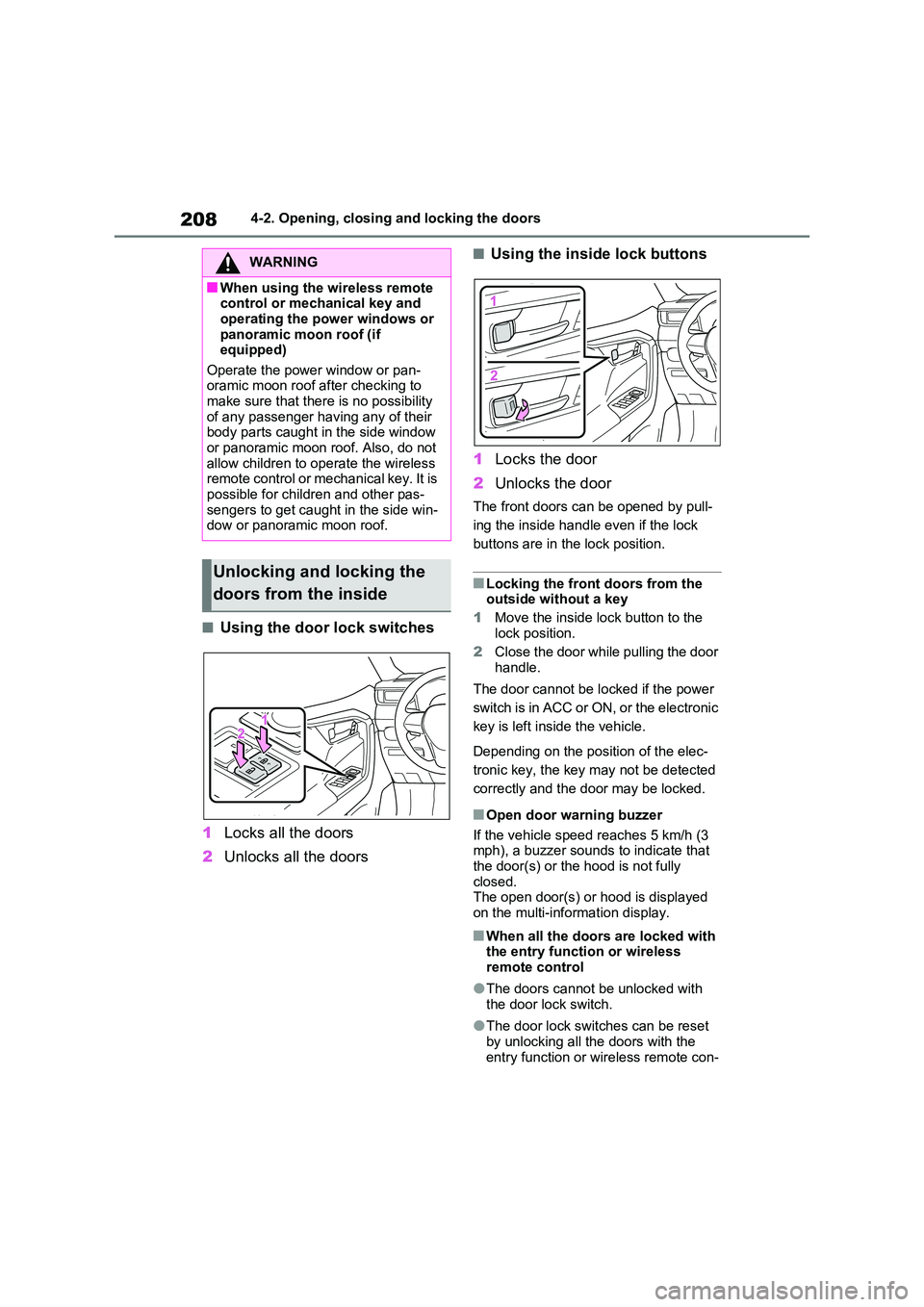
■Using the door lock switches
1 Locks all the doors
2 Unlocks all the doors
■Using the inside lock buttons
1 Locks the door
2 Unlocks the door
The front doors can be opened by pull-
ing the inside handle even if the lock
buttons are in the lock position.
■Locking the front doors from the outside without a key
1 Move the inside lock button to the
lock position.
2 Close the door while pulling the door handle.
The door cannot be locked if the power
switch is in ACC or ON, or the electronic
key is left inside the vehicle.
Depending on the position of the elec-
tronic key, the key may not be detected
correctly and the door may be locked.
■Open door warning buzzer
If the vehicle speed reaches 5 km/h (3 mph), a buzzer sounds to indicate that
the door(s) or the hood is not fully closed.The open door(s) or hood is displayed
on the multi-information display.
■When all the doors are locked with the entry function or wireless remote control
●The doors cannot be unlocked with the door lock switch.
●The door lock switches can be reset by unlocking all the doors with the
entry function or wireless remote con-
WARNING
■When using the wireless remote control or mechanical key and
operating the power windows or panoramic moon roof (if equipped)
Operate the power window or pan- oramic moon roof after checking to make sure that there is no possibility
of any passenger having any of their body parts caught in the side window or panoramic moon roof. Also, do not
allow children to operate the wireless remote control or mechanical key. It is possible for children and other pas-
sengers to get caught in the side win- dow or panoramic moon roof.
Unlocking and locking the
doors from the inside
Page 212 of 664
2124-2. Opening, closing and locking the doors
seconds after the doors are locked.
2 Locks all the doors
Check that the door is securely locked.
■Using the wireless remote
control
P.205
■Operation signals
P.206
■Security feature
P.206
■Using the door lock switches
P.208
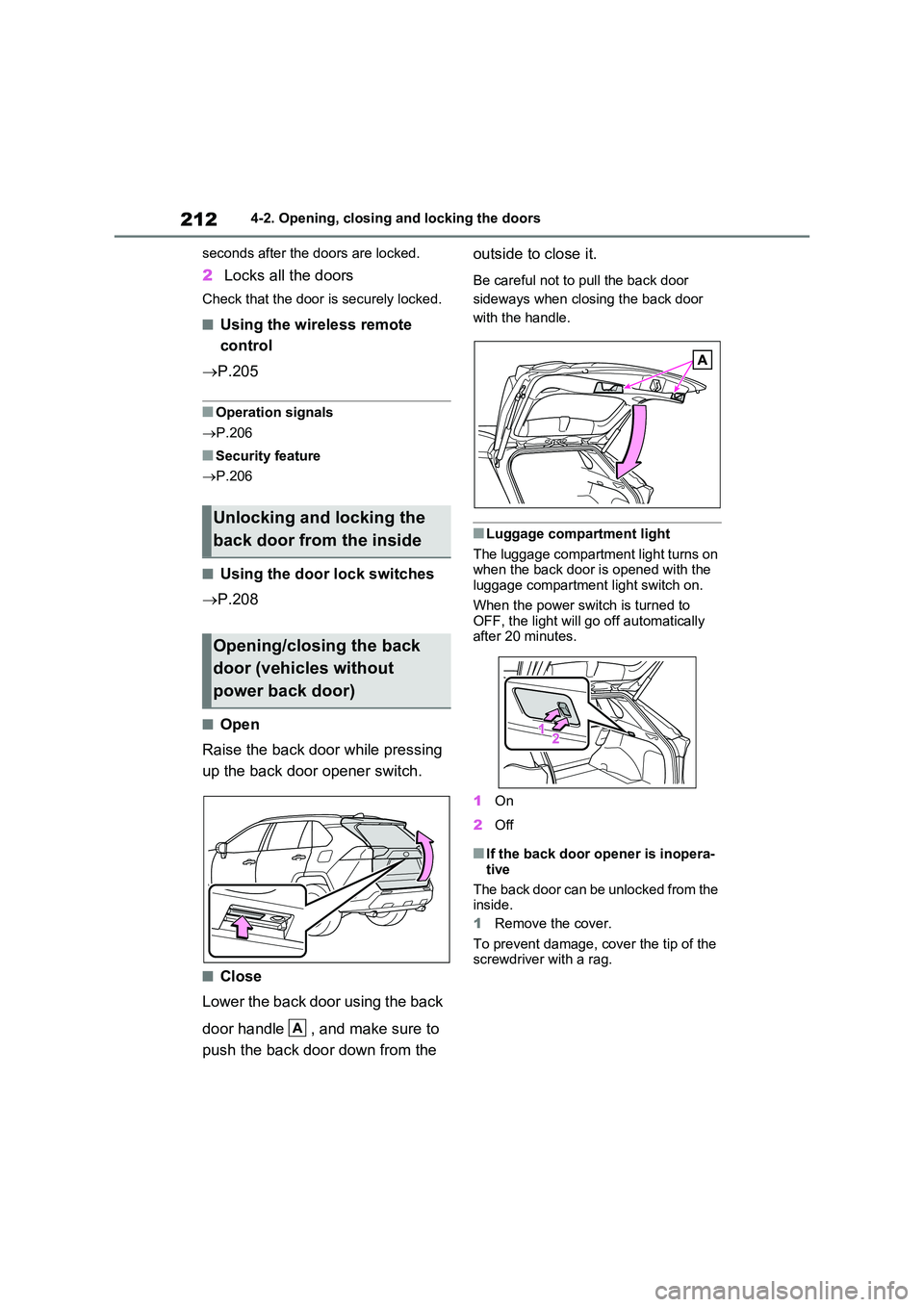
■Open
Raise the back door while pressing
up the back door opener switch.
■Close
Lower the back door using the back
door handle , and make sure to
push the back door down from the
outside to close it.
Be careful not to pull the back door
sideways when closing the back door
with the handle.
■Luggage compartment light
The luggage compartment light turns on when the back door is opened with the luggage compartment light switch on.
When the power switch is turned to OFF, the light will go off automatically after 20 minutes.
1 On
2 Off
■If the back door opener is inopera-
tive
The back door can be unlocked from the inside.
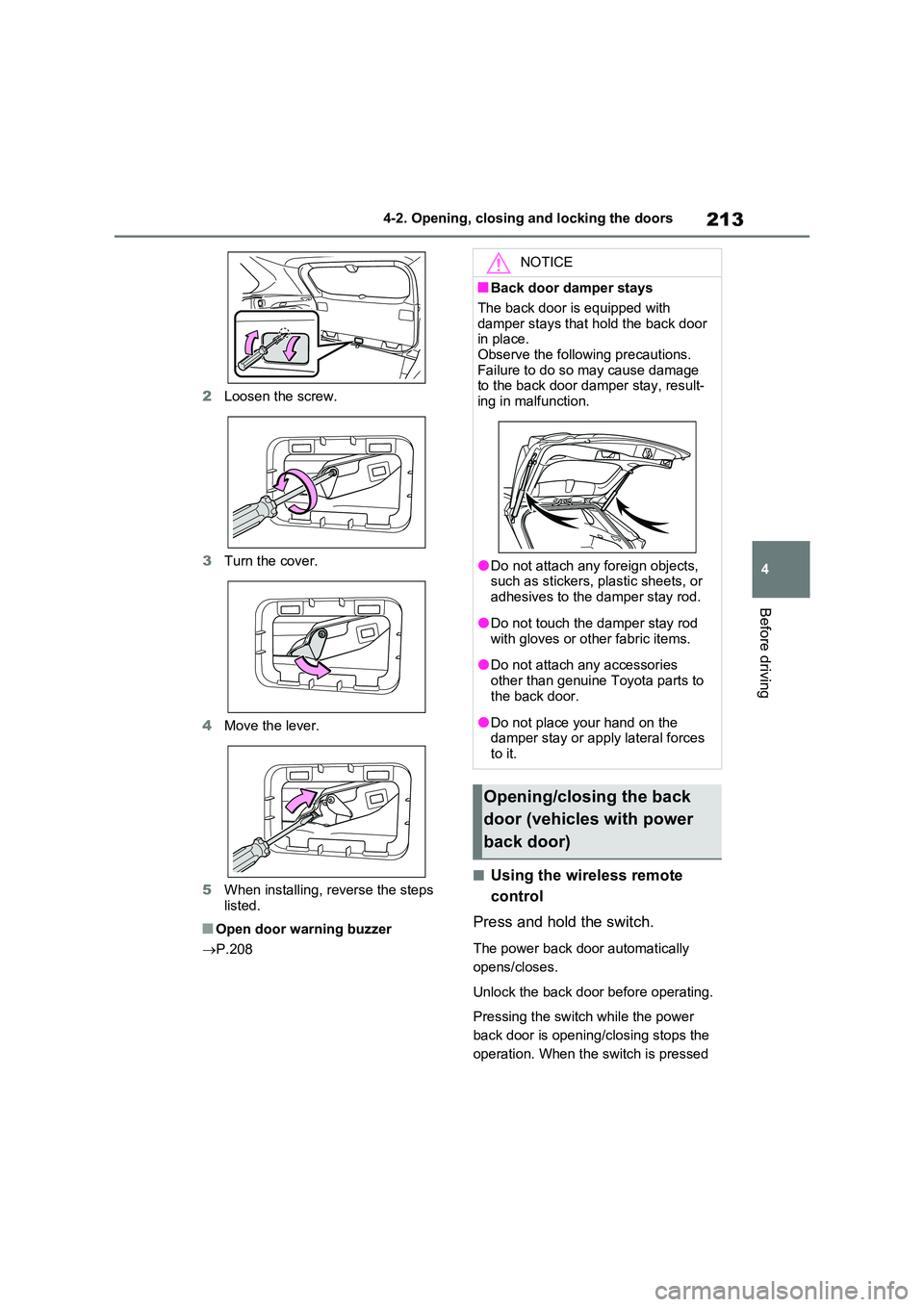
1 Remove the cover.
To prevent damage, cover the tip of the screwdriver with a rag.
Unlocking and locking the
back door from the inside
Opening/closing the back
door (vehicles without
power back door)
A
Page 213 of 664
213
4
4-2. Opening, closing and locking the doors
Before driving
2 Loosen the screw.
3 Turn the cover.
4 Move the lever.
5 When installing, reverse the steps
listed.
■Open door warning buzzer
P.208
■Using the wireless remote
control
Press and hold the switch.
The power back door automatically
opens/closes.
Unlock the back door before operating.
Pressing the switch while the power
back door is opening/closing stops the
operation. When the switch is pressed
NOTICE
■Back door damper stays
The back door is equipped with
damper stays that hold the back door in place.Observe the following precautions.
Failure to do so may cause damage to the back door damper stay, result-ing in malfunction.
●Do not attach any foreign objects, such as stickers, plastic sheets, or
adhesives to the damper stay rod.
●Do not touch the damper stay rod
with gloves or other fabric items.
●Do not attach any accessories
other than genuine Toyota parts to the back door.
●Do not place your hand on the damper stay or apply lateral forces to it.
Opening/closing the back
door (vehicles with power
back door)
Page 217 of 664
217
4 4-2. Opening, closing and locking the doors
Before driving
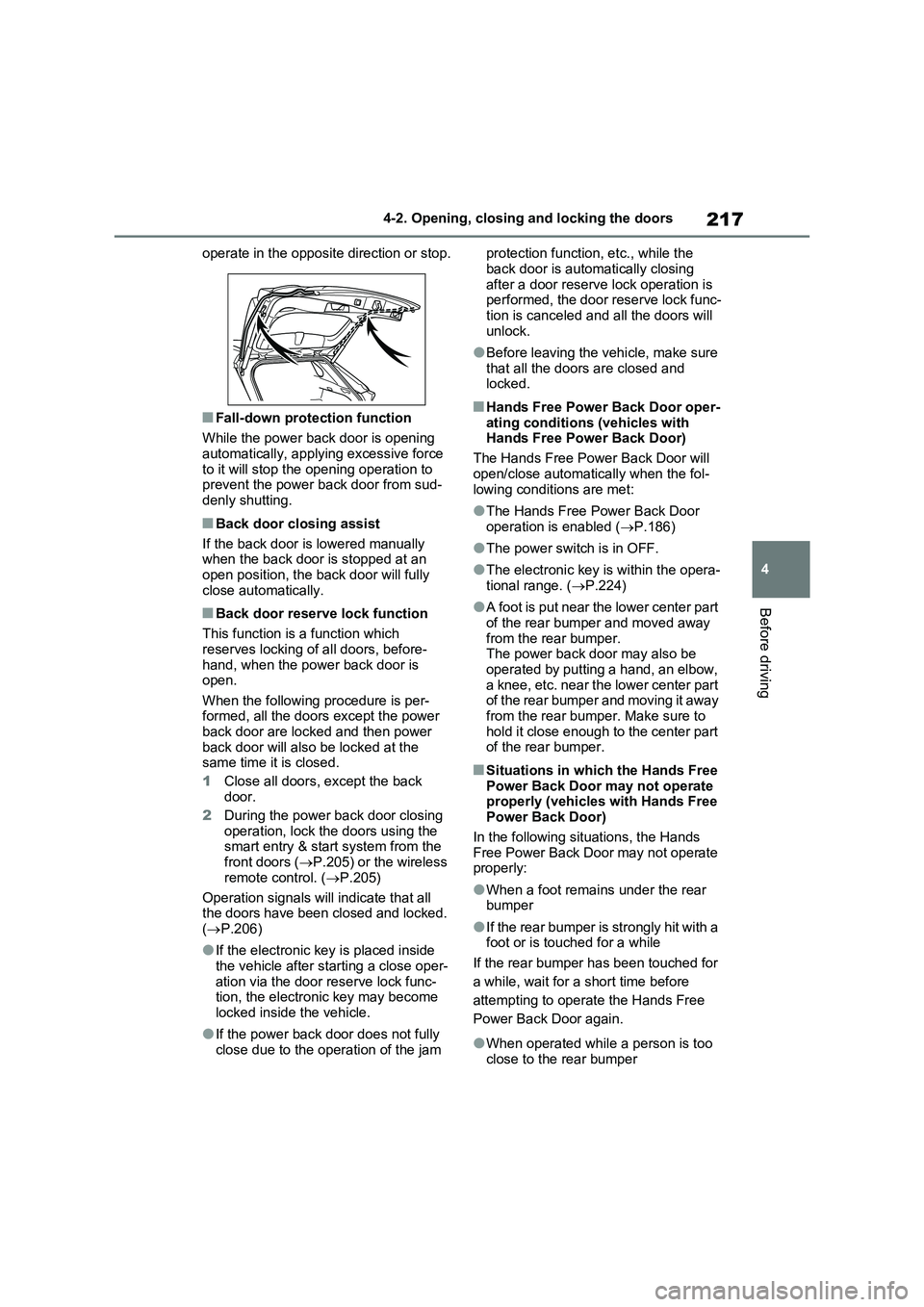
operate in the opposite direction or stop.
■Fall-down protection function
While the power back door is opening
automatically, applying excessive force
to it will stop the opening operation to
prevent the power back door from sud-
denly shutting.
■Back door closing assist
If the back door is lowered manually
when the back door is stopped at an
open position, the back door will fully
close automatically.
■Back door reserve lock function
This function is a function which
reserves locking of all doors, before-
hand, when the power back door is
open.
When the following procedure is per-
formed, all the doors except the power
back door are locked and then power
back door will also be locked at the
same time it is closed.
1Close all doors, except the back
door.
2During the power back door closing
operation, lock the doors using the
smart entry & start system from the
front doors (P.205) or the wireless
remote control. (P.205)
Operation signals will indicate that all
the doors have been closed and locked.
(P.206)
●If the electronic key is placed inside
the vehicle after starting a close oper-
ation via the door reserve lock func-
tion, the electronic key may become
locked inside the vehicle.
●If the power back door does not fully
close due to the operation of the jam protection function, etc., while the
back door is automatically closing
after a door reserve lock operation is
performed, the door reserve lock func-
tion is canceled and all the doors will
unlock.
●Before leaving the vehicle, make sure
that all the doors are closed and
locked.
■Hands Free Power Back Door oper-
ating conditions (vehicles with
Hands Free Power Back Door)
The Hands Free Power Back Door will
open/close automatically when the fol-
lowing conditions are met:
●The Hands Free Power Back Door
operation is enabled (P.186)
●The power switch is in OFF.
●The electronic key is within the opera-
tional range. (P.224)
●A foot is put near the lower center part
of the rear bumper and moved away
from the rear bumper.
The power back door may also be
operated by putting a hand, an elbow,
a knee, etc. near the lower center part
of the rear bumper and moving it away
from the rear bumper. Make sure to
hold it close enough to the center part
of the rear bumper.
■Situations in which the Hands Free
Power Back Door may not operate
properly (vehicles with Hands Free
Power Back Door)
In the following situations, the Hands
Free Power Back Door may not operate
properly:
●When a foot remains under the rear
bumper
●If the rear bumper is strongly hit with a
foot or is touched for a while
If the rear bumper has been touched for
a while, wait for a short time before
attempting to operate the Hands Free
Power Back Door again.
●When operated while a person is too
close to the rear bumper
Page 224 of 664
2244-2. Opening, closing and locking the doors
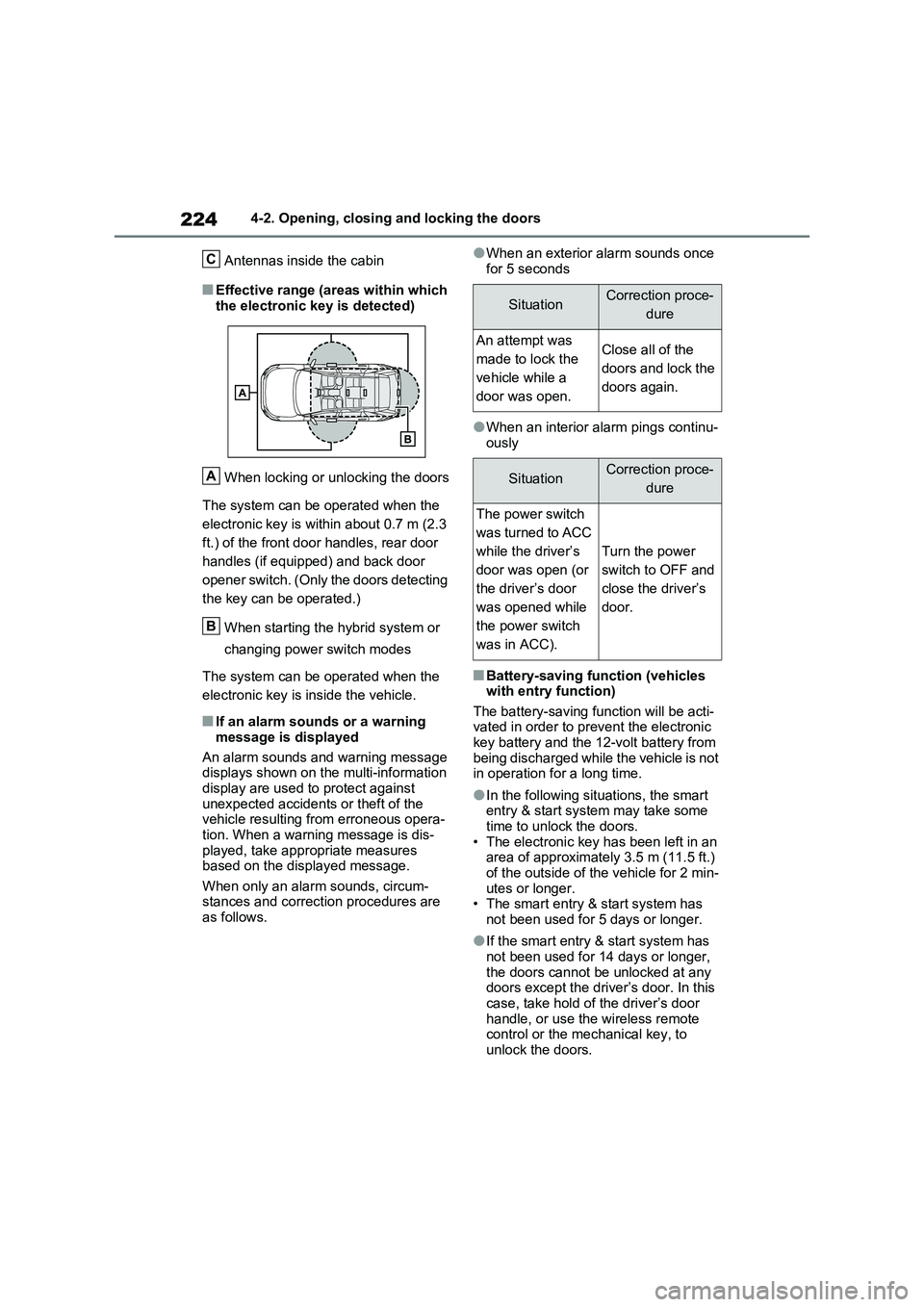
Antennas inside the cabin
■Effective range (areas within which
the electronic key is detected)
When locking or unlocking the doors
The system can be operated when the
electronic key is within about 0.7 m (2.3
ft.) of the front door handles, rear door
handles (if equipped) and back door
opener switch. (Only the doors detecting
the key can be operated.)
When starting the hybrid system or
changing power switch modes
The system can be operated when the
electronic key is inside the vehicle.
■If an alarm sounds or a warning
message is displayed
An alarm sounds and warning message displays shown on the multi-information
display are used to protect against unexpected accidents or theft of the vehicle resulting from erroneous opera-
tion. When a warning message is dis- played, take appropriate measures based on the displayed message.
When only an alarm sounds, circum- stances and correction procedures are as follows.
●When an exterior alarm sounds once
for 5 seconds
●When an interior alarm pings continu- ously
■Battery-saving function (vehicles with entry function)
The battery-saving function will be acti- vated in order to prevent the electronic key battery and the 12-volt battery from
being discharged while the vehicle is not in operation for a long time.
●In the following situations, the smart entry & start system may take some time to unlock the doors.
• The electronic key has been left in an area of approximately 3.5 m (11.5 ft.) of the outside of the vehicle for 2 min-
utes or longer. • The smart entry & start system has not been used for 5 days or longer.
●If the smart entry & start system has not been used for 14 days or longer,
the doors cannot be unlocked at any doors except the driver’s door. In this case, take hold of the driver’s door
handle, or use the wireless remote control or the mechanical key, to unlock the doors.
C
A
B
SituationCorrection proce-
dure
An attempt was
made to lock the
vehicle while a
door was open.
Close all of the
doors and lock the
doors again.
SituationCorrection proce-
dure
The power switch
was turned to ACC
while the driver’s
door was open (or
the driver’s door
was opened while
the power switch
was in ACC).
Turn the power
switch to OFF and
close the driver’s
door.
Page 225 of 664
225
4
4-2. Opening, closing and locking the doors
Before driving
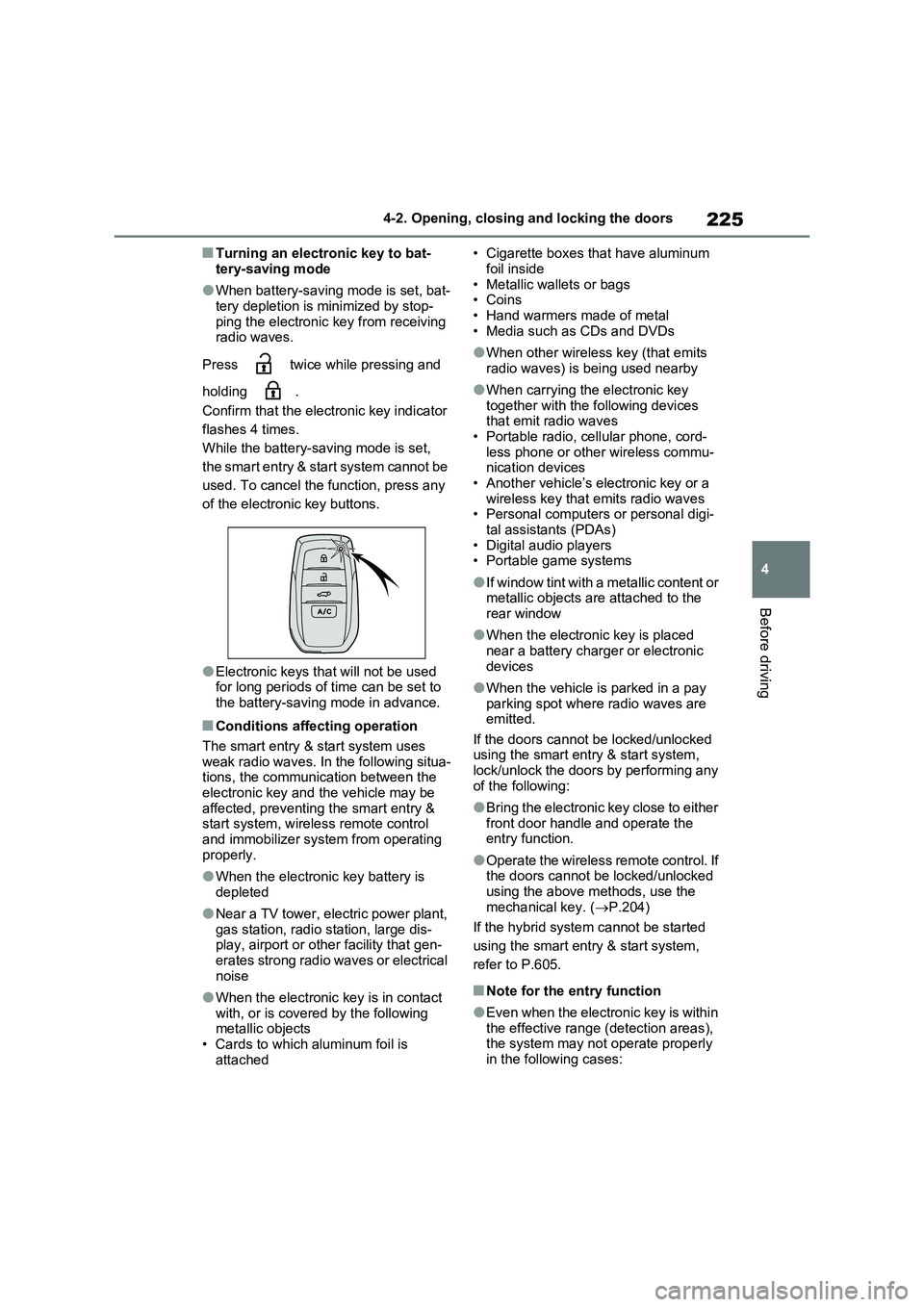
■Turning an electronic key to bat-
tery-saving mode
●When battery-saving mode is set, bat-
tery depletion is minimized by stop- ping the electronic key from receiving radio waves.
Press twice while pressing and
holding .
Confirm that the electronic key indicator
flashes 4 times.
While the battery-saving mode is set,
the smart entry & start system cannot be
used. To cancel the function, press any
of the electronic key buttons.
●Electronic keys that will not be used for long periods of time can be set to
the battery-saving mode in advance.
■Conditions affecting operation
The smart entry & start system uses
weak radio waves. In the following situa- tions, the communication between the electronic key and the vehicle may be
affected, preventing the smart entry & start system, wireless remote control and immobilizer system from operating
properly.
●When the electronic key battery is
depleted
●Near a TV tower, electric power plant,
gas station, radio station, large dis- play, airport or other facility that gen-erates strong radio waves or electrical
noise
●When the electronic key is in contact
with, or is covered by the following metallic objects• Cards to which aluminum foil is
attached
• Cigarette boxes that have aluminum
foil inside • Metallic wallets or bags•Coins
• Hand warmers made of metal • Media such as CDs and DVDs
●When other wireless key (that emits radio waves) is being used nearby
●When carrying the electronic key together with the following devices that emit radio waves
• Portable radio, cellular phone, cord- less phone or other wireless commu-nication devices
• Another vehicle’s electronic key or a wireless key that emits radio waves• Personal computers or personal digi-
tal assistants (PDAs) • Digital audio players• Portable game systems
●If window tint with a metallic content or metallic objects are attached to the
rear window
●When the electronic key is placed
near a battery charger or electronic devices
●When the vehicle is parked in a pay parking spot where radio waves are emitted.
If the doors cannot be locked/unlocked using the smart entry & start system, lock/unlock the doors by performing any
of the following:
●Bring the electronic key close to either
front door handle and operate the entry function.
●Operate the wireless remote control. If the doors cannot be locked/unlocked using the above methods, use the
mechanical key. ( P.204)
If the hybrid system cannot be started
using the smart entry & start system,
refer to P.605.
■Note for the entry function
●Even when the electronic key is within
the effective range (detection areas), the system may not operate properly in the following cases:
Page 226 of 664

2264-2. Opening, closing and locking the doors
• The electronic key is too close to the
window or outside door handle, near
the ground, or in a high place when
the doors are locked or unlocked.
• The electronic key is on the instru-
ment panel, luggage cover or floor, or
in the door pockets or glove box when
the hybrid system is started or power
switch modes are changed.
●Do not leave the electronic key on top
of the instrument panel or near the
door pockets when exiting the vehicle.
Depending on the radio wave recep-
tion conditions, it may be detected by
the antenna outside the cabin and the
door will become lockable from the
outside, possibly trapping the elec-
tronic key inside the vehicle.
●As long as the electronic key is within
the effective range, the doors may be
locked or unlocked by anyone. How-
ever, only the doors detecting the
electronic key can be used to lock or
unlock the vehicle.
●Even if the electronic key is not inside
the vehicle, it may be possible to start
the hybrid system if the electronic key
is near the window.
●The doors may unlock if a large
amount of water splashes on the door
handle, such as in the rain or in a car
wash when the electronic key is within
the effective range. (The doors will
automatically be locked after approxi-
mately 30 seconds if the doors are not
opened and closed.)
●If the wireless remote control is used
to lock the doors when the electronic
key is near the vehicle, there is a pos-
sibility that the door may not be
unlocked by the entry function. (Use
the wireless remote control to unlock
the doors.)
●Touching the door lock sensor while
wearing gloves may delay or prevent
lock operation. Remove the gloves
and touch the lock sensor again.
●When the lock operation is performed
using the lock sensor, recognition sig-
nals will be shown up to two consecu-tive times. After this, no recognition
signals will be given.
●If the door handle becomes wet while
the electronic key is within the effec-
tive range, the door may lock and
unlock repeatedly. In that case, follow
the following correction procedures to
wash the vehicle:
• Place the electronic key in a location 2
m (6 ft.) or more away from the vehi-
cle. (Take care to ensure that the key
is not stolen.)
• Set the electronic key to battery-sav-
ing mode to disable the smart entry &
start system. (P.225)
●If the electronic key is inside the vehi-
cle and a door handle becomes wet
during a car wash, a message may be
shown on the multi-information dis-
play and a buzzer will sound outside
the vehicle. To turn off the alarm, lock
all the doors.
●The lock sensor may not work prop-
erly if it comes into contact with ice,
snow, mud, etc. Clean the lock sensor
and attempt to operate it again, or use
the lock sensor on the lower part of
the door handle.
●A sudden approach to the effective
range or door handle may prevent the
doors from being unlocked. In this
case, return the door handle to the
original position and check that the
doors unlock before pulling the door
handle again.
●If there is another electronic key in the
detection area, it may take slightly lon-
ger to unlock the doors after the door
handle is gripped.
■When the vehicle is not driven for
extended periods
●To prevent theft of the vehicle, do not
leave the electronic key within 2 m (6
ft.) of the vehicle.
●The smart entry & start system can be
deactivated in advance. (P.633)
●Battery-saving mode can reduce the
power consumption of electronic keys.
(P.225)
Page 227 of 664
227
4 4-2. Opening, closing and locking the doors
Before driving
■To operate the system properly
Make sure to carry the electronic key
when operating the system. For vehicles
with entry function, do not get the elec-
tronic key too close to the vehicle when
operating the system from the outside of
the vehicle.
Depending on the position and holding
condition of the electronic key, the key
may not be detected correctly and the
system may not operate properly. (The
alarm may go off accidentally, or the
door lock prevention may not operate.)
■If the smart entry & start system
does not operate properly
●Locking and unlocking the doors: Use
the mechanical key. (P.604)
●Starting the hybrid system: P.317
■Customization
Settings (e.g. smart entry & start sys-
tem) can be changed.
(Customizable features: P.633)
If the smart entry & start system has
been deactivated in a customized set-
ting, refer to the explanations for the fol-
lowing operations.
●Locking and unlocking the doors:
Use the wireless remote control or
mechanical key. (P.205, 604)
●Starting the hybrid system and chang-
ing power switch modes: P.605
●Stopping the hybrid system: P.319