2011 TOYOTA VERSO S heating
[x] Cancel search: heatingPage 442 of 664
4425-5. Using the driving support systems
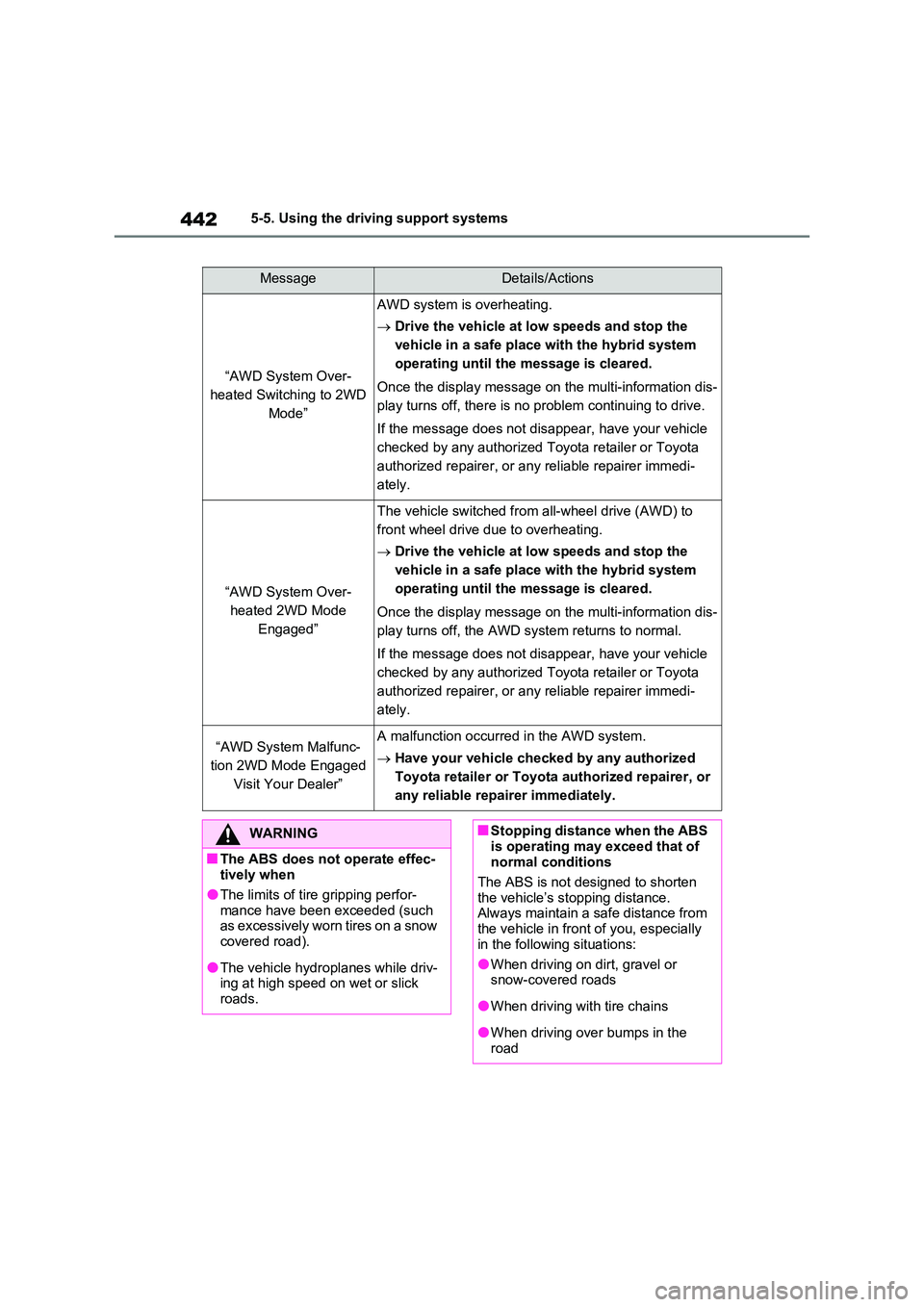
MessageDetails/Actions
“AWD System Over-
heated Switching to 2WD
Mode”
AWD system is overheating.
Drive the vehicle at low speeds and stop the
vehicle in a safe place with the hybrid system
operating until the message is cleared.
Once the display message on the multi-information dis-
play turns off, there is no problem continuing to drive.
If the message does not disappear, have your vehicle
checked by any authorized Toyota retailer or Toyota
authorized repairer, or any reliable repairer immedi-
ately.
“AWD System Over-
heated 2WD Mode
Engaged”
The vehicle switched from all-wheel drive (AWD) to
front wheel drive due to overheating.
Drive the vehicle at low speeds and stop the
vehicle in a safe place with the hybrid system
operating until the message is cleared.
Once the display message on the multi-information dis-
play turns off, the AWD system returns to normal.
If the message does not disappear, have your vehicle
checked by any authorized Toyota retailer or Toyota
authorized repairer, or any reliable repairer immedi-
ately.
“AWD System Malfunc-
tion 2WD Mode Engaged
Visit Your Dealer”
A malfunction occurred in the AWD system.
Have your vehicle checked by any authorized
Toyota retailer or Toyota authorized repairer, or
any reliable repairer immediately.
WARNING
■The ABS does not operate effec- tively when
●The limits of tire gripping perfor-
mance have been exceeded (such as excessively worn tires on a snow covered road).
●The vehicle hydroplanes while driv-ing at high speed on wet or slick
roads.
■Stopping distance when the ABS
is operating may exceed that of normal conditions
The ABS is not designed to shorten
the vehicle’s stopping distance. Always maintain a safe distance from the vehicle in front of you, especially
in the following situations:
●When driving on dirt, gravel or snow-covered roads
●When driving with tire chains
●When driving over bumps in the road
Page 454 of 664
4546-1. Using the air conditioning system and defogger
switch to outside air mode if the recircu-
lated air mode is used. (It may switch
automatically.)
To defog the windshield and the side
windows quickly, turn the air flow and
temperature up.
To return to the previous mode, press
the windshield defogger switch again
when the windshield is defogged.
When the windshield defogger switch is
on, the indicator illuminates on the
windshield defogger switch.
■Defogging the rear window
and outside rear view mirrors
Defoggers are used to defog the
rear window, and to remove rain-
drops, dew and frost from the out-
side rear view mirrors.
Press the rear window defogger
and outside rear view mirror defog-
gers switch.
The defoggers will automatically turn off
after 15 minutes.
When the rear window defogger and
outside rear view mirror defoggers
switch is on, the indicator illuminates on
the rear window defogger and outside
rear view mirror defoggers switch.
■Blower customization
The fan speed can be adjusted
according to your preference.
1Press the automatic mode or
airflow mode control switch.
2Press the blower customization
switch.
3Each time the blower customi-
zation switch is pressed, the fan
speed changes as follows.
Normal “ECO” “FAST”
■Heating
●In HV mode, the gasoline engine may
operate in order to extract heat from
the engine coolant via the heater.
●In EV mode, heating is done by a heat
pump system.
• When the outside temperature is low
or it is snowing, compared to conven-
tional vehicles, heating may be less
effective and warm air may not come
out.
• When the outside heat exchanger is
frosted over, fan speed declines and it
may become harder to heat the inte-
rior. However, it is not a malfunction.
In this situation, the air temperature
from the outlets may not change even
though the set temperature is raised.
• If frost has formed of the outside heat
exchanger, the heating performance
will decline. The frost can be removed
from the outside heat exchanger by
operating the Remote Air Conditioning
System before driving (P.460).
When frosted over, the heating opera-
tion of the Remote Air Conditioning
System starts after defrosting.
• When “AUTO” switch is turned on, the
heating is controlled optimally. There-
fore, the set heating performance may
not be achieved even if the fan speed
setting is increased.
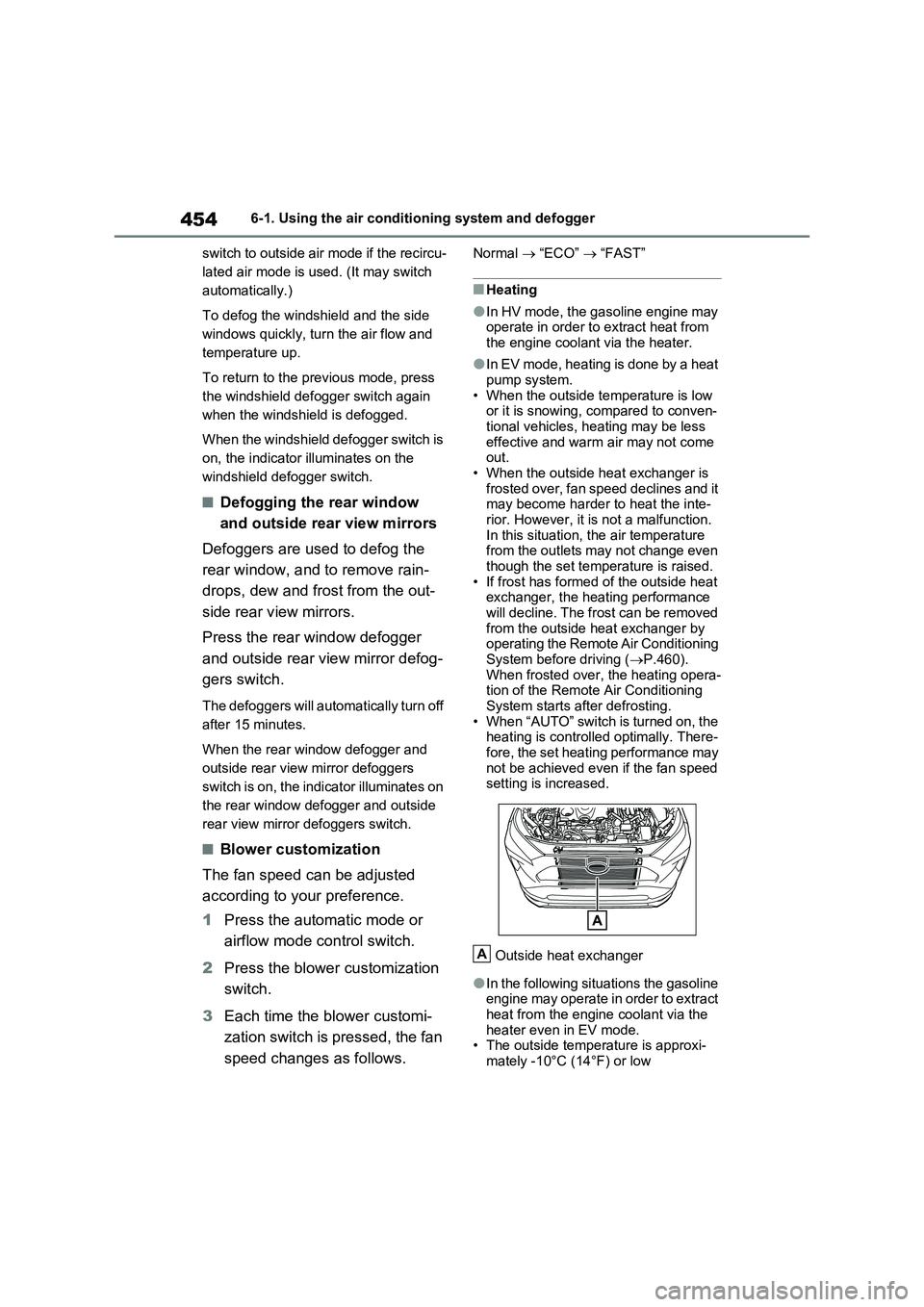
Outside heat exchanger
●In the following situations the gasoline
engine may operate in order to extract
heat from the engine coolant via the
heater even in EV mode.
• The outside temperature is approxi-
mately -10°C (14°F) or low
A
Page 455 of 664
455
6 6-1. Using the air conditioning system and defogger
Interior features
• is operating
■Water droplets during air condi-
tioning operation
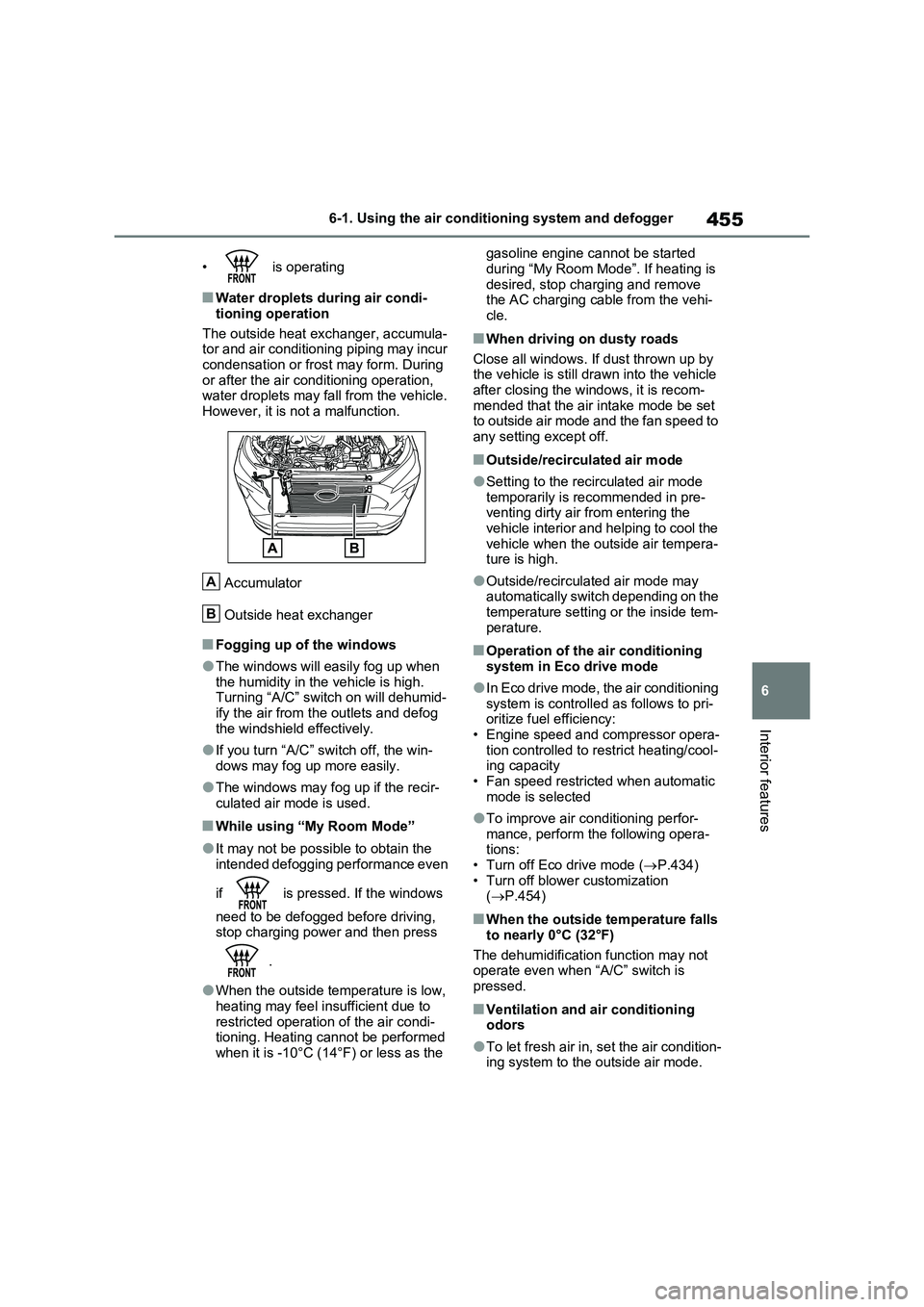
The outside heat exchanger, accumula-
tor and air conditioning piping may incur
condensation or frost may form. During
or after the air conditioning operation,
water droplets may fall from the vehicle.
However, it is not a malfunction.
Accumulator
Outside heat exchanger
■Fogging up of the windows
●The windows will easily fog up when
the humidity in the vehicle is high.
Turning “A/C” switch on will dehumid-
ify the air from the outlets and defog
the windshield effectively.
●If you turn “A/C” switch off, the win-
dows may fog up more easily.
●The windows may fog up if the recir-
culated air mode is used.
■While using “My Room Mode”
●It may not be possible to obtain the
intended defogging performance even
if is pressed. If the windows
need to be defogged before driving,
stop charging power and then press
.
●When the outside temperature is low,
heating may feel insufficient due to
restricted operation of the air condi-
tioning. Heating cannot be performed
when it is -10°C (14°F) or less as the gasoline engine cannot be started
during “My Room Mode”. If heating is
desired, stop charging and remove
the AC charging cable from the vehi-
cle.
■When driving on dusty roads
Close all windows. If dust thrown up by
the vehicle is still drawn into the vehicle
after closing the windows, it is recom-
mended that the air intake mode be set
to outside air mode and the fan speed to
any setting except off.
■Outside/recirculated air mode
●Setting to the recirculated air mode
temporarily is recommended in pre-
venting dirty air from entering the
vehicle interior and helping to cool the
vehicle when the outside air tempera-
ture is high.
●Outside/recirculated air mode may
automatically switch depending on the
temperature setting or the inside tem-
perature.
■Operation of the air conditioning
system in Eco drive mode
●In Eco drive mode, the air conditioning
system is controlled as follows to pri-
oritize fuel efficiency:
• Engine speed and compressor opera-
tion controlled to restrict heating/cool-
ing capacity
• Fan speed restricted when automatic
mode is selected
●To improve air conditioning perfor-
mance, perform the following opera-
tions:
• Turn off Eco drive mode (P.434)
• Turn off blower customization
(P.454)
■When the outside temperature falls
to nearly 0°C (32°F)
The dehumidification function may not
operate even when “A/C” switch is
pressed.
■Ventilation and air conditioning
odors
●To let fresh air in, set the air condition-
ing system to the outside air mode.
A
B
Page 461 of 664
461
6
6-1. Using the air conditioning system and defogger
Interior features
●The outside temperature is extremely
low
●When the hybrid system is cool (for
example, after being left for a long time in low temperatures)
■Windshield defogger
When defogging the windshield using
the Remote Air Conditioning System, defogging may be insufficient due to the power being restricted more than during
normal air conditioning operation. Also, the outside of the windshield may fog up due to the outside temperature, humidity
or air conditioning set temperature.
■Using the heater via the Remote Air Conditioning System
●When the outside temperature is low, heating may feel insufficient due to restricted operation of the air condi-
tioning.
●When the outside heat exchanger
becomes frosted over, heating perfor- mance may decline due to automati-cally switching to the frost removal
operation. ( P.452)
■Security feature
Any unlocked doors will be automatically locked when the system is operating.
The emergency flashers flash to indicate that the doors have been locked or the system has been turned off.
■Conditions affecting operation
P.225
■While the Remote Air Conditioning System is operating
●Depending on the operating condition of the Remote Air Conditioning Sys-tem, the air conditioning compressor
or cooling fan may spin and an operat- ing noise may be heard.However, this does not indicate a mal-
function.
●The air conditioning operation
switches, etc. will not operate while the Remote Air Conditioning System is operating.
■Electronic key battery depletion
P.202
■When the electronic key battery is fully depleted
P.543
■Customization
Setting (e.g. Operation using “A/C” on the wireless remote control) can be changed. (Customizable features:
P.629)
WARNING
■Precautions for the Remote Air Conditioning System
●Do not use the system if people are in the vehicle. Even when the system is in use, the
internal temperature may still reach a high or low level due to features such as the automatic shut-off.
Children and pets left inside the vehicle may suffer heatstroke dehy-dration or hypothermia, or could
result in death or serious injury.
●Depending on the surrounding envi-
ronment, signals from the wireless switch may transmit further than expected. Pay appropriate attention
to the vehicle’s surroundings and use the switch only when neces-sary.
●Do not operate “A/C” on the wire-less remote control if the hood is
open. The air conditioning may operate unintentionally and objects may be drawn into the electrical
cooling fan.
NOTICE
■To prevent the hybrid battery (traction battery) from being dis-charged
Use “A/C” on the wireless remote control only when necessary.
Page 569 of 664
569
8
8-2. Steps to take in an emergency
When trouble arises
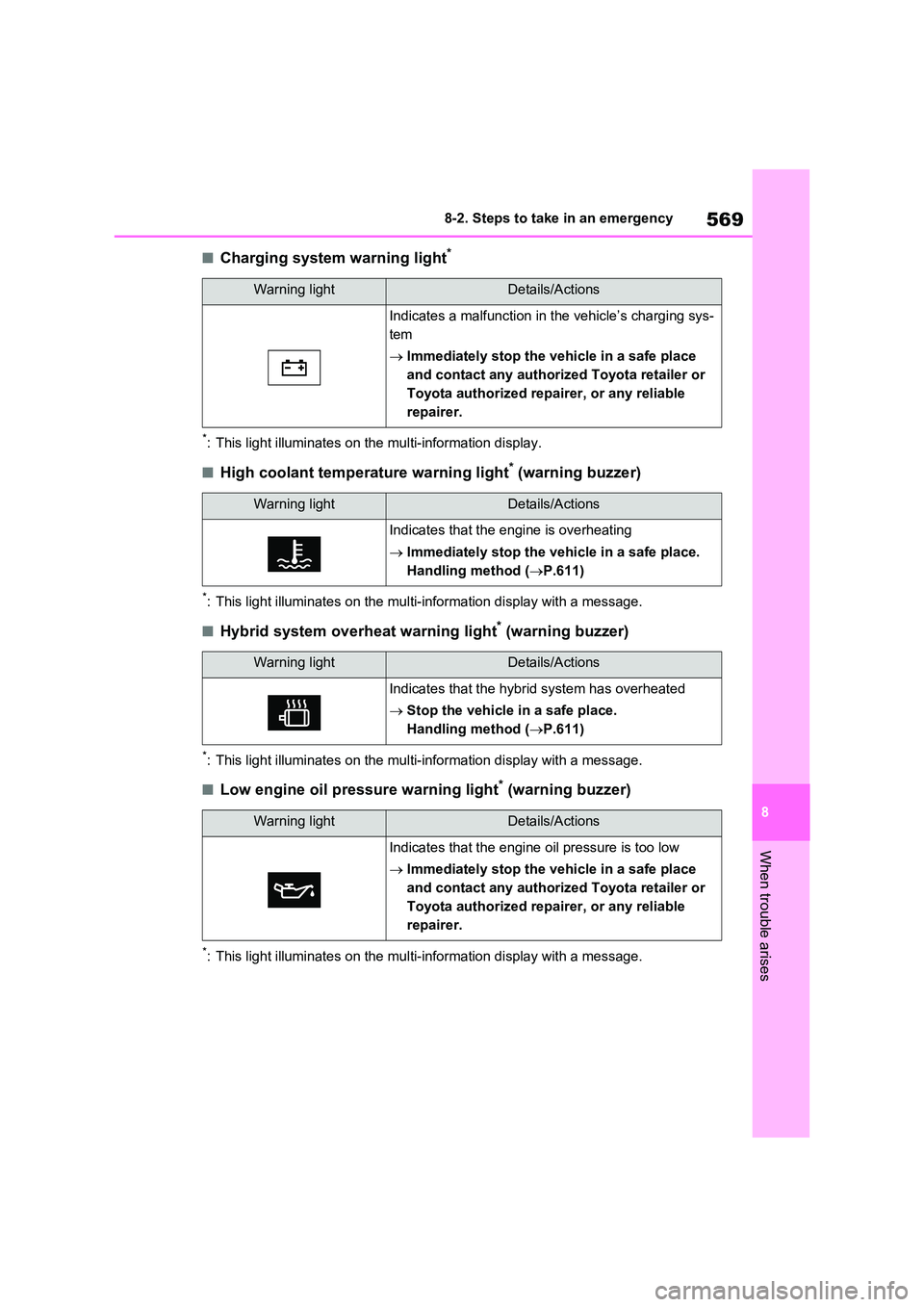
■Charging system warning light*
*: This light illuminates on the multi-information display.
■High coolant temperature warning light* (warning buzzer)
*: This light illuminates on the multi-information display with a message.
■Hybrid system overheat warning light* (warning buzzer)
*: This light illuminates on the multi-information display with a message.
■Low engine oil pressure warning light* (warning buzzer)
*: This light illuminates on the multi-information display with a message.
Warning lightDetails/Actions
Indicates a malfunction in the vehicle’s charging sys-
tem
Immediately stop the vehicle in a safe place
and contact any authorized Toyota retailer or
Toyota authorized repairer, or any reliable
repairer.
Warning lightDetails/Actions
Indicates that the engine is overheating
Immediately stop the vehicle in a safe place.
Handling method ( P.611)
Warning lightDetails/Actions
Indicates that the hybrid system has overheated
Stop the vehicle in a safe place.
Handling method ( P.611)
Warning lightDetails/Actions
Indicates that the engine oil pressure is too low
Immediately stop the vehicle in a safe place
and contact any authorized Toyota retailer or
Toyota authorized repairer, or any reliable
repairer.
Page 611 of 664
611
8
8-2. Steps to take in an emergency
When trouble arises
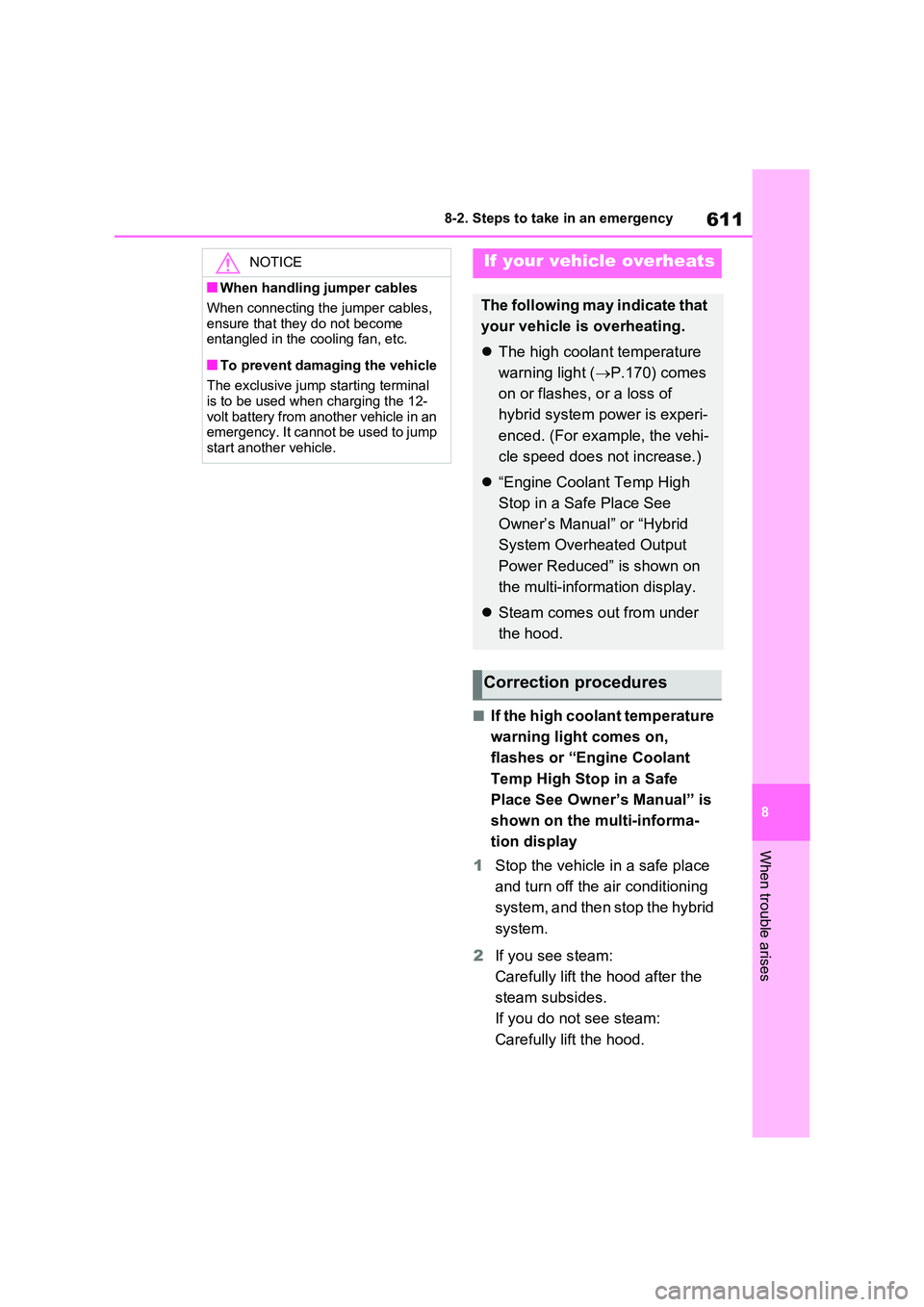
■If the high coolant temperature
warning light comes on,
flashes or “Engine Coolant
Temp High Stop in a Safe
Place See Owner’s Manual” is
shown on the multi-informa-
tion display
1 Stop the vehicle in a safe place
and turn off the air conditioning
system, and then stop the hybrid
system.
2 If you see steam:
Carefully lift the hood after the
steam subsides.
If you do not see steam:
Carefully lift the hood.
NOTICE
■When handling jumper cables
When connecting the jumper cables,
ensure that they do not become entangled in the cooling fan, etc.
■To prevent damaging the vehicle
The exclusive jump starting terminal is to be used when charging the 12-
volt battery from another vehicle in an emergency. It cannot be used to jump start another vehicle.
If your vehicle overheats
The following may indicate that
your vehicle is overheating.
The high coolant temperature
warning light ( P.170) comes
on or flashes, or a loss of
hybrid system power is experi-
enced. (For example, the vehi-
cle speed does not increase.)
“Engine Coolant Temp High
Stop in a Safe Place See
Owner’s Manual” or “Hybrid
System Overheated Output
Power Reduced” is shown on
the multi-information display.
Steam comes out from under
the hood.
Correction procedures
Page 651 of 664

651Alphabetical Index
When charging cannot be carried
out ............................................ 156
Charging port ................................ 105
If the charging port lid does not open
................................................. 121
Locking and unlocking ............... 121
Opening and closing .................. 106
Child-protector.............................. 209
Child restraint system .................... 50
Child restraint system installation
method....................................... 60
Fixed with a seat belt ................... 61
Fixed with an ISOFIX lower anchor-
age ............................................. 62
Points to remember...................... 51
Riding with children ...................... 49
Using a top tether anchorage....... 63
Child safety ..................................... 49
12-volt battery precautions. 507, 610
Airbag precautions ....................... 43
Back door precautions ............... 210
Charging precautions ................. 133
Heated steering wheel and seat
heater precautions ................... 462
How your child should wear the seat
belt ............................................. 36
Panoramic moon roof precautions
................................................. 296
Power window lock switch ......... 293
Power window precautions ........ 292
Rear door child-protectors ......... 209
Seat belt precautions ................... 35
Seat heater precautions ............. 462
Cleaning ................................ 488, 491
Aluminum wheels ....................... 488
DC/DC Converter air intake vent 536
Exterior....................................... 488
Front camera.............................. 345
Interior ........................................ 491
Radar sensor ............................. 345
Seat belts ................................... 491Water-repellent coating .............. 489
Clock ..............................................179
Coat hooks .................................... 484
Condenser ..................................... 504
Console box .................................. 469
Consumption screen .................... 195
Coolant
Capacity ..................................... 622
Checking .................................... 503
Preparing and checking before win-
ter ............................................. 445
Warning light .............................. 569
Cooling system .............................503
Engine overheating .................... 611
Hybrid system overheating......... 613
Cruise control
Cruise control .............................388
Dynamic radar cruise control with
full-speed range .......................376
Cup holders ...................................470
Current fuel consumption ............198
Current fuel economy................... 181
Curtain shield airbags ....................39
Customizable features ................. 629
D
Daytime running light system ..... 332
Replacing light bulbs ..................548
DC/DC converter air intake vent .... 98
Cleaning ..................................... 536
Deck board .................................... 472
Deck under tray.............................473
Defogger
Outside rear view mirrors ........... 454
Rear window .............................. 454
Windshield.................................. 453
Digital Rear-view Mirror ............... 280
Dimensions ...................................618
Display
BSM (Blind Spot Monitor)........... 393
Consumption screen ..................195
Page 653 of 664
653Alphabetical Index
If a warning light turns on ........... 568
If a warning message is displayed
................................................. 578
If the 12-volt battery is discharged
................................................. 606
If the electronic key does not operate
properly.................................... 604
If the fuel filler door cannot be
opened..................................... 603
If the hybrid system will not start 601
If the vehicle is trapped in rising
water ........................................ 561
If you have a flat tire........... 582, 593
If you lose your keys .................. 603
If you think something is wrong.. 566
If your vehicle becomes stuck .... 615
If your vehicle has to be stopped in
an emergency .......................... 560
If your vehicle needs to be towed
................................................. 563
If your vehicle overheats ............ 611
Emergency brake signal .............. 439
Emergency flashers ..................... 560
Emergency tire puncture repair kit
..................................................... 582
Energy monitor ............................. 195
Engine
Compartment ............................. 501
Exhaust gas precautions.............. 47
Hood .......................................... 498
How to start the hybrid system... 317
Identification number.................. 619
If the hybrid system will not start 601
If your vehicle has to be stopped in
an emergency .......................... 560
Overheating ............................... 611
Power switch .............................. 317
Engine coolant
Capacity ..................................... 622
Checking .................................... 503
High coolant temperature warning light .......................................... 569
Preparing and checking before win-
ter ............................................. 445
Warning light .............................. 569
Engine coolant temperature gauge
..................................................... 174
Engine oil
Capacity ..................................... 621
Checking .................................... 501
Preparing and checking before win-
ter ............................................. 445
Warning light .............................. 569
EPS (Electric Power Steering)
Function ..................................... 438
Warning light .............................. 570
EV/HV mode selection switch........ 86
EV driving range ........................... 102
EV mode ..........................................85
Exhaust gas precautions ............... 47
Extended Headlight Lighting system
..................................................... 333
F
Flat tire ................................... 582, 593
Tire pressure warning system .... 511
Floor mats ....................................... 32
Fluid
Brake .......................................... 624
Hybrid transmission.................... 623
Rear differential .......................... 624
Washer ....................................... 505
Fog lights
Replacing light bulbs ..................548
Switch......................................... 337
Wattage ...................................... 625
Footwell lights............................... 465
Front fog lights
Replacing light bulbs ..................548
Switch......................................... 337
Wattage ...................................... 625
Front passenger’s seat belt reminder