2011 SKODA OCTAVIA TOUR heating
[x] Cancel search: heatingPage 72 of 183

Heating and air conditioning system71
Using the system
Safety
Driving Tips
General Maintenance
Breakdown assistance
Technical Data
Set ClimaticRecommended settings of Climatic controls for the respective operating modes:
Setup
Setting of the control dial
Button
Air outlet vents 3
Defrosting the windscreen and
side windows
To the right up to
the stop
3
Switched off
Do not switch on
Open and align with the side window
Free windscreen and side win-
dows from mist
Desired tempera-ture
2 or 3
switched on
Do not switch on
Open and align with the side window
The fastest heating
To the right up to the stop
3
Switched off
briefly switched on
Opening
Comfortable heating
Desired tempera- ture
2 or 3
Switched off
Do not switch on
Opening
the fastest cooling
T o t h e l e f t u p t o t h e stop
briefly 4, then 2or 3
switched on
briefly switched on
Opening
optimal cooling
Desired tempera- ture
1, 2 or 3
switched on
Do not switch on
open and align to the roof
Fresh air mode - ventilation
T o t h e l e f t u p t o t h e stop
Desired position
Switched off
Do not switch on
Opening
A
B
C
2
3
s2lk.2.book Page 71 Monday, April 18, 2011 7:41 AM
Page 73 of 183

Heating and air conditioning system
72
Recirculated air mode
In recirculated air mode air is sucked out of the interior of the vehicle
and then fed back into the interior.Recirculated air mode prevents polluted ai r outside the vehicle from getting into the
vehicle, for example when driving through a tunnel or when standing in a traffic jam.Switching recirculated air mode on– Press the button page 70, fig. 82 the warning light lights up in the
button.Switching recirculated air mode off– Once again press the button . The warning light in the button goes out.
The recirculated air mode is switched off au tomatically if the air distribution control
is in position
page 70, fig. 82 . You can also switch recirculated air mode on
again from this setting by re peatedly pressing pushbutton .
WARNING
You should not leave recirculated air mode on over a longer period of time, as
“stale” air may result in fatigue in the dr iver and occupants, divert your attention
and also cause the windows to mist up. Th e risk of having an accident increases.
Switch recirculated air mode off as soon as the windows begin misting up.Using the air conditioning system economicallyThe compressor on the air conditioning system uses power from the engine when
in cooling mode which will effect the fuel consumption.
It recommended to open the windows or the doors of a vehicle for which the interior
has been strongly heated through the effect of direct sunlight in order to allow the
heated air to escape.
The cooling system should not be switched on while travelling when the window is
open.
The desired interior temperature can also be achieved without switching in the
cooling system just by switching to fresh air mode.
For the sake of the environment
When you economize on fuel, you also reduce pollutant emissions.Operational malfunctionsIf the cooling system does not operate at outside temperatures higher than +5 °C,
there is a problem in the system. The reasons for this may be:•
The fuse on the air conditioning system has blown. Check the fuse, replace it if
necessary page 156.
•
The cooling system has switched off automatically for a short time because the
coolant temperature of the engine is too hot page 16.
If you are not able to rectify the operat ional problem yourself, or if the cooling
capacity decreases, switch the cooling system off. Contact a specialist garage.
3
C
s2lk.2.book Page 72 Monday, April 18, 2011 7:41 AM
Page 74 of 183

Starting-off and Driving73
Using the system
Safety
Driving Tips
General Maintenance
Breakdown assistance
Technical Data
Starting-off and DrivingSetting steering wheel positionFig. 83 Adjustable steering wheel: Lever below steering columnYou can set the height and the forward/back position of the steering wheel to the
desired position.
– Adjust the driver seat page 11.
– Pull the lever below the steering column down fig. 83 - left. Observe the
guidelines .
– Set the steering wheel to the desired position (concerning height and forward/back position).
– Push the lever upwards as far as the stop.
WARNING
•
You must not adjust the steering wheel when the vehicle is moving!
•
The driver must maintain a distance of at least 25 cm to the steering wheel
fig. 83 - right. Not maintaining this minimum distance will mean that the
airbag system will not be able to properly protect you - hazard!
•
For safety reasons the lever must always be firmly pushed up to avoid the
steering wheel altering its position unin tentionally when driving - risk of acci-
dent!
•
If you adjust the steering wheel further towards the head, you will reduce
the protection offered by the driver airbag in the event of an accident. Make sure
the steering wheel is aligned to the chest.
•
When driving, hold the steering wheel with both hands firmly on the outer
edge in the 9 o'clock and 3 o'clock positi on. Never hold the steering wheel firmly
in the 12 o'clock position or in another way (e.g. in the middle of the steering
wheel or at the inner steering wheel edge). In such cases, injuries to the arms,
the hands and the head can occur when the driver airbag is deployed.
Ignition lockPetrol engines
- ignition switched off, engine off, the steering can be locked.
- ignition switched on
- start engine
Diesel engines - interruption of fuel suppl y, ignition switched off, engine off, the steering can
be locked.
- heating glow plugs on, ignition switched on•
You should not switch on any major elec trical components during the heating
period. Otherwise the vehicle battery will be drained unnecessarily.
- start engineWARNING (continued)
Fig. 84 Ignition lock positions
123123
s2lk.2.book Page 73 Monday, April 18, 2011 7:41 AM
Page 76 of 183

Starting-off and Driving75
Using the system
Safety
Driving Tips
General Maintenance
Breakdown assistance
Technical Data
Petrol enginesThese engines are fitted with a starter system which selects the correct fuel-air
mixture for every external air temperature.•
Do not operate accelerator before and when starting engine.
•
Interrupt the attempt at star ting after 10 seconds if the engine does not start
right away and wait for about 30 seconds before repe ating the attempt.
•
It is possible that the fuse on the electrical fuel pump is defect if the engine still
does not start. Check the fuse and replace it if necessary page 156.
•
Contact the nearest specialist garage to obtain professional assistance.
It may be necessary, if the engine is very hot, to slightly depress the accelerator
after the engine has started.
Diesel enginesGlow plug system
Diesel engines are equipped with a glow plug system, the preglow period being
controlled automatically in line with the coolant temperature and outside tempera-
ture.
The preglow indicator light
comes on after the ignition has been switched on.
You should not switch on any major elec trical components during the heating
period otherwise the vehicle battery will be drained unnecessarily.
•
You should start the engine immediately after the glow plug warning light
has gone out.
•
The glow plug warning light will come on for about one second if the engine is
at a normal operating temperature or if th e outside temperature is above +5 °C. This
means that you can start the engine right away .
•
Interrupt the attempt at starting after 10 seconds if the engine does not start
right away and wait for about 30 seconds before repe ating the attempt.
•
It is possible that the fuse on the diesel preglow system is defect if the engine
still does not start. Check the fuse and replace it if necessary page 156.
•
Contact the nearest specialist garage to obtain professional assistance.
Starting the engine after the fuel tank has run dry
It may take longer than normal to start the engine after refuelling if the fuel tank
has run completely dry - up to one minute. This is because the fuel system must first
of all be filled while the attempting to start the engine.
Switching off the engine– The engine can be switched off by tur ning the ignition key into position
page 73, fig. 84 .
WARNING
•
Never switch off the engine before the ve hicle is stationary - risk of accident!
•
The brake booster only operates when the engine is running. Greater phys-
ical effort for braking is required when en gine is switched off. Because if you do
not stop as normal, this can caus e an accident and severe injuries.Caution
you should not switch the engine off right away at the end of your journey after the
engine has been operated for a lengthy period at high loads but should be allowed
it to run at idling speed for about 2 minutes . This prevents any accumulation of heat
when the engine is switched off.
Note
•
The radiator fan may continue running for a further 10 minutes or so after the
engine and the ignition have been switched off. The coolant fan may, however, also
switch on again after some time if the coolant temperature rises because of an
a c c um ul a tio n o f he a t i n the en g in e o r i f the engine is warm and the engine compart-
ment is additionally heat ed by strong sunlight.
•
This is why particular care is required when carrying out any work in the engine
compartment page 131, “Working in the engine compartment”.
1
s2lk.2.book Page 75 Monday, April 18, 2011 7:41 AM
Page 77 of 183
Starting-off and Driving
76
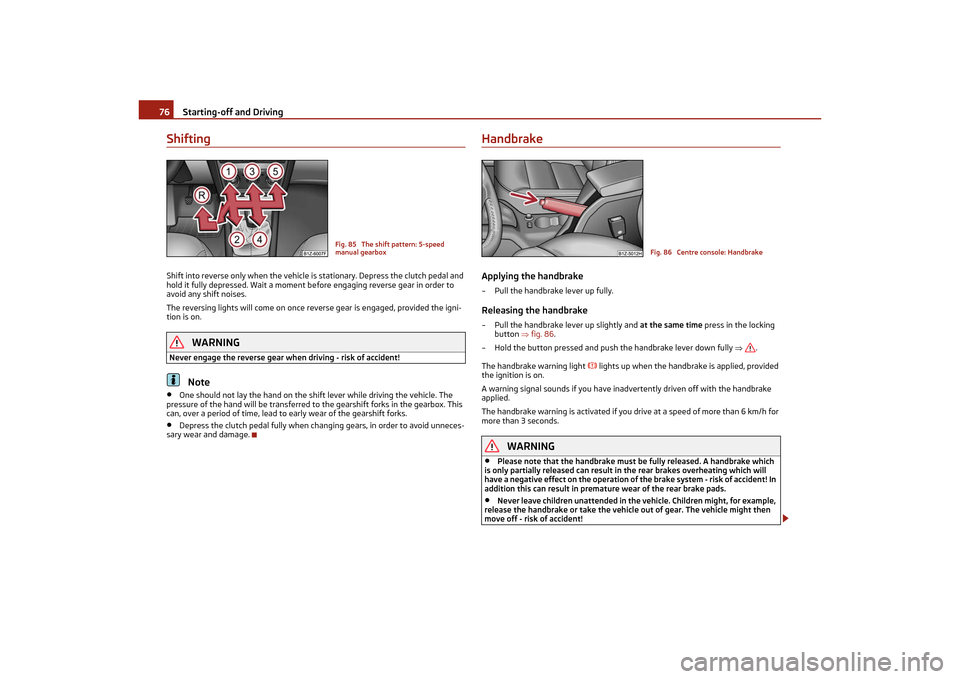
ShiftingShift into reverse only when the vehicle is stationary. Depress the clutch pedal and
hold it fully depressed. Wait a moment be fore engaging reverse gear in order to
avoid any shift noises.
The reversing lights will come on once reverse gear is engaged, provided the igni-
tion is on.
WARNING
Never engage the reverse gear when driving - risk of accident!
Note
•
One should not lay the hand on the shift lever while driving the vehicle. The
pressure of the hand will be transferred to the gearshift forks in the gearbox. This
can, over a period of time, lead to early wear of the gearshift forks.
•
Depress the clutch pedal fully when changing gears, in order to avoid unneces-
sary wear and damage.
HandbrakeApplying the handbrake– Pull the handbrake lever up fully.Releasing the handbrake– Pull the handbrake lever up slightly and at the same time press in the locking
button fig. 86.
– Hold the button pressed and push the handbrake lever down fully .
The handbrake warning light
lights up when the handbrake is applied, provided
the ignition is on.
A warning signal sounds if you have inadvertently driven off with the handbrake
applied.
The handbrake warning is activated if you drive at a speed of more than 6 km/h for
more than 3 seconds.
WARNING
•
Please note that the hand brake must be fully released. A handbrake which
is only partially released can result in the rear brakes overheating which will
have a negative effect on the operation of the brake system - risk of accident! In
addition this can result in premat ure wear of the rear brake pads.
•
Never leave children unattended in the vehicle. Children might, for example,
release the handbrake or take the vehicl e out of gear. The vehicle might then
move off - risk of accident!
Fig. 85 The shift pattern: 5-speed
manual gearbox
Fig. 86 Centre console: Handbrake
s2lk.2.book Page 76 Monday, April 18, 2011 7:41 AM
Page 107 of 183

Intelligent Technology
106
•
Changes to vehicle (e.g. on engine, on the brakes, on chassis or another combi-
nation of tyres and wheels) can influence the function of the ESP page 146,
“Accessories, changing and replacing parts”.
Electronic Differential Lock (EDL)*
The electronic differential lock prevents an individual wheel from
slipping.Models fitted with ESP are equipped with electronic differential lock (EDL).
General
The EDL makes it much easier, and sometimes at all possible, to start off, accelerate
and climb a steep hill when the conditions of the road surface are unfavourable.
Operating principle
The EDL is activated automatically, that is without any action on the part of the
driver. It monitors the speeds of the driven wheels with the aid of the ABS sensors.
Should only one drive wheel begin spinning on a slippery surface there will be an
appreciable difference in the speed of the driven wheels. The EDL function brakes
the slipping wheel and the differential transmits a greater driving force to the other
driven wheel. This control process is also accompanied by noises.
Overheating of the brakes
The EDL switches off automatically if unusually severe stresses exist in order to
avoid excessive heat genera tion in the disc brake on the wheel which is being
braked. The vehicle can continue to be driven and has the same characteristics as a
vehicle not fitted with EDL.
The EDL switches on again automatically as soon as the brake has cooled down.
WARNING
•
Carefully depress the accelerator when accelerating on uniformly slippery
road surfaces, such as ice and snow. The driven wheels might still spin despite
the EDL and affect the stability of the vehicle - risk of an accident!
•
You should always adapt your style of dr iving to the condition of road surface
and to the traffic situation even when your vehicle is fitted with EDL. The
increased safety offered must not temp t you to take greater risks than other-
wise - risk of an accident!
Note
•
If the ABS or ESP warning light comes on, this may also indicate a fault in the
EDL. Please have the vehicle inspected as soon as possible by a specialist garage.
•
Changes to vehicle (e.g. on engine, on the brakes, on chassis or another combi-
nation of tyres and wheels) can in fluence the function of the EDL page 146,
“Accessories, changing and replacing parts”.
Traction control system (TCS)
The traction control system prevents the driven wheels from spin-
ning when accelerating.General
The TCS makes it much easier, and sometimes at all possible, to start off, accelerate
and climb a steep hill when the conditions of the road surface are unfavourable.
Operating principle
The TCS switches on automatically when the engine is started and then conducts a
self-test. The system monitors the speeds of the driven wheels with the aid of the
ABS sensors. If the wheels are spinning, th e force transmitted to the road surface is
automatically adapted by reducing the engi ne speed. The system operates at all
speeds.
The TCS operates in combination with the ABS page 108, “Antilock brake system
(ABS)”. The TCS will not function if a fault exists in the ABS system.
The TCS warning light lights up in the instrument cluster when there is a fault on
the TCS
page 25.
During an intervention of th e system, the TCS warning light
flashes in the instru-
ment cluster page 25.
Fig. 112 TCS switch
s2lk.2.book Page 106 Monday, April 18, 2011 7:41 AM
Page 120 of 183

Towing a trailer119
Using the system
Safety
Driving Tips
General Maintenance
Breakdown assistance
Technical Data
Driving Tips
Particular caution is required when towing a trailer.– Do not, as far as possible, drive with your vehicle unladen and the trailer laden.
– Do not make full use of the legal maximum speeds. This applies in particular to downhill sections.
– Apply the brakes in good time.
– Keep a check on the coolant temperatur e gauge if the outside temperature is
high.
Distribution of weight
The distribution of the weight is very poor if your vehicle is unladen and the trailer
is laden. Maintain a particularly low speed if you cannot avoid driving with this
combination.
Driving speed
Do not drive faster than 80 km/hour for sa fety reasons. This also applies for coun-
tries in which higher speeds are allowed.
The fact that the driving stability of the vehicle + trailer combination reduces with
increasing speed means that the legally allowed speed should not be used when
there are unfavourable road, weather or wind conditions, particularly near accident
black spots.
You must always reduce your speed immedi ately as soon as you detect even just
the slightest swaying of the trailer. On no account attempt to stop the trailer from
“swaying” by accelerating.
Apply the brakes in good time! If the trailer is fitted with a trailer brake, apply the
brakes gently at first and then brake firmly . This will avoid brake jolts resulting from
the trailer wheels locking. Shift down gears in good time before negotiating a
downhill section to allow the engine to also act as a brake.
Engine overheating
Please keep a check on the coolant temper ature gauge if you have to negotiate a
lengthy slope in a low gear at a high engine speed when the outside temperature is
very high page 16, “Engine coolant temperature Display”.
If the needle of the coolant temperature gauge moves into the right-hand area or
even the red area of the scale, reduce yo ur speed immediately. Stop and switch off
the engine if the warning light
in the instrument cluster begins flashing. Wait a
few minutes and check the level of coolant in the coolant expansion bottle
page 134, “Inspecting the coolant level”. Please refer to the following guidelines
page 25, “Coolant temperature/coolant
level ”.
The coolant temperature can be reduced by switching on the heating.
Any increase in the cooling effect of the coolant fan through shifting down a gear
and increasing the engine speed is not possible since the fan speed is independent
of the engine speed. One should also not drop a gear for this reason when towing a
trailer as long as the engine can manage the slope without any drop in speed.
Detachable towing device*The ball head of the towing device is stow ed together with separate fitting instruc-
tions in the spare wheel well in the luggage compartment of the vehicle.
Inspect the ball head to ensure that it is properly locked each time before setting
off. The inspection is performed by turning the closed locking lever downwards. If
the locking lever can only be turned around a small angle (approx. 5°), the locking
mechanism is O.K. After the inspection pull the locking lever back again to its stop.
The towing device must not be used, if it does not wish to close or the locking lever
turns slightly in the closed position.
WARNING
Do not use any aids or tools for installing or removing the ball head. This might
result in damage to the locking mechanism to the extent that the safety of the
towing device is no longer assured - risk of an accident.
Note
•
Do not carry out any modifications or re pairs to the ball head or to any other
components on the towing device.
Fig. 118 Detachable ball head
s2lk.2.book Page 119 Monday, April 18, 2011 7:41 AM
Page 124 of 183

Taking care of your vehicle and cleaning the vehicle123
Using the system
Safety
Driving Tips
General Maintenance
Breakdown assistance
Technical Data
PolishingPolishing is only necessary if the paintwork of your vehicle has become unattractive
and if it is no longer possible to achieve a gloss with wax preservers.
You must treat the paintwork with a wax preserver if the polish you use does not
contain any preserving elements page 122.
We recommend using a preservative from Škoda genuine accessories offered by
your Škoda dealer.
Caution
•
You must not treat mat painted parts or plastic with polishing products or hard
wax.
•
Do not polish the paintwork of the vehicle in a dusty environment, otherwise the
paintwork can be scratched.
Chrome partsFirst clean the chrome parts with a damp cloth and then polish them with a soft, dry
cloth. If it does not prove to be adequate, use a chrome care product from Škoda
original accessories.
Caution
Do not polish the chrome parts in a du sty environment, otherwise they can be
scratched.Paint damageS li g ht da m a g e t o p a in tw o rk s uc h a s s c ra tc h e s, sc uf f s o r tra c e s o f c hi p da m a ge m ust
be touched up immediately with paint (Škoda painting pen) before any corrosion
can result. You can of course have this work carried out by authorised Škoda Service
Partners.
The authorised Škoda Service Partners have a range of matching touch-up pens or
spray cans available in the colour of your vehicle.
The paint number of the original paintwork of your vehicle is indicated on the
vehicle data sticker page 165.
Any corrosion which has already have formed must be removed thoroughly. Apply a
corrosion protection primer and then the paint to the affected point. You can of
course have this work carried out by authorised Škoda Service Partners.
Plastic partsExternal plastic parts are cleaned by norm al washing. Plastic parts and synthetic
leather can also be treated with special solvent-free plastic cleaning agents if a
damp cloth is not sufficient. Paint care products are not suitable for plastic parts.
Caution
Solvent-free cleaners attack the material and can damage it.WindowsOnly use a plastic ice scraper for removi ng snow and ice from the windows and
mirrors. You should not move the ice scraper forward and backward but in one direc-
tion on the window which yo u are cleaning in order to avoid any damage to the
surface of the glass.
You can best remove residues of rubber, oil, grease, wax or silicone by using a
special window cleaner or a special silicone remover.
You should also clean the windows regularly from the inside.
Do not use window leathers which you have used to polish the vehicle body to dry
off the windows. Residues of preservatives in the window leather can dirty the
window and reduce visibility.
Do not affix any stickers over the inside of the rear window to avoid damage to the
heating elements of the rear window heater.
We recommend using a preservative from Škoda genuine accessories offered by
your Škoda dealer.
Caution
Never remove snow or ice from the glass parts with warm or hot water - risk of
formation of cracks in the glass!The headlight lensesPlease do not use any aggressive cleaning or chemical solvent products for cleaning
the front headlights - risk of damage to the plastic lenses. Please use soap and
clean warm water.
s2lk.2.book Page 123 Monday, April 18, 2011 7:41 AM