2011 SKODA OCTAVIA lock
[x] Cancel search: lockPage 76 of 248
Cup holder
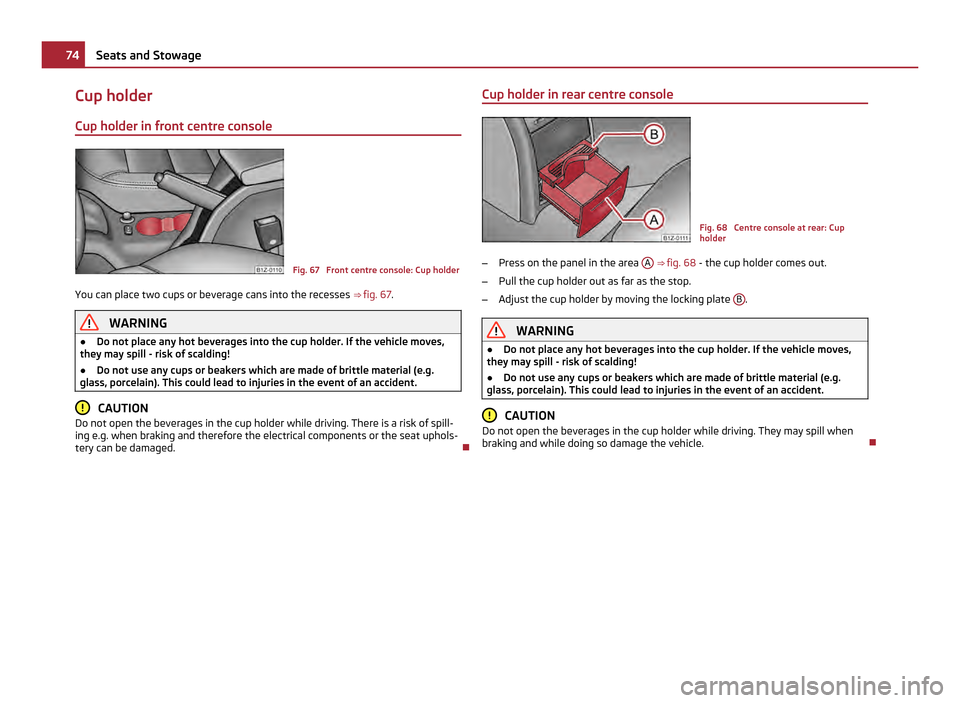
Cup holder in front centre console Fig. 67 Front centre console: Cup holder
You can place two cups or beverage cans into the recesses ⇒ fig. 67. WARNING
● Do not place any hot beverages into the cup holder. If the vehicle moves,
they may spill - risk of scalding!
● Do not use any cups or beakers which are made of brittle material (e.g.
glass, porcelain). This could lead to injuries in the event of an accident. CAUTION
Do not open the beverages in the cup holder while driving. There is a risk of spill-
ing e.g. when braking and therefore the electrical components or the seat uphols-
tery can be damaged. Cup holder in rear centre console Fig. 68 Centre console at rear: Cup
holder
– Press on the panel in the area A
⇒
fig. 68 - the cup holder comes out.
– Pull the cup holder out as far as the stop.
– Adjust the cup holder by moving the locking plate B .
WARNING
● Do not place any hot beverages into the cup holder. If the vehicle moves,
they may spill - risk of scalding!
● Do not use any cups or beakers which are made of brittle material (e.g.
glass, porcelain). This could lead to injuries in the event of an accident. CAUTION
Do not open the beverages in the cup holder while driving. They may spill when
braking and while doing so damage the vehicle. 74
Seats and Stowage
Page 82 of 248
Stowage compartment for spectacles
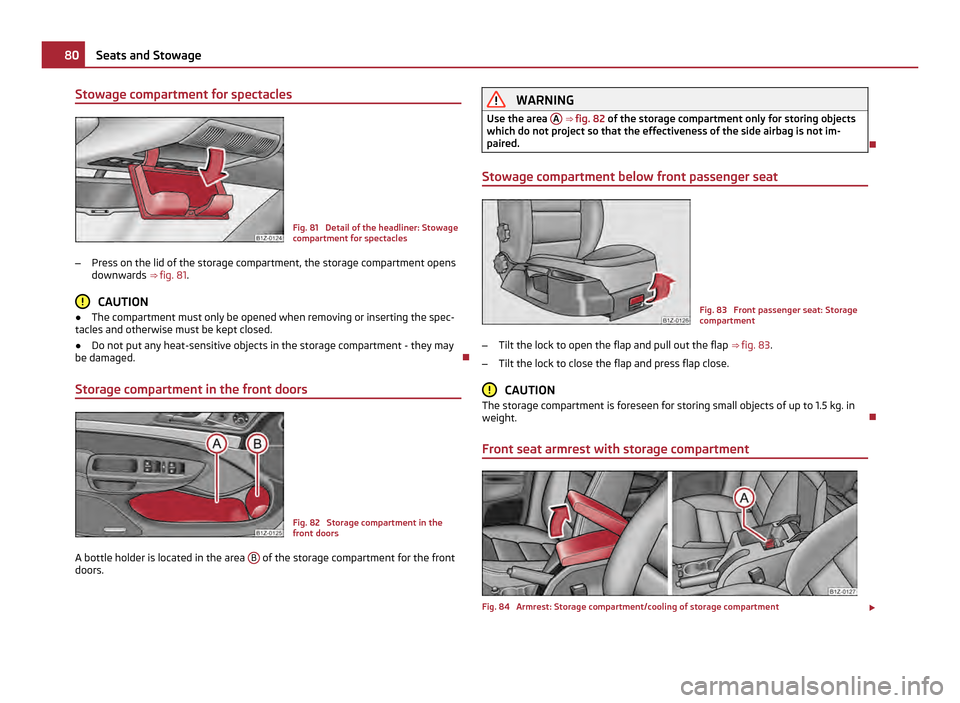
Fig. 81 Detail of the headliner: Stowage
compartment for spectacles
– Press on the lid of the storage compartment, the storage compartment opens
downwards ⇒ fig. 81 . CAUTION
● The compartment must only be opened when removing or inserting the spec-
tacles and otherwise must be kept closed.
● Do not put any heat-sensitive objects in the storage compartment - they may
be damaged.
Storage compartment in the front doors Fig. 82 Storage compartment in the
front doors
A bottle holder is located in the area B of the storage compartment for the front
doors. WARNING
Use the area A ⇒ fig. 82 of the storage compartment only for storing objects
which do not project so that the effectiveness of the side airbag is not im-
paired.
Stowage compartment below front passenger seat Fig. 83 Front passenger seat: Storage
compartment
– Tilt the lock to open the flap and pull out the flap ⇒ fig. 83 .
– Tilt the lock to close the flap and press flap close. CAUTION
The storage compartment is foreseen for storing small objects of up to 1.5 kg. in
weight.
Front seat armrest with storage compartment Fig. 84 Armrest: Storage compartment/cooling of storage compartment
£80
Seats and Stowage
Page 83 of 248

The armrest is adjustable for height and length.
Opening storage compartment
–
Open the lid of the armrest in the direction of arrow ⇒ fig. 84 - left.
Closing storage compartment
– Open the lid up to the stop, then you can fold it downwards.
Setting height
– First of all fold the lid to the bottom and lift it in the direction of arrow into one
of the 4 fixed positions.
Adjusting in forward/back direction
– Push the lid into the desired position.
Opening air inlet
– Pull the lock A in upward direction.
Closing air inlet
– Push the lock A as far as the stop downwards.
On vehicles fitted with air conditioning, the storage compartment is equipped
with a lockable inlet for thermally treated (warmed-up) air.
At open air supply, air flows into the storage with a temperature which is as high
as the one out of the air outlet nozzles, depending on temperature setting.
The air inlet in the storage compartment is connected to position through ad-
justment of the control dial for air distribution. This position causes the maximum
amount of air to flow into the storage compartment (depending on the rotary reg-
ulator position for the fan).
You can use the storage compartment, for example, to temper drinks cans, etc.
If you do not use the air inlet in the storage compartment, the end cover should
always be kept closed. Note
Push the lid of the armrest up to stop to the rear before operating the handbrake. Rear seat armrest with storage compartment
Fig. 85 Armrest of rear seats:
The armrest includes a storage compartment. You open the compartment by
pressing the button on the front side and raising the cover ⇒
fig. 85 .
Stowage compartment in rear centre console Fig. 86 Centre console at rear: Stowage
compartment
The storage compartment is equipped with a removable insert.
– Open the storage compartment by pulling on the upper edge of the storage
compartment A in the direction of arrow
⇒ fig. 86 . WARNING
The storage compartment is not a substitute for the ashtray and must also
not be used for such purposes - risk of fire! 81
Seats and Stowage Using the system Safety Driving Tips General Maintenance Breakdown assistance Technical data
Page 84 of 248

Seat backrest with opening for skis
Fig. 87 Rear seats: Handle of lid/luggage compartment: Unlock button
After folding open the armrest and the lid, an opening in the seat backrest be-
comes visible through which you can push the removable through-loading bag
with skis. You can fold open the armrest and the lid from the passenger or lug-
gage compartment.
Opening from passenger compartment
– Fold down the armrest of the rear seat at the loop ⇒ page 66.
– Pull the handle up to the stop in upward direction and fold open the lid down-
wards ⇒
fig. 87 - left.
Opening from luggage compartment
– Push the unlock button downwards ⇒
fig. 87 - right and fold the lid (with arm-
rest) to the front.
Closing
– Fold the lid and the armrest up to the stop in upward direction - the lid must
click into place audibly.
Ensure that the armrest is always locked into place after closing. You can recog-
nize this on the fact that the red field above the unlocking button A of the lug-
gage compartment is not visible. WARNING
The opening for the skis is solely used for transporting skis which are placed
in a properly secured removable through-loading bag ⇒
page 82. Through-loading bag The removable through-loading bag is solely used for transporting
skis. Fig. 88 Securing the removable
through-loading bag
Loading
– Open the boot lid/luggage compartment door.
– Fold the rear armrest and the cover in the seat backrest downwards
⇒ page 82, Seat backrest with opening for skis
.
– Place the empty removable through-loading bag in such a way that the end of
the bag with the zip lies in the boot.
– Push the skis into the removable through-loading bag from the luggage com-
partment ⇒ .
Securing
– Tighten the strap A on the free end around the skis in front of the bindings
⇒ fig. 88 .
– Fold the seat backrest a little forward.
– Guide the securing strap B through the opening in the seat backrest around
the upper part of the seat backrest.
– Then push the seat backrest back into the upright position until the locking
button clicks into place - check by pulling on the seat backrest.
– Insert the securing strap B into the lock
C until it is heard to lock in place.
On vehicles fitted with a luggage net partition, guide the securing strap B around
the housing when the net partition is rolled up. After fixing the luggage net parti-
tion in place, it is not longer possible to unroll the luggage net partition. £82
Seats and Stowage
Page 85 of 248

WARNING
● After placing skis into the through-loading bag, you must secure the bag
with the securing strap B .
● The strap A must hold the skis tight.
● Make sure that the strap A holds the skis in front of the binding (see also
imprint on the removable through-loading bag). Note
● The through-loading bag is foreseen for four pairs of skis. The total weight of
the skis which are transported must not exceed 17 kg.
● You must put the skis and the sticks in the removable through-loading bag
with the tips facing the rear.
● If there are several pairs of skis in the removable through-loading bag, ensure
that the bindings are positioned at the same height.
● Carefully fold the empty (dry) through-loading bag together, place it in the lug-
gage compartment and secure it to prevent it slipping. The removable through-
loading bag must never be folded together or stowed when moist.
Side compartment Fig. 89 Luggage compartment: Side
compartment
– You can open the compartment by turning the locks in the direction of arrow.
The CD changer is housed in this compartment. Stowage compartment behind the rear seats (Estate car)
Fig. 90 Removing the storage compart-
ment
Removing
– First remove the foldable luggage compartment cover ⇒ page 70.
– Grasp the housing with both hands and remove it by pulling in direction of ar-
row ⇒ fig. 90 .
Install
– Push the housing up to the stop into the catch.
– Re-insert the foldable luggage compartment cover. WARNING
Only place small and light objects up to a total weight of 3 kg into the storage
compartment. In the event of a vehicle collision heavy objects could be thrown
out of the compartment - risk of injuries! For this reason, the front part of the
luggage compartment cover must always cover over the storage compart-
ment.
Clothes hooks The clothes hooks are located on the middle pillar and on the handle of the head-
liner above each of the rear doors.
£ 83
Seats and Stowage Using the system Safety Driving Tips General Maintenance Breakdown assistance Technical data
Page 96 of 248

Auxiliary heating (auxiliary heating and ventilation)
Description and important information The auxiliary heating (auxiliary heating and ventilation) heats or
supplies the interior of the vehicle with fresh air independent of the
engine.
Auxiliary heating (parking heating)
The auxiliary heater (parking heater) functions in connection with the air-condi-
tioning system or Climatronic.
It can be used when stationary, when engine is switched off for preheating of the
vehicle as well as while driving (e.g. during the heating phase of the engine).
The engine is also preheated when the vehicle is stationary and the engine is
switched off, if the auxiliary heating is switched on.
The auxiliary heating (parking heating) warms up the coolant during the combus-
tion of fuel from the vehicle tank. The coolant warms up the air, which (if the
blower speed is not set to zero) flows into the occupant compartment.
Auxiliary ventilation
The auxiliary ventilation enables fresh air to flow into the vehicle interior by
switching off the engine, whereby the interior temperature is effectively de-
creased (e.g. with the vehicle parked in the sun). WARNING
● The auxiliary heating must never be operated in closed rooms - risk of poi-
soning!
● The auxiliary heating must not be running during refueling - risk of fire.
● The exhaust pipe of the auxiliary heating is located on the underside of
the vehicle. Therefore do not place the vehicle, if you wish to operate the aux-
iliary heating, in such a way that the exhaust gases of the auxiliary heating
can come easily into contact with inflammable materials (e.g. dry grass) or
easily inflammable substances (e.g. fuel run out). Note
If the auxiliary heating runs, the fuel consumption comes from the vehicle tank.
The auxiliary heating automatically controls the filling level in the fuel tank. If only
a low quantity of fuel is present in the fuel tank, the function of the auxiliary heat-
ing is blocked.
● The exhaust pipe of the auxiliary heating, which is located on the underside of
the vehicle, must not be clogged and the exhaust flow must not be blocked.
● If the auxiliary heating and ventilation is running, the vehicle battery discharg-
es. If the auxiliary heating and ventilation has been operated several times over a
longer period, the vehicle must be driven a few kilometers in order to recharge the
vehicle battery.
● The auxiliary heating only switches the blower on, if it has achieved a coolant
temperature of approx. 50 °C.
● At low outside temperatures, this can result in a formation of water vapour in
the area of the engine compartment. This is quite normal and is not an operating
problem.
● After switching off the auxiliary heating, the coolant pump runs for a short pe-
riod.
● The auxiliary heating and ventilation does not switch on or comes on, if the
vehicle battery indicates a low loading state ⇒
page 190, Automatic consumer
shut-off.
● The auxiliary heating (parking heating) does not switch on, if the following was
shown in the information display or before switching off the ignition: Please re-
fuel!
● The air inlet in front of the windscreen must be free of ice, snow or leaves in
order to ensure that the auxiliary heating operates properly.
● So that warm air can flow into the vehicle interior after switching on the auxili-
ary heating, you must maintain the comfort temperature normally selected by you
and leave the air outlet vents in an open position. It is recommended to put the air
flow in the position or . 94
Heating and air conditioning system
Page 98 of 248

After selecting the menu
Factory setting in the menu Aux. heating, it is possible
to return to the factory setting.
Radio remote control The auxiliary heating (auxiliary heating and ventilation) can be
switched on or off with the remote control. Fig. 97 Auxiliary heating: Radio remote control/bottom of the radio remote control with the
battery cover
–
For switching on, press the button ON .
– For switching off, press the button OFF .
The transmitter and the battery are housed in the housing of the remote control.
The receiver is located in the interior of the car.
If the battery is properly charged, the effective range is up to 600
m. For switching
on or off the auxiliary heating, hold the remote control vertically with the antenna A
⇒ fig. 97 towards the top. You must not cover over the antenna with the fin-
gers or the palm of the hand. Obstacles between the radio remote control and the
vehicle, bad weather conditions and a weaker battery can clearly reduce the
range.
The auxiliary heating can only be switched on or off with the radio remote control,
if the distance between the radio remote control and the vehicle is at least 2 m.
Warning light in the radio remote control
The warning light in the radio remote control ⇒ fig. 97
indicates after a keystroke
if the remote control signal was received by the auxiliary heating and if the bat-
tery is adequately charged. Display warning light Description
Lights up green for 2 seconds. The auxiliary heating was switched on.
Lights up red for 2 seconds. The auxiliary heating was switched off.
Slowly flashes green for 2 seconds. The ignition signal was not received.
Quickly flashes green for 2 seconds. The auxiliary heating is blocked, e. g
because the tank is nearly empty or
there is a fault in the auxiliary heating.
Flashes red for 2 seconds. The switch off signal was not received.
Lights up orange for 2 seconds, then
green or red. The battery is weak, however the
switching on or off signal was received.
Lights up orange for 2 seconds, then
flashes green or red. The battery is weak, however the
switching on or off signal was not re-
ceived.
Flashes orange for 5 seconds. The battery is discharged, however the
switching on or off signal was not re-
ceived. CAUTION
There are electronic components in the radio remote control, protect the remote
control against water, severe shocks and direct sun rays.
Changing the battery of the radio remote control If the warning light of the radio remote control indicates a weak or discharged
battery,
⇒ fig. 97, it must be replaced. The battery is located under a cover on the
back of the radio remote control.
– Insert a flat, blunt object, such as a coin, into the gap of the battery cover, turn
it against the direction of the arrow up to the mark, and unlock the cover
⇒ fig. 97 - right.
– Change the battery, replace the battery cover and lock it by moving it in the
direction of the arrow. For the sake of the environment
Dispose of a used battery in accordance with environmental regulations. £96
Heating and air conditioning system
Page 100 of 248

Starting-off and Driving
Setting steering wheel position Fig. 98 Adjustable steering wheel: Lever below the steering wheel/safe distance to the
steering wheel
You can set the height and the forward/back position of the steering wheel to the
desired position.
– Adjust the driver seat ⇒ page 60, Adjusting the front seats.
– Pull the lever below the steering wheel down ⇒ fig. 98 - left ⇒
.
– Set the steering wheel to the desired position (concerning height and forward/
back position).
– Push the lever upwards as far as the stop. WARNING
● You must not adjust the steering wheel when the vehicle is moving!
● The driver must maintain a distance of at least 25 cm to the steering wheel
⇒ fig. 98 - right. Not maintaining this minimum distance will mean that the air-
bag system will not be able to properly protect you - hazard!
● For safety reasons the lever must always be firmly pushed up to avoid the
steering wheel altering its position unintentionally when driving - risk of acci-
dent! WARNING (Continued)
● If you adjust the steering wheel further towards the head, you will reduce
the protection offered by the driver airbag in the event of an accident. Check
that the steering wheel is aligned to the chest.
● When driving, hold the steering wheel with both hands firmly on the outer
edge in the 9 o'clock and 3 o'clock position. Never hold the steering wheel
firmly in the 12 o'clock position or in another way (e.g. in the middle of the
steering wheel or at the inner steering wheel edge). In such cases, injuries to
the arms, the hands and the head can occur when the driver airbag is de-
ployed.
Ignition lock Fig. 99 Ignition lock positions
Petrol engines 1 - ignition switched off, engine off, the steering can be locked.
2 - ignition switched on
3 - start engine
Diesel engines 1 - interruption of fuel supply, ignition switched off, engine off, the steering can
be locked.
2 - heating glow plugs on, ignition switched on
● You should not switch on any major electrical components during the heating
period otherwise the vehicle battery will be drained unnecessarily. £98
Starting-off and Driving