2011 SKODA OCTAVIA lock
[x] Cancel search: lockPage 181 of 248

The filler flap is automatically unlocked or locked with the central locking.
Opening the fuel filler cap
–
Press in the middle of the left area of the fuel filler flap in direction of arrow 1⇒ fig. 147.
– Hold the fuel filler cap on the fuel filler tube with one hand and unlock it by
turning the vehicle key to the left (only valid for vehicles which do not have
automatic unlocking of the fuel filler flap).
– Unscrew the fuel filler cap anti-clockwise and place the fuel filler cap from
above on the fuel filler flap ⇒ fig. 147 - right.
Closing fuel filler cap
– Screw on the cap by turning it to the right until it is heard to lock.
– Hold the fuel filler cap on the fuel filler tube with one hand and lock it by turn-
ing the vehicle key to the right (only valid for vehicles which do not have auto-
matic locking of the fuel filler flap).
– Close the fuel filler flap until it locks.
The correct grade of fuel for your vehicle as well as the tyre size and inflation
pressures are stated on a sticker affixed to the inside of the fuel filler flap. Further
information on fuel ⇒
page 176.
The fuel tank has a capacity of about 55 litres or 60 litres 1)
. WARNING
Pay attention to any legal requirements if you do carry a spare canister in the
vehicle. We do not recommend carrying any fuel canisters in your vehicle for
safety reasons. The canister can be damaged in the event of an accident and
fuel may leak out. CAUTION
● Before refuelling it is necessary to switch off the auxiliary heating system
(auxiliary heating and ventilation).
● Remove any fuel which has spilled onto the paintwork of your vehicle immedi-
ately - risk of paint damage! ●
On vehicles fitted with a catalytic converter, never let the fuel tank run com-
pletely empty. An irregular supply of fuel to the engine can result in misfiring and
unburnt fuel may get into the exhaust system, which may result in overheating
and damage to the catalytic converter.
● The fuel tank is full just as soon as the pump nozzle switches off for the first
time, provided the nozzle has been operated properly. Do not continue refuelling -
otherwise the expansion volume is filled up. 1)
Valid for Octavia Combi 4x4 and Octavia Scout. 179
Fuel Using the system Safety Driving Tips General Maintenance Breakdown assistance Technical data
Page 182 of 248

Inspecting and Replenishing
Engine compartment
Bonnet remote release Fig. 148 Bonnet release lever
Bonnet remote release
– Pull the unlocking lever below the dash panel on the driver's side ⇒ fig. 148 .
The bonnet jumps out of its lock as a result of the spring force. A locking lever ap-
pears at the same time in the radiator grille.
Opening and closing the bonnet. Fig. 149 Radiator grille: Locking lever/securing the bonnet with the bonnet support
Opening the bonnet
–
Unlock the bonnet ⇒
fig. 148 . –
Ensure that the arms of the windscreen wipers are correctly in place against
the windscreen before opening the bonnet otherwise damage could occur to
the paintwork.
– Pulling on the locking lever in direction of arrow 1 ⇒
fig. 149
will unlock the
bonnet.
– Grip with the hand under the radiator grille and lift up the bonnet.
– Take the bonnet support out of its holder and set it in the opening 2 de-
signed for it.
Closing the bonnet
– Lift the bonnet slightly and unhook the bonnet support. Press the bonnet sup-
port into the holder designed to hold it.
– Allow the bonnet to drop from a height of about 20 cm into the lock - bonnet
do not press down on it!
– Check whether the bonnet is properly closed. WARNING
● Never open the bonnet if you see that steam or coolant is flowing out of
the engine compartment - risk of scalding! Wait long enough until the steam
or coolant has stopped escaping.
● For safety reasons, the bonnet must always be properly closed when driv-
ing. One should therefore check that the lock has in fact engaged properly af-
ter closing the bonnet.
● Stop your vehicle immediately while driving if you notice that the lock is
not properly engaged and close the bonnet properly - risk of an accident! CAUTION
Never open the bonnet using the locking lever - danger of causing damage. 180
Inspecting and Replenishing
Page 183 of 248

Working in the engine compartment
Particular care is required when carrying out any work in the en-
gine compartment!
There is a risk of injuries, scalding, accidents and fire when working in the en-
gine compartment, e.g. inspecting and replenishing oil and other fluids. For this
reason, it is essential to comply with the warning instructions stated below and
with the general applicable rules of safety. The engine compartment of your car
is a hazardous area ⇒
.
WARNING
● Never open the bonnet if you see that steam or coolant is flowing out of
the engine compartment - risk of scalding! Wait long enough until the steam
or coolant has stopped escaping.
● Switch off the engine and pull out the ignition key.
● Apply the handbrake firmly.
● If your vehicle is fitted with a manual gearbox, move the gearshift lever in-
to Neutral, or if it is fitted with automatic gearbox, move the selector lever in-
to position
P.
● Allow the engine to cool down.
● Keep children clear of the engine compartment.
● Do not touch any hot engine parts - risk of burns!
● Never spill oil and other fluids over the hot engine. Such fluids (e.g. the an-
tifreeze contained in the coolant) may ignite!
● Avoid short circuits in the electrical system - particularly on the battery.
● Never place your hand into the radiator fan as long as the engine is still
warm. The fan might suddenly start running!
● Never open the cap of the coolant expansion reservoir so long as the en-
gine is still warm. The cooling system is pressurized!
● Cover over the cap of the reservoir with a large cloth when opening it as
protection for your face, hands and arms from hot steam or hot coolant.
● Do not let objects, such as e.g cleaning cloth or tools lie in the engine com-
partment. WARNING (Continued)
● If you wish to work under the vehicle, you must secure the vehicle from
rolling away and support it with suitable supporting blocks: the car jack is not
sufficient for this - risk of injury!
● In cases where it be necessary to carry out inspection work when the en-
gine is running there is an additional risk from rotating parts (e.g. the V-ribbed
belt, alternator, radiator fan) and from the high-voltage ignition system.
Please observe in addition the following:
–Never touch the electrical cables of the ignition system.
– Absolutely avoid any jewellery, loose items of clothing or long hair from
getting into the rotating parts of the engine - Hazard! Therefore remove
any jewellery beforehand, tie up your hair and wear tight fitting clothing.
● Please also comply with the warning instructions stated below when car-
rying out any essential work on the fuel system or on the electrical system.
–Always separate the car battery from the electrical system.
– Do not smoke.
– Never carry out any work close to naked flames.
– Always keep a working fire extinguisher at hand. CAUTION
When replenishing fluids in the engine, always ensure that the fluids are on no ac-
count mixed up. This may result in major operating problems and also vehicle
damage! 181
Inspecting and Replenishing Using the system Safety Driving Tips General Maintenance Breakdown assistance Technical data
Page 187 of 248
Inspecting the coolant level
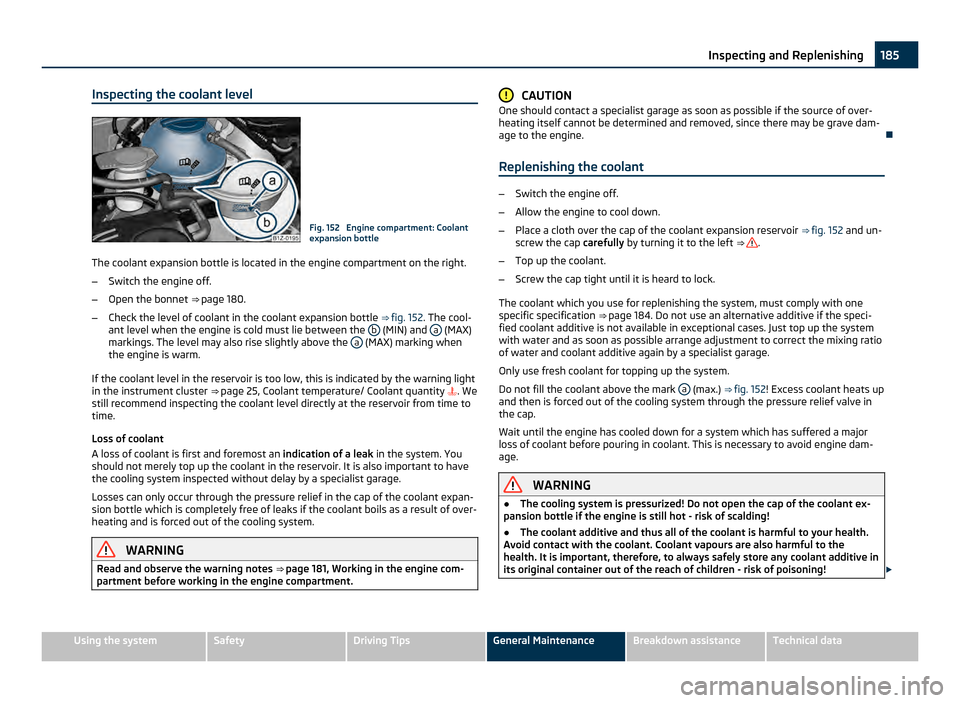
Fig. 152 Engine compartment: Coolant
expansion bottle
The coolant expansion bottle is located in the engine compartment on the right.
– Switch the engine off.
– Open the bonnet ⇒ page 180 .
– Check the level of coolant in the coolant expansion bottle ⇒ fig. 152 . The cool-
ant level when the engine is cold must lie between the b (MIN) and
a (MAX)
markings. The level may also rise slightly above the a (MAX) marking when
the engine is warm.
If the coolant level in the reservoir is too low, this is indicated by the warning light
in the instrument cluster ⇒ page 25, Coolant temperature/ Coolant quantity
. We
still recommend inspecting the coolant level directly at the reservoir from time to
time.
Loss of coolant
A loss of coolant is first and foremost an indication of a leak in the system. You
should not merely top up the coolant in the reservoir. It is also important to have
the cooling system inspected without delay by a specialist garage.
Losses can only occur through the pressure relief in the cap of the coolant expan-
sion bottle which is completely free of leaks if the coolant boils as a result of over-
heating and is forced out of the cooling system. WARNING
Read and observe the warning notes ⇒ page 181, Working in the engine com-
partment
before working in the engine compartment. CAUTION
One should contact a specialist garage as soon as possible if the source of over-
heating itself cannot be determined and removed, since there may be grave dam-
age to the engine.
Replenishing the coolant –
Switch the engine off.
– Allow the engine to cool down.
– Place a cloth over the cap of the coolant expansion reservoir ⇒
fig. 152 and un-
screw the cap carefully by turning it to the left ⇒ .
– Top up the coolant.
– Screw the cap tight until it is heard to lock.
The coolant which you use for replenishing the system, must comply with one
specific specification ⇒ page 184
. Do not use an alternative additive if the speci-
fied coolant additive is not available in exceptional cases. Just top up the system
with water and as soon as possible arrange adjustment to correct the mixing ratio
of water and coolant additive again by a specialist garage.
Only use fresh coolant for topping up the system.
Do not fill the coolant above the mark a (max.)
⇒ fig. 152 ! Excess coolant heats up
and then is forced out of the cooling system through the pressure relief valve in
the cap.
Wait until the engine has cooled down for a system which has suffered a major
loss of coolant before pouring in coolant. This is necessary to avoid engine dam-
age. WARNING
● The cooling system is pressurized! Do not open the cap of the coolant ex-
pansion bottle if the engine is still hot - risk of scalding!
● The coolant additive and thus all of the coolant is harmful to your health.
Avoid contact with the coolant. Coolant vapours are also harmful to the
health. It is important, therefore, to always safely store any coolant additive in
its original container out of the reach of children - risk of poisoning! £ 185
Inspecting and Replenishing Using the system Safety Driving Tips General Maintenance Breakdown assistance Technical data
Page 190 of 248

WARNING (Continued)
● Never charge a frozen or thawed battery - risk of explosion and caustic
burns! Replace a frozen battery.
● Never jump-start the batteries which have a too low electrolyte level - risk
of explosion and caustic burns!
● Never use a battery which is damaged - risk of explosion! Immediately re-
place a damaged battery. CAUTION
● You must only disconnect the battery if the ignition is switched off, otherwise
the electrical system (electronic components) of the vehicle may be damaged.
When disconnecting the battery from the electrical system of the vehicle, first dis-
connect the negative terminal (-) of the battery. Then disconnect the positive ter-
minal (+).
● When reconnecting the battery, first connect the positive terminal (+) and only
then the negative terminal (-) of the battery. You must on no account connect the
cables wrongly - risk of a cable fire.
● Ensure that battery acid does not come into contact with the vehicle body oth-
erwise damage could occur to the paintwork.
● Do not place the battery in direct daylight in order to protect the battery hous-
ing from the effects of ultra-violet light.
● If the vehicle has not been driven for more than 3 to 4 weeks, the battery will
discharge This is because certain electrical components consume electricity (e. g.
control units) also in idle state. You can prevent the discharging of the battery by
disconnecting the negative terminal or charging the battery constantly with a very
low charging current. For the sake of the environment
A removed battery is a special type of waste which is harmful to the environment
- contact your specialist garage regarding disposing of the battery. Note
● Please also refer to the guidelines ⇒ page 190
, also after connecting the bat-
tery.
● You should replace batteries older than 5 years. Battery cover
Fig. 154 Engine compartment: Polyester cover of the vehicle battery/plastic cover of the ve-
hicle battery
The battery is located in the engine compartment in a polyester cover
⇒ fig. 154 -
left or in a polyester cover ⇒
fig. 154 - right.
– Open the battery cover in direction of arrow 1
⇒
fig. 154 or press the interlock
2 on the side of the battery cover, fold the cover up and remove the battery.
– The installation of the battery cover takes place in the reverse order.
The edge of the polyester battery cover ⇒
fig. 154 - left is inserted between the
battery and the side wall of the battery cover when working on the battery.
Battery control Fig. 155 The battery: Electrolyte level
indicator
The battery is practically maintenance-free under normal operating conditions. £188
Inspecting and Replenishing
Page 192 of 248

WARNING
● Never charge a frozen or thawed battery - risk of explosion and caustic
burns. Replace a frozen battery.
● Never charge a battery which has a too low electrolyte level - risk of explo-
sion and caustic burns. CAUTION
On vehicles with the “START/STOP” system, the pole terminal of the charger must
not be connected directly to the negative terminal of the vehicle battery, but only
to the engine earth ⇒ fig. 172.
Disconnecting and reconnecting the battery On disconnecting and reconnecting the battery the following functions are initially
deactivated or are no longer able to operate fault-free.
Operation Operating measure
Electrical power window (operational faults) ⇒ page 41
Enter the car stereo/radio navigation system
code number see operating instructions for the
car stereo/radio navigation sys-
tem
Setting the clock ⇒ page 13
Data in the multi-functional indicator are de-
leted. ⇒ page 14
We recommend having the vehicle checked by an authorised ŠKODA Service Part-
ner to ensure full functionality of all electrical systems.
Replacing the battery When replacing a battery, the new new battery must have the same capacity,
voltage (12
V), amperage and be the same size. Suitable types of vehicle battery
are available from an authorised ŠKODA Service Partner.
We recommend you have a battery change carried out by an authorised ŠKODA
Service Partner, who will properly install the new battery and dispose of the origi-
nal one. CAUTION
Vehicles with a “START-STOP” system are fitted with a special battery type which
allows the battery control unit to check the energy level for recurring engine start.
This battery must only be replaced by a battery of the same type. For the sake of the environment
Batteries contain poisonous substances such as sulphuric acid and lead. For this
reason, it must be disposed of properly. Under no circumstances must it be dis-
posed of in the communal rubbish.
Automatic consumer shut-off Under heavy load on the vehicle battery, the vehicle electrical system manage-
ment automatically takes various measures to avoid draining the vehicle battery.
●
The idling speed is raised to allow the generator to deliver more electricity to
the electrical system.
● If necessary, some electrical consumers are limited in their performance or are
temporarily switched off completely. Note
Despite such intervention by the vehicle electric system management, the vehicle
battery may be drained. For example, when the ignition is switched on a long time
with the engine turned off or the side or parking lights are turned on during lon-
ger parking.
Windshield washer system Fig. 156 Engine compartment: Wind-
shield washer fluid reservoir
£190
Inspecting and Replenishing
Page 198 of 248

You can fit winter tyres of a lower speed category to your vehicle provided that
you also do not drive faster than the permissible maximum speed for such tyres,
even if the possible maximum speed of your vehicle is higher. The corresponding
tyre category can damage the tyres when exceeding the permissible maximum
speed.
Please pay attention to the notes if you decide to fit winter tyres
⇒
page 192.
You can also fit so-called “all-year tyres” instead of winter tyres.
Please contact your specialist garage if there are any points which are not clear
who will be able to provide you with information regarding the maximum speed
for your tyres. WARNING
You must on no account drive your car at more than the permissible maximum
speed for your winter tyres - risk of an accident resulting from tyre damage
and loss of control over your car. For the sake of the environment
Fit your summer tyres on again in good time since summer tyres offer you better
grip and handling on roads which are free of snow and ice as well as ar tempera-
tures below 7 °C - the braking distance is shorter, there is less tyre noise, tyre
wear is reduced and fuel consumption is reduced. Note
Please observe the various differing legal requirements regarding tyres.
Unidirectional tyres The direction of rotation of the tyres is marked by arrows on the wall of the tyre
.
This indicates the direction of rotation of the tyre, and it is essential that the tyres
are fitted on to run in this direction. Only then are the tyres able to provide the
optimal properties in terms of grip, low noise, wear-and-tear and aquaplaning.
Should it be necessary to fit on a spare wheel in exceptional cases with a tyre not
dedicated to the running direction or in opposite running direction, please adopt a
cautious style of driving as the tyre is no longer able to provide optimal grip and
handling in such a situation. This particularly important on wet roads. Pay atten-
tion to the following points ⇒
page 199, Spare wheel.
You should have the defective tyre replaced as soon as possible and restore the
correct direction of rotation on all tyres Snow chains Snow chains must only be mounted on the front wheels.
When driving on wintry roads, snow chains improve not only traction, but also the
braking performance.
For technical reasons, it is only permissible to fit snow chains with the following
wheel/tyre combinations. Wheel size Depth (D) Tyre size
6J x 15
a) 47 mm 195/65
6.5J x 15
a) 50 mm 195/65
6J x 16
a) 50 mm 205/55
6J x 17
b) 45 mm 205/50
a)
Only fit snow chains with links and locks not larger than 15 mm.
b) Only fit snow chains with links and locks not larger than 9 mm.
Remove the full wheel trims before installing the snow chains.
Observe the different national legal regulations relating to the use of snow chains
and the maximum vehicle speed with snow chains. WARNING
Please pay attention to the information in the supplied fitting instructions of
the snow chain manufacturer. CAUTION
You must take the chains off as soon as you drive on roads which are free of
snow. They adversely affect the handling of your vehicle, damage the tyres and
are rapidly destroyed. Note
We recommend that you use snow chains from ŠKODA Original Accessories. 196
Wheels and Tyres
Page 200 of 248
Breakdown assistance
Breakdown assistance
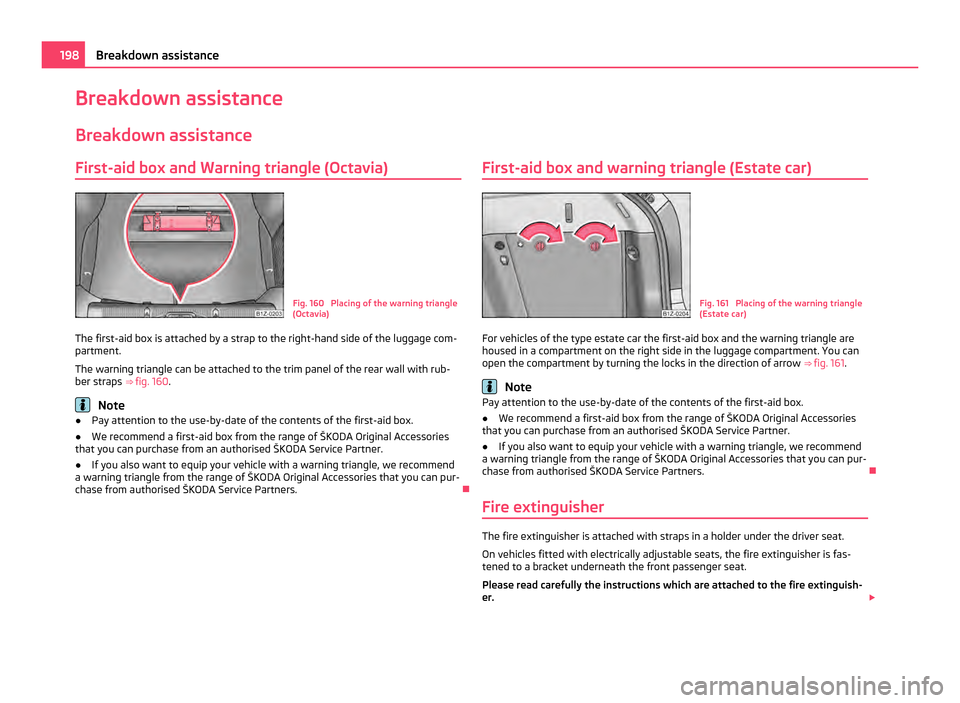
First-aid box and Warning triangle (Octavia) Fig. 160 Placing of the warning triangle
(Octavia)
The first-aid box is attached by a strap to the right-hand side of the luggage com-
partment.
The warning triangle can be attached to the trim panel of the rear wall with rub-
ber straps ⇒
fig. 160 . Note
● Pay attention to the use-by-date of the contents of the first-aid box.
● We recommend a first-aid box from the range of ŠKODA Original Accessories
that you can purchase from an authorised
ŠKODA Service Partner.
● If you also want to equip your vehicle with a warning triangle, we recommend
a warning triangle from the range of
ŠKODA Original Accessories that you can pur-
chase from authorised ŠKODA Service Partners. First-aid box and warning triangle (Estate car) Fig. 161 Placing of the warning triangle
(Estate car)
For vehicles of the type estate car the first-aid box and the warning triangle are
housed in a compartment on the right side in the luggage compartment. You can
open the compartment by turning the locks in the direction of arrow ⇒
fig. 161 . Note
Pay attention to the use-by-date of the contents of the first-aid box.
● We recommend a first-aid box from the range of ŠKODA Original Accessories
that you can purchase from an authorised
ŠKODA Service Partner.
● If you also want to equip your vehicle with a warning triangle, we recommend
a warning triangle from the range of
ŠKODA Original Accessories that you can pur-
chase from authorised ŠKODA Service Partners.
Fire extinguisher The fire extinguisher is attached with straps in a holder under the driver seat.
On vehicles fitted with electrically adjustable seats, the fire extinguisher is fas-
tened to a bracket underneath the front passenger seat.
Please read carefully the instructions which are attached to the fire extinguish-
er. £198
Breakdown assistance