2011 Seat Ibiza SC traction control
[x] Cancel search: traction controlPage 5 of 278

Table of Contents
Manual structure . . . . . . . . . . . . . . . . . . . . 5
Content . . . . . . . . . . . . . . . . . . . . . . . . . . . . . . . . 6
Safety First . . . . . . . . . . . . . . . . . . . . . . . . . . . . 7
Safe driving . . . . . . . . . . . . . . . . . . . . . . . . . . . . . . . 7
Brief introduction . . . . . . . . . . . . . . . . . . . . . . . . . 7
Proper sitting position for occupants . . . . . . . . . 10
Pedal area . . . . . . . . . . . . . . . . . . . . . . . . . . . . . . . 16
Storing objects . . . . . . . . . . . . . . . . . . . . . . . . . . . 16
Seat belts . . . . . . . . . . . . . . . . . . . . . . . . . . . . . . . . . 18
Brief introduction . . . . . . . . . . . . . . . . . . . . . . . . . 18
Why wear seat belts? . . . . . . . . . . . . . . . . . . . . . . 20
Seat belts . . . . . . . . . . . . . . . . . . . . . . . . . . . . . . . 24
Belt tensioners* . . . . . . . . . . . . . . . . . . . . . . . . . . 27
Airbag system . . . . . . . . . . . . . . . . . . . . . . . . . . . . . 29
Brief introduction . . . . . . . . . . . . . . . . . . . . . . . . . 29
Front airbags . . . . . . . . . . . . . . . . . . . . . . . . . . . . . 33
Side airbags . . . . . . . . . . . . . . . . . . . . . . . . . . . . . 37
Deactivating airbags* . . . . . . . . . . . . . . . . . . . . . . 40
Child safety . . . . . . . . . . . . . . . . . . . . . . . . . . . . . . . 42
Brief introduction . . . . . . . . . . . . . . . . . . . . . . . . . 42
Child seats . . . . . . . . . . . . . . . . . . . . . . . . . . . . . . . 44
Securing child seats . . . . . . . . . . . . . . . . . . . . . . . 47
Operating Instructions . . . . . . . . . . . . . 51
Cockpit . . . . . . . . . . . . . . . . . . . . . . . . . . . . . . . . . . . 51
Overview . . . . . . . . . . . . . . . . . . . . . . . . . . . . . . . . 51
Instruments . . . . . . . . . . . . . . . . . . . . . . . . . . . . . . 53 LPG system* . . . . . . . . . . . . . . . . . . . . . . . . . . . . . 54
Digital instrument panel display . . . . . . . . . . . . . 55
Warning lamps . . . . . . . . . . . . . . . . . . . . . . . . . . . 61
Steering column controls* . . . . . . . . . . . . . . . . . 74
General information . . . . . . . . . . . . . . . . . . . . . . . 74
Audio Control . . . . . . . . . . . . . . . . . . . . . . . . . . . . . 75
Audio + Telephone Control . . . . . . . . . . . . . . . . . . 76
Unlocking and locking . . . . . . . . . . . . . . . . . . . . . 77
Central locking . . . . . . . . . . . . . . . . . . . . . . . . . . . 77
Keys . . . . . . . . . . . . . . . . . . . . . . . . . . . . . . . . . . . . 81
Radio frequency remote control* . . . . . . . . . . . . . 82
Anti-theft alarm system* . . . . . . . . . . . . . . . . . . . 84
Tailgate . . . . . . . . . . . . . . . . . . . . . . . . . . . . . . . . . 87
Windows . . . . . . . . . . . . . . . . . . . . . . . . . . . . . . . . 89
Panorama tilting sunroof* . . . . . . . . . . . . . . . . . . 91
Lights and visibility . . . . . . . . . . . . . . . . . . . . . . . . 94
Lights . . . . . . . . . . . . . . . . . . . . . . . . . . . . . . . . . . . 94
Interior lights . . . . . . . . . . . . . . . . . . . . . . . . . . . . . 101
Visibility . . . . . . . . . . . . . . . . . . . . . . . . . . . . . . . . . 102
Windscreen wipers . . . . . . . . . . . . . . . . . . . . . . . . 103
Rear view mirrors . . . . . . . . . . . . . . . . . . . . . . . . . . 106
Seats and storage compartments . . . . . . . . . . 110
The importance of correct seat adjustment . . . . . 110
Head restraints . . . . . . . . . . . . . . . . . . . . . . . . . . . 111
Front seats . . . . . . . . . . . . . . . . . . . . . . . . . . . . . . . 113
Rear seats . . . . . . . . . . . . . . . . . . . . . . . . . . . . . . . 115
Storage compartment . . . . . . . . . . . . . . . . . . . . . . 117
Ashtrays, cigarette lighter and power socket . . . 120
First-aid kit, warning triangle, fire extinguisher* 122
Luggage compartment . . . . . . . . . . . . . . . . . . . . . 123
Air conditioning . . . . . . . . . . . . . . . . . . . . . . . . . . . 125
Heating . . . . . . . . . . . . . . . . . . . . . . . . . . . . . . . . . 125
Air conditioning* . . . . . . . . . . . . . . . . . . . . . . . . . . 128 Climatronic . . . . . . . . . . . . . . . . . . . . . . . . . . . . . . 131
General notes . . . . . . . . . . . . . . . . . . . . . . . . . . . . 133
Driving . . . . . . . . . . . . . . . . . . . . . . . . . . . . . . . . . . . . 135
Steering . . . . . . . . . . . . . . . . . . . . . . . . . . . . . . . . . 135
Safety . . . . . . . . . . . . . . . . . . . . . . . . . . . . . . . . . . . 136
Ignition lock . . . . . . . . . . . . . . . . . . . . . . . . . . . . . . 136
Starting and stopping the engine . . . . . . . . . . . . 138
Start-Stop function* . . . . . . . . . . . . . . . . . . . . . . . 141
Manual gearbox . . . . . . . . . . . . . . . . . . . . . . . . . . 144
Automatic gearbox* . . . . . . . . . . . . . . . . . . . . . . . 145
Handbrake . . . . . . . . . . . . . . . . . . . . . . . . . . . . . . . 152
Acoustic parking aid system* . . . . . . . . . . . . . . . 154
Cruise speed* (Cruise control system) . . . . . . . . 157
Practical Tips . . . . . . . . . . . . . . . . . . . . . . . . . 161
Intelligent technology . . . . . . . . . . . . . . . . . . . . . 161
Brakes . . . . . . . . . . . . . . . . . . . . . . . . . . . . . . . . . . 161
Anti-lock brake system and traction control ABS 162
Electronic Stability Programme (ESP)* . . . . . . . . 163
Driving and the environment . . . . . . . . . . . . . . . 166
Running-in . . . . . . . . . . . . . . . . . . . . . . . . . . . . . . . 166
Exhaust gas purification system . . . . . . . . . . . . . 167
Economical and environmentally friendly driving 168
Driving abroad . . . . . . . . . . . . . . . . . . . . . . . . . . . . 171
Trailer towing . . . . . . . . . . . . . . . . . . . . . . . . . . . . . 171
Vehicle maintenance and cleaning . . . . . . . . . 174
General notes . . . . . . . . . . . . . . . . . . . . . . . . . . . . 174
Care of the vehicle exterior . . . . . . . . . . . . . . . . . . 175
Vehicle interior maintenance . . . . . . . . . . . . . . . . 180
3
Table of Contents
Page 70 of 278
68Cockpit
There is a fault in the ABS if:
● The warning lamp does not light up when the ignition is switched on.
● The warning lamp does not go out again after a few seconds
● The warning lamp lights up when the vehicle is moving
The vehicle can still be braked in the normal way, without the ABS function.
Take the vehicle to a specialised workshop as soon as possible. For further
information on the ABS go to ⇒ page 162.
If there is a fault in the ABS, the ESP* and the tyre pressure warning lamp
will also light up.
Brake system fault
If the ABS warning lamp lights up together with the brake warning lamp
, this indicates not only a fault in the ABS function, but also a possible
fault in the brake system ⇒
.
WARNING
● Before opening the bonnet, read and observe the warnings on
⇒ page 193, Working in the engine compartment.
● If the brake warning lamp should light up together with the ABS
warning lamp , stop the vehicle immediately and check the brake fluid
level in the reservoir ⇒ page 205, Brake fluid. If the fluid level has drop-
ped below the “MIN” mark you must not drive on. Risk of accident. Ob-
tain technical assistance.
● If the brake fluid level is correct, the fault in the brake system may
have been caused by a failure of the ABS system. This could cause the
rear wheels to lock quickly when you brake. This could cause the rear to
break away. Risk of skidding. Stop the vehicle and seek technical assis-
tance.
Differential lock fault (EDL)*
EDL operates along with the ABS in vehicles equipped with
an Electronic Stability Programme (ESP)*
A malfunction in the EDL is indicated by the ABS warning lamp . Take the
vehicle to a specialised workshop as soon as possible. For further informa-
tion on the EDL see ⇒ page 164, Electronic differential lock (EDL)*.
Traction control system (TCS)* /
The traction control system prevents the driven wheels from
spinning when the vehicle is accelerating
There are two warning lamps for the traction control system: and . Both
warning lamps light up together when the ignition is switched on and
should turn off after approximately 2 seconds. This is the time taken for the
function check.
The lamp has the following function:
● It flashes when the TCS is on, and the vehicle is moving.
If the system is deactivated or if it has any fault, the warning lamp will re-
main lit. It will also come on if a fault should occur in the ABS because the
TCS operates in conjunction with the ABS. For further information, see
⇒ page 161, Brakes
The lamp provides information about the disconnection status of the
system:
● It stays lit when the TCS is disconnected after pressing the TCS OFF
switch.
By pressing again, TCS function is reactivated and the warning lamp switch-
ed off.
Page 138 of 278
136Driving
Safety
Electronic Stability Programme (ESP)*
ESP helps make driving safer in certain situations.
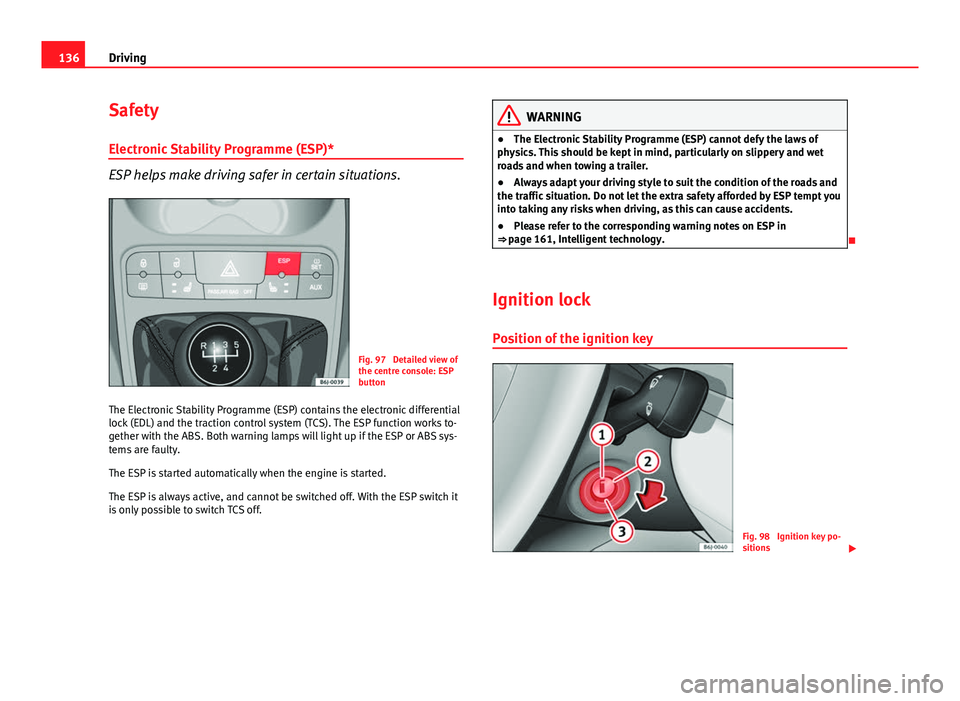
Fig. 97 Detailed view of
the centre console: ESP
button
The Electronic Stability Programme (ESP) contains the electronic differential
lock (EDL) and the traction control system (TCS). The ESP function works to-
gether with the ABS. Both warning lamps will light up if the ESP or ABS sys-
tems are faulty.
The ESP is started automatically when the engine is started.
The ESP is always active, and cannot be switched off. With the ESP switch it
is only possible to switch TCS off.
WARNING
● The Electronic Stability Programme (ESP) cannot defy the laws of
physics. This should be kept in mind, particularly on slippery and wet
roads and when towing a trailer.
● Always adapt your driving style to suit the condition of the roads and
the traffic situation. Do not let the extra safety afforded by ESP tempt you
into taking any risks when driving, as this can cause accidents.
● Please refer to the corresponding warning notes on ESP in
⇒ page 161, Intelligent technology.
Ignition lock Position of the ignition key
Fig. 98 Ignition key po-
sitions
Page 154 of 278
152Driving
WARNING (Continued)
● The brake servo does not work with the engine off. You need more
force to stop the vehicle.
● Power steering does not work when the engine is not running. That is
why it is much more difficult to turn the steering wheel.
● Never remove the key from the ignition if the vehicle is in motion. The
steering lock could suddenly engage, and you would not be able to steer
the vehicle.
● Never allow the car to roll downhill with the selector lever in “N”, re-
gardless of the engine is running or not.
CAUTION
If you allow the vehicle to move when the engine is switched off or with the
selector lever in position “N”, take your foot off the accelerator and wait un-
til the engine starts idling before returning to position “D”.
Kickdown feature
This feature allows maximum acceleration. If you press the accelerator down thoroughly, the gearbox automatically
changes down, depending on speed and engine speed, into a lower gear to
take full advantage of give the vehicle maximum acceleration.
The gearbox does not change gear until the engine reaches the maximum
determined engine speed for the gear.
WARNING
You could lose control of the vehicle if you accelerate on slippery road
surfaces. Risk of serious injury.
● Be particularly careful when using the kickdown features on slippery
road surfaces. With a fast acceleration, the vehicle could lose traction
and skid.
● You should use the kickdown feature only when traffic and weather
conditions allow it to be used safely.
Handbrake Using the handbrake
The handbrake should be applied firmly to prevent the vehi-
cle from accidentally rolling away.
Fig. 110 Handbrake be-
tween the front seats
Page 164 of 278
162Intelligent technology
WARNING
● The risk of accident is higher if you drive too fast, if you do not keep
your distance to the vehicle in front, and when the road surface is slip-
pery or wet. The increased accident risk cannot be reduced by the brake
assist system.
● The brake assist system cannot defy the laws of physics. Slippery
and wet roads are dangerous even with the brake assist system! There-
fore, it is essential that you adjust your speed to suit the road and traffic
conditions. Do not let the extra safety features tempt you into taking any
risks when driving.
Anti-lock brake system and traction control
ABS Anti-lock brake system (ABS)
The anti-lock brake system prevents the wheels locking dur-
ing braking.
The anti-lock brake system (ABS) is an important part of the vehicle's active
safety system.
How the ABS works
If one of the wheels is turns too slowly in relation to the road speed, and is
close to locking, the system will reduce the braking pressure for this wheel.
The driver is made aware of this control process by a pulsating of the brake
pedal and audible noise. This is a deliberate warning to the driver that one
or more of the wheels is tending to lock and the ABS control function has
intervened. In this situation it is important to keep the brake pedal fully de-
pressed so the ABS can regulate the brake application. Do not “pump”. If you brake hard on a slippery road surface, the best possible control is re-
tained as the wheels do not lock.
However, ABS will not necessarily guarantee shorter braking distances in
all
conditions. The braking distance could even be longer if you brake on gravel
or on fresh snow covering a slippery surface.
WARNING
● The anti-lock brake system cannot defy the laws of physics. Slippery
and wet roads are dangerous even with ABS! If you notice that the ABS is
working (to counteract locked wheels under braking), you should reduce
speed immediately to suit the road and traffic conditions. Do not let the
extra safety features tempt you into taking any risks when driving.
● The effectiveness of ABS is also determined by the tyres fitted
⇒ page 209.
● If the running gear or brakes are modified, the effectiveness of the
ABS could be severely limited.
Traction control system (TCS)*
The traction control system prevents the drive wheels from
spinning when the vehicle is accelerating. The system al-
ways includes ABS
Description and operation of the traction control system during
acceleration (TCS)
TCS reduces engine power to help prevent the drive wheels of front-wheel
drive vehicles losing traction during acceleration. The system works in the
entire speed range in conjunction with ABS. If a malfunction occurs in the
ABS, the TCS will also be inoperative.
Page 165 of 278

163
Intelligent technology
TCS helps the vehicle to start moving, accelerate and climb a gradient in
slippery conditions where this may otherwise be difficult or even impossi-
ble.
The TCS is switched on automatically when the engine is started. If necessa-
ry, it may be turned on or off by briefly pushing the ESP button on the centre
console.
When the TCS is off, the warning lamp is lit. The TCS should normally be
left on. Only in exceptional circumstances, when the slipping of the wheels
is required, can they be disconnected using the ESP button, for example.
● With compact temporary spare wheel.
● When using the snow chains.
● When driving in deep snow or on loose surfaces
● When the vehicle is bogged-down, to free it by rocking.
The TCS should be switched on again as soon as possible.
WARNING
● It must be remembered that TCS cannot defy the laws of physics. This
should be kept in mind, particularly on slippery and wet roads and when
towing a trailer.
● Always adapt your driving style to suit the condition of the roads and
the traffic situation. Do not let the extra safety afforded by TCS tempt you
into taking any risks when driving, this can cause accidents.
CAUTION
● In order to ensure that TCS function correctly, all four wheels must be fit-
ted with the same tyres. Any differences in the rolling radius of the tyres can
cause the system to reduce engine power when this is not desired.
● Modifications to the vehicle (e.g. to the engine, the brake system, run-
ning gear or any components affecting the wheels and tyres) could affect
the efficiency of the ABS and TCS. XDS*
Driveshaft differential
When taking a bend, the driveshaft differential mechanism allows the outer
wheel to turn at a higher speed than the inner wheel. In this way, the wheel
that is turning faster (outer wheel) receives less drive torque than the inner
wheel. This may mean that in certain situations the torque delivered to the
inner wheel is too high, causing the wheels to spin. On the other hand, the
outer wheel is receiving a lower drive torque than it could transmit. This
causes an overall loss of lateral grip on the front axle, resulting in under-
steer or “lengthening” of the trajectory.
By using the ESP sensors and signals, the XDS system is able to detect and
correct this effect.
Through the ESP, the XDS brakes the inner wheel, thereby counteracting the
excess drive torque in this wheel. This means that the driver's desired tra-
jectory is much more precise,
The XDS system operates in combination with the ESP and is always active,
even when the traction control, TCS, is disconnected.
Electronic Stability Programme (ESP)* General notes
The Electronic Stability Programme increases the vehicle's
stability on the road.
The Electronic Stability Programme helps reduce the danger of skidding.
The Electronic Stability Programme (ESP) consists of ABS, EDL and TCS.
Safety FirstOperating InstructionsPractical TipsTechnical Specifications
Page 166 of 278
164Intelligent technology
Electronic Stability Programme (ESP)*
ESP reduces the danger of skidding by braking the wheels individually.
The system uses the steering wheel angle and road speed to calculate the
changes of direction desired by the driver, and constantly compares them
with the actual behaviour of the vehicle. If the desired course is not being
maintained (for instance, if the vehicle is starting to skid), then the ESP
compensates automatically by braking the appropriate wheel.
The forces acting on the braked wheel bring the vehicle back to a stable
condition. If the vehicle tends to oversteer, the system will act on the front
wheel on the outside of the turn.
WARNING
● It must be remembered that ESP cannot defy the laws of physics. This
should be kept in mind, particularly on slippery and wet roads and when
towing a trailer.
● Always adapt your driving style to suit the condition of the roads and
the traffic situation. Do not let the extra safety afforded by ESP tempt you
into taking any risks when driving, as this can cause accidents.
CAUTION
● In order to ensure that ESP functions correctly, all four wheels must be
fitted with the same tyres. Any differences in the rolling radius of the tyres
can cause the system to reduce engine power when this is not desired.
● Modifications to the vehicle (e.g. to the engine, the brake system, run-
ning gear or any components affecting the wheels and tyres) could affect
the efficiency of the ABS, EDL, ESP and TCS. Anti-lock brake system (ABS)
The anti-lock brake system prevents the wheels locking during braking
⇒ page 162.
Electronic differential lock (EDL)*
The electronic differential lock helps prevent the loss of trac-
tion caused if one of the driven wheels starts spinning.
EDL helps the vehicle to start moving, accelerate and climb a gradient in
slippery conditions where this may otherwise be difficult or even impossi-
ble.
The system will control the revolutions of the drive wheels using the ABS
sensors (in case of an EDL fault the warning lamp for ABS lights up)
⇒ page 67.
At speeds of up to approximately 80 km/h, it is able to balance out differen-
ces in the speed of the driven wheels of approximately 100 rpm caused by a
slippery road surface on one side of the vehicle. It does this by braking the
wheel which has lost traction and distributing more driving force to the oth-
er driven wheel via the differential.
To prevent the disc brake of the braking wheel from overheating, the EDL
cuts out automatically if subjected to excessive loads. The vehicle will con-
tinue to function normally without EDL. For this reason, the driver is not in-
formed that the EDL has been switched off.
The EDL will switch on again automatically when the brake has cooled
down.
Page 167 of 278

165
Intelligent technology
WARNING
● When accelerating on a slippery surface, for example on ice and
snow, press the accelerator carefully. Despite EDL, the driven wheels may
start to spin. This could impair the vehicle's stability.
● Always adapt your driving style to suit road conditions and the traffic
situation. Do not let the extra safety afforded by EDL tempt you into tak-
ing any risks when driving, this can cause accidents.
CAUTION
Modifications to the vehicle (e.g. to the engine, the brake system, running
gear or any components affecting the wheels and tyres) could affect the effi-
ciency of the EDL. ⇒ page 183
The traction control system (TCS)
The traction control system prevents the drive wheels from spinning when
the vehicle is accelerating ⇒ page 162.
Safety FirstOperating InstructionsPractical TipsTechnical Specifications